
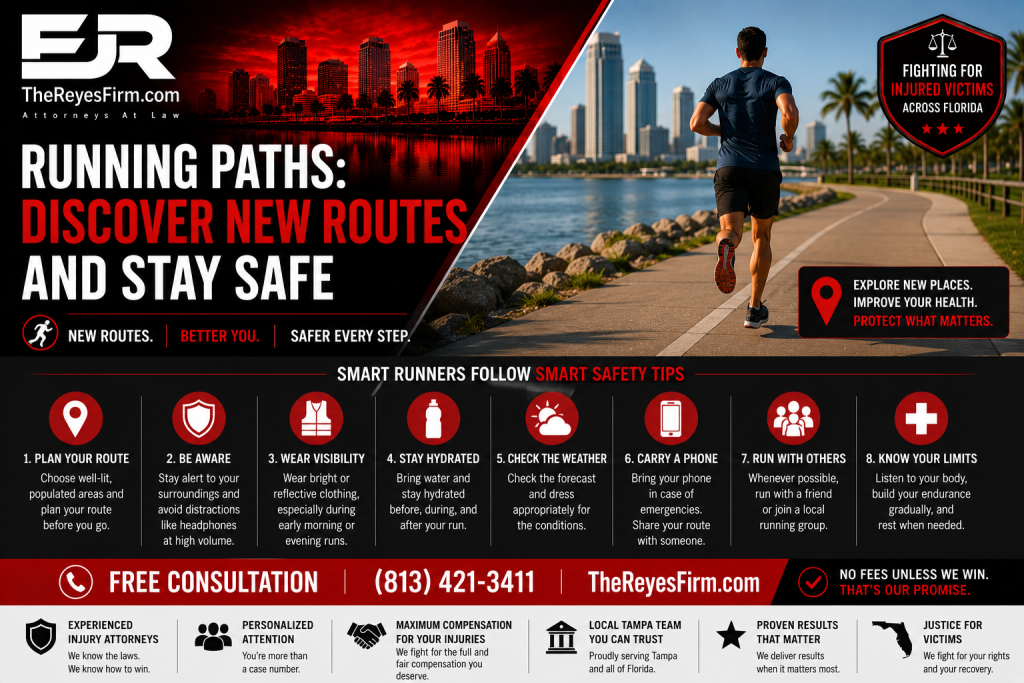
A good run can clear your head and start your day, but the wrong route, or one careless driver, can change everything in an instant. Whether you are chasing a personal best or just getting started, knowing where to run, how to stay safe, and what your rights are if a crash or hazard injures you makes every mile better. Here is your guide to all three.
The Reyes Firm
Injured While Running in Tampa?
Hit by a car, bitten by a dog, or hurt by a hazard? Know your rights. Had a bad day?
Running is one of the simplest ways to stay healthy, and the right route keeps it interesting. This guide covers how to find great places to run, the apps that make it easier, how to stay safe on every outing, and the legal rights Florida runners should know if something goes wrong along the way.
How do you find the best running routes near you?
The best running route balances distance, terrain, safety, and scenery to match your goals. Most routes fall into three shapes: an out-and-back, where you run to a point and return, a loop that circles back to your start, or a point-to-point that ends somewhere new. Each offers a different rhythm and challenge.
For ideas close to home, local parks often have scenic trails for every level, riverfront paths offer flat terrain and good views, and quiet residential streets can be a peaceful, low-traffic option. To keep things fresh, explore unfamiliar neighborhoods, run your usual loop in the opposite direction, or stitch together sections of different routes into a custom workout.
What are the best apps for finding and tracking running routes?
Running apps are like a digital training partner, helping you discover routes, track your pace, and map custom paths. A few of the most popular include:
- MapMyRun for route mapping, GPS tracking, and social features
- Strava for connecting with other runners, joining challenges, and tracking progress
- RunGo for turn-by-turn voice navigation, which is ideal for exploring new routes
- AllTrails for a large database of trails, especially in parks and rural areas
Most apps let you draw and save custom routes, then calculate the distance and elevation for you. When you build one, mark clear waypoints at turns and intersections, add notes about hazards, and factor in traffic and lighting so your route is as safe as it is enjoyable.
How can you stay safe on any running route?
A few simple habits keep you safe no matter where you run. Stay hydrated before, during, and after your run, dress for the weather in breathable clothing, wear reflective gear in low light, and warm up to lower your injury risk. Just as important, carry your phone and some identification, use a safety app to share your location, and always let someone know your route and when you expect to be back.
Weather changes the equation too. In heat, hydrate well and run during cooler hours. In cold, wear layers, a hat, and gloves. In rain, choose water-resistant gear and take extra care on slick surfaces. In wind, pick sheltered routes and protect exposed skin. For more running safety guidance, the Road Runners Club of America is a helpful national resource.
What makes a good running route?
The perfect route fits your fitness level while keeping you motivated. When choosing one, weigh the terrain, the distance, the difficulty, and above all the safety, favoring well-lit, low-traffic paths, especially after dark. Start with shorter distances and build gradually as your endurance grows.
A strong route tends to be safe, scenic, easy to access, and varied enough to keep things interesting. Urban routes offer convenience and amenities but come with traffic and crowding, while rural routes offer peace and nature but take more planning. The right mix depends on what you value most in a run.
What are your legal rights if you’re injured while running in Florida?
Runners have the right to use public spaces safely, and when someone else’s negligence causes an injury, Florida law may entitle you to compensation. The most common situations are being struck by a careless driver, being attacked by a loose or unleashed dog, and being hurt by a dangerous condition on a poorly maintained path. Each of these can support a personal injury claim against the party responsible.
Knowing your rights ahead of time helps you respond well if the unexpected happens. The sections below break down the three scenarios runners face most often, along with the Florida laws that apply.
⚠️ Deadline Warning: Under Florida Statute § 95.11(3)(a), you generally have two years from the date of your injury to file a personal injury lawsuit. If a government entity is responsible for a hazardous public path, an even earlier written notice may be required, so do not wait to speak with a lawyer.
Can a dog owner be held liable if their dog attacks you while running?
Yes, and Florida law is unusually protective of bite victims. Under Florida Statute § 767.04, a dog owner is strictly liable when their dog bites someone who is in a public place or lawfully in a private place, regardless of whether the dog ever showed aggression before. That means you do not have to prove the owner knew the dog was dangerous. Owners can also be held responsible under Florida law for other injuries a dog causes, such as knocking a runner down.
If a dog attacks you on a run, get to safety, seek medical care, and document the dog, the owner, and the location. These cases are often covered by the owner’s homeowner’s or renter’s insurance.
💡 Did You Know? Florida is a strict liability state for dog bites. Unlike states that follow a “one bite rule,” Florida does not give owners a free pass for a first bite. A dog owner can be held liable for a bite even if the dog had never bitten or threatened anyone before. Source: Fla. Stat. § 767.04.
What are your rights if a car hits you while running in Tampa?
If a negligent driver strikes you while you are running, you have the right to pursue compensation for your injuries. Pedestrians, including runners, are entitled to use roads and crosswalks safely, and a driver who is speeding, distracted, or fails to yield can be held responsible. Because these collisions often cause severe harm, such as a traumatic brain injury or other catastrophic injuries, the stakes are high.
The same right to recover applies if a dangerous condition on a public path, like uneven pavement or an unmarked obstacle, causes your injury. These premises liability claims can be brought against a private property owner, or against a government entity that controls the path. Claims against a city or county come with special rules, including a written notice requirement under Florida Statute § 768.28, which makes early legal advice especially important.
🛡️ Your Rights Under Florida Law: Under Florida Statute § 768.81, your compensation is reduced by your share of fault, and you may be barred from recovery if you are found greater than 50% responsible. Insurers often try to blame an injured runner, and an experienced Tampa injury lawyer works to protect the facts and keep your assigned fault as low as the evidence allows.
 Sporty Black Man Jogging On Bridge, back view, empty space
What are the 5 steps to take if you’re injured while running in Tampa?
Whether a car, a dog, or a hazard caused your injury, these steps protect your health and your legal case. The order matters.
- Get to safety and call 911. Move out of harm’s way if you can, and make sure police and medical responders are notified so there is an official record of what happened.
- Get medical care right away. Even if your injury feels minor, get checked the same day. Adrenaline can mask serious harm, and a prompt medical record links your injuries to the incident.
- Document the scene. Photograph the vehicle, dog, or hazard, along with the location and your injuries. Get the driver’s or dog owner’s information and contact details for any witnesses.
- Report it to the right authority. Report a crash to the police, a dog attack to animal control, and a dangerous public path to the property owner or government agency, and keep copies of everything.
- Call The Reyes Firm before talking to insurers. Adjusters may try to minimize your claim, and you are not required to give a recorded statement first. Call 833-4 BAD DAY for a free consultation.
The Reyes Firm
4730 N. Habana Ave., Suite 201, Tampa, FL 33614
Phone: 833-4 BAD DAY | thereyesfirm.com
How The Reyes Firm handles your running injury case
When a run ends in an injury that was not your fault, the last thing you should have to fight is an insurance company. We handle that for you, throughout Tampa and Hillsborough County, whether you were struck by a driver, attacked by a dog, or hurt by a hazardous path.
When we take on a running injury case, we typically:
- Investigate what caused your injury, gathering the police or incident report, photos, witness statements, and any available footage before it disappears
- Identify every responsible party and insurance policy, from a driver’s auto coverage to a dog owner’s homeowner’s policy to a property owner or government entity
- Handle the special rules that apply to claims against government entities, including strict notice deadlines that can otherwise bar a valid claim
- Work with medical experts to document the full scope of your injuries and any long-term treatment and care you will need
- Calculate full damages, covering past and future medical expenses, lost wages, reduced earning capacity, and the lasting impact on your life
- Handle all insurance communication on your behalf, countering attempts to blame you or undervalue your claim, and preparing your case as if it will go to trial
No lawyer can promise an outcome. What we can promise is that we treat your case seriously, explain every step in plain language, and fight to hold the responsible party accountable so you can get back on your feet.
Frequently asked questions for Tampa runners
How do I create a running route?
Use a running app like Strava or MapMyRun as a route planner to design a path based on your preferences. You can draw and save a custom route, and the app will calculate the distance and elevation, or you can choose from existing routes other runners have shared.
What is a reasonable distance to start running?
Beginners can start with a comfortable goal, such as 20 to 30 minutes or a couple of miles, and build gradually. Add a little distance or time to each run so your body can adapt, and avoid pushing past your limits too quickly.
Can I sue if a dog bites me while running in Florida?
Often, yes. Under Fla. Stat. § 767.04, Florida holds dog owners strictly liable when their dog bites someone who is lawfully in a public or private place, even if the dog never bit anyone before. These claims are frequently covered by the owner’s homeowner’s or renter’s insurance.
What should I do if a car hits me while running?
Call 911, get medical care right away, and document the scene, the vehicle, and any witnesses if you are able. As a pedestrian, you have the right to pursue compensation from a negligent driver, so avoid giving a recorded statement to their insurer before speaking with a lawyer.
Can I file a claim if I trip on a broken public sidewalk or path?
Possibly. If a dangerous condition on a path caused your injury, you may have a premises liability claim against the property owner, or a claim against the government entity that controls it. Claims against a city or county require a written notice under Fla. Stat. § 768.28, so prompt legal advice is important.
How long do I have to file an injury claim in Florida?
Under Fla. Stat. § 95.11(3)(a), you generally have two years from the date of your injury to file a personal injury lawsuit. Claims involving a government entity can carry earlier notice deadlines, which is one more reason to act quickly.
Does it matter if I was partly at fault for my running injury?
You may still recover compensation. Under Fla. Stat. § 768.81, your award is reduced by your share of fault, and you are barred only if you are found more than 50% responsible. A lawyer works to keep your assigned fault as low as the evidence allows.
What are the best apps for finding running routes?
Popular options include Strava and MapMyRun for mapping and tracking, RunGo for turn-by-turn voice navigation, and AllTrails for trail running. Each helps you discover routes and keep your workouts varied and safe.

Edward Reyes, Esq. is a Florida Bar-admitted personal injury attorney and the founder of The Reyes Firm in Tampa, Florida. He represents people injured by the negligence of others in cases involving pedestrian accidents, car crashes, dog bites, and unsafe property conditions throughout Tampa and the surrounding counties. Edward Reyes, Esq. handles personal injury claims on a contingency fee basis, meaning clients pay nothing unless the firm recovers compensation for them.
Read more about Edward Reyes.
How Can The Reyes Firm Help You?
If you’ve had a bad day, whether a car accident, a slip and fall, a trucking crash, or any injury that wasn’t your fault, The Reyes Firm is in your corner. Our Tampa personal injury attorneys offer free consultations and work on a contingency fee basis, which means you pay us nothing unless we win your case.
You shouldn’t have to fight the insurance companies alone. Let us fight for you.
📍 Address: 4730 N. Habana Ave., Suite 201, Tampa, FL 33614
📞 Phone: 833-4 BAD DAY
🌐 Website: Schedule your free consultation today at thereyesfirm.com
Had a bad day? Call The Reyes Firm. We’ll handle the rest.
The information in this blog post is for general informational purposes only and does not constitute legal advice. Reading this article does not create an attorney-client relationship with The Reyes Firm. Every case is unique. If you have been injured in an accident that wasn’t your fault, consult a licensed Florida personal injury attorney about your specific situation.


