
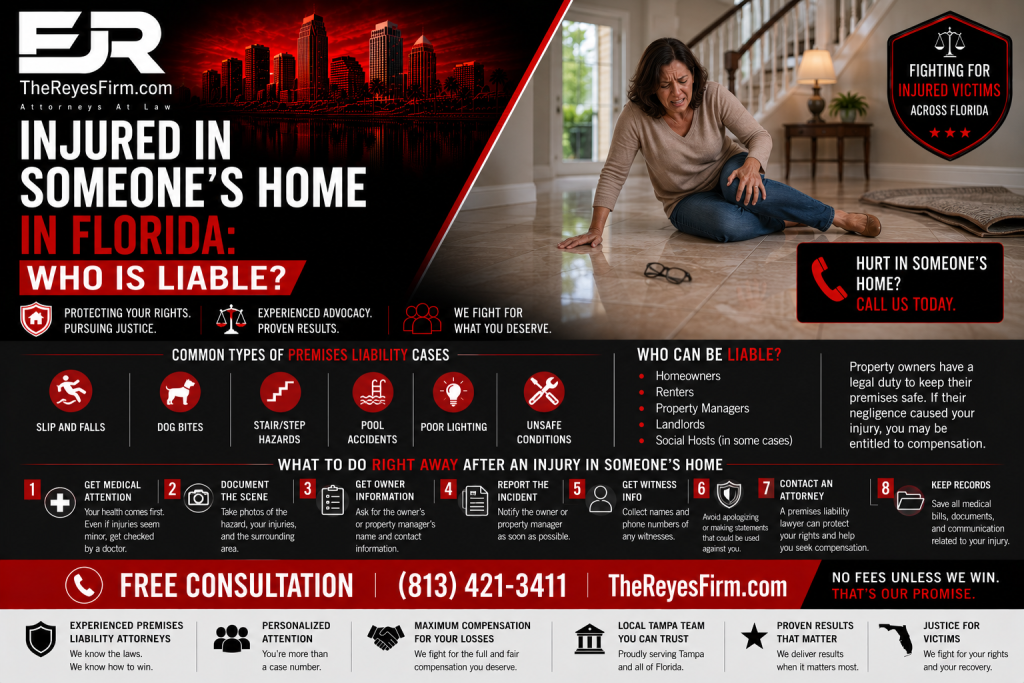
Injured in Someone’s Home in Florida: Who Is Liable?
You were at a friend’s barbecue, a family member’s house, or a neighbor’s pool when something went wrong. Now you are hurt, facing medical bills, and dreading an impossible question: do you really file a claim against someone you care about? Here is what Florida law actually says about who is liable when you are injured in someone’s home, and why the answer may surprise you. The Reyes Firm Injured at Someone Else’s Home in Tampa? Find out who actually pays before you decide anything. Had a bad day? Contact Us Now 2 Years Deadline to file an injury claim Fla. Stat. § 95.11(3)(a) 3 Levels Visitor status sets the duty owed Florida premises liability law Strict Dog owner liability for bites Fla. Stat. § 767.04 50% Fault share that bars recovery Fla. Stat. § 768.81 Getting hurt at someone else’s home is uniquely uncomfortable. The property owner is often a friend, a relative, or a neighbor, and no one wants to turn a bad afternoon into a conflict. But Florida law recognizes that homeowners have real responsibilities to the people they invite in, and the way these claims actually work is far less personal than most people assume. Can you sue a homeowner if you’re injured in their home? Yes, when a hazard on someone’s property causes your injury and the homeowner failed to meet their legal duty of care, Florida law allows you to pursue compensation. This area of law is called premises liability, and it holds property owners responsible for keeping their property reasonably safe for the people they invite onto it. Liability is not automatic, though. A homeowner is not responsible for every accident that happens under their roof. The question is whether they knew or should have known about a dangerous condition and failed to fix it or warn you about it. ⚠️ Deadline Warning: Under Florida Statute § 95.11(3)(a), you generally have two years from the date of your injury to file a personal injury lawsuit. Missing this deadline almost always means losing your right to recover anything. Don’t wait to call a lawyer. Will your friend or family member have to pay out of pocket? Usually not, and this is the single most important thing to understand before you decide what to do. Most homeowners and renters carry liability insurance precisely because accidents happen to guests. When you bring a claim after an injury at someone’s home, you are in practice making a claim against that insurance policy, not against your friend’s savings account. That changes the emotional math considerably. Your host has already paid premiums for years for exactly this situation, and the insurer, not your friend, investigates the claim, negotiates, and writes the check up to the policy limits. Many homeowners are relieved when a guest uses the coverage, because the alternative is watching someone they care about drown in medical bills after getting hurt in their home. 💡 Did You Know? A claim after an injury at someone’s home is typically paid by their homeowner’s or renter’s liability insurance, not by the homeowner personally. That is what the coverage exists for. Understanding this often removes the biggest reason injured guests hesitate to protect their own rights. Does it matter why you were at the home? It matters a great deal. Florida decides how much protection you get based on your status as a visitor, and there are three broad levels: Invited guests. If you were invited over socially, Florida gives you substantial protection. The homeowner must keep the property in a reasonably safe condition and warn you about concealed dangers they knew about or should have known about, which you could not reasonably discover yourself. Uninvited licensees. Someone who enters for their own convenience without an invitation, such as a person cutting across a yard, is owed a narrower duty. The owner must refrain from willful or wanton harm and warn of known dangers that are not obvious. Trespassers. Under Florida Statute § 768.075, a property owner generally owes a trespasser only a duty to avoid gross negligence or intentional misconduct, and Florida law limits an owner’s liability further in certain circumstances. Most guests injured at a friend’s house fall into the first category, which is the strongest position under Florida law. Workers such as contractors and delivery personnel are treated as invitees and are also well protected. What has to be proven in a home injury claim? A premises liability claim rests on four elements: the homeowner owed you a duty of care, they breached that duty, the breach caused your injury, and you suffered real damages. The heart of most cases is proving the homeowner knew or should have known about the hazard, whether that is a broken step they had been meaning to fix, a loose railing, or a puddle that sat unaddressed. One nuance surprises people. Florida has a demanding statute for slip-and-fall claims involving a transitory substance, but it applies to business establishments, not private residences. A claim at a private home follows ordinary premises liability principles instead of that heightened business standard. On the other side, a homeowner may argue the danger was open and obvious to you, which is a real defense, though it does not automatically defeat a claim in every situation. What kinds of injuries happen at someone’s home? Home injuries range from bruises to permanently disabling harm. The most common claims involve: Slip, trip, and fall injuries from wet floors, loose rugs, uneven walkways, poor lighting, or clutter Stairway and railing failures, where a broken step or a loose banister causes a serious fall Swimming pool accidents, including drownings and falls on slick decking, which in the worst cases lead to a wrongful death claim Dog bites and animal attacks, which carry their own strict rules discussed below Falling objects and structural problems, such as a collapsing deck, a falling shelf, or a rotted balcony The resulting injuries are often severe. A fall down stairs can cause a traumatic