
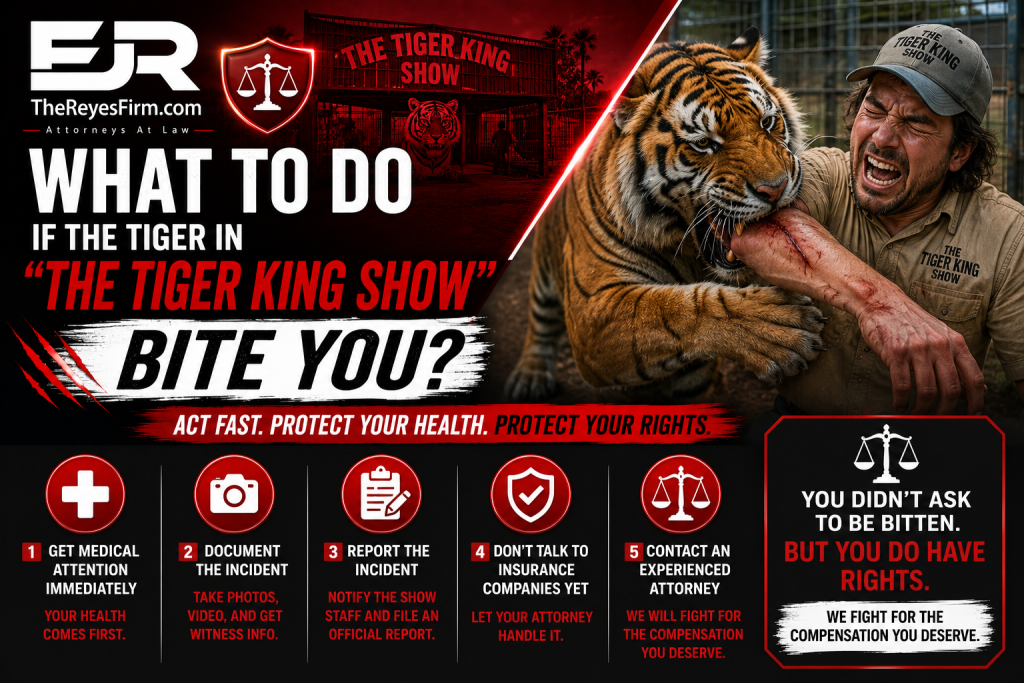
What to do if the tiger in “The Tiger King Show” bite you?
Shows about big-cat owners turned exotic pets into a national fascination, and they raised a strange but serious question: what actually happens if a tiger, or any wild animal, attacks you? In Florida the answer is a powerful legal doctrine called strict liability, and it works very differently from a typical injury claim. For the most severe maulings, which can even turn deadly, understanding this rule is the first step to holding the right people accountable. TL;DR — QUICK SUMMARY If a wild or exotic animal like a tiger attacks you in Florida, the owner is held responsible under strict liability, even if you cannot prove they were careless. Strict liability exists because keeping a dangerous wild animal is treated as inherently dangerous, so negligence does not have to be proven. Florida classifies tigers and other big cats as Class I wildlife, the most dangerous category, under Florida Statute 379.303. Dog bites are covered by their own strict-liability law, Florida Statute 767.04, which is similar but separate from the wild-animal rule. You have two years from the attack to file a lawsuit under Florida Statute 95.11(3)(a), so acting quickly protects your claim. The Reyes Firm Injured by a Dangerous Animal? Find out who is responsible for your Tampa injury. Had a bad day? Contact Us Now Strict Liability No need to prove negligence for a wild animal attack Florida common law Class I FWC’s category for tigers and big cats Fla. Stat. 379.303 $2 Million Liability insurance to possess Class I wildlife FWC Rule 68A-6 2 Years To file an injury lawsuit Fla. Stat. 95.11(3)(a) What does strict liability mean if a wild or exotic animal attacks you? Strict liability means the owner or keeper of a wild animal is legally responsible for the injuries it causes, even if you cannot prove they did anything careless. In a typical injury case you have to show that someone was negligent, but with a dangerous wild animal that requirement falls away. Because keeping an animal like a tiger is treated as inherently dangerous, the law places responsibility on whoever chose to keep it, automatically. That is a meaningful advantage if you are hurt. You do not have to prove the owner failed to lock a cage or ignored a warning. You only have to show that their wild animal injured you. These attacks are rarely minor, often causing deep puncture wounds, nerve damage, and the kind of catastrophic harm seen in a serious spinal injury, which is exactly why the law treats them so seriously. What counts as a wild or exotic animal in Florida? Florida sorts captive wildlife into three categories based on how dangerous the animal is. Under Florida Statute § 379.303, the Florida Fish and Wildlife Conservation Commission defines Class I, Class II, and Class III wildlife, with Class I reserved for the most dangerous animals. Tigers, lions, bears, and great apes are all Class I. The rules reflect how risky these animals are. A person cannot legally keep Class I wildlife without special licensing, and the state requires either a $10,000 bond or $2 million in liability insurance to possess one. When an owner skips those requirements, or houses the animal unsafely, that failure can sit on top of the strict liability they already face if the animal hurts someone. 💡 Did You Know? Florida classifies tigers and other big cats as Class I wildlife, the most dangerous category, under Fla. Stat. § 379.303. State rules require anyone keeping Class I wildlife to carry either a $10,000 bond or $2 million in liability insurance, a sign of just how foreseeable the danger is. Source: Fla. Stat. § 379.303 and FWC Rule 68A-6, leg.state.fl.us. How is an exotic animal attack different from a dog bite in Florida? Both can make an owner responsible without proof of carelessness, but they come from different parts of the law. Dog bites have their own statute. Under Florida Statute § 767.04, a dog owner is liable when their dog bites someone, regardless of whether the dog ever showed aggression before, with only narrow exceptions. Wild and exotic animals are covered instead by Florida’s common-law rule of strict liability for dangerous animals. The practical effect is similar, in that you do not have to prove the owner was negligent, but the legal foundation is different, and the injuries from an exotic animal are usually far more severe than a typical dog bite. Severe facial and head wounds, for example, can lead to a traumatic brain injury that changes a victim’s life. Watch: What to do if a wild animal attacks you In this short video, attorney Edward Reyes explains strict liability and what it means if you are ever bitten by a tiger or another wild animal. Tampa personal injury lawyer Edward Reyes represents people in Tampa and Hillsborough County, Florida who have suffered an injury in an incident or accident type of accident. Speak Directly to Me, At No Cost, Today 813.421.3411If a dangerous animal has injured you or someone you love, The Reyes Firm offers free consultations and can review your case at no cost. Who can be held responsible when an exotic animal attacks? More than one party may share the blame, and identifying all of them is part of building your case. Responsibility can fall on the animal’s owner, the keeper or handler, a roadside zoo or traveling exhibit, a sanctuary, or the owner of the property where the attack happened. When an unsafe enclosure, a missing barrier, or careless supervision contributed to the attack, a premises liability claim can exist alongside strict liability. Even when responsibility seems obvious, pinning down every owner, handler, and insurer, along with any required bond or policy, is what turns a clear case into a fully compensated one. The party that controlled the animal is not always the same party that controlled the property, and both can matter to your recovery. ⚠️ Deadline Warning: Under Florida Statute § 95.11(3)(a), you have two years