
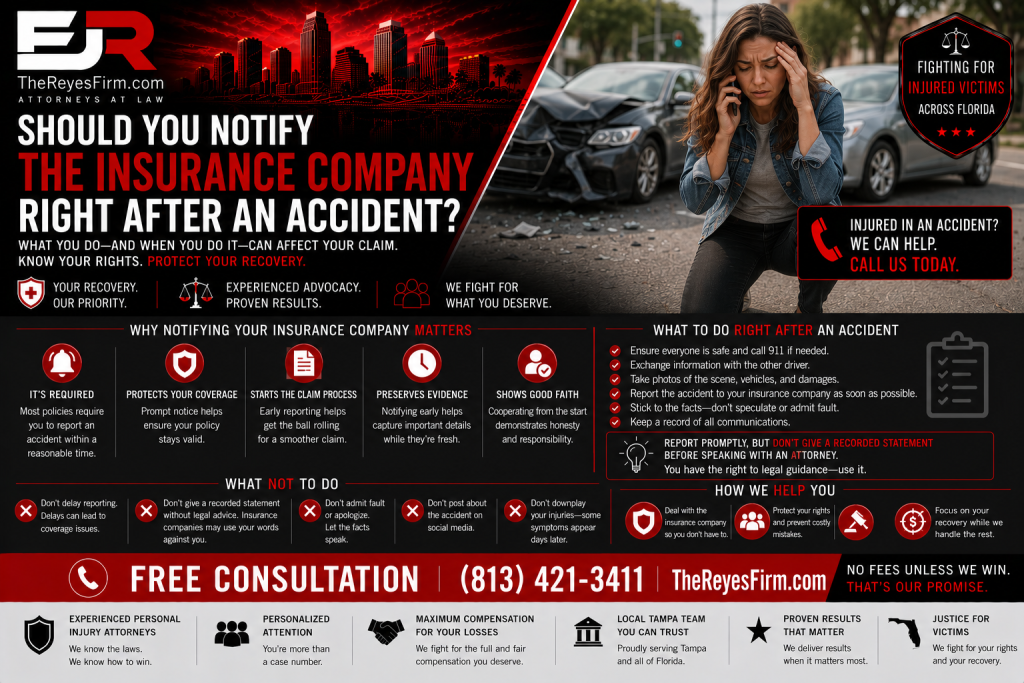
Should You Notify The Insurance Company Right After An Accident?
Moments after a crash, your phone starts ringing with insurance calls, and it is easy to say the wrong thing to the wrong company without realizing it. Which insurer should you talk to, what should you say, and who can you politely shut down? Getting this right in the first days protects your claim. Here is what you need to know about notifying the insurance company after an accident in Florida. The Reyes Firm Insurance Calling After Your Tampa Crash? Know what to say before you pick up. Had a bad day? Contact Us Now Yes, Notify Tell your own insurer promptly Your policy requires it Not Required No recorded statement to the other insurer Protect your claim Duty to Defend Your insurer defends covered claims Even if at fault 2 Years Deadline to file an injury lawsuit Fla. Stat. § 95.11 The hours after a crash are chaotic, and insurance companies know it. That is often when their adjusters reach out, while you are shaken, in pain, and unsure of your rights. Understanding the simple difference between the insurer you should call and the one you can decline puts you back in control of those conversations. Should you notify the insurance company right after an accident? Yes, you should notify your own insurance company promptly after a crash. Reporting the accident starts your claim and creates an official record, and just as importantly, your policy almost certainly requires you to do it. The key is understanding that “notify the insurance company” means your own insurer, which is very different from the other driver’s insurer. That distinction is the whole point of this article. You have obligations to your own insurance company, and you have protections when it comes to the other side’s. Confusing the two is one of the most common and costly mistakes people make right after an accident. Why should you notify your own insurance company? There are three good reasons. First, nearly every auto policy contains a cooperation and notice provision that requires you to report an accident promptly, and failing to do so can give your insurer a reason to dispute coverage later. Second, reporting starts your claim and, in Florida, is tied to accessing your Personal Injury Protection benefits under Florida Statute § 627.736, which pay for your initial medical care regardless of fault. Third, your own insurer stands behind you if a claim is made against you. Whether or not the crash was your fault, notifying your insurer puts the accident on record so the company can step in and protect you if the other party pursues a claim. That protection is part of what you pay for. 💡 Did You Know? Even if the accident was your fault, your own insurance company generally has a duty to defend you against claims covered by your policy. That means if someone makes a claim against you, your insurer can provide the defense, which is a core part of what your liability coverage is for, and one more reason to notify your own insurer promptly. What should you tell your own insurance company? Keep it factual and simple. Your insurer needs the basic information to open your claim: that an accident happened, when and where it occurred, who was involved, and the other driver’s information. Providing those facts is exactly what starting a claim requires. What you should avoid is just as important. Do not guess about who was at fault or volunteer opinions about how the crash happened, because you may not have the full picture, and speculation can come back to hurt you. Do not downplay your injuries by saying you feel fine, since many injuries appear days later, and do not exaggerate them either. Stick to what you know for certain, and let the facts speak. Do you have to talk to the other driver’s insurance company? No, and this is where your protections come in. You are generally not required to give the at-fault driver’s insurance company a recorded statement, and you should be very cautious about doing so. That insurer’s job is to pay as little as possible, and a recorded statement gives them material to twist, take out of context, or use to argue that your injuries are minor or that you were partly to blame. If the other insurer contacts you, you can simply get the claim number for your records and decline to give a detailed or recorded statement. You do not owe the other side an account of the crash, and politely declining is well within your rights. ⚠️ Important Warning: The at-fault driver’s insurer may call soon after the crash, sounding friendly and eager to help you. Remember that you are generally not required to give them a recorded statement, and anything you say can be used to minimize or deny your claim. Get the claim number, stay polite, and refer them to your lawyer rather than discussing the crash or your injuries. What should you do if the other insurer calls you? Handle it calmly and briefly. You can be courteous without giving the other insurer what it is looking for. In practice, that means taking down the claim number and the adjuster’s contact information, then declining to provide a recorded statement or to discuss fault, the details of the crash, or the extent of your injuries. The simplest and safest response is to let them know that your attorney will be in touch, and then end the call. Once you have a lawyer, all of this communication can go through your lawyer, so you never have to worry about saying the wrong thing to someone whose goal is to reduce your recovery. 🛡️ Your Rights Under Florida Law: Under Florida Statute § 768.81, your compensation is reduced by your share of fault. This is exactly why what you say to insurers matters so much, because an offhand apology or a guess about what happened can be treated as an admission and used