September 11, 2022

Legal

White Collar Crime Lawsuit 2022| The Latest Updates

  The annual losses suffered from white-collar crimes range from $426 billion to $1.7 trillion as of 2021. Unfortunately, there was only 4,727 white-collar crime lawsuit in 2021. White-collar crimes are non-violent crimes that are generally committed for financial gain. Fraud is a common white-collar crime and is covered within Chapter 817 of the Florida Annotated Statutes. Also, white collar crimes refer to various offenses committed within a corporate or an organizational setting. As per the FBI, “such crimes are characterized by deceit, concealment, or violation of trust.” The motivating factor behind such crimes is to get or refrain from losing money. Before a victim decides to file a white-collar crime lawsuit in Florida or the accused starts to fight against the allegations. In both scenarios, it is important to understand white-collar crimes in detail. Understanding white-collar crimes in Florida There are various types of white-collar crimes prevailing in Florida. Some of them are called misdemeanors and others are charged as felonies. Following are some of the white-collar crimes that enable the victim to file white-collar crime lawsuits in 2022: Banking fraud. Bribery. Credit card fraud. Corruption. Embezzlement. Financial fraud. Forgery. Healthcare fraud. Insider dealing. Insurance fraud. Racketeering. Tax evasion. The exploitation of senior citizens. Medicare fraud. Money laundering. Real estate fraud. Generally, white-collar crimes are charged as felonies as they fall under the same bracket of misuse of public or government office. If a victim can prove any losses occurred to incidents mentioned above, then he/she becomes eligible for the white collar crime compensation.  The penalties for white-collar crimes Since there are different types of white-collar crimes and each crime has different penalties. The strictness of the crime depends upon various factors like the number of victims or the amount of money involved in the white-collar crime. Whether the accused will be required to pay the compensation to the victims or it can be settled. It depends upon the money lost in the crime and the court or legal fees. The penalty entirely depends upon the crime.  As per the white-collar crime updates in 2022, the following are the penalties charged for white-collar crimes: Misdemeanor White-collar crimes can lead to misdemeanor or felony charges. The accused charged with first-degree misdemeanor faces up to $1,000 and one years in prison. The second-degree misdemeanor can bring the penalty up to $500 and 60 days in jail. Felonies Third-degree felonies incur up to a $5,000 fine and five years in jail. Second-degree felony charges carry 15 years in jail and a $10,000 fine. A first-degree felony charge incurs up to $10,000 and 30 years of sentence in jail. If the white-collar crime offender is charged with two or more offenses that gain $50,000 or more, then the accused needs to pay a $30,000 fine and 30 years sentence in jail. Apart from all the above-mentioned penalties, the accused could be placed on probation and lose his/her professional license. To prove the accountability of the accused, the victim must get the legal assistance of the best attorney for white-collar crime. A recent case A Miami pharmacy owner was recently sentenced to four years of jail for his actions in a national Medicare fraud. The accused had submitted fraudulent claims to Medicare for drugs that were not required or prescribed at all. The accused submitted the drugs using the names of the doctors and Medicare beneficiaries. Defensive strategies against white-collar crimes When a person or an organization is charged with a white-collar crime, it becomes important to hire a professional, expert, and reliable white-collar crime lawyer in Florida. With help of an experienced attorney, the accused can increase the chances of walking away with lesser charges or penalties. Such white-collar crime lawyers in Florida are experts in negotiating the charges with the prosecuting attorney and reducing them to misdemeanor charges or at least providing an opportunity to lead a less severe charge. The prime thing to note while building a criminal defense strategy for white-collar crimes is to check what type and number of evidence the prosecution has. It is important to determine the elements of the crime and evidence to make white-collar crime lawsuits stronger. Always remember that there may be some soft spots or evidence that can be managed differently because there can be sometimes when the government gets the wrong idea. The lawsuit against white-collar crime often has a pile of documents in the store to handle. In case any document goes missing, it can break the whole case and the defense attorney will leverage such an opportunity. To tackle such a situation, it becomes essential to keep a ledger to keep a check on the documents.  One of the most common defensive strategies is to source the money. Another defensive strategy is the defense of the state. It is not uncommon for people to make mistakes without any criminal intent. Such a type of defense is entirely legitimate in the defense of white-collar crimes. How can a white-collar crime attorney in Florida help? An experienced attorney can help the accused or victim win the white-collar crime lawsuit. Check out some of the most common reasons to choose a proficient attorney to file your claim: An expert law firm helps the accused to retain the professional license. The attorney works with the client to ensure that the charges are dropped. A professional attorney creates a strong legal defense. Preserving all essential pieces of evidence. Helping the victim to get fair compensation. Determining a fair compensation and ensuring that the victim is getting the compensation he/she deserves. Talking on behalf of the accused, the attorney can help to prove an accused is innocent. Anyone is innocent until proven guilty. The attorney works to keep the accused on the innocent side. For a victim, the best attorney for white-collar crime ensures to provide fair compensation to the victim for the losses incurred due to white-collar crimes. For all the above-mentioned reasons, both the accused and victim need to hire a white-collar crime firm in Florida.  Consult with The Reyes Firm today Call us at (833)422-3329  to get a free consultation regarding
Uber accident claim timeline in Florida
Injury, Settlement

How Long Does an Uber Accident Claim Take in Florida 2026?

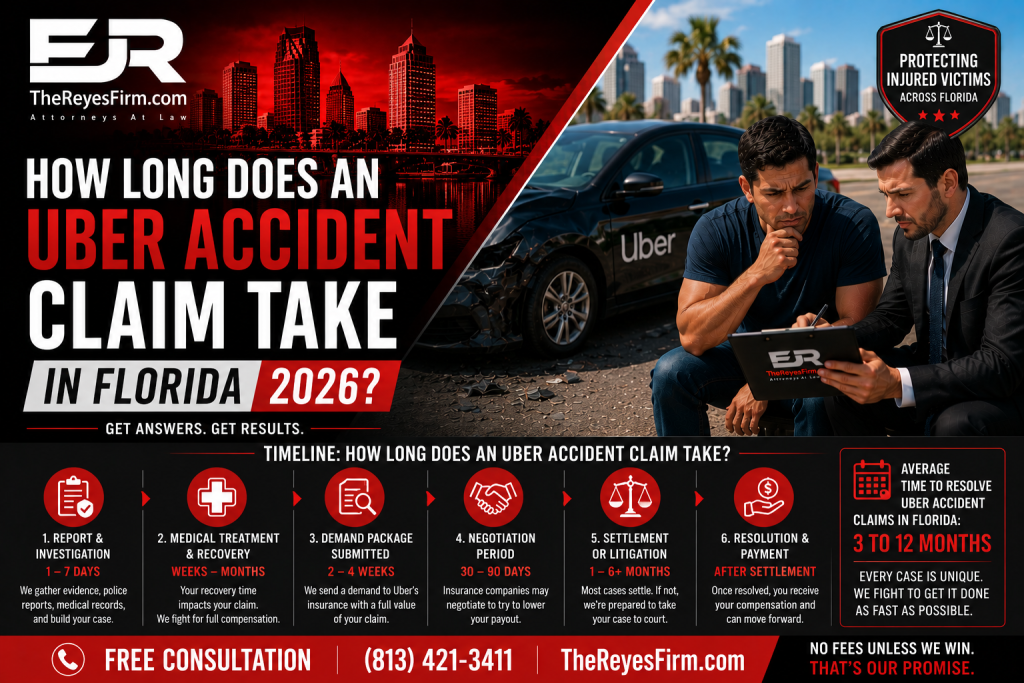
You were hurt in an Uber or Lyft crash, you’ve filed your claim, and now you’re stuck on the question nobody seems to answer straight: how long is this going to take? The honest version is more useful than the hopeful one, so here is how a Florida rideshare claim actually moves from the crash to a check. The Reyes Firm Waiting on an Uber or Lyft Claim in Tampa? Find out where your case stands and what’s slowing it down. Had a bad day? Contact Us Now 2 Years Deadline to file your lawsuit Fla. Stat. 95.11(3)(a) $10K PIP paid fast, no fault needed Fla. Stat. 627.736 $1M Coverage that can extend talks Fla. Stat. 627.748 3 Periods App statuses that set coverage Fla. Stat. 627.748 How long does an Uber or Lyft accident claim take in Florida? It depends on the severity of your injuries and whether fault and coverage are disputed, but a useful range helps. A clear-fault case with a full recovery can often settle within a few months of you finishing treatment. A serious-injury case, or one where the insurers fight over liability, commonly takes a year or longer, and cases that go into litigation can run longer still. The timeline is driven by the facts, not by a calendar. The single biggest factor is your own medical recovery. A claim should generally not settle until you reach maximum medical improvement, the point where doctors can say what your long-term condition and future care will look like. Settling before then risks accepting a number that doesn’t account for surgery you still need or income you’ll keep losing. In that sense, a longer timeline is sometimes the price of a fair result rather than a sign something is wrong. ⚠️ Deadline Warning: Under Florida Statute § 95.11(3)(a), you have two years from the date of your crash to file a personal injury lawsuit. That clock keeps running while you negotiate, so a stalling insurer can quietly push you toward the deadline. Don’t let the timeline run out before you act. What are the stages of an Uber accident claim? Most rideshare claims move through the same identifiable stages, and knowing where you are helps you see what’s left. The process generally looks like this. Medical treatment and PIP. You treat your injuries, and your own Personal Injury Protection pays the first portion of bills regardless of fault. This stage continues until you near maximum medical improvement. Investigation and evidence gathering. Your lawyer pins down which app period was active, secures trip and app data, the police report, witness statements, and your medical records. The demand. Once your damages are known, your attorney sends a demand package to the responsible insurer laying out liability and the full value of your claim. Negotiation. The insurer responds, usually low at first, and a period of back-and-forth follows. Many cases resolve here. Filing a lawsuit, if needed. If the insurer won’t be reasonable, your lawyer files suit, which opens discovery, depositions, and often mediation. Many cases still settle during this phase. Settlement or trial. The case resolves by agreement or, in a minority of cases, proceeds to a verdict. 💡 Did You Know? Under Florida Statute § 627.748, a rideshare crash falls into one of three coverage periods based on the driver’s app status, and the higher $1 million policy only applies once a ride is accepted. Disputes over which period was active are a common reason a claim takes longer. Source: Florida Statutes, leg.state.fl.us. Watch: What does the Uber accident claim process look like? This short overview walks through the stages of a rideshare injury claim and what tends to slow them down. If you’re unsure which stage your case is in, that’s a question The Reyes Firm answers for free at 833-4 BAD DAY. What makes a rideshare claim take longer? A few specific things stretch the timeline, and most of them are about complexity rather than your case being weak. The more of these that apply, the longer you should expect the process to run. Serious injuries take longer because the case has to wait on maximum medical improvement and often on future-care and earning estimates, including lost earning capacity. Disputed fault adds time because liability has to be proven before value is even discussed. Arguments over which app period was active can pull in multiple insurers, each with its own process. Medical liens and health-insurer reimbursement claims have to be sorted before disbursement. And an insurer that simply refuses to negotiate fairly forces the case into litigation, which is slower by design. None of this is unusual, and an ordinary car accident can hit the same snags. The difference with rideshare is the layered coverage. 🛡️ Your Rights Under Florida Law: Under Florida Statute § 768.81, your compensation is reduced by your share of fault, and you may be barred from recovery if you are found greater than 50% responsible for your own harm. Disputed fault can lengthen a claim, but a Tampa rideshare lawyer works to protect the facts and keep your percentage of fault as low as the evidence allows. How does the timeline affect what you can recover? The two are tied together. Settling quickly can feel good, but a rushed settlement often locks in a number before your full damages are known, which is why patience through maximum medical improvement usually protects your recovery. The slower track exists to make sure property damage, medical bills, lost income, pain and suffering, and any future losses are all on the table. For the full breakdown of the categories you can claim and how the rideshare coverage limits factor in, see our guide on how much an Uber or Lyft accident claim is worth. The short version is that a well-documented claim, given the time it needs, almost always ends up worth more than a fast one. What are the 5 steps to keep your Uber accident claim moving? You can’t control the insurer,

Amusement park injury claim process guide
Legal, Premise Liability

Amusement Park Lawsuit: Complete Process to File Your Claim

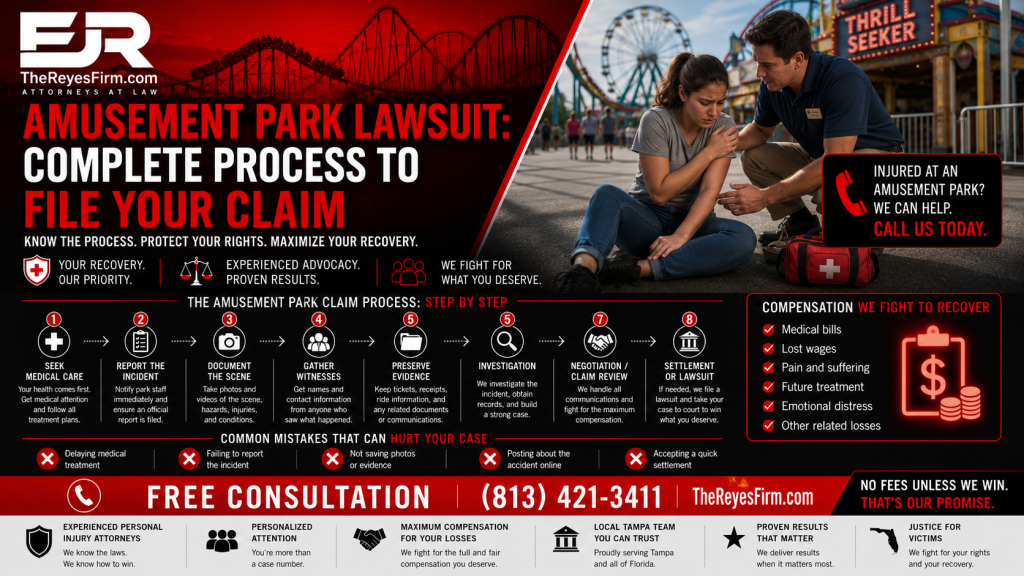
A day at the park should not end in the emergency room. When it does, because a ride malfunctioned, a walkway was unsafe, or an operator was careless, you may be left with serious injuries and a confusing question: who is responsible, and what can you do about it? Florida is the theme park capital of the country, and its rules for amusement park injuries have some surprising features. Here is a clear guide to amusement park injury claims in Florida. The Reyes Firm Injured at a Florida Amusement Park? Find out who may be responsible for your injury. Had a bad day? Contact Us Now 2 Years Deadline to file your injury claim Fla. Stat. § 95.11(5)(a) Self-Inspected Large parks inspect their own rides Fla. Stat. § 616.242 exemption 50% Bar Over half at fault ends recovery Fla. Stat. § 768.81 Duty of Care Parks must keep visitors reasonably safe Premises liability With Walt Disney World, Universal, SeaWorld, Busch Gardens, and countless fairs and carnivals, Florida draws tens of millions of visitors to its rides every year. The overwhelming majority have a safe, fun time. But when something goes wrong on a ride or on park grounds, the injuries can be severe, and figuring out your rights involves a mix of premises liability, product liability, and a regulatory system with some unusual gaps. What kind of claim is an amusement park injury? Most amusement park injury cases are premises liability claims, which are a form of negligence. As a paying guest, you are what the law calls a business invitee, and the park owes you a duty to use reasonable care to keep its property safe and to warn you of dangers it knew about or should have discovered. When the park falls short and you are hurt, that failure can form the basis of a claim. Depending on what happened, other legal theories may apply as well. If a ride was defectively designed or manufactured, you may have a product liability claim against the ride’s maker. If an operator was careless or a maintenance company did shoddy work, ordinary negligence principles apply to them. Many serious cases involve more than one of these at the same time. How does Florida regulate amusement park rides? This is where Florida gets interesting. The Florida Department of Agriculture and Consumer Services, or FDACS, has statewide responsibility to inspect amusement rides under Florida Statute § 616.242. Rides fall into two broad groups: temporary rides, like those at traveling fairs and carnivals, which are inspected each time they are set up, and permanent rides at fixed facilities, which are permitted and inspected on a regular basis. The surprising part is the exemption. Parks with more than 1,000 employees that keep full-time ride inspectors on staff are exempt from state inspection and instead inspect their own rides. That is why Florida’s largest parks operate under a self-regulation system rather than routine state oversight. After the 2022 death of a teenager on an Orlando ride, the Legislature passed the Tyre Sampson Act in 2023, tightening some requirements, but the core exemption for the biggest parks remains. 💡 Did You Know? Florida’s largest theme parks, those with more than 1,000 employees and full-time inspectors on staff, are exempt from state ride inspections under § 616.242 and instead inspect their own rides. Whether that self-inspection was done properly is often a central question when someone is seriously injured at a major park. What causes amusement park injuries? Amusement park injuries come from a range of causes, and identifying the right one is key to knowing who is responsible. Common causes include: Mechanical failure. Restraint or lap-bar failures, structural component failures, brake failures, and detachments can turn a ride dangerous in an instant. Operator error. Mistakes during loading and unloading, failing to properly secure riders, or improperly stopping or starting a ride. Inadequate maintenance. Skipped or careless maintenance and inspection that allows a defect to go unaddressed. Design or manufacturing defects. A ride that is unsafe as designed or built, which can support a product liability claim against the manufacturer. Unsafe premises. Slip, trip, and fall hazards on walkways, stairs, and queue areas, which are especially common at fairs and temporary setups on uneven ground. Inadequate warnings or screening. Failing to warn about a ride’s risks or to enforce height, health, or safety restrictions. Injuries range from broken bones, sprains, and lacerations to serious head, neck, and back trauma, and in the worst cases, catastrophic injury or death. Because the forces involved can be significant, an injury that seems minor at first should still be evaluated promptly. Who can be held liable for an amusement park injury? Liability depends entirely on what caused your injury, and more than one party may share responsibility. The park or ride operator may be liable for unsafe premises, negligent operation, poor maintenance, or inadequate training and warnings. The ride’s manufacturer may be liable if a design or manufacturing defect caused the failure. A separate maintenance or inspection contractor may be liable if its work fell short. Sorting this out takes investigation, because the evidence, ride maintenance logs, inspection records, operator training files, and surveillance video, is largely in the hands of the park. At the largest parks, where inspections are done in-house under the § 616.242 exemption, whether those self-inspections were thorough often becomes a focal point of the case. Serious ride injuries can involve a traumatic brain injury or a spinal cord injury, and the most tragic result in a wrongful death claim. 🛡️ Your Rights Under Florida Law: As a paying guest, you are a business invitee, and an amusement park owes you a duty to use reasonable care to keep its premises safe and to warn of dangers it knew about or should have discovered. If the park breached that duty and you were injured as a result, you may have a valid claim for your losses. How long do you have to file an amusement park injury

Legal

Easy Steps to File Your Scooter Accident Lawsuit In 2022

According to the U.S. Consumer Product Safety Commission (CPSC), around 41 deaths and 133,000 severe injuries were linked to scooter accidents and other micro-mobility devices from 2017 to 2019. If you or someone you know has been injured by a scooter accident, filing a scooter accident lawsuit is your best decision. Types of scooter injuries Brain injuries Bleeding in the brain (intracranial hemorrhage). Bone fractures in arms and legs. Broken wrist, ankle, toes, and fingers. Death. Eye injury and vision loss. Facial fractures. Face lacerations. Organ damage. Paralysis. Permanent disability. Scarring. Teeth damage. Torn ligaments and tendons. Types of scooter accident lawsuits  When you file a scooter accident lawsuit payout after an accident, you need to determine if there was a negligent party responsible for your injuries and damages. For instance, the negligent party can be the motorist, the municipality, or the manufacturer of the scooter. Therefore, depending on the details of your accident, your settlement attorney for the scooter accident will help you determine the negligent party. Driver error: Crashes between the scooter driver and the motorists are the most dangerous forms of collision. Therefore, if you are hit by a vehicle, you can file a compensation claim and recover your losses and injuries from the motorist or their insurance company. The scooter accident compensation claim is also similar to car accidents, bicycle accidents, or motor vehicle accidents. Manufacturer defects: Have you ever seen a video of a scooter, e-bike, and more catching fire due to manufacturing defects? The manufacturer’s defects include malfunctioning wheels, brakes, electrical components, or anything else that fails with your scooter. A personal injury attorney will help you determine if your accident was preventable or caused by the negligence of the manufacturer or scooter company. Road maintenance or disrepair: You may be entitled to compensation from the municipality if the city or town fails to maintain the roads properly and your scooter accident results from that failure. Due to flaws like potholes, fractures, and building materials left on the roads, the municipality can be held liable. In some cases, these risky situations can result in life-threatening injuries. To obtain compensation for your injury, lost wages, and other factors, choose a skilled and experienced scooter accident attorney in Florida to develop your case against the city. Can I file a scooter accident claim against the city? The injured scooter riders are eligible to file a scooter accident lawsuit against the city if they were injured due to poorly maintained streets. Various injury lawsuits have been filed in Florida by the pedestrians who have gone through the following situations: People who were injured while riding the scooter. People who were injured when scooters crashed into them. People who tripped over the scooters. Other parties that can be held liable in a scooter accident claim A scooter rider who struck a pedestrian is probably responsible for any injuries or property damage the victim sustains. A pedestrian may be held responsible for any injuries or property damage sustained by a scooter user if the pedestrian willfully causes the collision. In the event of a collision between a car and a scooter, you can file a scooter accident lawsuit in Florida against the party that broke any rules, laws, or regulations. Any injuries or damages sustained by a user, a pedestrian, or a vehicle as a result of a defect can be held accountable by the scooter manufacturer. These circumstances could be the subject of a product liability claim. The manufacturer of the scooter may also be responsible for injuries brought on by a non-operational scooter, such as those sustained by a pedestrian who trips over one. If there are too many scooters clogging the sidewalks, the city may also be responsible for injuries brought on by non-functioning scooters, such as those sustained by pedestrians who trip over them. You can also file a scooter accident lawsuit against the city if the scooter accident is caused by road and walkway debris, unmaintained roads, or unmarked hazards. Businesses are also accountable for scooter accidents due to unmaintained work areas, unmarked hazards, road and walkway debris, and more. Things to do if you are injured in a scooter accident If you have been injured in a scooter accident, seek immediate medical attention. It will help you recover faster, and document your injuries to avoid gaps in treatment that may increase the chances to get a fair scooter accident lawsuit settlement. Don’t worry if you are unable to stand, you can call 911 and allow paramedics to take you to the nearest emergency department. You can also contact the police if the accident caused severe bodily injury or major property damage. However, if you lose consciousness for any length of time, it is important to be examined for your head injuries. If the police do not report to the scene, you are allowed to file a police report immediately afterward or a scooter accident lawsuit in 2022.  When a scooter rider has struck you, you need to gather all the details of the individual, including name, contact information, and driver’s license number. In addition, you need to figure out the type of scooter the rider was on. Get the name, address, phone number, driver’s license number, and insurance details of the driver if you are a scooter rider who has been hit by another vehicle. Acquire as much proof as you can from the situation to get a fair settlement for your scooter accident.  If possible, record the situation on camera, including the vehicles, injured people, and the road. Find out who might have seen what happened and get their contact information. All documentation should be saved and copied, such as records of appointments with doctors, prescription drug or medical device receipts, cost of physical therapy, and all other expenditures associated with your accident or injury, including invoices and receipts. You should also keep the documentation of lost income from the number of workdays you missed while recovering with you. Contact a personal injury lawyer with experience handling cases involving scooter accidents to file your scooter accident lawsuit.  Get in touch with The

Scroll to Top