
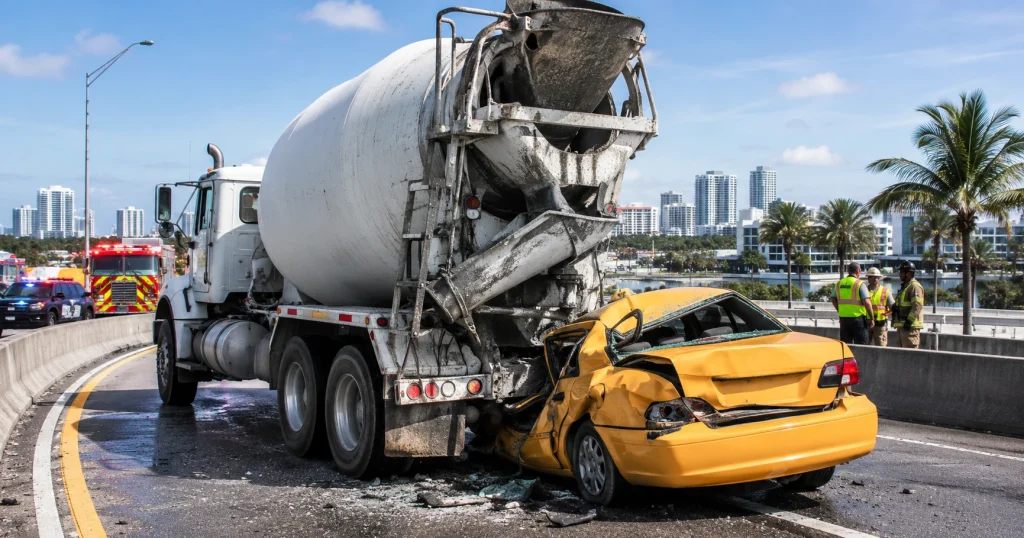
Cement Truck Accident Lawyer Florida: What Victims Should Know After a Serious Crash
Quick Summary A cement truck and taxi crash on the I-595 ramp to I-95 Southbound in Fort Lauderdale reportedly sent seven people to the hospital, including a child. Cement trucks are commercial vehicles, which means these cases may involve federal safety rules, company records, electronic driver logs, maintenance files, black box data, and higher insurance coverage than a regular car accident. In Florida, negligence-based personal injury claims generally must be filed within two years, but key evidence can disappear much sooner. After a cement truck crash, seek medical care, document the scene, avoid recorded statements, and speak with a lawyer who understands commercial vehicle investigations. Had a bad day? Call The Reyes Firm at 833-4 BAD DAY. What Happened in the I-595 Cement Truck and Taxi Crash? On May 15, 2026, CBS Miami reported that a cement truck and a taxi were involved in a crash on the ramp connecting I-595 to I-95 Southbound in Fort Lauderdale. According to the Florida Highway Patrol, the taxi was stopped in the outside lane when the front of the cement truck collided with the rear of the taxi. Seven people were transported to hospitals, including four adults and one child listed as trauma alerts. CBS Miami also reported that a hazmat crew responded after fuel leaked from the tractor cab. This article does not assign fault in that specific crash. The incident serves as a real-world example of why crashes involving cement trucks and commercial vehicles require fast, careful investigation. Although this crash occurred in Fort Lauderdale, the same commercial vehicle issues are present throughout Florida, including Tampa, Hillsborough County, Riverview, Brandon, Plant City, and along major freight routes such as I-4, I-75, I-275, and the Selmon Expressway. When a cement truck or concrete mixer is involved in a serious crash, the question is rarely limited to “What did the driver do?” A proper investigation may also look at the company, dispatch records, maintenance history, driver logs, vehicle data, and whether federal or Florida safety rules were followed. Where Did the Fort Lauderdale Cement Truck Crash Happen? The crash was reported on the ramp from I-595 to I-95 Southbound in Fort Lauderdale, near the major interchange west of Fort Lauderdale-Hollywood International Airport. This map shows the approximate incident area based on public news reports. Map shown for general location context only. The exact crash location should be confirmed through the official crash report or investigating agency records. Why Is a Cement Truck Crash Different From a Regular Car Accident in Florida? A cement truck crash is different from a regular car accident because cement trucks are commercial vehicles. That means the case may involve federal safety regulations, business records, company policies, inspection requirements, and multiple potential defendants. In a regular car crash, the main issue is often whether one driver made a mistake. In a cement truck crash, the investigation may also ask: Was the driver properly trained? Was the truck inspected before the trip? Were the brakes, tires, and steering systems maintained? Was the driver fatigued or under pressure to meet a delivery deadline? Did the company preserve electronic data after the crash? Did dispatch records show an unrealistic route or schedule? Did a mechanical problem contribute to the collision? Florida Statute 316.302 states that owners and drivers of commercial motor vehicles operating on Florida public highways are subject to applicable federal safety regulations, including rules found in 49 C.F.R. parts 382-386 and 390-397. That matters because a cement truck crash is not just a personal injury claim. It may also be a commercial vehicle investigation. Why Are Cement Truck Crashes So Dangerous? Cement trucks can cause severe injuries because of their size, weight, height, and stopping distance. A fully loaded concrete mixer can weigh many times more than a passenger vehicle. When a vehicle that heavy hits a car, a taxi, a motorcycle, or a pedestrian, the force can be devastating. Cement trucks also have unique risk factors, including: Longer stopping distances Large blind spots High center of gravity Heavy rotating drum Load balance issues Tight delivery schedules Frequent operation in traffic-heavy areas Repeated stops near construction zones, highways, and commercial sites These factors can make crashes more severe and investigations more complex. For injured people, the most important point is simple: the evidence needs to be preserved quickly. How Common Are Commercial Vehicle Crashes in Florida? Commercial vehicle crashes are not rare in Florida. According to FLHSMV data cited in the original draft, Florida recorded 46,651 commercial motor vehicle crashes in 2024, resulting in 315 fatalities. Nationally, the National Safety Council reports that 5,340 people died in large-truck crashes in 2024. The NSC also reports that 70% of deaths in large-truck crashes were occupants of other vehicles, not the large truck. That pattern matters in cement truck cases. When a heavy commercial vehicle collides with a smaller passenger vehicle, the occupants of the smaller vehicle often face the most severe consequences. Who Can Be Held Liable After a Cement Truck Accident in Florida? Multiple parties may be responsible after a cement truck accident in Florida. The driver may be one part of the case, but the investigation should not stop there. Depending on the facts, potential liable parties may include: The cement truck driver was speeding, distracted, fatigued, impaired, or engaged in unsafe driving, which contributed to the crash The concrete company or trucking company, if negligent hiring, poor training, unsafe scheduling, or weak supervision played a role A maintenance contractor if brake failure, tire failure, steering problems, or skipped repairs contributed A dispatcher or company supervisor if the driver was pressured to meet unrealistic delivery times A parts manufacturer if a defective truck component contributed to the crash Another driver in a separate vehicle triggered or worsened the collision In many cement truck cases, the company behind the driver is one of the most important parts of the investigation. Company records may show whether safety rules were followed before the crash. Watch: Why Cement Truck Accident Liability Can