
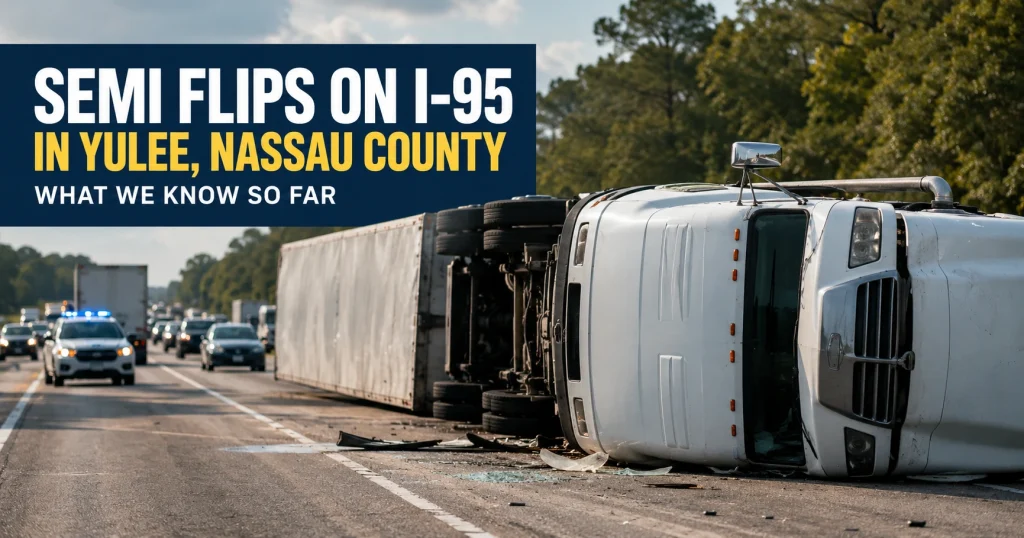
I-95 Nassau County Semi Crash: What Florida Families Should Know
Quick Summary A tractor-trailer reportedly flipped onto its side on I-95 South in Yulee, Nassau County. News4JAX reported that the crash blocked the two right lanes and caused backups. Florida Highway Patrol said the crash involved injuries. Early reports did not say how severe the injuries were. Families may have legal options, depending on the evidence and Florida law. Had a bad day? Call The Reyes Firm at 833-4 BAD DAY. Traffic slowed on I-95 South in Yulee after a tractor-trailer flipped onto its side. The I-95 Nassau County semi crash blocked two right lanes and involved injuries, according to News4JAX. For families, early news can raise difficult questions. What happened? How serious were the injuries? What evidence will matter later? Early reports do not always explain the full cause. A truck crash investigation may review the road, vehicle, driver, cargo, and records before fault is clear. What Do We Know About the Crash? The verified report says a tractor-trailer flipped onto its side on I-95 South in Yulee, Nassau County. The crash blocked the two right lanes and caused traffic backups. Florida Highway Patrol said injuries were involved, but the early report did not specify their severity. The early report did not assign fault. At this stage, the public report does not say what caused the tractor-trailer to overturn. It does not identify any final fault finding. It also does not state that any driver, company, or other party caused the crash. Known reported facts: Detail Reported information Location I-95 South in Yulee, Nassau County Vehicle Tractor-trailer Incident Semi flipped onto its side Traffic impact Two right lanes blocked Injuries Reported by FHP, severity unclear Fault Not stated in early report That careful wording matters because truck crash cases depend on evidence, not guesses. Why Can This Type of Crash Be So Serious? A semi-truck rollover can be serious because large commercial vehicles are heavy, long, and hard to stop quickly. Even a single-truck crash can block lanes, increase the risk of secondary crashes, spill cargo, and put nearby drivers in danger. A rollover can create risk beyond the first impact. Florida traffic data shows why commercial vehicle crashes deserve close review. FLHSMV reported 46,651 commercial motor vehicle crashes and 315 fatalities in Florida in 2024. 💡 Did you know? FLHSMV reported 46,651 commercial motor vehicle crashes in Florida in 2024, with 315 fatalities. That does not explain this Nassau County crash. It shows why commercial vehicle safety matters across Florida. For people in Tampa, Riverview, Brandon, Plant City, and communities across Hillsborough County, truck crashes can raise similar questions. That can include crashes on I-4, I-75, I-275, and other major roads. The next question is what makes these cases different from a regular car crash. What Makes a Truck or Commercial Vehicle Crash Different? A truck or commercial vehicle crash can involve more evidence and more parties than a regular car crash. Depending on the evidence, investigators may review the driver, carrier, maintenance company, cargo loader, owner, broker, or another business. More records may exist in a truck crash. Truck cases may involve: Driver qualification records Hours-of-service logs Electronic logging device data Engine control module data Maintenance and inspection records Cargo loading documents Dashcam or traffic camera footage Insurance policies and company safety records FMCSA explains that hours-of-service rules limit driving and work time. The goal is to help drivers stay awake and alert. FMCSA lists key limits for property-carrying drivers, including an 11-hour driving limit after 10 straight hours off duty and a 14-hour work window. NHTSA reported that deaths in crashes involving large trucks decreased 2.5 percent from 2023 to 2024. Key safety questions may include: Did the truck driver have enough rest? Was the truck inspected before the trip? Were the brakes, tires, and lights in safe condition? Was the cargo loaded and secured properly? Was any camera or electronic data saved? Still have questions? Call The Reyes Firm at 833-4 BAD DAY. The consultation is free, and there’s no obligation. Watch: Why Commercial Truck Crashes Near Tampa Can Be So Serious Commercial trucks move through busy Florida roads every day, including areas near the Port of Tampa. This video explains why heavy truck traffic, tight roads, delivery pressure, and commercial routes can create serious risks when something goes wrong. Note: This video is provided for general education. It does not describe the exact I-95 Nassau County semi crash discussed in this article. Those records can help families understand what happened after the first report fades from the news. What Should Families Do After a Fatal Crash in Florida? Families should focus first on medical care, safety, and documents. After a serious truck crash, the investigation may move quickly. Key evidence can disappear. If a death occurs, Florida law may also set strict deadlines. Families should protect evidence early. Practical steps may include: Get medical care and follow treatment instructions. Save photos, videos, names, and witness details. Keep all crash-related paperwork. Avoid recorded statements without legal guidance. Do not post crash details online. Ask about saving truck data, camera footage, and maintenance records. ⚠️ Warning: Florida Statute § 95.11 generally provides a 2-year statute of limitations for negligence and wrongful death actions. Missing a deadline can harm a case. Families should speak with a Florida attorney as soon as they can. This does not mean every crash leads to a claim. It means injured people and families should understand the timeline before proof becomes harder to find. Once the timeline is clear, the next step is looking at who may be legally responsible. Who May Be Liable After This Type of Crash? Possible liable parties may include a driver, a trucking company, a vehicle owner, a maintenance contractor, a cargo loader, or another party. That answer depends on the evidence. No one should assume fault from an early news report alone. Fault must be proven with evidence. The investigation may consider: Speed and braking Lane position Driver fatigue Distraction Vehicle defects Tire or brake