
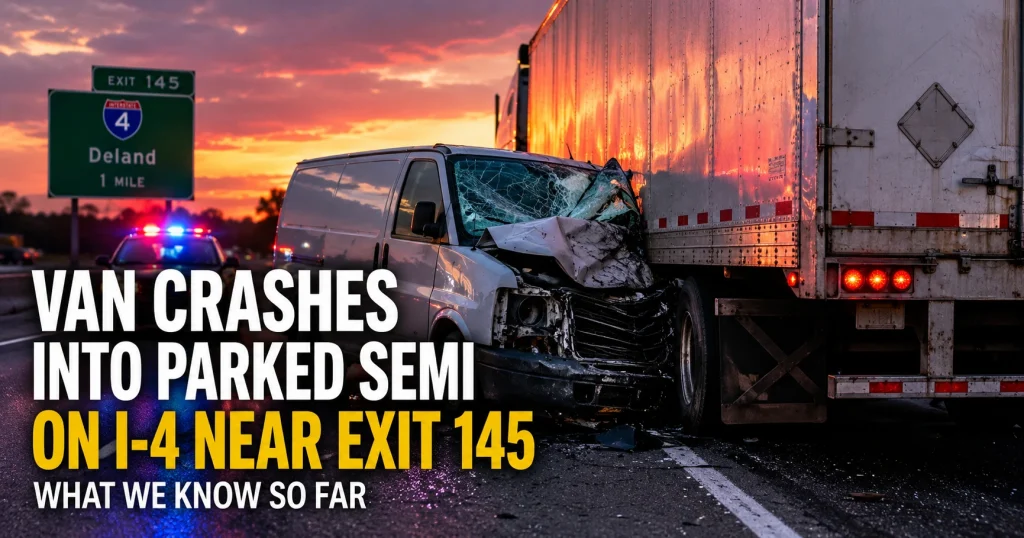
Van Hits Parked Semi on I-4: Who Could Be Liable in a Florida Shoulder Crash?
What You Need to Know A sprinter van struck a semi-truck parked on the right shoulder of I-4 in Volusia County on June 25, 2026. FHP cited the van driver for careless driving and not wearing a seat belt. The published report did not identify a violation by the truck driver. Florida law restricts parking on limited-access highway shoulders but provides exceptions for disabled vehicles and certain other situations. Commercial trucks may also have state and federal duties involving hazard lights and roadside warning devices. Fault in a similar crash can depend on driver conduct, the reason for the truck’s stop, vehicle position, warning devices, and physical evidence. Had a bad day? Call The Reyes Firm at 833-4 BAD DAY. A crash involving a semi-truck parked on an interstate shoulder may look simple at first. One vehicle was moving. The other was stopped. But if you were hurt in a similar crash, a Tampa truck accident lawyer may need to examine much more than which vehicle was moving at impact. Florida has rules about stopping on highway shoulders. Commercial trucks can also face additional warning-device requirements. At the same time, every driver has a duty to stay in control of the vehicle and use reasonable care. That makes the facts critical. What Happened When the Van Hit the Parked Semi-Truck on I-4? Florida Highway Patrol said a 27-year-old Jacksonville man driving a sprinter van abruptly left I-4 and struck the side of a semi-truck parked on the right shoulder near Exit 145 in Volusia County. The June 25, 2026 crash badly damaged the van, but officials reported no deaths or serious injuries. Where Did the I-4 Semi-Truck Crash Happen? The crash was reported on Interstate 4 near Exit 145 in Volusia County, Florida. Map shows the general area of the reported crash and is provided for informational purposes only. FOX 35 Orlando reported that the crash happened during the evening rush hour. FHP said: The van left the roadway before impact. The van struck the side of the parked semi-truck. The van driver was taken to a hospital and is expected to survive. The van driver received citations for careless driving and not wearing a seat belt. The truck driver was standing outside the semi and was not injured. The published report does not explain why the semi-truck had stopped on the shoulder. It also does not report that FHP cited the truck driver. Those missing facts matter when discussing liability. This article does not claim that the semi-truck driver or trucking company caused or contributed to this crash. It explains issues that may arise in a similar Florida shoulder collision. 💡 Did You Know? FLHSMV’s final 2024 Florida Traffic Crash Facts report lists 46,677 crashes involving commercial motor vehicles and 304 CMV fatalities statewide. Those final figures replace FLHSMV’s earlier preliminary 2024 totals. The seat belt issue reported in the I-4 crash is also significant from a safety standpoint. NHTSA reports that 48% of passenger vehicle occupants killed in crashes in 2024 were unrestrained among cases with known restraint use. Who Could Be Liable When a Vehicle Hits a Semi Parked on the Shoulder? The moving driver may carry significant responsibility after hitting a parked semi, but a stopped truck is not automatically removed from the liability analysis. Investigators may examine why the truck stopped, where it was positioned, how visible it was, what warning devices were used, and the actions that caused the other vehicle to leave its lane. In the reported Volusia County crash, FHP cited the van driver for careless driving. That is an important fact. But similar crashes can involve different circumstances. Questions may include: Issue What Investigators May Examine Moving driver’s conduct Speed, distraction, fatigue, lane departure, impairment, medical issues, or loss of control Reason for the truck’s stop Breakdown, mechanical failure, crash, emergency, traffic condition, or another reason Truck position How far the truck was from the travel lane and how it was positioned on the shoulder Visibility Lighting, weather, road geometry, reflective materials, and sight distance Hazard lights If required warning lights were operating Warning devices If triangles, reflectors, or other devices were required and properly placed Time stopped How long the commercial vehicle had been on the shoulder A police citation can matter, but civil fault may require a separate investigation. Our guide to who is liable in a truck accident in Florida explains how more than one person or company can become part of that investigation. 🛡️ Your Rights Under Florida Law: Florida Statute § 768.81 uses modified comparative negligence in covered negligence cases. A person’s damages can be reduced based on that person’s percentage of fault. A party found more than 50% at fault for his or her own harm generally cannot recover damages in a negligence action covered by the statute. Can a Semi-Truck Legally Park on an Interstate Shoulder in Florida? Florida generally restricts stopping, standing, or parking on the roadway or shoulder of a limited-access highway. However, the law provides exceptions. A vehicle disabled by a mechanical failure or crash may remain on the shoulder for up to six hours. Other lawful stops may also fall within exceptions stated in Florida law. Florida Statute § 316.1945 specifically addresses stopping and parking on limited-access facilities. The law generally prohibits parking on the roadway or shoulder but allows a vehicle that is disabled or unsafe to drive because of mechanical failure or a crash to remain there for no more than six hours. That means seeing a semi on the shoulder does not, by itself, tell you whether the stop was lawful. What Warning Lights Are Required? Florida Statute § 316.301 applies to certain trucks, buses, tractor-trailers, semitrailers, and other large vehicles. For covered vehicles stopped on a roadway or adjacent shoulder, the driver generally must immediately activate hazard-warning lights. The statute also contains additional warning-device requirements in specified circumstances, including some vehicles disabled or stopped for more than 10 minutes. Federal commercial vehicle rules can apply