
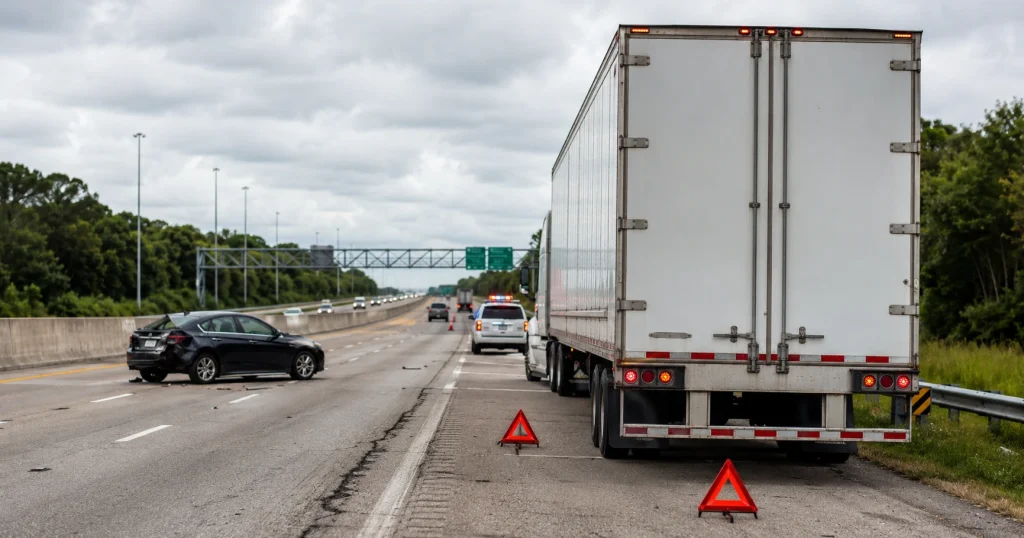
I-4 Semi-Truck Crash Near Lakeland: What Injured People Should Know
What You Need to Know Two young men were critically injured in an August 3, 2026, crash involving two tractor-trailers on I-4 near Lakeland. Investigators had not publicly assigned fault at the time of reporting. Federal rules may require a disabled commercial truck to use hazard lights and place warning devices. Evidence from the trucks, drivers, carrier, roadway, and passenger vehicle may help determine responsibility. Florida generally gives injured people two years to file negligence claims, but evidence can disappear much sooner. Had a bad day? Call The Reyes Firm at 833-4 BAD DAY. A serious semi-truck crash can change your life in seconds. You may leave the scene in an ambulance while trucking companies and insurers begin protecting their interests. A Lakeland truck accident attorney can investigate the vehicles, drivers, trucking companies, warning devices, maintenance records, and other evidence. The August 2026 crash on I-4 shows why these investigations require care and urgency. The Reyes Firm serves injured people in Tampa and the South Shore communities, including Tampa, Riverview, Brandon, Plant City, and communities across Hillsborough County. We also help people understand their legal options after serious crashes in nearby Polk County. What Happened in the I-4 Semi-Truck Crash Near Lakeland? Two young men suffered critical injuries after their Lexus collided with a disabled tractor-trailer on westbound I-4 near State Road 33. According to news reports citing the Florida Highway Patrol, the Lexus then rotated into the travel lanes and was struck by a second tractor-trailer. Authorities had not publicly determined fault. The crash occurred at approximately 3:50 p.m. on August 3, 2026, just west of Exit 38. The Lexus reportedly entered the outside shoulder and struck the disabled tractor-trailer. The impact caused the car to rotate back into the roadway, where another westbound tractor-trailer struck it in the center lane. The Lexus driver, a 20-year-old man from Winter Haven, and his 19-year-old passenger from Orlando were taken to the hospital. FOX 13 described their injuries as critical. The tractor-trailer drivers were not reported injured. Westbound I-4 remained closed for several hours as investigators and emergency crews worked at the scene. Traffic was diverted at Exit 38. FOX 13 News and WWSB reported details provided by FHP. The published reports do not establish negligence. A full investigation would be needed before deciding who may be legally responsible. Approximate Location of the I-4 Semi-Truck Crash Map shows the approximate incident area for informational purposes only. Who Could Be Responsible for a Crash With a Disabled Semi-Truck? Responsibility may extend to one or more drivers, a motor carrier, a maintenance provider, or another business. Investigators must determine why the truck was disabled, where it was stopped, what warnings were provided, and how each driver responded. More than one person or company can share fault under Florida law. Potentially responsible parties may include: The driver of the disabled tractor-trailer The trucking company that operated or controlled it A maintenance provider that failed to correct a mechanical problem The driver or carrier of the second tractor-trailer The driver of the passenger vehicle A parts manufacturer, if defective equipment contributed Another business responsible for dispatch, inspection, or vehicle control A truck’s electronic control module may contain information about speed, braking, throttle position, and other activity before impact. Electronic logging devices, dispatch records, maintenance files, inspection reports, GPS information, photographs, video footage, and witness statements may also matter. A Lakeland personal injury attorney can review the evidence and explain how Florida law may apply to the specific crash. ⚠️ Warning: Florida Deadlines Can Expire Quickly Florida generally allows two years to bring a negligence lawsuit under Florida Statute § 95.11. An injured person must also receive initial medical care within 14 days to qualify for many Florida PIP benefits under Florida Statute § 627.736. Do not wait for the lawsuit deadline before investigating. Trucking evidence may be lost much sooner. What Rules Apply When a Commercial Truck Becomes Disabled? Federal regulations generally require a commercial driver stopped on a highway or shoulder to activate hazard flashers immediately. The driver may also need to place reflective triangles or other approved warning devices within 10 minutes. The exact placement depends on the road, traffic direction, visibility, hills, curves, and other conditions. Under 49 C.F.R. § 392.22, a stopped commercial motor vehicle generally must use its hazard warning flashers. On a divided or one-way highway, the regulation generally requires warning devices at: Approximately 10 feet from the truck on the traffic side Approximately 100 feet toward approaching traffic Approximately 200 feet toward approaching traffic Different placement rules may apply near hills, curves, or other obstructions. Florida incorporates federal commercial motor vehicle safety rules through Florida Statute § 316.302. Investigators may examine compliance with these rules, but a regulatory violation alone does not answer every liability question. They may also ask: Were the truck’s hazard lights working? Were reflective triangles placed properly? How long had the tractor-trailer been disabled? Could the truck have been moved farther from traffic? Did the driver contact dispatch, law enforcement, or roadside assistance? Did a maintenance failure cause the breakdown? Did approaching drivers have enough time and distance to react? 📊 Did You Know? FMCSA’s current Florida data reports 8,834 qualifying large-truck and bus crashes in 2024. Those crashes resulted in 4,414 reported injuries and 271 fatalities. FMCSA notes that recent MCMIS figures can change as reports are updated. What Should You Do After an I-4 Truck Accident? Get medical care, report the collision, and preserve any evidence you can safely collect. Avoid guessing about fault or giving the trucking company’s insurer a detailed recorded statement before receiving legal advice. A truck accident investigation should begin quickly because vehicles can be repaired and electronic information can be overwritten. After a serious crash: Call 911. Ask for police and emergency medical assistance. Accept medical evaluation. Some head, neck, back, and internal injuries may not be immediately obvious. Photograph the scene if it is safe. Include the vehicles, trailer numbers, company markings, tire marks, debris,