
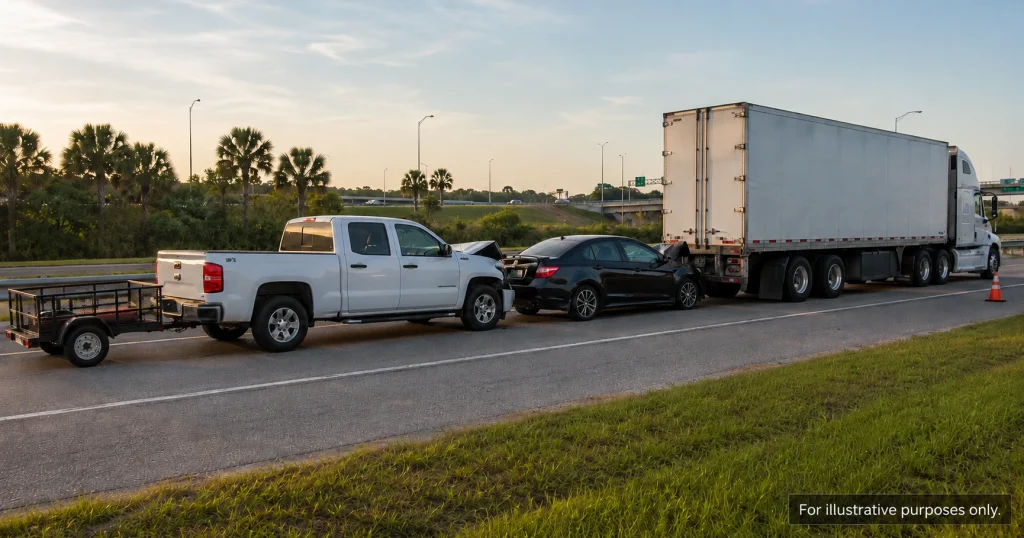
3-Car Collision: Who Is at Fault After a Polk Parkway Truck Crash?
What You Need to Know A three-vehicle crash on Polk Parkway near Interstate 4 took the life of a Winter Haven man on May 18, 2026. According to news reports, a pickup truck towing a utility trailer struck a Toyota from behind and pushed it into a tractor-trailer. The driver who caused the first impact may be responsible, but investigators must review the entire chain of events. Photos, videos, witness statements, vehicle data, and company records can help show what happened. If negligence caused the crash, eligible family members may be able to bring a claim under the Florida Wrongful Death Act. Had a bad day? Call The Reyes Firm at 833-4 BAD DAY. SCHEDULE A FREE CASE REVIEW After a three-car crash, families often want answers to two painful questions: How did this happen, and who is responsible? When several vehicles collide within seconds, the answer may not be clear right away. To determine who is at fault in a 3-car collision, investigators must carefully examine the order of each impact. They may also review each driver’s actions and determine whether a vehicle owner, employer, or business played a role. The fatal Polk Parkway crash shows how complicated these cases can become. This guide reviews what has been reported and explains how Florida law may apply. The investigation may uncover new evidence, so no final conclusion about fault should be made yet. What Happened in the Fatal Polk Parkway Truck Crash? A fatal three-vehicle crash occurred on westbound Polk Parkway near Interstate 4 on May 18, 2026. According to news reports citing the Florida Highway Patrol, a pickup towing a utility trailer struck a Toyota sedan from behind. The impact pushed the Toyota into a tractor-trailer that had slowed for traffic. The crash happened at about 6:10 a.m. on State Road 570 in Polk County. The Toyota and tractor-trailer were reportedly slowing because of traffic ahead. A Ford pickup towing a utility trailer then struck the Toyota. Reported Area of the Polk Parkway Crash The crash was reported on westbound Polk Parkway near Interstate 4 in Lakeland, Florida. This map shows the general area and not the exact crash location. The 42-year-old Winter Haven man driving the Toyota died at the scene. The pickup driver and tractor-trailer driver were not reported injured. They do not replace the complete crash investigation. Citations, toxicology findings, vehicle inspections, phone records, or other evidence could add important facts. The presence of a tractor-trailer also does not mean that its driver or trucking company caused the crash. Available reports state that the tractor-trailer was slowing with traffic before the Toyota was pushed into it. 💡 Did You Know? Florida recorded 381,210 reportable crashes and 3,184 traffic deaths in 2024, according to preliminary FLHSMV data. Of those crashes, 46,651 involved commercial motor vehicles and resulted in 315 deaths. These figures show how often commercial vehicles are involved in serious crashes across Florida, but they do not determine who was responsible in any individual case. View the FLHSMV crash reports and statistics. Across the country, an estimated 39,345 people lost their lives in traffic crashes in 2024, according to NHTSA. Although that number was lower than the year before, it still represents thousands of families who lost someone they loved. Read NHTSA’s 2024 traffic fatality estimate. In a 3-Car Collision, Who Is at Fault? Fault generally rests with the person or business whose careless conduct caused or contributed to the chain of impacts. The rear driver may be responsible if that driver failed to slow down, but rear-end placement alone does not decide the case. Investigators must study each driver’s actions and the full sequence of the crash. Florida law requires drivers to leave a reasonable and prudent distance based on speed, traffic, and road conditions. Florida Statute § 316.0895 addresses following too closely. In a typical chain-reaction crash, investigators ask: Which vehicle made the first impact? Did a driver follow too closely or fail to brake? Was a driver distracted, speeding, tired, or impaired? Did a sudden lane change or unsafe stop contribute? Did defective brakes, tires, lights, or trailer equipment play a role? Was any driver working for a business at the time? The answer to who is at fault in a three-car accident may turn on a few seconds of evidence. A driver in the middle is not automatically responsible for striking the vehicle ahead. If a rear impact pushed that driver’s car forward, the middle driver may have had no reasonable chance to prevent the second collision. A police report is important, but it does not always decide civil liability. Insurance companies, attorneys, experts, and courts may review evidence unavailable to the responding officer. ⚠️ Warning: Florida Deadlines Can End a Claim Florida generally allows two years to bring many negligence and wrongful death actions under Florida Statute § 95.11. Some cases have different deadlines or notice requirements, including claims involving government entities. Waiting too long can also allow videos, electronic data, and business records to disappear. Speak with a lawyer promptly to understand the deadline that may apply to your case. Can More Than One Party Be Responsible for a Chain-Reaction Crash? More than one driver, vehicle owner, employer, or business may share responsibility for a chain-reaction collision. Florida assigns fault according to each party’s contribution to the harm. A thorough investigation should look beyond the initial police report and identify every person or company whose conduct may have played a role. Potentially responsible parties may include: A driver who failed to slow down or maintain a safe distance A vehicle owner who knowingly allowed an unsafe person to drive An employer whose worker caused the crash while performing job duties A company that failed to inspect or maintain a work vehicle A trailer owner or maintenance provider responsible for unsafe equipment A manufacturer responsible for a defective vehicle component Another driver whose separate conduct contributed to the collision Florida uses a modified comparative negligence system. Under Florida Statute § 768.81,