
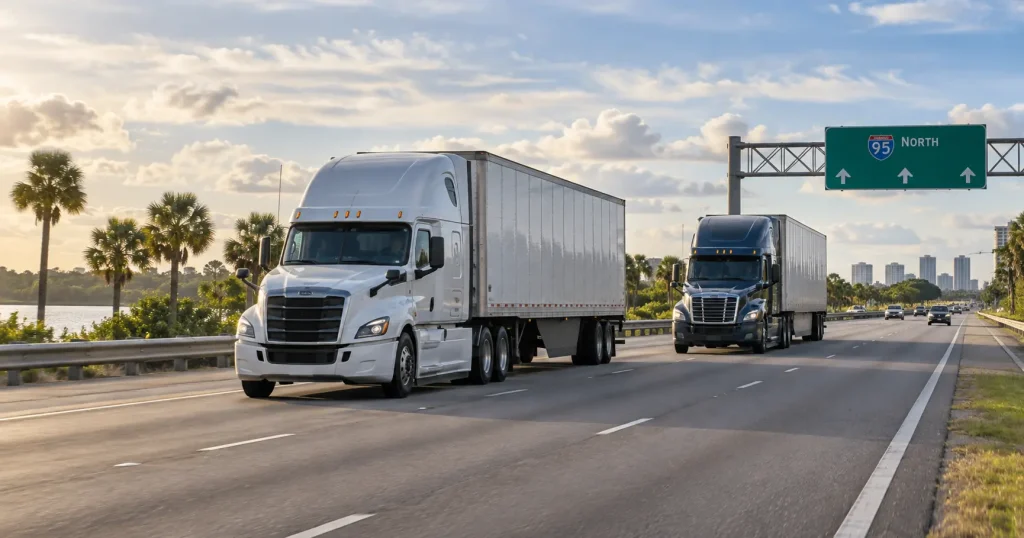
Florida Semi-Truck Wrongful Death Lawyer: Fatal I-95 Crash
What You Need to Know A truck driver died after two commercial trucks collided on I-95 in Brevard County in February 2026. The initial news report does not establish who caused the crash. Truck data, electronic logs, maintenance records, and videos may help explain what happened. A truck driver’s family may have a third-party wrongful death claim in addition to possible workers’ compensation benefits. Florida generally allows two years to file a wrongful death lawsuit, but evidence can disappear much sooner. Had a bad day? Call The Reyes Firm at 833-4 BAD DAY ((833) 422-3329) Losing someone in a semi-truck crash changes a family in an instant. You may be grieving while trucking companies, insurers, and their lawyers already collect evidence and protect themselves. A Florida semi-truck wrongful death lawyer can investigate the crash, identify every potentially responsible party, and explain your family’s legal options. You do not need to know who caused the crash before asking for help. The fatal February 2026 crash involving two commercial trucks on I-95 in Brevard County shows why these cases require more than an initial crash report. What Happened in the Fatal I-95 Truck Crash? Two commercial trucks were involved in a fatal crash on northbound I-95 near Deering Parkway in Brevard County on February 26, 2026. One semi-truck reportedly overturned, struck a guardrail, and caught fire. Its driver died at the scene, but the available report does not determine who was legally responsible. According to WESH, the crash occurred near Mims and closed the northbound lanes while emergency crews responded. Another commercial vehicle, described as a Volvo truck, was also involved. The map shows the approximate reported location near I-95 and Deering Parkway. It does not identify the exact point of impact. Early news reports cannot answer every question that matters in a wrongful death case. Investigators may still need to determine: How the two commercial vehicles came into contact If either truck changed lanes before impact How fast each vehicle was traveling If driver fatigue or distraction contributed If a tire, brake, steering, or mechanical problem played a role If the cargo was properly loaded and secured What the trucks’ electronic systems recorded If another vehicle contributed to the collision The report does not establish negligence. A traffic citation, or the absence of one, would not automatically decide civil responsibility. ⚠️ Warning: Florida Statute § 95.11 generally gives a family two years from the date of death to file a wrongful death lawsuit. Different requirements may apply when a government agency, workers’ compensation claim, or another special circumstance is involved. Evidence can disappear long before the filing deadline. Who Can Be Held Responsible for a Fatal Semi-Truck Crash? A truck driver, motor carrier, vehicle owner, maintenance company, cargo business, parts manufacturer, or another motorist may be responsible. Some fatal crashes involve several companies and insurance policies. Identifying the right parties requires examining the evidence, contracts, vehicle records, and business relationships connected to the trip. Potentially responsible parties may include: Potential party Conduct and evidence to investigate Commercial driver Speed, lane changes, distraction, fatigue, impairment, training, and driving history Motor carrier Hiring, supervision, dispatch instructions, safety practices, and driving-hour monitoring Tractor or trailer owner Vehicle condition, inspections, repairs, leases, and responsibility for maintenance Maintenance contractor Work performed on the brakes, tires, steering, lights, and coupling system Cargo loader or shipper Cargo weight, balance, placement, and securement Parts manufacturer Defective tires, brakes, steering components, or other vehicle parts Another motorist Unsafe passing, sudden lane changes, distraction, speeding, or other careless conduct Road contractor or government agency Construction conditions, traffic controls, road defects, or damaged safety equipment A trucking company may be responsible for its driver’s actions when the driver was performing work for the business. The company may also face a separate claim for careless hiring, training, supervision, dispatching, or maintenance. Federal and Florida commercial vehicle rules can affect driving hours, vehicle inspections, repairs, and cargo securement. A violation may be relevant, but investigators must still show how it contributed to the crash. The Reyes Firm provides more information about Florida truck and commercial vehicle accident claims and the evidence involved in tractor-trailer accidents. 💡 Did You Know? The FLHSMV 2024 Traffic Crash Facts report recorded 381,423 crashes, 246,426 injuries, and 3,098 traffic deaths in Florida. Nationally, NHTSA’s 2022 traffic safety data reported 5,936 deaths and 160,608 injuries in crashes involving large trucks. These totals cover many types of crashes and do not establish the cause of any individual collision. Can a Truck Driver’s Family File a Wrongful Death Claim? A truck driver’s family may have a wrongful death claim when another person or company contributed to the driver’s death. Possible defendants include another motor carrier, commercial driver, maintenance contractor, loading company, manufacturer, or roadway contractor. Workers’ compensation benefits and a separate third-party claim may sometimes apply at the same time. This distinction matters because the two types of claims serve different purposes. Workers’ compensation death benefits If the driver was an employee and died while performing job duties, eligible dependents may qualify for workers’ compensation death benefits. Those benefits may include certain funeral expenses and part of the worker’s lost wages, subject to Florida law. A workers’ compensation claim generally does not require the family to prove that the employer caused the crash. However, the law limits available benefits. Third-party wrongful death claims A third-party claim may be available when someone outside the driver’s employer caused or contributed to the crash. Examples may include: A driver employed by another trucking company A separate motor carrier A contractor responsible for unsafe repairs A company that improperly loaded the trailer A manufacturer that supplied a defective component A careless passenger-vehicle driver A road construction contractor A third-party claim may provide compensation that is not available through workers’ compensation. It can also involve reimbursement rights or insurance liens, so the two claims must be carefully coordinated. Families should not assume that workers’ compensation is their only option. A detailed investigation may uncover another responsible