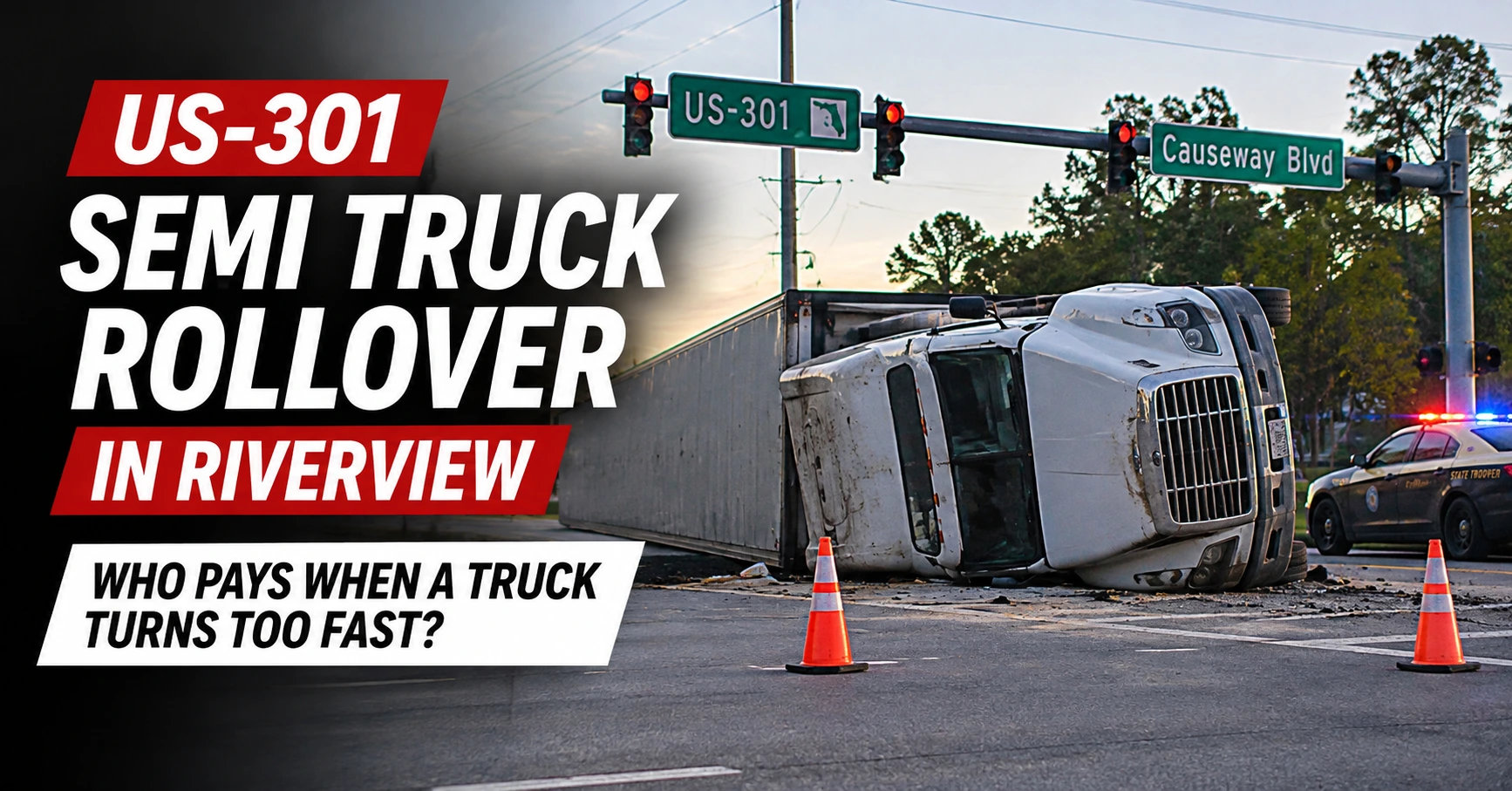
A loaded semi can weigh 20 to 30 times as much as your car, which is exactly why large trucks are governed by a thick web of federal safety rules. When a trucking company or driver breaks those rules, the results can be catastrophic, and the violation itself can become powerful evidence in your case. Here is a clear look at the safety regulations behind large truck accidents, and why they matter so much after a crash.
The Reyes Firm
Hurt in a Tampa Truck Crash?
A safety violation could be the key to your case. Had a bad day?
Because large trucks are so heavy and so dangerous when something goes wrong, the trucking industry is one of the most heavily regulated on the road. These safety rules exist to prevent crashes before they happen. Understanding them helps you see not only how truck accidents occur, but how a company’s failure to follow the rules can become the foundation of a strong injury claim. For a broader look at how and why these crashes happen, see our guide to the common causes of commercial truck accidents; this article focuses on the safety regulations themselves.
What safety regulations govern large trucks?
Most large commercial trucks that cross state lines are regulated by the Federal Motor Carrier Safety Administration, part of the U.S. Department of Transportation. The FMCSA sets and enforces safety rules covering nearly every aspect of trucking, and trucking companies and drivers are legally required to follow them.
These rules fall into a few main categories: limits on how many hours a driver can be behind the wheel, requirements for maintaining and inspecting the truck, standards for who is qualified to drive and for drug and alcohol testing, and rules for how cargo is loaded and secured. A failure in any one of these areas can lead directly to a serious crash, and each is worth understanding.
How do hours-of-service rules prevent fatigued driving?
Driver fatigue is one of the most dangerous problems in trucking, and the FMCSA’s hours-of-service rules are designed to combat it. For most property-carrying trucks, a driver may drive a maximum of 11 hours after 10 consecutive hours off duty, and may not drive beyond the 14th hour after coming on duty. Drivers must also take a 30-minute break after 8 hours of driving, and are limited to 60 hours over 7 days or 70 hours over 8 days.
To enforce these limits, most trucks are now required to use electronic logging devices, which automatically record driving time and make it far harder to hide violations. When a driver or company pushes past these limits to meet a deadline, a fatigued driver ends up operating a heavy truck, and the electronic logs often reveal exactly what happened.
💡 Did You Know? Modern trucks carry a digital paper trail. Electronic logging devices record a driver’s hours, and many trucks also have event data recorders that capture speed, braking, and other information around a crash. This data can be powerful evidence of a safety violation, but it can be overwritten or lost within days, which is why acting quickly to preserve it is so important.
What safety rules apply to the truck and its cargo?
A truck is only as safe as its condition, and federal rules require trucking companies to systematically inspect, repair, and maintain their vehicles, keeping records of that work. Brakes, tires, lights, and steering components must be kept in safe working order, and drivers are expected to perform pre-trip inspections. When a company skips maintenance to save money or time, a brake failure or tire blowout can cause a devastating crash.
Cargo is regulated too. Federal cargo securement rules govern how loads must be distributed, secured, and restrained so they do not shift, spill, or fall. Overloading a truck beyond the typical 80,000-pound federal limit, or loading it unevenly, makes it harder to stop and control and can cause rollovers. When cargo is improperly loaded or secured, responsibility may extend beyond the driver to the company or others who handled the load.
What are the driver qualification and testing requirements?
Not just anyone can legally drive a large truck. Drivers must hold a valid commercial driver’s license, meet medical certification requirements, and be qualified for the type of vehicle and cargo they operate. Trucking companies are responsible for verifying these qualifications and maintaining a driver qualification file, and they are required to conduct drug and alcohol testing under federal rules.
When a company puts an unqualified, improperly licensed, or impaired driver behind the wheel, it creates serious risk, and it may face liability for negligent hiring or supervision if a crash results. The driver’s qualification file, testing records, and history often become important pieces of evidence in a truck accident case.
How does a safety violation affect your injury claim?
This is where safety regulations meet your case directly. When a trucking company or driver violates a federal safety rule, that violation can be strong evidence of negligence. In many situations, breaking a safety rule that is designed to prevent exactly the kind of harm you suffered helps establish that the company failed to act as it should have, which is the heart of a negligence claim.
That is why the truck’s records matter so much. The electronic logs, maintenance records, inspection reports, driver qualification file, and drug and alcohol testing results can all reveal whether the rules were followed. A lawyer moves quickly to demand that this evidence be preserved before it is lost, then uses it to build your case. This kind of evidence is often the difference between a disputed claim and a clear one.
🛡️ Your Rights Under Florida Law: You have the right to pursue the trucking company, not just the driver, when its safety failures contributed to your crash. Under Florida’s comparative negligence law, Florida Statute § 768.81, your compensation is reduced by your share of fault, and being more than 50 percent at fault generally bars recovery, so proving the company’s violations is key to protecting your claim.
How long do you have to act after a truck crash?
You need to act on two timelines at once. The legal deadline is set by Florida Statute § 95.11(5)(a), which generally gives you two years from the date of the crash to file a personal injury lawsuit, a deadline shortened from four years in March 2023. Missing it can end your right to recover.
But the practical deadline is often much shorter. The electronic logs, maintenance records, and other evidence that prove a safety violation can be overwritten, discarded, or lost in a matter of days or weeks if no one acts to preserve them. That is why contacting a lawyer quickly after a truck crash is so important: the sooner the evidence is secured, the stronger your case will be.
⚠️ Deadline Warning: Under § 95.11(5)(a), you generally have two years from the date of your crash to file a truck accident lawsuit, reduced from four years in March 2023. Critical safety evidence like electronic logs and maintenance records can disappear far sooner, so the time to involve a lawyer is right away, not near the deadline.
Watch: Truck Safety and What to Do After a Crash
If you prefer to hear it explained, the short video below covers truck safety concerns and what to do after a crash with a large truck.
When you are ready to talk through your own situation, The Reyes Firm offers free consultations with no obligation.
What steps should you take after a truck crash?
These five steps protect your health and your claim. The order matters.
- Get medical care promptly. See a doctor within 14 days to protect your health and your PIP benefits, even if your injuries seem minor.
- Report the crash and get the crash report. Make sure law enforcement documents the scene, and note the trucking company and truck details.
- Act fast to preserve the truck’s records. The logs, maintenance records, and data can vanish, so a lawyer should demand their preservation right away.
- Do not give the trucking company’s insurer a recorded statement. Their adjusters move quickly, and you are not required to speak with them before getting legal advice.
- Call The Reyes Firm. Truck cases move fast and reward early action. Call 833-4 BAD DAY for a free consultation.
The Reyes Firm
4730 N. Habana Ave., Suite 201, Tampa, FL 33614
Phone: 833-4 BAD DAY | thereyesfirm.com
How The Reyes Firm handles your truck accident case
Truck accident cases turn on evidence that is often controlled by the trucking company, and getting to it quickly takes experience. We handle that for injured clients throughout Tampa and Hillsborough County.
When we take on a truck accident case, we typically:
- Move immediately to preserve evidence, sending demands so electronic logs, maintenance records, and data are not lost or overwritten
- Investigate the company’s safety compliance, examining hours-of-service records, maintenance history, the driver qualification file, and drug and alcohol testing
- Identify the safety violations that contributed to your crash and support your claim
- Work with qualified experts, including accident reconstruction and trucking safety specialists
- Handle the trucking company’s insurers and defense lawyers, so you are not pressured into an early, inadequate settlement
- Pursue your full damages, including medical bills, lost wages, future care, and pain and suffering, as our guide to what drives a settlement explains
No lawyer can promise a particular outcome. What we can promise is a fast, thorough investigation, honest guidance, and a firm willing to hold a trucking company accountable for its safety failures.
Frequently asked questions about truck safety and accidents
What agency regulates large truck safety?
The Federal Motor Carrier Safety Administration, or FMCSA, sets and enforces the safety rules for most large commercial trucks, covering driving hours, maintenance, driver qualification, drug and alcohol testing, and cargo. Trucking companies and drivers are legally required to follow them.
What are the hours-of-service rules for truck drivers?
For most property-carrying trucks, a driver may drive up to 11 hours after 10 consecutive hours off duty, may not drive past the 14th hour on duty, must take a 30-minute break after 8 hours of driving, and is limited to 60 hours in 7 days or 70 in 8. Electronic logging devices record this.
Can a safety violation help my truck accident claim?
Yes. When a trucking company or driver violates a federal safety rule designed to prevent the kind of harm you suffered, that violation can be strong evidence of negligence, helping to establish that the company failed to act as it should have.
What records prove a truck safety violation?
Key records include electronic logs and hours-of-service data, maintenance and inspection records, the driver qualification file, and drug and alcohol testing results. These can reveal whether the rules were followed, which is why preserving them quickly is so important.
How long do I have to file a truck accident claim in Florida?
Under Fla. Stat. § 95.11(5)(a), you generally have two years from the date of the crash to file a personal injury lawsuit, reduced from four years in March 2023. Because evidence can vanish much sooner, it is wise to act right away.
What if I was partly at fault for the crash?
Under Fla. Stat. § 768.81, your recovery is reduced by your share of fault, and if you are found more than 50 percent at fault, you generally cannot recover from the other party. Proving the trucking company’s safety violations helps counter attempts to shift blame.
Why is it important to act fast after a truck crash?
The electronic logs, maintenance records, and other evidence that prove a safety violation can be overwritten or discarded within days or weeks. Acting quickly allows a lawyer to demand that this evidence be preserved before it is lost.
Do I need a lawyer for a truck accident case?
It is strongly advisable. Truck cases involve federal safety regulations, evidence controlled by the trucking company, and well-funded insurers and defense lawyers, and an experienced attorney can investigate, preserve evidence, and level the playing field.

Edward Reyes, Esq. is a Florida Bar-admitted personal injury attorney and the founder of The Reyes Firm in Tampa, Florida. He represents people injured by the negligence of others in cases involving car accidents, truck and commercial vehicle crashes, and other serious injuries throughout Tampa and the surrounding counties. Edward Reyes, Esq. handles personal injury claims on a contingency fee basis, meaning clients pay nothing unless the firm recovers compensation for them.
Read more about Edward Reyes.
How Can The Reyes Firm Help You?
If you’ve had a bad day, whether a car accident, a truck crash, or any injury that wasn’t your fault, The Reyes Firm is in your corner. Our Tampa personal injury attorneys offer free consultations and work on a contingency fee basis, which means you pay us nothing unless we win your case.
You shouldn’t have to fight a trucking company and its insurers alone. Let us fight for you.
📍 Address: 4730 N. Habana Ave., Suite 201, Tampa, FL 33614
📞 Phone: 833-4 BAD DAY
🌐 Website: Schedule your free consultation today at thereyesfirm.com
Had a bad day? Call The Reyes Firm. We’ll handle the rest.
The information in this blog post is for general informational purposes only and does not constitute legal advice. Federal trucking regulations contain conditions and exceptions not fully summarized above, and both federal rules and Florida law are subject to change. Reading this article does not create an attorney-client relationship with The Reyes Firm. Every case is unique. If you have been injured in a truck accident that wasn’t your fault, consult a licensed Florida personal injury attorney about your specific situation.