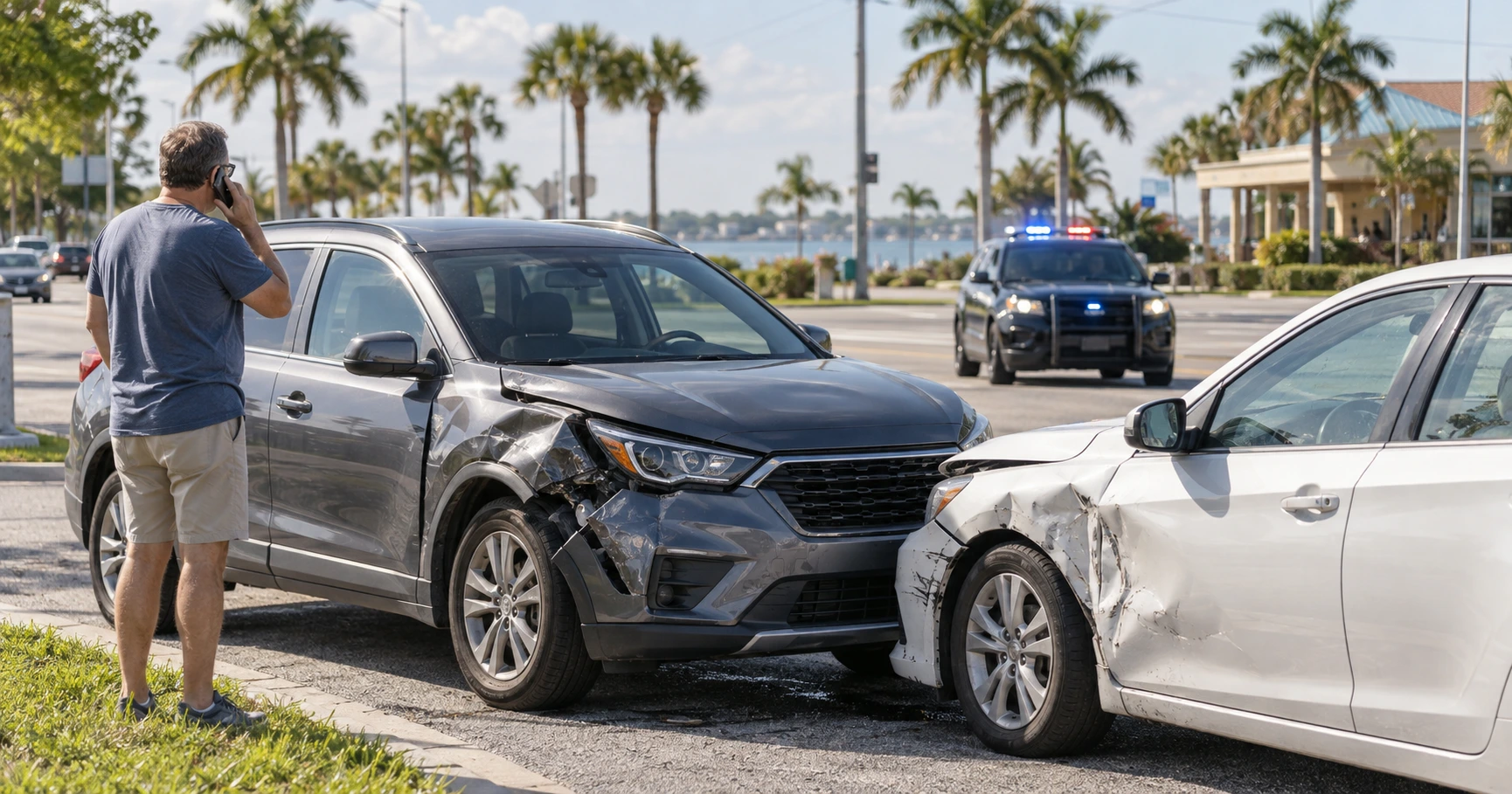
You’re in the emergency room. Your car is damaged. Your body hurts. One question keeps coming up: Did the truck driver or the trucking company break the rules before the crash?
In an FMCSA violations truck accident Tampa case, that question matters. Commercial trucks follow federal safety rules that regular drivers do not. Those rules can help prove why the crash happened and who may be responsible.
What this means:
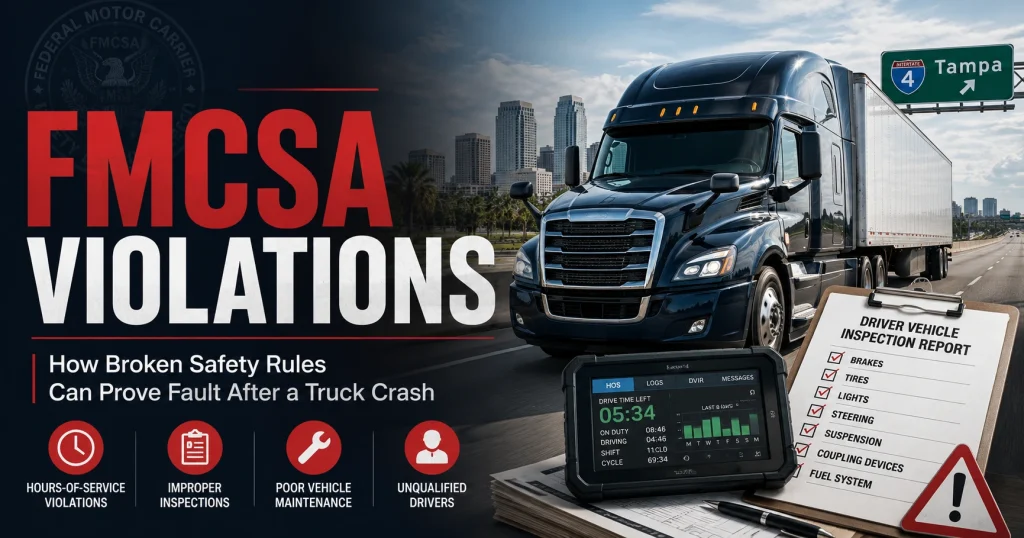
FMCSA violations can help prove fault in a Tampa truck accident case when a truck driver, carrier, broker, or trucking company broke federal safety rules before the crash. These violations may involve driver fatigue, unsafe maintenance, missing inspections, poor hiring practices, drug-testing failures, or Hours-of-Service violations.
WHAT YOU NEED TO KNOW
- FMCSA rules are federal safety rules for commercial trucks, drivers, and trucking companies.
- Florida Statute Section 316.302 applies many federal commercial vehicle safety rules to trucks operating on Florida roads.
- FMCSA violations can become strong evidence that a driver, carrier, broker, or trucking company acted negligently.
- ELD logs, Hours of Service records, maintenance files, CSA scores, and driver qualification files can help prove what happened.
- Had a bad day? Call The Reyes Firm. 833-4 BAD DAY.
What Are FMCSA Violations in a Tampa Truck Accident Case?
FMCSA violations are broken federal trucking safety rules that may help prove negligence after a Tampa truck crash. These rules cover driver hours, maintenance, drug testing, driver qualifications, cargo safety, and recordkeeping. If a driver or carrier broke one of these rules before the crash, that violation can become important evidence.
The FMCSA is the Federal Motor Carrier Safety Administration. It regulates many commercial motor vehicles across the United States.
These vehicles may include:
Vehicle Type | Why FMCSA Rules May Matter |
| They carry heavy loads and can cause severe injuries | |
| Semi-trucks | They often cross state lines and follow federal rules |
Box trucks | They may be used for delivery, moving, or freight |
Dump trucks | They may involve commercial maintenance and safety records |
| Delivery trucks | They may involve driver schedules and company pressure |
| Tractor-trailers | They often involve carriers, brokers, and shippers |
Florida also gives many of these rules legal force. Under Florida Statute Section 316.302, many federal commercial motor vehicle regulations apply to commercial trucks operating on Florida roads.
That means a federal trucking violation can matter in a Florida personal injury case. It can help show that the driver or company failed to follow safety standards created to protect people on the road.
Florida recorded 46,651 commercial motor vehicle crashes in 2024, with 315 fatalities, according to preliminary FLHSMV data. Tampa roads and Hillsborough County corridors, including I-4, I-75, and I-275, carry heavy commercial traffic every day.
If you were hurt in a crash involving a semi-truck, delivery truck, or commercial vehicle, a Tampa truck and commercial vehicle accident attorney can investigate the federal rules that may apply to your case.
⚠️ Warning: Know Your Deadline: Florida’s statute of limitations for most personal injury cases is 2 years under Fla. Stat. § 95.11(3)(a). Trucking evidence can disappear long before that deadline. ELD records, dashcam footage, dispatch messages, and maintenance files may be overwritten or deleted if your attorney does not act quickly.
How Do Hours of Service Violations Prove a Fatigued Truck Driver Crash?
Hours-of-Service violations can help prove that a truck driver stayed behind the wheel too long before a crash. Under 49 CFR Part 395, many truck drivers may drive up to 11 hours within a 14-hour on-duty window after 10 consecutive hours off duty. Breaking those limits can support a fatigue-based negligence claim.
Driver fatigue is one of the most serious safety issues in trucking. The FMCSA’s Large Truck Crash Causation Study found that fatigue was coded for 13% of truck drivers involved in the studied crashes.
A tired truck driver may react more slowly. They may drift between lanes. They may miss stopped traffic. They may fail to brake in time.
On Tampa highways like I-275, I-4, and I-75, one delayed reaction can cause severe injuries.
The key evidence is often the truck’s Electronic Logging Device, also called an ELD. An ELD records when the driver was on duty, driving, or resting.
Your attorney can compare ELD records with dispatch logs, fuel receipts, toll records, GPS data, and delivery schedules. If the records do not match, that can raise serious questions about the driver’s schedule and the carrier’s safety practices.
| Evidence Type | What It Can Show |
| ELD logs | Driving time, rest breaks, and Hours of Service violations |
| Dispatch records | Delivery pressure or unsafe scheduling |
| Fuel receipts | Travel timeline and route confirmation |
| Toll records | Movement across Florida corridors |
| GPS data | Location, speed, and route history |
| Delivery records | Timing pressure before the crash |
When The Reyes Firm handles a fatigued-truck-driver crash in Tampa, we move quickly to preserve ELD logs and Hours-of-Service records. If those records are lost, overwritten, or deleted, proving the violation can become much harder.
Watch: Why Truck Accident Cases Are Different From Car Accident Cases
Truck accident cases often involve federal safety rules, electronic log books, driver hours, maintenance records, and inspection requirements that do not apply in the same way to regular car accident cases. This video explains why FMCSA regulations can matter when proving fault after a commercial vehicle crash.
Video Summary: Commercial truck accident cases can involve FMCSA safety regulations, electronic log books, driver fatigue, vehicle inspections, maintenance records, and trucking company liability.
📊 Did You Know: The FMCSA’s Large Truck Crash Causation Study found fatigue was coded for 13% of truck drivers involved in the studied crashes. Florida recorded 46,651 commercial motor vehicle crashes in 2024 with 315 fatalities, according to preliminary FLHSMV data. Nationally, NHTSA reported 5,472 deaths in crashes involving large trucks in 2023, and 70% of those killed were occupants of other vehicles.
What FMCSA Violations Can Show Trucking Company Negligence?
FMCSA violations can indicate trucking company negligence when a carrier fails to hire safe drivers, maintain safe trucks, test for drugs or alcohol, or comply with federal safety rules. Many truck crashes are not caused by one bad decision. They often come from unsafe company systems.
Here are common FMCSA violations that may matter in a Tampa truck accident case:
| FMCSA Violation | Federal Rule | Why It Matters |
| Hours of Service violation | 49 CFR Part 395 | Shows possible fatigue or unsafe scheduling |
| Drug or alcohol testing failure | 49 CFR Part 382 | Shows the carrier may have ignored safety testing |
| Driver qualification violation | 49 CFR Part 391 | Shows the driver may not have been fit to drive |
| Vehicle maintenance violation | 49 CFR Part 396 | Shows the truck may not have been safe |
| Unsafe driving pattern | FMCSA SMS data | Shows repeated safety problems |
| Missing records | FMCSA recordkeeping rules | Shows possible poor compliance or concealment |
Hours of Service Violations
Hours-of-Service rules limit how long commercial truck drivers can drive and work. If a carrier pressured a driver to meet a delivery schedule that required unsafe hours, the company may share responsibility.
Drug and Alcohol Testing Violations
Federal rules require certain pre-employment, random, reasonable suspicion, and post-accident drug and alcohol testing. If a carrier skipped required testing or ignored a failed test, that can support a claim for trucking company negligence.
Driver Qualification Violations
A trucking company must make sure its drivers are properly licensed, medically qualified, and fit to operate a commercial truck. The driver qualification file may show a history of crashes, violations, medical problems, or missing records.
Vehicle Maintenance Violations
Carriers must inspect, repair, and maintain their commercial vehicles. Bad brakes, worn tires, broken lights, steering issues, or ignored inspection reports can turn a preventable maintenance problem into a serious Tampa truck crash.
These records help answer a deeper question: Did the trucking company know there was a safety risk before the crash? If the answer is yes, the case may involve more than driver error.
⚖️ Your Rights Under Florida Law: Under Fla. Stat. § 768.72, punitive damages require evidence that supports intentional misconduct or gross negligence. In plain English, that may include conduct showing a conscious disregard for someone else’s safety. A carrier that knowingly ignores fatigue, failed drug tests, or dangerous maintenance problems may create a stronger claim.
How Can ELD Logs and CSA Scores Help Prove Fault?
ELD logs and CSA scores can help prove fault by showing both the driver’s conduct and the trucking company’s safety history. ELD logs can reveal Hours-of-Service violations before a crash. CSA scores can show if the carrier had a pattern of unsafe driving, maintenance problems, driver fitness issues, or federal safety violations.
An ELD is one of the most important pieces of evidence in a Tampa truck accident case. It can show the driver’s work hours, driving time, rest breaks, and possible fatigue.
CSA scores come from the FMCSA’s Safety Measurement System. They track safety performance across categories such as Unsafe Driving, Hours-of-Service Compliance, Driver Fitness, and Vehicle Maintenance.
A poor CSA history does not automatically prove fault in one crash. But it can help show a pattern. That pattern may support arguments for negligent hiring, negligent supervision, or negligent retention.
| Record | Best Use in a Truck Accident Case |
| ELD logs | Prove driver hours and fatigue |
| CSA scores | Show carrier safety patterns |
| Driver qualification file | Check hiring and fitness issues |
| Maintenance records | Prove repair failures |
| Inspection reports | Show prior safety violations |
| Dispatch records | Show delivery pressure |
| Black box data | Show speed, braking, and engine activity |
| Dashcam footage | Show road conditions and driver behavior |
For example, a carrier with repeated maintenance violations may have known its trucks were unsafe. A carrier with repeated Hours-of-Service violations may have known its drivers were being pushed too hard.
An attorney can pull the carrier’s DOT number, review public FMCSA data, request non-public records through legal channels, and compare those records with the crash facts.
What Evidence Should Be Preserved After a Tampa Truck Crash?
The most important evidence after a Tampa truck crash includes ELD logs, black box data, dashcam footage, driver qualification files, maintenance records, dispatch messages, inspection reports, and carrier safety records. This evidence can disappear quickly, so your attorney should send preservation letters as soon as possible.
Truck accident evidence is different from regular car accident evidence. Much of it is controlled by the trucking company, its insurer, third-party vendors, or onboard systems.
Important evidence may include:
- ELD logs: These show driving time, on-duty time, rest breaks, and possible Hours of Service violations.
- Black box data: This may show speed, braking, throttle use, and engine activity before impact.
- Dashcam footage: This may show traffic conditions, lane position, driver behavior, and the crash itself.
- Driver qualification files: These can show CDL status, medical certification, training history, and prior violations.
- Maintenance records: These can show brake problems, tire issues, inspection failures, and delayed repairs.
- Dispatch messages: These can show delivery pressure, route instructions, and unsafe scheduling.
- Carrier safety history: This can show repeated violations before your crash.
The legal tool used to protect this evidence is called a litigation hold letter. This letter tells the carrier, insurer, broker, shipper, and other parties to preserve crash-related records.
Fast action matters. If the trucking company deletes evidence after proper notice, the court may consider the consequences of the destruction of evidence.
What Should You Do After a Truck Accident Involving FMCSA Violations?
After a Tampa truck accident, get medical care, report the crash, document the scene, avoid recorded statements, and speak with a truck accident attorney before evidence disappears. FMCSA violation cases depend on fast evidence preservation. The sooner your attorney acts, the stronger your investigation may be.
Use this step-by-step checklist:
| Step | What To Do | Why It Matters |
| 1 | Call 911 | Creates an official crash record |
| 2 | Get medical care | Protects your health and documents injuries |
| 3 | Photograph the truck | Captures company logos, DOT number, and damage |
| 4 | Photograph the scene | Preserves road, weather, debris, and skid mark evidence |
| 5 | Get witness names | Protects testimony before people leave |
| 6 | Avoid recorded statements | Prevents insurer tactics from hurting your claim |
| 7 | Call a lawyer quickly | Helps preserve ELD, dashcam, and company records |
If you can do so safely, take photos of:
- The truck’s DOT number
- The company name or logo
- License plates
- Vehicle damage
- Road conditions
- Skid marks
- Debris
- Traffic signs
- Visible injuries
- Witness vehicles
Do not admit fault at the scene. Do not guess about what happened. Stick to basic facts when speaking with law enforcement.
How The Reyes Firm Handles Your FMCSA Violation Case
The Reyes Firm handles FMCSA violation cases by moving quickly to preserve evidence, identify all liable parties, and prove that federal safety rules were violated. Commercial truck cases require more than a basic crash report. They require a law firm that understands trucking regulations, carrier records, expert review, and insurer pressure.
Commercial truck cases are not regular car accident cases with bigger vehicles. They involve federal rules, corporate defendants, insurance teams, brokers, shippers, and evidence that may disappear quickly.
High-volume firms may be built to process thousands of injury claims. The Reyes Firm is built to move fast on hard cases that require focused investigation and trial-ready preparation.
When The Reyes Firm takes an FMCSA violations truck accident Tampa case, we may:
- Send litigation hold letters to the carrier, insurer, broker, shipper, and other parties who may control evidence.
- Preserve ELD logs, Hours of Service records, dashcam footage, black box data, dispatch records, and maintenance files.
- Review the driver’s ELD data to look for 11-hour driving limit violations, 14-hour window issues, and skipped rest breaks.
- Pull the carrier’s CSA score and FMCSA safety history to identify repeated violations or unsafe patterns.
- Examine the driver qualification file for CDL status, medical certification, drug testing history, prior crashes, and hiring red flags.
- Trace dispatch records and delivery schedules to see if the company pressured the driver to violate federal safety rules.
- Work with trucking safety experts, accident reconstruction experts, medical experts, and economic experts when the case requires it.
The trucking company may start building its defense within hours. Its insurer may call quickly. Its legal team may already know which records help them and which hurt them.
You deserve someone moving just as fast for you.
The Reyes Firm is located at 4730 N. Habana Ave., Suite 201, Tampa, FL 33614. We serve Tampa, Riverview, Brandon, Plant City, and communities across Hillsborough County. Call 833-4 BAD DAY.
Frequently Asked Questions
What is the FMCSA in a Tampa truck accident case?
The FMCSA is the Federal Motor Carrier Safety Administration. It creates and enforces federal safety rules for many commercial trucks, drivers, and carriers. In a Tampa truck accident case, FMCSA rules can help show if the driver or trucking company failed to follow required safety standards.
Can FMCSA violations prove fault after a truck crash in Florida?
Yes, FMCSA violations can become strong evidence of fault after a Florida truck crash. A violation may show that the driver or carrier broke a safety rule before the collision. Your attorney can use those records to help prove negligence, causation, and trucking company responsibility.
How do I know if the truck driver violated Hours of Service rules?
You usually will not know without an investigation. Your attorney can request ELD logs, dispatch records, fuel receipts, GPS data, and delivery schedules. These records can show how long the driver had been working and driving before the crash.
What is an ELD and why does it matter?
An ELD is an Electronic Logging Device. It records a commercial driver’s hours, driving time, on-duty time, and rest periods. In a fatigued-truck-driver crash, ELD data can be one of the strongest pieces of evidence.
Can the trucking company be responsible for the driver’s violation?
Yes, the trucking company may be responsible if the driver was working within the scope of employment. The company may also be directly responsible for negligent hiring, poor training, unsafe scheduling, bad maintenance, or ignored safety violations.
What records should my attorney request after a Tampa truck crash?
Your attorney should request ELD logs, black box data, dashcam footage, driver qualification files, maintenance records, inspection reports, dispatch communications, and carrier safety history. These records can help show how the crash happened and who may be responsible.
How long do I have to file a truck accident claim in Florida?
Florida’s statute of limitations for most personal injury cases is 2 years under Fla. Stat. Section 95.11(3)(a). That does not mean you should wait. Trucking evidence can disappear quickly, so early legal action can protect your claim.
What should I do right now after a commercial truck crash in Tampa?
Get medical care first. Take photos of the vehicles, injuries, road conditions, license plates, company logos, and the truck’s DOT number if you safely can. Do not give a recorded statement to the trucking company’s insurer before speaking with a lawyer.
What Is the Bottom Line on FMCSA Violations After a Tampa Truck Crash?
FMCSA violations can be powerful evidence in a Tampa truck accident case because they show broken safety rules, unsafe company practices, and preventable risk. These cases often depend on records that disappear quickly. Prompt legal action can help preserve evidence before the trucking company controls the narrative.
If you were hurt in a crash with a semi-truck, box truck, delivery truck, or other commercial vehicle, you do not have to investigate the carrier alone.
The Reyes Firm can review the crash, preserve key evidence, and explain your next step.

Edward Reyes, Esq. is a Florida Bar admitted personal injury attorney and the founder of The Reyes Firm in Tampa, Florida. His practice focuses on serious injury and wrongful death cases involving truck crashes, commercial vehicle collisions, FMCSA violations, and trucking company liability. Edward represents injured people across Tampa, Hillsborough County, and the South Shore communities from the firm’s office at 4730 N. Habana Ave., Suite 201, Tampa, FL 33614.
Read more about Edward Reyes.
How Can The Reyes Firm Help You?
If you’ve had a bad day, a car accident, a slip and fall, a trucking crash, or any injury that wasn’t your fault, The Reyes Firm is in your corner. Our Tampa personal injury attorneys offer free consultations and work on a contingency fee basis, which means you pay us nothing unless we win your case.
You shouldn’t have to fight the insurance companies alone. Let us fight for you.
📍 Address: 4730 N. Habana Ave., Suite 201, Tampa, FL 33614
📞 Phone: 833-4 BAD DAY
Had a bad day? Call The Reyes Firm. We’ll handle the rest.
The content of this article is provided for general informational purposes only and does not constitute legal advice. Reading this article does not create an attorney-client relationship between you and The Reyes Firm or any of its attorneys. Every case is different, and past results do not guarantee a similar outcome. If you’ve been involved in a truck accident in Tampa or anywhere in Florida, consult a licensed Florida attorney about your specific situation. The Reyes Firm is located at 4730 N. Habana Ave., Suite 201, Tampa, FL 33614. Phone: 833-4 BAD DAY. Website: thereyesfirm.com.