If you were hurt in an Uber or Lyft crash, rideshare vs. personal insurance coverage in Florida can feel really confusing. The driver may point to Uber or Lyft. The personal insurer may say the driver was working. The rideshare company may ask for additional proof before confirming coverage.
That delay can hurt your claim. App status can decide which policy applies, how much coverage may be available, and whether an insurer tries to deny payment.
This guide explains how Florida rideshare insurance works after a crash in Tampa, what evidence to save, and when to call The Reyes Firm for help.
Quick Summary
- The driver’s app status can determine which insurance policy applies.
- If the app is off, the driver’s personal auto insurance is usually the starting point.
- If the app was on but no ride had been accepted, Florida law requires at least $50,000 per person, $100,000 per incident, and $25,000 in property damage coverage.
- If the driver had accepted a ride or was transporting a passenger, Florida law requires at least $1 million in primary auto liability coverage.
- A rideshare endorsement may matter for the driver’s own coverage, vehicle repairs, deductibles, and insurance gaps.
- App login records, ride receipts, screenshots, and crash reports can help prove which coverage phase applied.
- Most Florida negligence-based personal injury lawsuits must be filed within 2 years.
Why Does App Status Matter After an Uber or Lyft Crash?
The most important insurance question after a rideshare crash is not only, “Was this an Uber or Lyft driver?”
The better question is:
What was the driver doing on the app at the exact moment of impact?
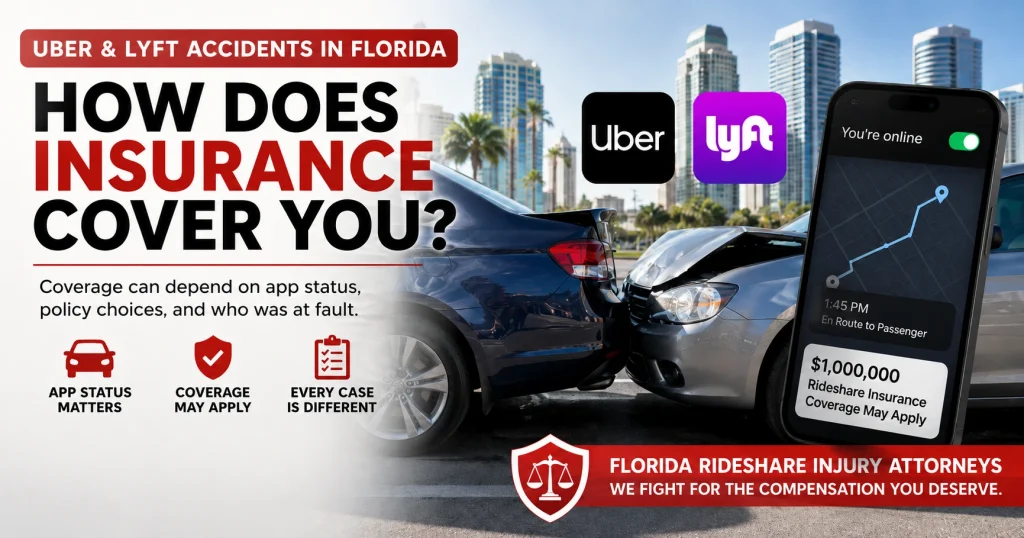
Florida law separates rideshare insurance into different coverage periods. Those periods can affect which insurer must respond and how much coverage may be available.
They can also affect whether the driver’s personal auto policy tries to deny the claim.
In Florida, a transportation network company driver may be:
- Offline
The driver is not logged into the Uber or Lyft app. - Logged in and waiting for a ride request
The driver is available for rides but has not accepted a trip. - En route to pick up a passenger
The driver has accepted a ride and is heading to the pickup location. - Transporting a passenger
The passenger is inside the vehicle.
Each phase can trigger a different insurance review.
Once you understand the app phase, the next step is figuring out which policy applies.
What Insurance Applies If the Uber or Lyft App Was Off?
If the Uber or Lyft app was completely off, the claim usually starts with the driver’s personal auto insurance.
In this situation, Uber or Lyft may argue that the driver was not using the platform.
If the driver was not logged in, the rideshare company’s insurance may not apply.
That can be a problem for injury victims. Florida’s basic insurance requirements may not be enough after a serious crash.
Florida PIP benefits are generally limited to $10,000 in medical and disability benefits. “PIP” means Personal Injury Protection, which helps pay certain crash-related medical costs.
Medical benefits generally reimburse 80% of reasonable and necessary medical expenses if you get initial care within 14 days after the crash.
For serious injuries, minimum coverage can disappear quickly. This is especially true when emergency care, surgery, missed work, or long-term treatment is involved.
This is why every possible source of recovery should be reviewed, including:
- The rideshare driver’s personal auto policy
- The injured person’s own PIP coverage
- The injured person’s own uninsured or underinsured motorist coverage
- Any other at-fault driver’s insurance
- Any available umbrella or excess policies
⚠️ Important Deadline: Most Florida negligence-based personal injury lawsuits must be filed within 2 years. That deadline is found in Florida Statute § 95.11.
If the app is off, coverage may be limited, but the investigation should not stop there. Other parties, insurance policies, or negligence factors may still affect your claim.
What Happens If the Driver Was Logged In But Had Not Accepted a Ride?
This is commonly called Period 1. It is one of the most important insurance gaps in rideshare accident cases.
Period 1 means the driver was logged into Uber or Lyft and available for ride requests. The driver had not accepted a ride yet.
No passenger is in the vehicle. No trip has started. But the driver is still using the app for rideshare work.
Under Florida Statute §627.748, this period requires specific coverage:
- $50,000 for death or bodily injury per person
- $100,000 for death or bodily injury per incident
- $25,000 for property damage
- PIP benefits meet Florida’s minimum coverage requirements
- UM/UIM coverage as required by Florida law
These coverage requirements may be satisfied by the driver’s policy, the TNC’s policy, or both. “TNC” means transportation network company, such as Uber or Lyft.
This period matters because many personal auto policies exclude rideshare work. Florida law allows personal auto insurers to exclude app-on rideshare losses.
Those exclusions may apply to liability, UM/UIM, medical payments, collision, comprehensive coverage, and PIP. Collision coverage helps pay for vehicle damage from a crash. Comprehensive coverage helps pay for non-crash losses, such as theft or certain weather damage.
In plain English: if the driver was logged into Uber or Lyft, the review should not stop with the driver’s personal policy.
Still have questions? Call The Reyes Firm at 833-4 BAD DAY. The consultation is free, and there’s no obligation.
That coverage gap is why rideshare endorsements matter.
What Is a Rideshare Endorsement, and Why Does It Matter?
A rideshare endorsement is extra coverage a driver may add to a personal auto policy.
It may also be called ride-hailing insurance, ridesharing coverage, or a TNC endorsement.
This topic matters because many people search for “rideshare vs personal insurance Florida.” They want to know whether personal insurance covers rideshare driving.
The answer is often: not fully, and sometimes not at all.
A major auto insurer explains that personal auto insurance usually does not cover driving for rideshare companies. Rideshare company coverage may also have limits or gaps, which is why app status, policy language, and all available insurance coverage should be reviewed carefully after a crash.
A rideshare endorsement may help fill some of those gaps, but coverage depends on the policy’s exact terms.
For injured passengers, pedestrians, cyclists, or other drivers, the endorsement may explain why one insurer denies coverage.
It may also explain why another policy becomes important.
For rideshare drivers, the endorsement may affect:
- Whether their own vehicle damage is covered
- Whether their personal collision or comprehensive coverage applies
- Whether a deductible gap exists
- Whether PIP, MedPay, or UM/UIM benefits are available
- Whether the personal insurer excludes the claim because the driver was logged into the app
A rideshare endorsement does not replace Florida’s required TNC insurance. It may help fill gaps between personal insurance and rideshare company coverage.
An endorsement may help the driver, but vehicle damage can still create another dispute.
Does Uber or Lyft Cover Vehicle Damage After a Crash?
Not always.
The $1 million rideshare policy is mainly about liability coverage. Liability coverage helps pay for injuries or damage caused to others.
It does not automatically mean every loss is fully covered.
For the rideshare driver’s own vehicle, Uber and Lyft may offer contingent comprehensive and collision coverage during certain covered periods.
“Contingent” means the coverage depends on other facts, such as the driver’s own policy.
That coverage usually depends on whether the driver already carries comprehensive and collision coverage on their personal auto policy.
Uber states that its insurance may cover vehicle repair when a driver is en route or on a trip. The coverage may pay up to actual cash value with a $2,500 deductible.
Uber also states there is no Uber-maintained collision or comprehensive coverage in certain situations. That includes when the driver is offline or online but has not accepted a trip.
Lyft states that contingent comprehensive and collision coverage may apply while the app is on and the driver is en route or during rides. Lyft also states that this coverage may have a $2,500 deductible.
💡 Did You Know? The injury claim and the vehicle damage claim may involve different coverage questions. That is why the same crash can lead to different answers from the driver, Uber, Lyft, and insurers.
Vehicle damage is one issue, but injury coverage changes again once a ride has been accepted.
What Coverage Applies During an Accepted Uber or Lyft Ride?
If the driver had accepted a ride through the app, Florida law treats that as a prearranged ride.
A prearranged ride begins when the driver accepts a ride through the digital network.
It continues while the driver transports the rider. It ends when the last rider exits the vehicle.
During a prearranged ride, Florida law requires at least $1 million in primary auto liability coverage.
That coverage applies to death, bodily injury, and property damage. The statute also requires PIP benefits and UM/UIM coverage as required by Florida law.
This higher coverage phase may apply when:
- The driver accepted your ride and was heading to pick you up
- You were already inside the Uber or Lyft
- The crash happened before you exited the vehicle
- Another vehicle hit the Uber or Lyft during your active ride
That does not mean the insurance company will automatically pay the full value of a claim.
Coverage is only one part of the case. Fault, injury severity, medical records, lost income, and future care may still be disputed.
Even during an active ride, another driver may have caused the crash.
What If Another Driver Hit the Uber or Lyft You Were Riding In?
If another driver caused the crash, you may have a claim against that driver’s insurance.
But that may not be the only available coverage.
Depending on the facts, a rideshare passenger may need to review all available insurance policies.
Those policies may include:
- The at-fault driver’s bodily injury coverage
- The Uber or Lyft insurance policy that applied during the ride
- Available UM/UIM coverage
- The passenger’s own auto policy
- Household auto policies
- Umbrella or excess coverage
- Any additional liable parties
This is especially important if the at-fault driver has no insurance. It also matters if that driver does not have enough insurance.
Rideshare accidents often involve multiple insurers. Each one may try to shift responsibility to another policy.
A careful insurance investigation can help identify all possible sources of recovery.
The number of injured people can also affect how far the coverage goes.
What If Multiple People Were Hurt in the Same Rideshare Crash?
A $1 million policy may sound like enough. But serious crashes can involve multiple injured people.
If several people are hurt, the available insurance may have to be divided among multiple claims.
That can make timing and investigation important.
For example, one rideshare crash may involve:
- An injured Uber or Lyft passenger
- A rideshare driver with injuries
- Another driver with injuries
- Pedestrians or cyclists
- Multiple vehicle damage claims
- Medical bills from several people
- Competing claims against the same insurance policy
This does not mean you should rush into a settlement. It means you should understand the available coverage before accepting any offer.
To understand coverage, you first need proof of what the driver was doing on the app.
Can a Driver Hide Their Uber or Lyft App Status After a Crash?
A driver should not try to hide rideshare app activity after a crash.
Some rideshare drivers worry that telling their insurer about Uber or Lyft work will cause problems.
They may fear higher premiums, a denial, or a coverage dispute.
Driver forums show that Florida rideshare drivers often ask about endorsements, mileage, insurance costs, and disclosure.
But after a crash, app status is not a casual detail. It can decide which insurance policy applies.
Florida law requires a TNC driver to provide insurance information after a crash. That information must be provided to directly involved parties, insurers, and investigating police officers.
Upon request, the driver must also disclose whether they were logged into the app or engaged in a prearranged ride.
Florida law also requires a TNC to provide login and logout times during a claims investigation. This can include the 12 hours before and 12 hours after the crash.
App activity may be verified through:
- Platform login records
- Ride acceptance timestamps
- Digital receipts
- Passenger screenshots
- GPS and trip data
- Police reports
- Insurance coverage disclosures
- Discovery in litigation
If you were injured, do not rely only on what the driver says at the scene.
Save your ride receipt, screenshots, driver information, vehicle details, crash report number, and messages from Uber or Lyft.
Your own policy may also matter, even if you were only a passenger.
Does Your Own Personal Car Insurance Cover You in a Rideshare Crash?
Sometimes, yes.
Your own PIP coverage may apply even if you were a passenger in someone else’s vehicle.
Florida PIP generally provides up to $10,000 in medical and disability benefits. This is subject to legal rules, including the 14-day treatment rule.
Your own uninsured or underinsured motorist coverage may also matter. It can help when the at-fault driver does not have enough insurance.
Coverage depends on:
- Your policy language
- Whether you own an insured vehicle
- Whether you are listed on a household policy
- The rideshare driver’s app status
- Whether Uber or Lyft coverage applies
- Whether another driver caused the crash
- Whether any exclusions apply
Do not assume only one policy applies. Rideshare crashes often require a layered insurance review.
The more coverage layers involved, the more important your evidence becomes.
What Should You Save After a Tampa Uber or Lyft Accident?
Evidence can disappear quickly after a rideshare crash.
The sooner you document what happened, the easier it may be to prove which coverage phase applied.
Try to save:
- Screenshots of the ride confirmation
- The driver’s name and profile photo
- The license plate shown in the app
- The digital receipt
- Trip pickup and drop-off details
- Photos of all vehicles involved
- Photos of the crash scene
- Photos of injuries, if appropriate
- Names and phone numbers of witnesses
- Police report number
- Insurance information from all drivers
- Messages from Uber, Lyft, or any insurer
- Medical records and discharge paperwork
- Proof of missed work or lost income
You should also get medical care as soon as possible. Florida PIP benefits may depend on getting initial care within 14 days.
Good evidence helps prevent insurers from controlling the story.
Common Insurance Disputes After an Uber or Lyft Crash
Rideshare accident claims often become complicated because several insurers may be involved.
Each insurance company may try to reduce or avoid responsibility.
Common disputes include app status disputes and other coverage fights.
These disputes may include:
- App status disputes: Was the driver offline, logged in, en route, or transporting a passenger?
- Personal policy exclusions: Did the driver’s policy exclude rideshare or business use?
- TNC coverage disputes: Which coverage period applied under Florida Statute §627.748?
- Fault disputes: Did one driver or more than one driver cause the crash?
- Medical causation disputes: Is the insurer arguing your injuries were unrelated?
- Treatment disputes: Is the insurer questioning whether your medical care was needed?
- Damage disputes: Is the insurer undervaluing your losses?
- Multiple claimant disputes: Are several injured people claiming against the same policy?
- Deductible disputes: Is vehicle damage subject to a high rideshare deductible?
- UM/UIM disputes: Is there disagreement about whether extra coverage applies?
This is why rideshare crash cases should be treated as insurance investigations from the beginning.
When disputes start early, legal help can keep the claim moving in the right direction.
How The Reyes Firm Helps After a Tampa Rideshare Crash
The Reyes Firm helps injured people understand what insurance may apply after an Uber or Lyft crash in Tampa.
The firm also helps clients throughout Hillsborough County.
A rideshare accident case may involve multiple insurance companies and multiple policies.
It may also involve more than one theory of fault.
The firm’s role is to investigate the facts, preserve key evidence, and explain your legal options.
Depending on the case, The Reyes Firm may help by:
- Reviewing the crash report and available evidence
- Investigating the rideshare driver’s app status
- Requesting trip, login, and insurance information
- Identifying all available insurance policies
- Reviewing medical records and injury documentation
- Communicating with insurance adjusters
- Evaluating settlement offers
- Preserving app data, vehicle evidence, and witness information
- Preparing the case for litigation when necessary
Every case is different. The value and outcome of a rideshare accident claim depend on the facts, available coverage, injuries, and Florida law.
The Reyes Firm is located at:
The Reyes Firm
4730 N. Habana Ave., Suite 201
Tampa, FL 33614
Phone: 833-4 BAD DAY
Had a bad day? Call The Reyes Firm.
The questions below answer what most people ask next.
Frequently Asked Questions About Rideshare vs. Personal Insurance in Florida
What is the first thing I should do after a rideshare crash in Tampa?
Get medical attention first. Then save your ride receipt, app screenshots, vehicle photos, witness details, and crash report.
Before giving a recorded statement to any insurer, consider speaking with a Florida personal injury attorney.
How do I know whether the Uber or Lyft driver’s app was on?
The driver’s app status may be confirmed through ride records, login data, trip information, insurance disclosures, and discovery.
Discovery is the formal process of obtaining evidence when a lawsuit is filed.
Florida law also allows certain login and logout records to be requested during a claims coverage investigation.
That may include the 12 hours before and 12 hours after the accident.
Do Uber and Lyft drivers need a rideshare endorsement in Florida?
A rideshare endorsement is not the same as the TNC insurance required under Florida law.
However, it may help fill gaps in the driver’s personal insurance.
This is especially important when the driver is logged into the app but has not accepted a ride.
Coverage depends on the policy and endorsement language.
Do Uber or Lyft cover a driver’s car repairs after a crash?
Sometimes, but not always.
Uber and Lyft may provide contingent collision and comprehensive coverage during certain covered periods.
This usually applies only if the driver already has that coverage on a personal policy.
Deductibles may be high, and coverage may not apply during every app phase.
What if the rideshare driver’s personal insurance denies the claim?
A denial from the driver’s personal insurer does not automatically end the case.
Florida law allows TNC coverage to apply during app-on periods.
Personal auto policies may also exclude rideshare-related losses.
The next step is to determine which coverage phase applied.
What if the driver says they were not working for Uber or Lyft?
Do not rely only on the driver’s statement.
App login records, ride receipts, trip data, screenshots, and insurance disclosures may help confirm app status.
Florida law allows certain app login and logout times to be requested during a claims coverage investigation.
Can I sue Uber or Lyft directly after a crash in Florida?
It depends on the facts.
Florida law includes protections for transportation network companies in certain claims.
But that does not erase the insurance coverage required under Florida Statute §627.748.
Other claims may also apply based on the facts.
What if I were a pedestrian or cyclist hit by an Uber or Lyft driver?
You may still have a claim.
The available insurance depends on the driver’s app status and whether the driver was engaged in a prearranged ride.
Pedestrian and bicycle cases should be investigated quickly because injuries are often serious.
Evidence can also disappear with time.
Is a rideshare crash different from a regular car accident?
Yes.
A regular car accident usually starts with the drivers’ personal auto policies.
A rideshare crash may involve personal insurance, a rideshare endorsement, TNC insurance, PIP, UM/UIM, and third-party coverage.
How long do I have to file a Florida rideshare accident lawsuit?
Most negligence-based personal injury lawsuits in Florida must be filed within 2 years.
Some exceptions may apply, but you should not rely on an exception without legal advice.
Does it matter if I was not wearing a seatbelt in the Uber or Lyft?
It can.
Florida uses a comparative fault system. That means fault can be divided between more than one person.
The defense may argue that not wearing a seatbelt contributed to the injuries.
That does not automatically prevent recovery. But it may affect the damage analysis depending on the facts.
Key takeaway: App status, policy language, and evidence can decide the direction of a rideshare crash claim.
The answers matter more when they come from a local firm that handles these cases.

Edward Reyes, Esq., is a Florida personal injury attorney and founder of The Reyes Firm in Tampa, Florida. He represents injured people in car accidents, commercial vehicle accidents, rideshare accidents, and serious injury cases. His work includes cases throughout Tampa and the surrounding Tampa Bay area.
How Can The Reyes Firm Help You?
If you had a bad day because of a car accident, rideshare crash, trucking crash, slip and fall, or another injury, The Reyes Firm can help you understand your options.
The firm offers free consultations and works on a contingency fee basis. That means there are no attorneys’ fees unless compensation is recovered for you. Case costs and expenses are handled in accordance with the written fee agreement.
You should not have to deal with the insurance company alone.
Had a bad day? Call The Reyes Firm.
Legal Disclaimer: This article is for general informational purposes only and is not legal advice. Reading it does not create an attorney-client relationship with The Reyes Firm or Edward Reyes, Esq. Every case is different, and results depend on the facts, evidence, insurance coverage, and applicable law. No attorney’s fees are owed unless compensation is recovered, subject to the written fee agreement. Case costs and expenses are handled in accordance with the written fee agreement.