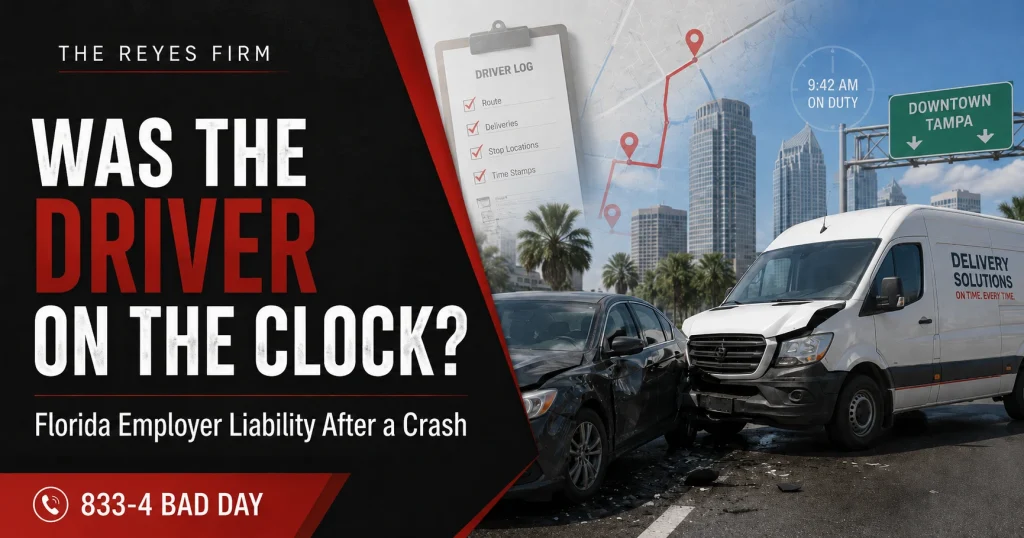
In Florida, you can find out whether a driver was on the clock by reviewing the crash report, vehicle ownership, insurance details, route data, dispatch records, GPS or telematics records, time sheets, and employer policies. The key issue is whether the driver was acting within the scope of their work.
Key Takeaways
- The police report is a starting point, but it may not tell the full story.
- A company logo, uniform, delivery app, work truck, or commercial insurance policy can be an early clue.
- Dispatch logs, GPS data, telematics records, time sheets, and delivery records may show whether the driver was working.
- An attorney can send preservation letters quickly so important records are not deleted or overwritten.
- If a lawsuit becomes necessary, records may be obtained through discovery or subpoenas.
- Whether the driver was “on the clock” may affect whether an employer, vehicle owner, or commercial insurance policy is a party to the claim.
Why This Question Matters After a Tampa Crash
After a crash, one of the most important questions is simple: Was the driver working when they hit you?
That answer can change the direction of the entire injury claim. If the driver was doing work for an employer, making a delivery, traveling between job sites, or driving a company vehicle for business purposes, the claim may involve more than the driver’s personal auto insurance.
This comes up often in Tampa and Hillsborough County, especially along I-4, I-75, I-275, Brandon, Riverview, Plant City, Seffner, Gibsonton, Apollo Beach, Ruskin, Wimauma, Lithia, and Palm River. Work trucks, delivery vans, rideshare vehicles, construction vehicles, and company cars are on the road every day.
If a work vehicle, delivery van, company car, or commercial truck caused your crash, our Commercial Vehicle Accident Lawyer Tampa page explains how these cases are investigated and what evidence may matter.
Finding out whether the driver was on the clock early can help preserve evidence, identify the right insurance coverage, and determine whether an employer or vehicle owner may be legally responsible.
How Do You Find Out If the Driver Was Working?
Start with the crash report, but do not stop there.
The police report may list a company name, commercial vehicle information, insurance details, vehicle ownership, or notes about the driver’s job. It may also mention a logo, a work van, a delivery vehicle, or other details observed at the scene.
However, the crash report is usually only the beginning. It may not include the driver’s schedule, route, job assignment, app activity, or internal company records.
Records That May Show the Driver Was On the Clock
Evidence | What It May Show |
| Police crash report | Company name, vehicle owner, insurance information, or commercial vehicle details |
Vehicle registration | Whether the vehicle was owned by a company, employer, or commercial fleet |
| Insurance documents | Whether a personal or commercial policy may apply |
Dispatch records | Whether the driver had an active job, delivery, or service call |
| GPS or telematics data | Where the vehicle was before, during, and after the crash |
Delivery app records | Whether the driver was logged in, assigned a route, or completing an order |
| Time sheets or payroll records | Whether the driver was clocked in or being paid at the time |
Employer vehicle policies | Whether the driver was authorized to use the vehicle |
| Phone records or work messages | Whether the driver was communicating with a supervisor, dispatcher, or customer |
Witness photos or videos | Company logos, uniforms, cargo, tools, or work-related activity |
If the company will not voluntarily provide these records, an attorney can send a preservation letter and, if litigation becomes necessary, seek records through discovery or subpoenas.
Why Does It Matter Whether the Driver Was On the Clock?
It matters because the claim may involve employer liability.
Under the legal doctrine commonly called respondeat superior, an employer may be responsible for an employee’s negligence when the employee was acting within the course and scope of employment. In plain English, that means the company may be responsible if the driver was doing work for the company when the crash happened.
Florida also recognizes the dangerous instrumentality doctrine, which can make a vehicle owner responsible when they allow someone else to drive their vehicle, and that driver causes a crash. In a crash involving a company vehicle, this may raise questions about both the driver and the vehicle owner.
This does not mean every crash involving a work vehicle automatically creates employer liability. The facts matter. A driver may be in a company vehicle but still using it for a personal errand. A driver may also be in a personal vehicle but still performing work duties.
The issue is not just whether the driver had a job. The issue is whether the driver was acting for the employer at the time of the crash.
Florida Commercial Vehicle Crash Context
Commercial and work vehicles are a major part of Florida traffic. FLHSMV’s 2024 By the Numbers report recorded 46,651 commercial motor vehicle crashes and 315 fatalities involving commercial motor vehicle crashes. The report also notes that the 2024 crash numbers were preliminary.
For injured people and families, those numbers matter because commercial vehicle cases often involve evidence that regular car accident claims do not. That may include driver logs, GPS data, company safety policies, maintenance records, hiring records, and commercial insurance coverage.
⚠️ WARNING: Florida’s Filing Deadline
Florida generally gives injured people two years to file a negligence lawsuit after a crash. The deadline usually starts on the date of the crash, not the date treatment ends. Some cases may have different deadlines, especially if a government vehicle, workers’ compensation issue, or wrongful death claim is involved.
What If the Employer Says the Driver Was Off the Clock?
That is a common defense.
An employer may argue that the driver was on a personal errand, off the assigned route, commuting, or engaged in something unrelated to work. In some cases, this is called a “frolic and detour” issue.
The difference can be important:
| Situation | Why It Matters |
| The driver was making a delivery | May support employer liability |
| The driver was traveling between job sites | May support employer liability |
| The driver was driving to a customer appointment | May support employer liability |
| The driver was commuting to or from work | Employer liability may be harder to prove |
| The driver made a short work-related stop | May still support employer liability |
| The driver took a long personal detour | The employer may argue that the driver was outside the scope of work |
This is why records matter. GPS data, dispatch records, text messages, delivery app logs, and time sheets may indicate whether the driver was still performing work duties or had stepped outside the scope of the job.
💡 DID YOU KNOW?
A driver can be in a company vehicle and still not be acting within the scope of work. The opposite can also be true. A driver may be in a personal vehicle but still performing job duties. That is why dispatch logs, GPS data, delivery app records, time sheets, and employer policies matter.
Does It Matter If the Driver Was an Employee or an Independent Contractor?
Yes, but the label alone does not always answer the question.
A company may classify a driver as an independent contractor, especially in delivery, courier, rideshare, and gig work. But courts and insurers may look deeper than the label. Important facts can include who controlled the driver’s schedule, route, equipment, work rules, branding, and customer assignments.
Questions that may matter include:
- Did the company control the driver’s route?
- Did the company require a uniform, logo, or branded vehicle?
- Did the company provide the vehicle or equipment?
- Did the company track the driver through an app or GPS system?
- Did the company control pricing, assignments, or customer communication?
- Was the driver free to accept other work?
- Was the driver performing a core service for the company?
These cases are fact-specific. A 1099 label does not automatically protect a company from every claim, and a W-2 label does not automatically prove liability in every crash.
🛡️ YOUR RIGHTS:
Under Florida’s modified comparative fault rule, you may still be able to recover damages if you were partly at fault, as long as you were not found more than 50 percent responsible. Any recovery may be reduced by your percentage of fault.
What if the driver were in a Company Vehicle?
A company vehicle is a strong clue, but it is not the final answer.
A company car, delivery van, pickup truck, box truck, or work vehicle may point to employer involvement. However, you still need to know why the driver was using the vehicle at that time.
Important questions include:
- Who owned the vehicle?
- Who insured the vehicle?
- Was the driver allowed to use it?
- Was the driver working when the crash happened?
- Was the driver following company policy?
- Was the driver carrying tools, cargo, equipment, food, packages, or work materials?
- Was the driver traveling to a job site, a delivery location, a customer appointment, or a company facility?
If the vehicle was owned by a company, there may also be commercial insurance coverage. Commercial insurance can be important in serious injury cases because medical bills, lost income, future care, and long-term damages may exceed the limits of a personal auto policy.
What if the driver were using their personal car for Work?
Employer liability may still be possible.
Many workers use their own cars for deliveries, errands, sales calls, home health visits, repairs, inspections, customer meetings, and other job duties. If the driver was using a personal vehicle to perform work, the employer may still be part of the investigation.
Examples may include:
- Food delivery drivers
- Package delivery drivers
- Sales representatives
- Home health workers
- Contractors traveling between job sites
- Employees running company errands
- Rideshare drivers logged into an app
- Workers transporting supplies or equipment
The key question is whether the driver was acting on behalf of the employer or business at the time of the crash.
Florida Laws That May Affect a Driver-On-the-Clock Accident Claim
Several Florida laws and legal doctrines may affect these cases.
Florida Statute § 95.11: Time Limit for Negligence Claims
Florida Statute § 95.11 generally gives injured people two years to file a negligence lawsuit. Current Florida law lists “an action founded on negligence” under the two-year limitations period.
This deadline is important because evidence can disappear long before the legal deadline arrives. GPS data, dashcam footage, surveillance video, app activity, and dispatch records may be quickly deleted or overwritten.
Florida Statute § 768.81: Comparative Fault
Florida uses a modified comparative fault rule. If an injured person is found partly at fault, their recovery may be reduced by their percentage of fault. If they are found to be greater than 50 percent at fault, they may not recover damages under the statute.
Insurance companies may try to shift blame by arguing that the injured person was speeding, distracted, or failed to avoid the crash. Evidence from the work vehicle may help respond to those arguments.
Florida Workers’ Compensation Issues
If you were working when the crash happened, your own employer’s workers’ compensation coverage may also be involved. Florida Statute § 440.11 generally makes workers’ compensation the exclusive remedy against an injured worker’s own employer, subject to limited exceptions.
That does not necessarily stop you from bringing a separate third-party claim against the driver, the driver’s employer, the vehicle owner, or another responsible party.
Florida Government Vehicle Claims
If the driver worked for a city, county, state agency, public school district, or other government entity, special notice rules and limits may apply under Florida Statute § 768.28. That statute includes written notice requirements for claims against the state, its agencies, and subdivisions.
Government vehicle cases should be reviewed quickly because the rules differ from those for ordinary private company claims.
What Should You Do Right After the Crash?
Get medical care first. Your health and safety matter most.
After that, try to preserve anything that may show the driver was working. If you can do so safely, take photos of the vehicle, company logo, license plate, driver uniform, cargo, tools, delivery bags, app screens, or anything else that looks work-related.
You should also:
- Get the police report number.
- Save all crash photos and videos.
- Write down witness names and contact information.
- Keep medical records and billing information.
- Save repair estimates and rental car receipts.
- Avoid guessing about the fault.
- Avoid giving a detailed recorded statement to the employer’s insurance company before getting legal guidance.
- Contact an attorney quickly if a company, commercial vehicle, or work driver may be involved.
📌 EVIDENCE TIP:
GPS data, dashcam footage, delivery app logs, dispatch records, and surveillance video can disappear quickly. If a work vehicle or company driver may be involved, it is important to preserve evidence as early as possible.
How The Reyes Firm Can Help
If you were injured in a crash with a driver who may have been working, The Reyes Firm can help you understand your options.
These cases can involve employment records, commercial insurance policies, vehicle ownership questions, GPS data, dispatch records, delivery app activity, company vehicle policies, and multiple possible defendants.
The Reyes Firm can help investigate:
- Whether the driver was on the clock
- Whether the driver was acting within the course and scope of work
- Whether a company vehicle was involved
- Whether the vehicle owner may be responsible
- Whether commercial insurance may apply
- Whether the company failed to properly hire, train, supervise, or retain the driver
- Whether important evidence needs to be preserved immediately
The goal is to identify every responsible party and every available source of recovery, while helping you avoid unnecessary communication with insurance companies.
No attorney can guarantee an outcome. Every case depends on the facts, evidence, insurance coverage, injuries, and applicable law.
Frequently Asked Questions
How can I tell if the driver who hit me was working?
Start with the police report, vehicle ownership, insurance information, company logos, uniforms, cargo, and witness statements. Then look for dispatch records, GPS data, delivery app logs, time sheets, and employer policies. An attorney can help preserve these records and request them.
Is the employer automatically responsible if the driver was in a company vehicle?
Not automatically. A company vehicle is an important clue, but the key question is whether the driver was acting within the scope of their work. If the driver was using the vehicle for a personal errand, the employer may dispute liability.
What if the police report does not mention a company?
That happens often. The report may miss employment details. Vehicle registration, insurance records, photos, app data, witness statements, and company records may still show that the driver was working.
Can I sue the driver’s employer after a crash in Florida?
You may be able to bring a claim against the employer if the driver was acting within the course and scope of employment or if another theory of liability applies. These cases are fact-specific and should be reviewed by a Florida personal injury attorney.
Can I sue the insurance company directly?
In many Florida injury cases, the lawsuit names the driver, employer, vehicle owner, or other responsible parties rather than naming the liability insurer directly. Insurance still matters because applicable policies may fund a settlement or judgment.
What if the driver were an independent contractor?
The contractor label does not always end the analysis. The extent of the company’s control over the driver’s work, route, schedule, equipment, branding, and assignments may matter. These cases require a closer look at the actual working relationship.
What if the driver was commuting?
A normal commute usually makes employer liability harder to prove. However, exceptions may apply if the driver was traveling between job sites, carrying out a work assignment, transporting tools or materials, or performing a task for the employer.
What if the driver was drunk while working?
The facts matter. If the driver was acting within the course and scope of employment, employer liability may still be investigated. If the employer knew or should have known about unsafe driving risks, negligent hiring, retention, or supervision may also be reviewed.
How quickly should I act?
As soon as possible. GPS data, dashcam footage, dispatch records, app logs, surveillance video, and vehicle data may be deleted or overwritten. A preservation letter can help protect evidence before it disappears.
How long do I have to file a Florida negligence lawsuit?
Florida Statute § 95.11 generally gives injured people two years to file a negligence lawsuit. Different deadlines may apply in special cases, including claims involving government vehicles or workers’ compensation issues.

Edward Reyes, Esq., is the founder of The Reyes Firm, a Tampa-based personal injury law firm. He is admitted to practice law in Florida and handles personal injury matters, including car accidents, commercial vehicle crashes, employer liability issues, and serious injury claims throughout Tampa Bay and Hillsborough County.
Read more about Edward Reyes.
How Can The Reyes Firm Help You?
If you were injured in a crash with a driver who may have been working, The Reyes Firm can help you understand your options.
These cases can involve employment records, commercial insurance, company vehicle policies, GPS data, dispatch records, and multiple possible defendants.
The Reyes Firm can help investigate whether the driver was on the job, whether a company vehicle was involved, and whether an employer, vehicle owner, or commercial insurance policy may be part of the claim.
Free consultations are available. Attorney’s fees, costs, and case expenses are explained in the written fee agreement before representation begins.
Had a bad day? Call The Reyes Firm.
📍 Address: 4730 N. Habana Ave., Suite 201, Tampa, FL 33614
📞 Phone: 833-4 BAD DAY
🌐 Website: Schedule your free consultation today
Legal Disclaimer: This article is for general informational purposes only and does not constitute legal advice. Every crash involves different facts, and the outcome of an employer liability claim depends on the specific evidence, insurance coverage, injuries, and applicable Florida law. Reading this page does not create an attorney-client relationship with The Reyes Firm. Contact a licensed Florida attorney to discuss your specific situation.