What You Need to Know
- Medical records help connect the accident, your symptoms, your diagnosis, and your treatment.
- Neurological and cognitive testing may document problems with memory, concentration, learning, and problem-solving.
- Family members, coworkers, and friends can describe specific changes they noticed after the accident.
- Accident evidence helps connect the force or event that caused the injury to your traumatic brain injury.
- Work records and qualified experts may help document lost income, reduced earning ability, future care, and long-term limitations.
Had a bad day? Call The Reyes Firm at 833-4 BAD DAY.
If you are trying to prove a traumatic brain injury after an accident in Tampa, you may be dealing with an injury other people cannot easily see. You may have headaches, memory problems, trouble focusing, personality changes, fatigue, or difficulty doing work that once felt routine.
A serious TBI claim usually cannot rest on one medical note or one test. You need a clear record showing what happened, when symptoms began, how doctors evaluated you, and how your life changed after the accident.
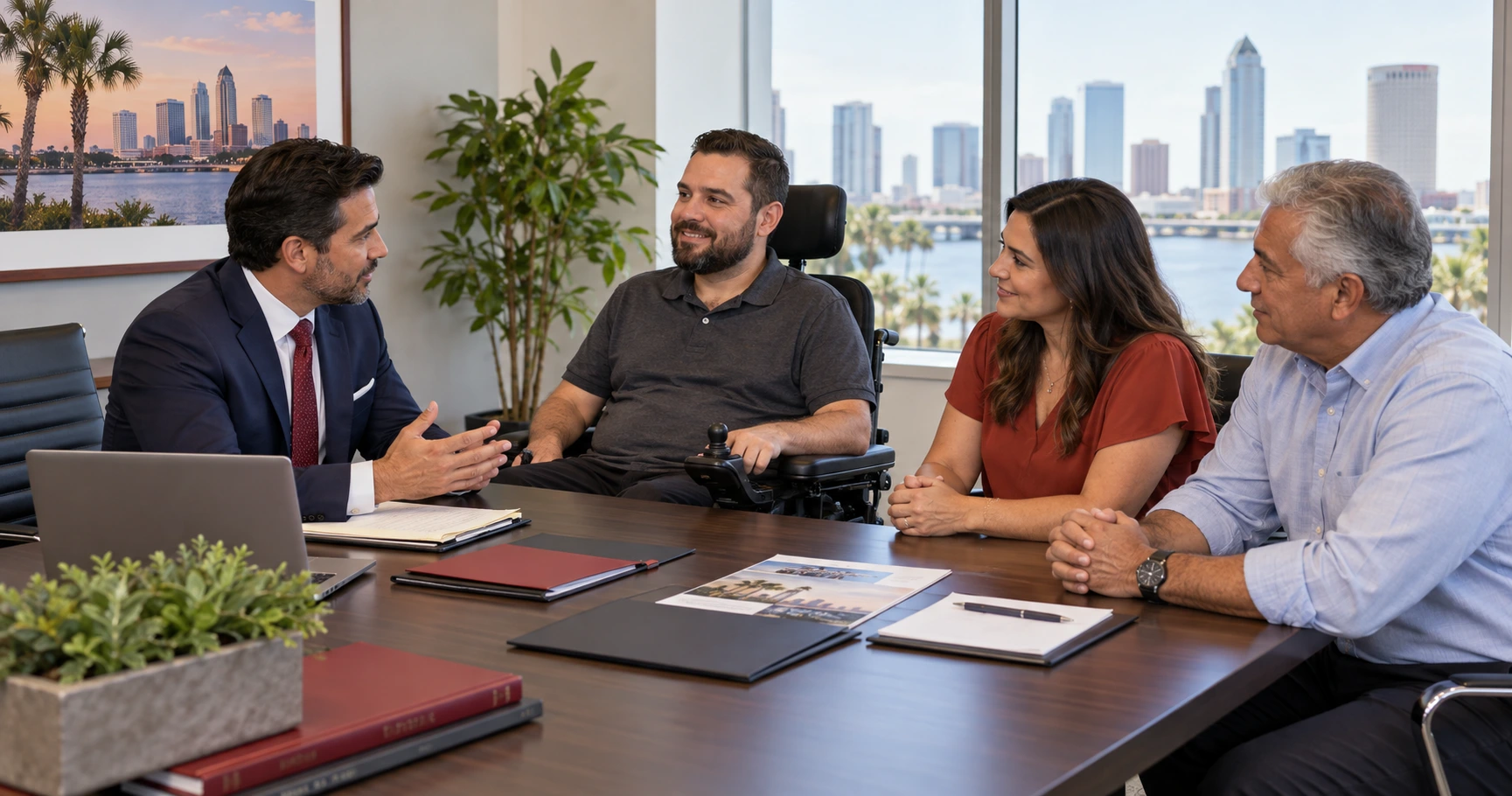
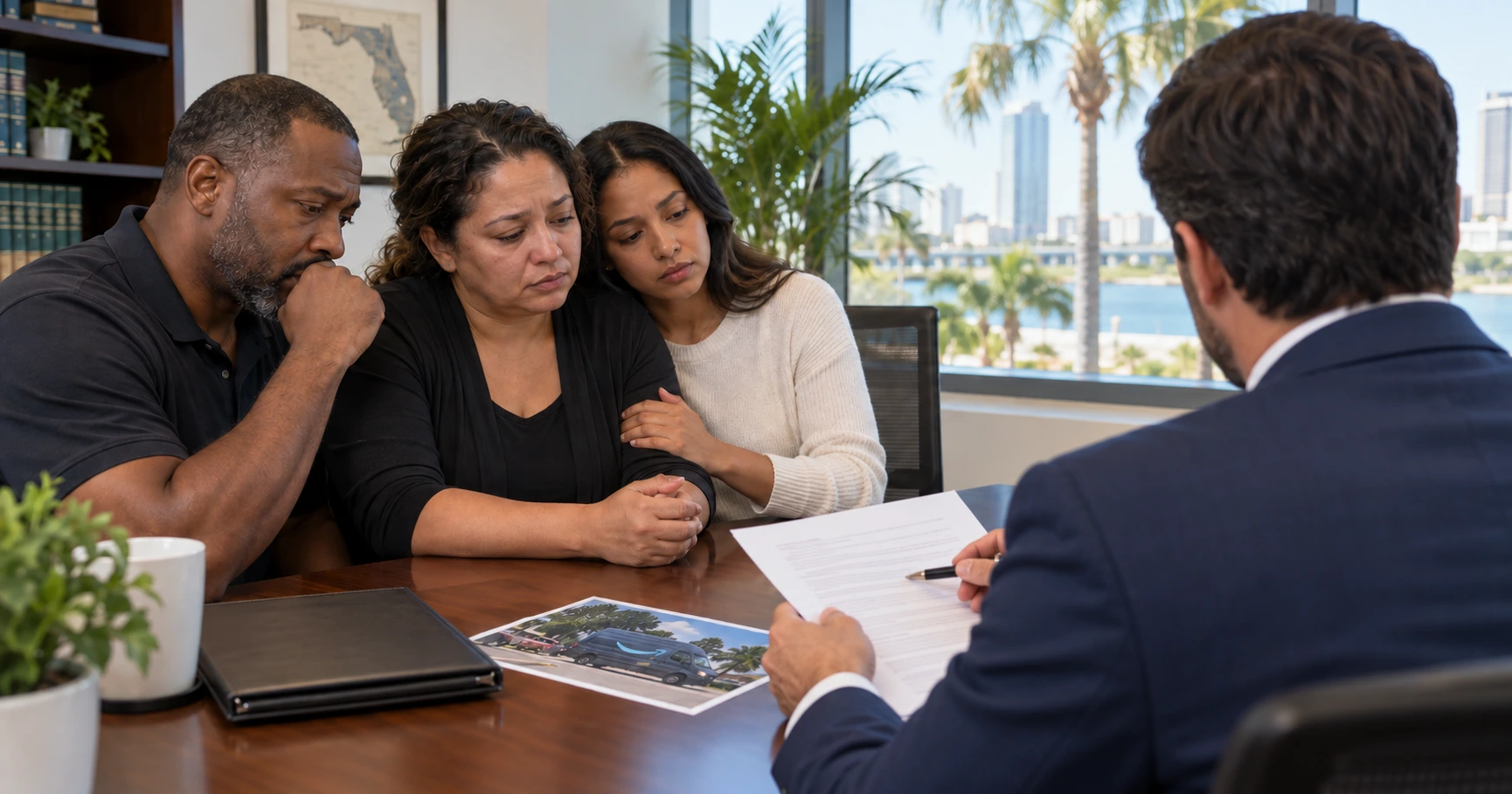
A Tampa traumatic brain injury lawyer can help organize that evidence and identify gaps before an insurance company uses them to challenge your claim.
What Medical Evidence Can Prove a Traumatic Brain Injury?
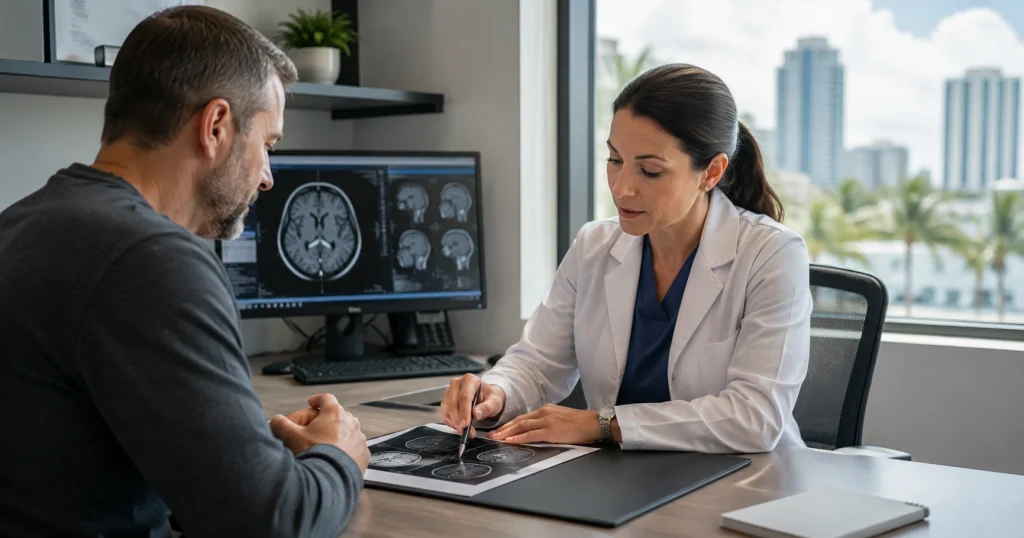
Medical records are usually the foundation of a TBI claim because they connect the accident, symptoms, diagnosis, treatment, and future limits over time. Strong proof may include emergency records, follow-up visits, specialist notes, imaging when ordered, medication history, rehabilitation records, and clear documentation of changes in memory, balance, mood, sleep, or concentration.
The goal is to build a medical timeline.
Depending on your care, useful records may include:
- Emergency room or urgent care records
- Primary care and specialist notes
- Neurology or rehabilitation evaluations
- CT, MRI, or other imaging reports when ordered
- Physical, occupational, or speech therapy records
- Prescription and medication records
- Records documenting ongoing symptoms and restrictions
Consistency matters. A record that follows your symptoms from the accident through treatment can help explain how the injury developed and how it continues to affect you.
Your medical history also matters. If you had a prior concussion, migraine condition, memory issue, or other neurological problem, that history should be addressed rather than ignored. The question is what changed after this accident.
⚠️ Warning: Florida Deadlines Can Affect Your TBI Case
Florida Statute § 95.11 generally gives a person two years to file an action founded on negligence. Different deadlines or notice rules can apply to medical negligence, government claims, wrongful death, and other situations. The lawsuit deadline also does not stop video, witness memories, or other evidence from disappearing sooner. See Florida Statute § 95.11.
Can Neurological and Cognitive Testing Help Prove a TBI?
Neurological, neuropsychological, and neurocognitive testing can help document how a brain injury affects thinking, memory, concentration, problem-solving, and daily function. These tests do not replace a doctor’s diagnosis, but they can add structure to symptoms that may be hard to see from the outside, especially when cognitive changes affect work or independence.
The CDC explains that healthcare providers may evaluate learning, memory, concentration, and problem-solving after a mild TBI. Neuropsychological or neurocognitive tests may help identify the injury’s effects.
Testing may help document problems involving:
- Short-term or long-term memory
- Attention and concentration
- Processing speed
- Learning new information
- Problem solving
- Planning and organization
View test results alongside the rest of the medical record. A TBI claim should not be reduced to one score.
Doctors may also compare test findings with your education, work history, prior medical history, reported symptoms, and daily functioning. That broader picture can be especially useful when your main problems involve thinking, communication, or behavior rather than an obvious physical injury.
How Can Family, Friends, and Coworkers Help Prove a Brain Injury?
Family members, friends, coworkers, and supervisors can help show what changed after the accident. Their observations may document memory lapses, slower thinking, mood changes, missed responsibilities, fatigue, confusion, or new work problems. This testimony is strongest when it gives specific before-and-after examples and matches the medical and employment record.
Someone who lives with you may notice changes that never appear during a short medical appointment.
Useful observations may include:
- Forgetting appointments, conversations, or familiar tasks
- Getting confused while driving or following directions
- Needing more help with bills, meals, or household responsibilities
- Becoming unusually irritable, withdrawn, or emotionally reactive
- Struggling to follow conversations or complete several steps in order
- Sleeping much more or much less than before the accident
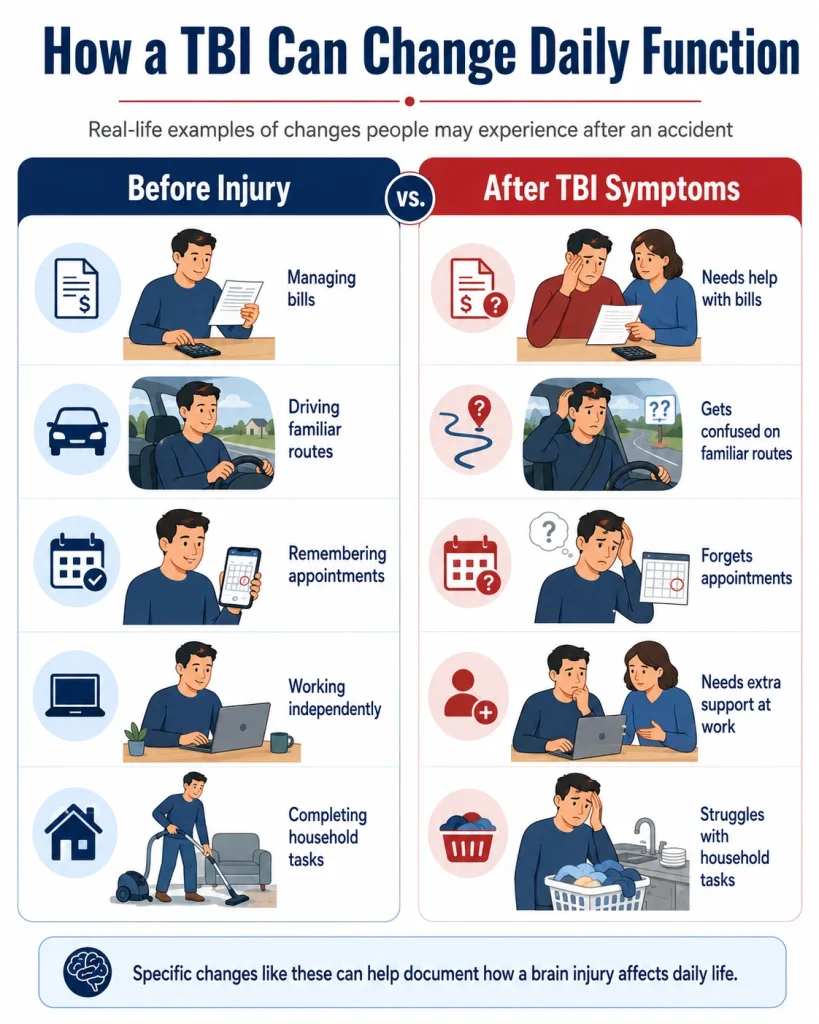
Specific examples are more useful than general statements.
Saying, “He changed after the crash,” tells only part of the story.
Explaining that you handled the family finances before the accident but now forget payments, repeat transactions, or need another person to review the accounts gives a much clearer picture of functional change.
Coworkers can provide similar evidence. A supervisor may notice slower work, repeated instructions, missed deadlines, or duties you can no longer perform safely.
What Accident Evidence Connects a TBI to a Tampa Accident?
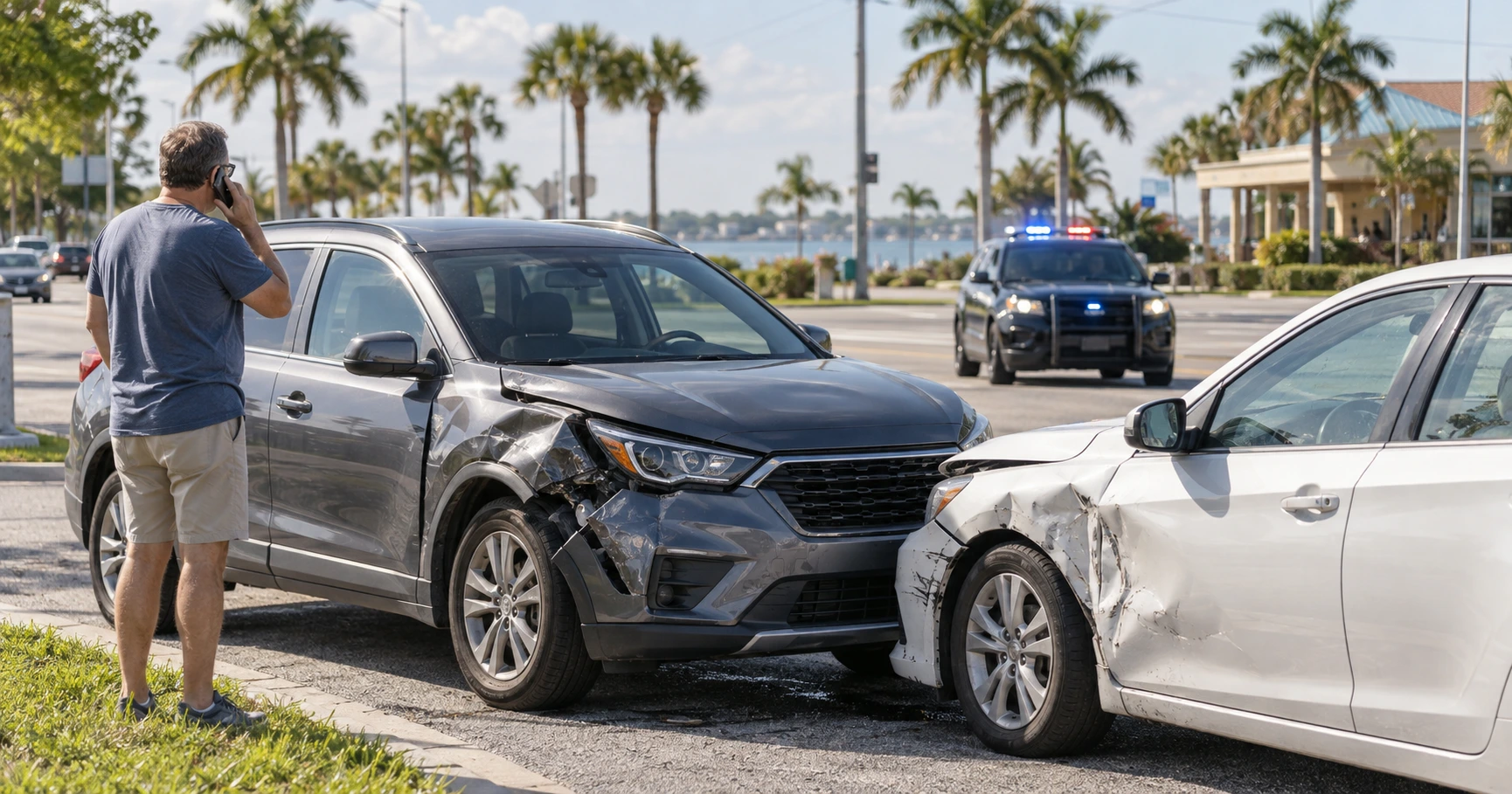
Accident evidence helps connect the TBI to the event that caused it. Depending on the case, useful proof may include crash reports, photos, video, witness statements, vehicle damage, event data, property records, incident reports, or other physical evidence. The goal is to show how the accident happened and why the injury is linked to it.
Not every traumatic brain injury comes from a motor vehicle crash. TBIs can also follow falls and other serious incidents.
For a Tampa vehicle collision, evidence may include:
- Crash scene photographs
- Vehicle damage photographs
- Dashcam or surveillance video
- Witness statements
- Police or Florida crash reports
- Electronic vehicle information when available
- Records showing the timing of emergency medical care
A serious crash on I-275, I-4, or another Tampa roadway may involve evidence held by drivers, businesses, government agencies, or vehicle owners. Some records can become harder to obtain as time passes.
💡 Did You Know?
In 2024, Florida recorded an age-adjusted traumatic brain injury death rate of 19.7 per 100,000 people, according to the Florida Department of Health. This statewide rate includes TBIs from multiple causes. TBI can have serious and lasting effects, which is why documenting symptoms, treatment, and changes in daily function can be important after an accident.
This Florida statistic includes traumatic brain injuries from multiple causes and is not limited to motor vehicle crashes. It does not prove an individual claim, which still requires evidence tied to your accident, medical condition, and losses.
How Do Work Records and Experts Show the Long-Term Effects of a TBI?
Work records and qualified experts can show how a TBI affects earning ability, future care, and independence. Pay records, attendance history, job evaluations, restrictions, and vocational evidence may show losses that medical bills alone cannot capture. In serious cases, medical, rehabilitation, vocational, economic, or life-care experts may help explain long-term needs.
A traumatic brain injury can affect work even when you return to the same job.
Evidence may include:
- Pay records showing missed time or reduced hours
- Employer records showing changed duties or accommodations
- Performance reviews from before and after the accident
- Medical restrictions affecting job tasks
- Records of lost promotions, overtime, or career opportunities
- Vocational analysis when future work ability is disputed
Past lost wages and reduced future earning ability are different losses.
Past wages look backward at income you already missed. Reduced earning capacity looks at what the injury may prevent you from earning in the future.
For a permanent or severe injury, catastrophic injury compensation in Florida may involve future medical treatment, reduced earning capacity, rehabilitation, assistance, and other supported losses.
A life care plan after a catastrophic injury may also help document future treatment, therapy, equipment, medication, home support, and other needs when the medical evidence supports them.
No single expert is required in every case. The experts used should fit the disputed medical, vocational, financial, or accident issues.
🛡️ Your Rights Under Florida Law: If your TBI resulted from a motor vehicle crash, Florida Statute § 627.737 can affect a claim for pain, suffering, mental anguish, and inconvenience. The law allows those damages in covered cases when the injury meets specific thresholds, including a significant permanent loss of an important bodily function or a permanent injury within a reasonable degree of medical probability. Medical proof of permanency can therefore become a major issue in a serious TBI claim.
What Can Make a Traumatic Brain Injury Claim Harder to Prove?
TBI claims become harder when the record has long treatment gaps, an unclear symptom history, conflicting statements, missing work proof, or weak evidence connecting the accident to the injury. Those problems do not automatically defeat a claim. They do give an insurer more room to question causation, severity, permanence, and the amount of loss.
Common evidence problems include:
- Long gaps between medical visits
- Important symptoms missing from early records
- Different descriptions of symptoms in different records
- Prior head injuries that are not clearly addressed
- Missing employment or wage documentation
- Accident video or witness information that was not preserved
Do not try to hide a prior concussion or medical condition. A clear medical history can help doctors and lawyers separate your baseline condition from new or worsened problems after the accident.
Be careful with social media, too. A photograph or short video rarely shows the full effect of a brain injury, but an insurer may still try to use online posts to question your limitations.
If you are deciding who should investigate a complicated brain injury case, our guide to choosing a catastrophic injury lawyer in Tampa explains what to ask about evidence preservation, experts, long-term damages, communication, and trial preparation.
How The Reyes Firm Handles Your Traumatic Brain Injury Case
The Reyes Firm approaches a serious TBI claim by building the medical, accident, work, and daily-life evidence together. We move quickly to protect available proof, identify insurance and responsible parties, document long-term losses, and prepare the case around the specific injury. A serious brain injury should not be treated like a routine claim.
A Tampa catastrophic injury lawyer should understand that the effects of a brain injury may reach far beyond the first hospital bill.
Here is how The Reyes Firm approaches a serious TBI case:
- We listen first. We learn what happened, what symptoms you are dealing with, what your doctors are saying, and what your family has noticed.
- We investigate quickly. We gather accident reports, photographs, video, witness information, incident records, and other available evidence.
- We build the medical timeline. We organize treatment records, testing, diagnoses, rehabilitation, restrictions, and information about future medical needs.
- We document real-life changes. We look at work problems, lost income, household limitations, cognitive changes, family responsibilities, and loss of independence.
- We involve qualified experts when appropriate. The case may require medical, neuropsychological, vocational, economic, rehabilitation, or life-care analysis.
- We handle insurance communications. We address requests, coverage issues, claim disputes, and efforts to minimize the injury while keeping you informed in plain English.
- We prepare serious cases with trial in mind. Not every case goes to trial, but organized evidence and early preparation can matter during negotiation and litigation.
The Reyes Firm helps injured people throughout Tampa and the South Shore communities.
Serving Tampa, Riverview, Brandon, Plant City, and communities across Hillsborough County.
The Reyes Firm
4730 N. Habana Ave., Suite 201
Tampa, FL 33614
833-4 BAD DAY
thereyesfirm.com
Had a bad day? Call The Reyes Firm at 833-4 BAD DAY.
Frequently Asked Questions About Proving a Traumatic Brain Injury in Tampa
Can I prove a TBI if my brain imaging was normal?
A scan is only one part of a TBI evaluation. The CDC explains that mild TBI assessment can also involve symptoms and neuropsychological or neurocognitive testing of areas such as memory, learning, concentration, and problem-solving.
Your doctors should decide which tests are medically appropriate. A legal claim should be evaluated from the full medical and functional record.
Do I need a neurologist to prove a traumatic brain injury?
Not every TBI claim follows the same medical path. Your treating healthcare providers should determine which specialists and tests fit your symptoms.
From a legal perspective, specialist records can be useful when diagnosis, prognosis, cognitive impairment, or permanency is disputed.
Can my spouse or family members help prove my brain injury?
Yes, their observations may help document changes in memory, mood, communication, independence, and daily responsibilities. Their testimony is usually stronger when they describe specific changes rather than making broad statements.
Medical and employment records can provide additional support.
What if I had a concussion before my Tampa accident?
A prior concussion does not automatically prevent you from bringing a claim for a new injury or a worsening of an existing condition. The medical record should clearly address your condition before the accident and what changed afterward.
Do not hide prior treatment. Accurate history helps qualified medical professionals evaluate the difference.
How long do I have to file a TBI lawsuit in Florida?
Florida Statute § 95.11 generally provides a two-year period for actions founded on negligence. Other claims can have different deadlines or special notice requirements.
Evidence can become harder to recover long before that filing deadline, so early investigation may still matter.
Can I have a TBI claim if I went back to work?
Returning to work does not by itself answer how serious an injury is. You may still have reduced hours, accommodations, slower performance, missed advancement, or limits on the work you can safely perform.
You need reliable medical and employment evidence to prove those losses.
How soon should I contact a Tampa traumatic brain injury lawyer?
Consider getting legal guidance early when symptoms are serious, work is affected, fault is disputed, or important evidence may need to be preserved. Early review can help identify medical, accident, insurance, employment, and witness records that may matter later.
A consultation also gives you a chance to understand the process before making major decisions with an insurer.

Edward Reyes, Esq., is admitted to The Florida Bar. He focuses his personal injury practice on helping people hurt in serious Florida accidents, including cases involving traumatic brain injuries and other catastrophic harm. He helps injured people and families understand evidence, insurance issues, long-term losses, and the legal steps that may follow a life-changing injury.
How Can The Reyes Firm Help You?
If you’ve had a bad day — a car accident, a slip and fall, a trucking crash, or any injury that wasn’t your fault — The Reyes Firm is in your corner. Our
Tampa personal injury attorneys
offer free consultations and work on a contingency fee basis, which means you pay us nothing unless we win your case.
You shouldn’t have to fight the insurance companies alone. Let us fight for you.
📍 4730 N. Habana Ave., Suite 201, Tampa, FL 33614
Had a bad day? Call The Reyes Firm. We’ll handle the rest.
This article provides general information and is not legal advice. Reading it does not create an attorney-client relationship with The Reyes Firm or Edward Reyes, Esq. Past results do not guarantee a similar outcome. Every traumatic brain injury case involves different facts, medical evidence, insurance coverage, deadlines, and legal issues. Speak with a qualified Florida attorney about your circumstances.