What You Need to Know
- A rear-end truck accident can happen when a commercial truck strikes a smaller vehicle or when a passenger vehicle hits the back of a truck or trailer.
- The driver in the back is not automatically the only person who may be responsible.
- Truck data, electronic logs, maintenance records, dispatch messages, videos, and physical evidence may help explain what happened.
- A driver, motor carrier, maintenance company, cargo business, manufacturer, or another motorist may share liability.
- Florida generally allows two years to file a negligence lawsuit, but important trucking evidence may disappear much sooner.
Had a bad day? Call The Reyes Firm at 833-4 BAD DAY ((833) 422-3329).
A rear-end truck crash can leave you trying to make sense of several things at once. You may be in pain, your car may be badly damaged, and an insurance company may already be asking for a statement before you know the full extent of your injuries.
These crashes are not always simple. A commercial truck may hit stopped traffic, a smaller vehicle may strike a trailer that was hard to see, or one impact may set off a chain reaction. The location of the damage does not always tell the complete story.
A Riverview rear-end truck accident lawyer can investigate how the vehicles moved, why the truck did not stop or why the crash could not be avoided, and whether a driver, trucking company, maintenance provider, cargo business, or another party contributed to the crash.
What Is a Rear-End Truck Accident?
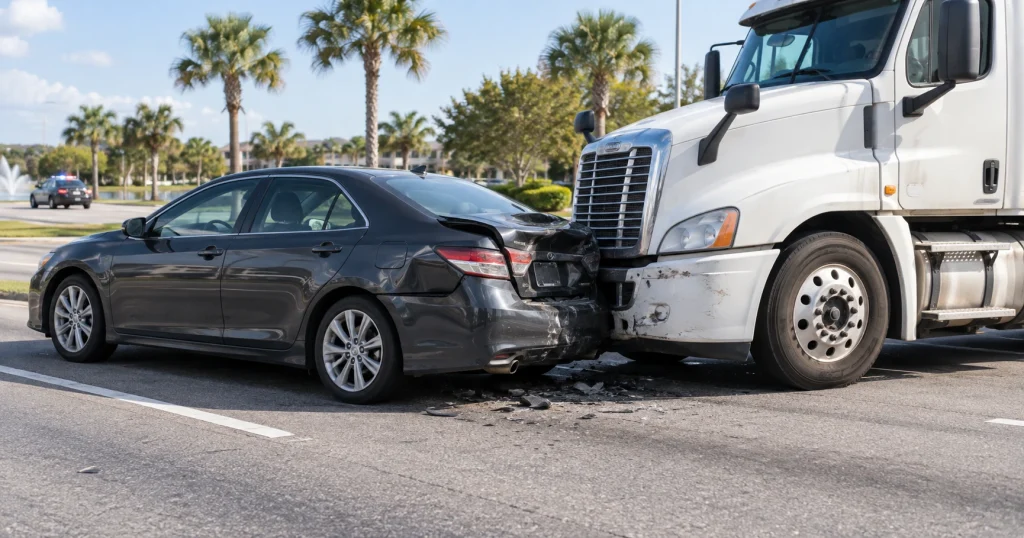
A rear-end truck accident is a collision in which the front of one vehicle strikes the back of a commercial truck, trailer, or another vehicle. The phrase covers several different crash patterns, and those differences matter when determining fault.
When a Commercial Truck Strikes a Smaller Vehicle
This often happens when traffic slows or stops, and the truck does not have enough distance to brake. Investigators may examine speed, following distance, driver attention, fatigue, cargo weight, road conditions, and the condition of the brakes and tires.
When a Smaller Vehicle Strikes a Truck or Trailer
The following driver may appear responsible at first. However, the investigation should also ask why the truck was in that position and whether it was reasonably visible.
Defective brake lights, missing reflective markings, an unsafe stop, a damaged rear underride guard, or a trailer entering the roadway without enough clearance may affect liability.
When Several Vehicles Are Involved
A truck may strike the final car in a line of stopped traffic and push it into other vehicles. Another driver may also cause the sudden stop or unsafe lane change that started the sequence.
Damage patterns, videos, witness statements, and vehicle data may be needed to determine the order of impacts.
A truck that turns sideways during the sequence can block several lanes. Learn more about jackknife truck accidents and why these crashes often involve more than one vehicle.
Why Can a Rear-End Truck Accident Cause Severe Injuries?
A commercial truck is much heavier and taller than a passenger vehicle. When that weight moves into a smaller car, the force can crush the rear of the vehicle, push it into traffic, or cause a second collision. People in the smaller vehicle often face the greatest risk.
Large trucks also need more time and space to stop. Speed, cargo weight, wet pavement, road grade, brake condition, and tire condition can all increase the distance needed.
The Federal Motor Carrier Safety Administration advises commercial drivers traveling below 40 mph to leave at least one second for every 10 feet of vehicle length. A typical tractor-trailer may need about four seconds, with another second added above 40 mph and more space in poor conditions.
💡 Did You Know? In a nationwide study of serious large-truck crashes, federal researchers found that 23.1% of the large trucks involved were in rear-end collisions. About 13% were the striking vehicle, including trucks that hit stopped, slower-moving, or decelerating vehicles. The study examined fatal and injury crashes investigated from 2001 through 2003.
What Can Cause a Rear-End Truck Crash in Riverview?
A rear-end truck crash usually involves more than one factor. The driver may have made a mistake, but company decisions, vehicle condition, cargo, or another road user may also have contributed.
Possible causes include:
- Following too closely or driving too fast for traffic
- Phone use, in-cab distraction, or failure to watch the road
- Fatigue or driving beyond safe limits
- Worn, defective, or poorly adjusted brakes
- A tire failure or another mechanical problem
- Overloaded or unevenly distributed cargo
- Rain, darkness, construction, or limited visibility
- Unsafe lane changes or merges by the truck or another vehicle
- A truck or trailer stopped in an unsafe location
- Defective lights, reflectors, or warning equipment
A lane change before impact may require a separate look at the truck’s no-zones. Our guide to truck blind-spot accidents explains how visibility limits can affect fault.
If a tire failed before the crash, maintenance and product records may become important. Read more about truck tire blowout accidents.
Who May Be Liable for a Riverview Rear-End Truck Accident?
A driver, company, contractor, manufacturer, or another motorist may be legally responsible. Some crashes involve several businesses and insurance policies, so the name printed on the truck may not identify everyone connected to the trip.

| Potential party | Conduct and evidence to investigate |
|---|---|
| Truck driver | Speed, following distance, distraction, fatigue, impairment, lane movement, and pre-trip inspections |
| Motor carrier | Hiring, training, supervision, dispatch pressure, safety practices, and driving-hour monitoring |
| Tractor or trailer owner | Vehicle condition, inspections, repairs, leases, and responsibility for maintenance |
| Maintenance provider | Work performed on brakes, tires, lights, steering, and warning systems |
| Cargo loader or shipper | Cargo weight, balance, placement, securement, and loading instructions |
| Parts manufacturer | Defective brakes, tires, lights, collision systems, or underride equipment |
| Another motorist | Unsafe lane changes, sudden stops, distraction, speeding, or other careless conduct |
A trucking company may be responsible for a driver’s work and may also face a separate claim for careless hiring, training, supervision, dispatching, or maintenance. The evidence must still connect the unsafe decision or condition to the collision.
What Evidence Should Be Preserved After the Crash?
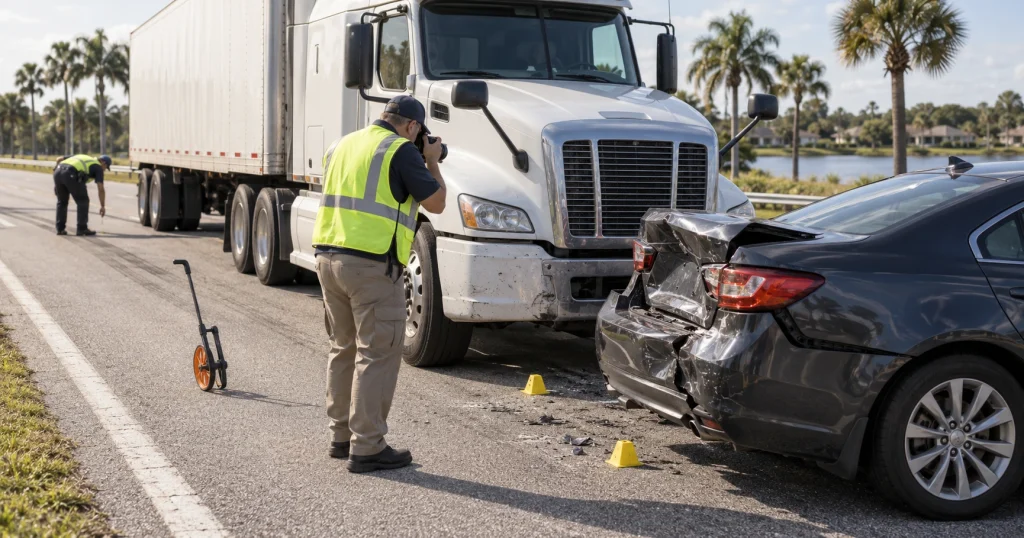
The most useful evidence is often the evidence that can disappear first. Trucking companies may keep records not included in the police report, and some electronic or video information may be overwritten during normal business operations.
Electronic and Company Evidence
Important evidence may include:
- Engine control module or event data recorder information
- Electronic logging device records
- GPS and fleet-tracking history
- Forward-facing and driver-facing camera footage
- Collision-warning or automatic-braking information
- Dispatch messages, delivery schedules, toll records, and fuel records
- Driver qualification, training, medical, and safety files
- Inspection, maintenance, and repair records
- Cargo weight, loading, and securement documents
Evidence You May Be Able to Document
If it is safe and your condition allows, try to document:
- The truck’s USDOT number and carrier name
- Tractor and trailer license plates and unit numbers
- Damage to every involved vehicle
- Vehicle positions, skid marks, debris, and roadway damage
- Trailer lights, reflective markings, and the rear underride guard
- Traffic signals, construction signs, weather, and road conditions
- Witness names and contact information
- Nearby businesses or homes that may have cameras
Safety and medical care come first. If your condition allows, save photographs and videos in more than one location. Do not repair or dispose of important physical evidence before it has been properly documented.
For a complete step-by-step checklist, read what to do after a truck accident in Riverview.
⚠️ Warning: Florida Statutes section 95.11 generally provides two years to file a negligence lawsuit. A shorter deadline or special notice rule may apply in some cases.
Videos, truck data, and other records may be lost long before the lawsuit deadline, so waiting can make an investigation harder.
Source: Florida Statutes section 95.11
What Injuries Can Happen in a Rear-End Truck Accident?
Rear-end truck crashes can cause injuries that are painful immediately and others that become clearer over the next several hours or days.
Don’t ignore headaches, confusion, neck or back pain, numbness, weakness, chest pain, or worsening discomfort.
Possible injuries include:
- Concussions and other traumatic brain injuries
- Neck and back injuries
- Herniated or damaged spinal discs
- Spinal cord injuries and paralysis
- Broken bones and crush injuries
- Chest, abdominal, and internal injuries
- Burns, scars, and disfigurement
- Anxiety, sleep problems, and post-traumatic stress
Don’t delay medical care while waiting to see whether an insurance claim will be accepted. Early treatment protects your health and creates a record of your symptoms, testing, diagnoses, and recommended care.
What Compensation May Be Available?
Compensation depends on the injuries, available insurance, financial losses, future needs, and evidence showing who was responsible. There is no standard settlement amount for a rear-end truck accident.
Depending on the circumstances, compensation may cover:
- Emergency care, hospitalization, surgery, and rehabilitation
- Future medical treatment and assistance
- Lost income and reduced earning ability
- Vehicle damage and other property losses
- Pain, suffering, disability, and disfigurement
- Wrongful death damages when a family member is killed
🛡️ Your Rights: Florida uses a modified comparative-fault rule in ordinary negligence cases. Compensation may be reduced by the injured person’s percentage of fault.
A person found more than 50 percent responsible for their own harm generally cannot recover damages. Independent evidence is especially important when an insurer tries to place unfair blame on the injured person.
Source: Florida Statutes section 768.8hat Evidence Should Be Preserved After1
How The Reyes Firm Handles Riverview Rear-End Truck Accident Cases
At The Reyes Firm, we look beyond the damage photographs and the first version of the police report. We investigate the people, vehicles, companies, safety decisions, and insurance policies connected to the collision.
Our work may include:
- Obtaining the complete law enforcement investigation
- Sending preservation notices to trucking companies and vehicle owners
- Securing truck data, electronic logs, GPS records, and camera footage
- Reviewing driver hiring, qualification, training, and safety records
- Examining vehicle inspections, repairs, brakes, tires, lights, and warning systems
- Investigating motor carriers, contractors, cargo businesses, and vehicle owners
- Reviewing dispatch records, delivery schedules, leases, and corporate relationships
- Identifying commercial, umbrella, and third-party insurance coverage
- Interviewing witnesses and locating available video
- Working with reconstruction, trucking-safety, medical, and mechanical professionals when appropriate
- Documenting lost income, medical expenses, future needs, and personal losses
- Preparing the case for trial when a fair resolution is not offered
We do not assume the rear driver is the only responsible party. We follow the evidence and investigate anyone or any company that may have helped create the danger.
The Reyes Firm is based at 4730 N. Habana Ave., Suite 201, Tampa, FL 33614. We serve Riverview, Tampa, Brandon, Plant City, and communities across Hillsborough County.
If you were injured in a rear-end truck crash, call 833-4 BAD DAY ((833) 422-3329) to discuss what happened.
Frequently Asked Questions About Riverview Rear-End Truck Accidents
Is the Rear Driver Always at Fault in Florida?
No. The following driver may appear responsible, but evidence involving an unsafe lane change, illegal stop, defective lights, poor visibility, mechanical failure, or chain reaction can change the analysis.
Who May Be Responsible When a Semi-Truck Rear-Ends a Car?
The truck driver may be responsible for unsafe driving. The motor carrier, maintenance provider, cargo business, manufacturer, or another motorist may also share liability if their actions contributed to the crash.
What If I Hit a Truck That Was Stopped in the Road?
Investigators should determine why the truck was stopped and whether it had working lights, reflective markings, warning devices, and a lawful reason to be there.
Investigators may also review your speed, attention, and opportunity to avoid the truck.
Can a Claim Begin Before the Trucking Investigation Is Finished?
Yes. A civil investigation can begin while law enforcement or insurers continue their work. Starting early may help preserve videos, truck data, company records, and physical evidence.
Should I Speak With the Trucking Company’s Insurance Adjuster?
Consider getting legal advice first. The adjuster may request a recorded statement, broad medical authorization, or settlement release before you know the full extent of your injuries or have access to the trucking evidence.
How Long Do I Have to File a Florida Truck Accident Lawsuit?
Florida generally allows two years to file an action founded on negligence. Different deadlines or notice rules may apply, so confirm the correct deadline as soon as possible.
How Much Does It Cost to Hire The Reyes Firm?
The Reyes Firm offers free consultations and handles accepted personal injury cases on a contingency fee basis. The firm does not collect attorney fees unless it recovers money, subject to the representation agreement.

Edward Reyes, Esq. is the founder and managing attorney of The Reyes Firm and a member of The Florida Bar. His practice includes personal injury cases involving commercial trucks, catastrophic injuries, and wrongful death.
He represents injured people and families dealing with insurers after serious accidents.
How Can The Reyes Firm Help You?
If you’ve had a bad day, a car accident, a slip and fall, a trucking crash, or any injury that was not your fault, The Reyes Firm is in your corner.
Our Tampa personal injury attorneys offer free consultations and work on a contingency fee basis, meaning you pay nothing unless we win your case.
You shouldn’t have to fight insurance companies alone. Let us fight for you.
The Reyes Firm
📍 4730 N. Habana Ave., Suite 201
Tampa, FL 33614
Had a bad day? Call The Reyes Firm. We’ll handle the rest.
Legal disclaimer: This article provides general information and is not legal advice. Reading this article or contacting The Reyes Firm does not create an attorney-client relationship. Every case is different. Past results do not guarantee a similar outcome.