What You Need to Know
- If a semi-truck rear-ends you in Florida, the truck driver is presumed at fault, but the trucking company can try to rebut that.
- Truck drivers must not follow too closely, and federal rules require them to slow down in fog, rain, and smoke.
- Your own PIP coverage pays first. Losses beyond PIP may be claimed against the truck driver and the trucking company.
- If you are found more than 50% at fault, Florida law bars you from recovering any damages.
- You generally have two years to file a lawsuit, and only 14 days to get medical care to use your PIP benefits.
Had a bad day? Call The Reyes Firm at 833-4 BAD DAY.
You were stopped in traffic. You did nothing wrong. Then a semi-truck slammed into the back of your car. If you were rear-ended by a semi-truck, you may be hurt, scared, and already getting calls from an insurance company you have never heard of.
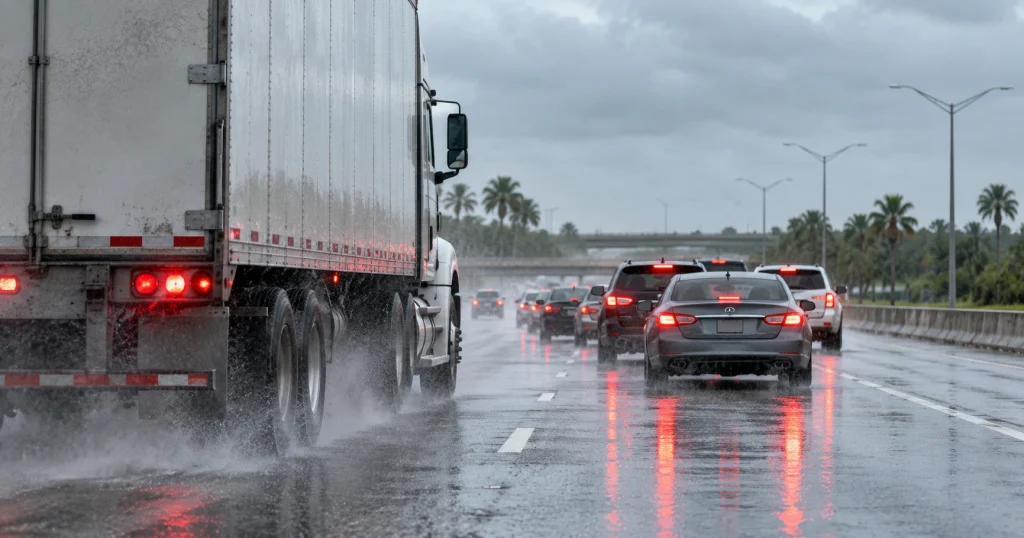
These crashes are different from a normal fender bender. A loaded semi can weigh many times more than your car. It can crush a car, push it into other vehicles, and turn a slowdown into a pileup. The trucking company and its insurer will move fast to protect themselves.
This guide explains who is at fault in Florida, which safety rules truck drivers must follow, whose insurance pays, and the deadlines that can make or break a claim in Tampa and across Florida.
Who is at fault when a semi-truck rear-ends you in Florida?
In Florida, the driver who hits you from behind is presumed to be at fault. That presumption comes from Florida case law, not a statute. A trucking company can rebut it with evidence that you were also careless, such as a sudden stop without a clear reason or broken brake lights. A jury then splits fault by percentage.
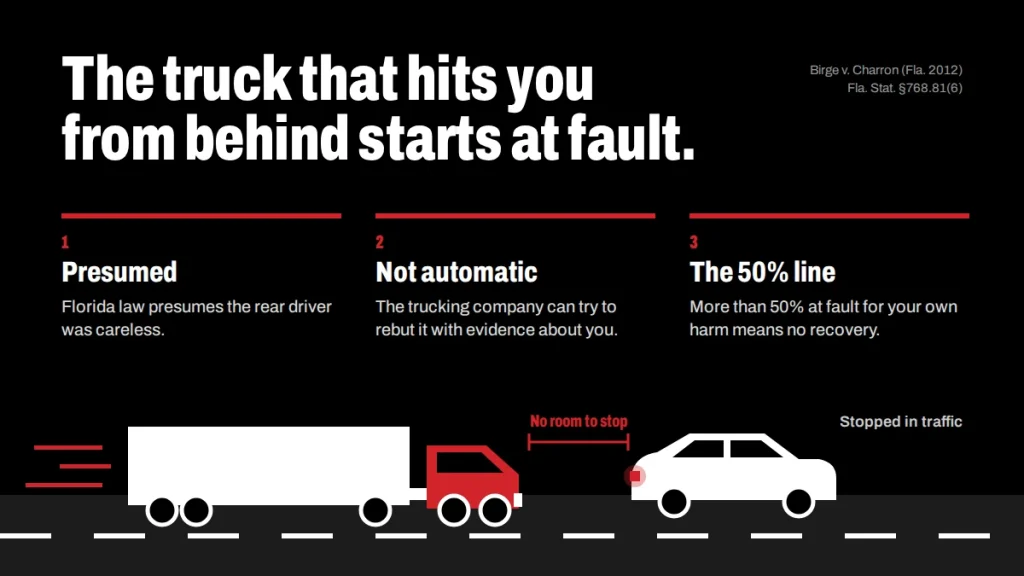
The Florida Supreme Court explained this rule in Birge v. Charron (2012). The court said the rear-end presumption fills gaps in the evidence. Once evidence shows the front driver was also negligent, Florida’s comparative fault system decides the case.
In plain English: the truck that hits stopped traffic starts out on the wrong side of the case. But “presumed” does not mean “automatically.” Expect the trucking company to look for anything that shifts blame to you.
In a chain-reaction crash, fault can be split among several drivers. That is common when a truck pushes one car into another.
🛡️ Your Rights Under Florida Law: You can still recover if you share some of the blame. Under Florida Statutes §768.81, your damages are reduced by your own percentage of fault. But under §768.81(6), a person found more than 50% at fault for their own harm cannot recover any damages. This rule applies to most negligence cases filed after Florida’s 2023 tort reform. It does not apply to medical negligence cases. Every case depends on its facts.
What happens when a semi-truck hits stopped traffic on a Florida highway?
Earlier this year, the Martin County Sheriff’s Office reported that a semi-truck hit traffic stopped for weather on Florida’s Turnpike near Hobe Sound. Several vehicles were involved, and one semi overturned. One person had a minor injury, and FHP reported no life-threatening injuries. A weather slowdown turned one truck into a multi-vehicle crash.
The crash happened on March 13, 2026, near mile marker 123. At least two semis and multiple other vehicles were involved. No fault findings or charges were reported in that coverage.
The same pattern happens closer to home. In May 2026, FHP reported that a semi on northbound I-75 in Hillsborough County failed to stop in time and struck another semi that had stopped for traffic. No one was hurt in that crash.
Tampa drivers see sudden slowdowns every day on I-75, I-4, and I-275. When a truck follows too closely, it may have no room left to stop.
What safety rules should a truck driver follow to avoid hitting stopped traffic?
Florida law says no driver may follow another vehicle more closely than is reasonable and prudent for the speed, traffic, and road conditions. Federal rules add that truck drivers must use extreme caution and reduce speed in fog, rain, mist, or smoke. A truck that can’t stop for traffic ahead may have broken one or both rules.
Here are the key rules:
- Following too closely. Florida Statutes §316.0895(1) bars any driver from following too closely.
- Truck-to-truck spacing. Under §316.0895(2), outside a business or residence district, a truck may not follow within 300 feet of another truck or towing vehicle. This 300-foot rule applies to a truck following another truck, not a car.
- Bad weather. 49 C.F.R. §392.14 requires truck drivers to use extreme caution and reduce speed when weather affects visibility or traction. If conditions get dangerous enough, the driver must stop driving until it is safe.
A loaded truck needs far more room to stop than a car. That is why following distance matters so much. Learn more about the federal trucking regulations that apply to commercial drivers.
A traffic ticket for following too closely is a noncriminal moving violation. A ticket can be useful evidence, but it is not the same as a civil finding of fault.
💡 Did You Know? In 2023, 5,472 people were killed nationwide in traffic crashes involving large trucks. Seventy percent of them were in other vehicles, and another 12 percent were pedestrians, cyclists, or others outside a vehicle. In Florida, large-truck crashes killed 341 people that year, and 233 of them were in other vehicles. Source: NHTSA, Traffic Safety Facts: Large Trucks, 2023 Data (DOT HS 813 717, April 2025).
Who pays your medical bills after a semi-truck rear-ends you?
Your own personal injury protection (PIP) coverage pays first, even when a truck hits you. PIP covers 80% of reasonable medical bills up to $10,000 if you get initial care within 14 days. Bills and losses beyond PIP may be claimed against the truck driver, the trucking company, and their liability insurer.
Here is how the money usually flows:
| Coverage | What it may pay | Key limit |
|---|---|---|
| Your PIP (§627.736) | 80% of reasonable medical bills, plus some lost income | $10,000; care must start within 14 days |
| Truck’s liability insurance | Medical bills, lost wages, pain and suffering beyond PIP | Depends on the policy and who is at fault |
| Your uninsured or underinsured motorist coverage | Losses the at-fault driver’s coverage can’t cover | Only if you bought it |
Trucks often carry far more insurance than a typical car. Under 49 C.F.R. §387.9, for-hire trucks hauling general freight across state lines must carry at least $750,000 in liability coverage. Some hazardous loads require $1 million or $5 million. These are minimums for certain carriers. Not every truck on a Florida road falls under them.
The trucking company isn’t automatically responsible just because its driver was working. Responsibility depends on who employed the driver, who owned the truck, and what caused the crash. A semi-truck accident settlement depends on fault, injuries, available insurance, and evidence.
How long do you have to file a claim after a semi-truck crash in Florida?
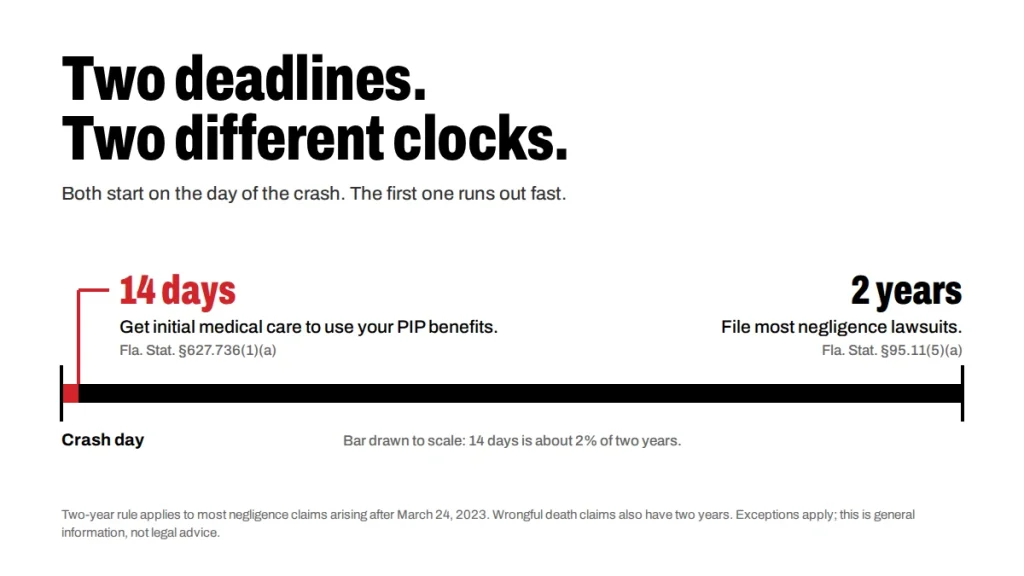
For most negligence claims that arose after March 24, 2023, Florida gives you two years from the crash to file a lawsuit. A wrongful death claim generally has two years from the date of death. These are separate from the 14-day PIP rule, which only controls your PIP medical benefits.
Two years can sound like plenty of time. It is not. Truck crash cases need early work to find the right companies, insurers, and records.
⚠️ Warning: Two deadlines, two different rules. Under Florida Statutes §95.11(5)(a), most negligence lawsuits must be filed within two years. Under §627.736(1)(a), you must get initial medical care within 14 days of the crash to use your PIP medical benefits. Missing the 14-day window can cost you PIP benefits. Missing the two-year deadline can end your right to sue. Claims from before the 2023 tort reform may follow older rules.
What should you do after a semi-truck rear-ends you in Tampa?
Call 911, get checked by a doctor within 14 days, and photograph the scene, the truck, and its company name and USDOT number. Get witness names. Don’t give a recorded statement to the trucking company’s insurer before you understand your rights. Truck evidence like driver logs and onboard data can be lost, so act quickly.
Use this checklist:
- Call 911 and ask for a crash report.
- Get medical care, even if you feel okay. Some injuries show up later.
- Photograph all vehicles, the truck’s door markings, and the road conditions.
- Collect names and phone numbers from witnesses.
- Keep every medical bill, receipt, and missed-work record.
- Talk to a Tampa truck accident lawyer before you sign anything.
How The Reyes Firm Handles Your Semi-Truck Rear-End Collision Case
Truck crash cases are won or lost on evidence, and much of that evidence belongs to the trucking company. The Reyes Firm acts early to determine what happened, who is responsible, and how much insurance is available.
When we take a semi-truck rear-end case, our work can include:
- Investigating the crash. We review the crash report, photos, witness statements, and any available traffic or dashcam video.
- Identifying every responsible party. That may include the driver, the motor carrier, the truck’s owner, and other companies involved in the trip.
- Requesting trucking records. Driver logs, onboard electronic data, maintenance records, and the carrier’s federal safety and insurance filings can show speed, following distance, and hours on the road.
- Checking the safety rules. We compare what the driver did against Florida’s following-distance law and federal rules like the duty to slow down in bad weather.
- Documenting your injuries and losses. Attorney Edward Reyes spent years working in personal injury medicine before law school, so we review your treatment and records closely.
- Handling the insurance companies. We deal with the adjusters so you can focus on getting better.
- Preparing for trial when needed. Many cases settle. When an insurer won’t be fair, we prepare the case for court.
The Reyes Firm is located at 4730 N. Habana Ave., Suite 201, Tampa, FL 33614. Call 833-4 BAD DAY for a free consultation. We are serving Tampa, Riverview, Brandon, Plant City, and communities across Hillsborough County, and we help clients in English and Spanish.
Frequently Asked Questions About Being Rear-Ended by a Semi-Truck
Is the truck driver always at fault in a rear-end crash in Florida?
No, but the rear driver is presumed to be at fault. The trucking company can try to rebut that presumption with evidence that you were also careless. If that happens, a jury splits fault by percentage.
What if the truck pushed my car into the car in front of me?
In a chain-reaction crash, more than one driver can share fault. The truck that started the chain is often a key target of the claim. The facts, photos, and crash report will matter.
How much is a semi-truck rear-end accident settlement worth?
No one can give you a reliable number without knowing your case. Value depends on your injuries, medical bills, lost income, fault, and the insurance available. Be careful of anyone who promises a figure early.
Do I have to use my own insurance if a truck hit me?
Yes. In Florida, your PIP coverage pays first for medical bills and up to $10,000 in lost income. You must get initial care within 14 days of the crash to use PIP medical benefits.
Should I talk to the trucking company’s insurance adjuster?
You are not required to give the trucking company’s insurer a recorded statement. What you say can be used to shift blame to you. Speak with a lawyer first.
What if the crash happened in fog or heavy rain?
Bad weather does not excuse a truck driver. Federal rule 49 C.F.R. §392.14 requires truck drivers to use extreme caution and reduce speed in fog, rain, mist, or smoke. If it gets dangerous enough, the driver must stop driving.
How long do I have to file a lawsuit after a truck crash in Tampa?
For most negligence claims that arose after March 24, 2023, Florida generally allows two years under §95.11(5)(a). A wrongful death claim generally has two years from the date of death. Talk to a lawyer early, because truck cases take time to build.

Edward J. Reyes, Esq., founded The Reyes Firm in Tampa, Florida, in 2017 and serves as its managing attorney. He represents people injured in truck, car, motorcycle, and other serious crashes across Tampa Bay and Central Florida.
How Can The Reyes Firm Help You?
If you’ve had a bad day — a car accident, a slip and fall, a trucking crash, or any injury that wasn’t your fault — The Reyes Firm is in your corner. Our Tampa personal injury attorneys offer free consultations and work on a contingency fee basis, meaning you pay nothing unless we win your case.
You shouldn’t have to fight the insurance companies alone. Let us fight for you.
📍 Address: 4730 N. Habana Ave., Suite 201, Tampa, FL 33614
📞 Phone: 833-4 BAD DAY
🌐 Website: Schedule your free consultation today at thereyesfirm.com
Had a bad day? Call The Reyes Firm. We’ll handle the rest.
Legal Disclaimer: This article provides general information about Florida law and is not legal advice. Reading it does not create an attorney-client relationship with The Reyes Firm. Laws change, and every case depends on its own facts. Speak with a licensed Florida attorney about your situation. The news events described are based on public reports, and The Reyes Firm does not represent anyone involved in them.