What You Need to Know
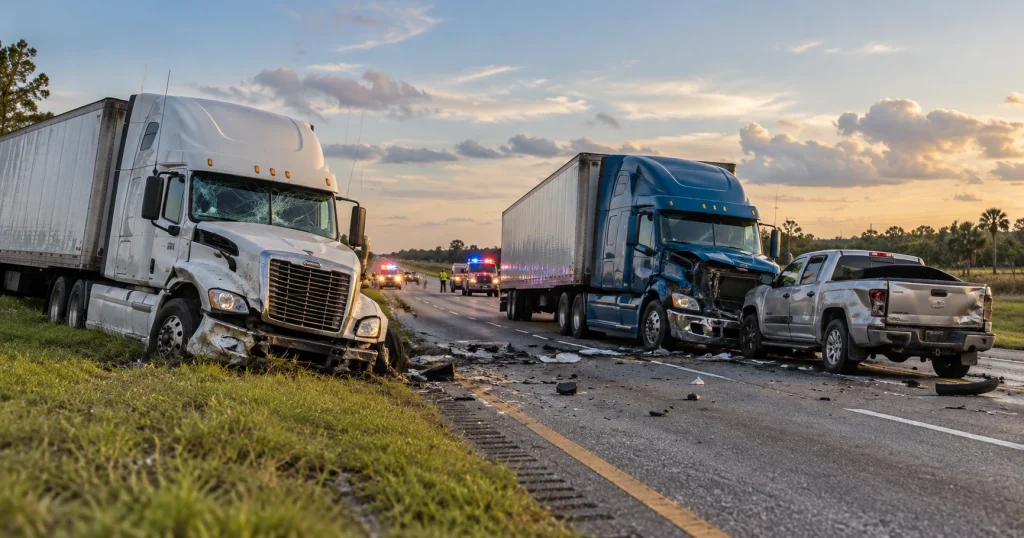
- On January 14, 2026, a fiery crash involving two semi-trucks and a pickup on SR-60 at Peavine Road in Kenansville, Osceola County, left one driver dead and another hurt.
- According to an FHP crash report, one semi failed to stop for stopped traffic, hit a second semi, and pushed it into a pickup. The crash remained under investigation.
- When several vehicles and more than one commercial truck are involved, more than one insurance policy may apply, and each at-fault party generally pays only its own share.
- If you are found more than 50 percent at fault for your own injuries, Florida law bars recovery in most negligence cases.
- Most injury lawsuits must be filed within two years, and trucking companies must keep driver logs for only six months, so acting early matters.
Had a bad day? Call The Reyes Firm at 833-4 BAD DAY.
You are sitting in slow traffic. You did everything right. Then a car slams into you from behind and shoves you into the truck ahead.
The fiery SR-60 semi-truck crash Osceola County on January 14, 2026, raises questions many drivers in Osceola County, Tampa, and across Central Florida never think about until it happens to them: when several vehicles crash, who is responsible, and whose insurance pays?
The answer is rarely simple. A multi-car accident lawyer often has to sort out several drivers, a trucking company, and multiple insurance policies before anyone can say who owes what. This guide explains how Florida splits fault, who pays first, and how you can protect your claim.
What Happened in the SR-60 Semi-Truck Crash Osceola County?
On Wednesday, January 14, 2026, at about 2:37 p.m., two semi-trucks and a pickup crashed on westbound SR-60 at Peavine Road in Kenansville, Osceola County, during the SR-60 semi-truck crash Osceola County. According to an FHP crash report reported by WKMG, one semi failed to stop for traffic and struck a Peterbilt semi, pushing it into a Ford F-150.
Troopers said the Peterbilt and the pickup were stopped for traffic ahead. The first semi caught fire, and its driver died at the scene. The Peterbilt driver was taken to a hospital with injuries that were not life-threatening, and the pickup driver was not hurt, according to the same report. FOX 35 also reported the crash.
The crash blocked SR-60 in both directions. WKMG reported that it remained under investigation.
Incident Location
Reported crash area: Westbound SR-60 at Peavine Road, Kenansville, Osceola County, Florida. The crash happened at about 2:37 p.m.
The investigation was ongoing when this article was prepared. Troopers’ account is preliminary, and nothing reported so far establishes legal fault. No one should draw conclusions about any driver before the investigation is complete.
⚠️ Warning: Two Years Can Go Fast. Under Florida Statute § 95.11, most negligence lawsuits, including most crash injury claims, must be filed within two years. Wrongful death claims also have a two-year limit. This shorter deadline applies to claims that arose after March 24, 2023. Claims against a government agency can have separate notice rules.
Who Can Be at Fault When a Semi-Truck and Several Cars Crash?
Fault in a multi-car crash can fall on any driver whose careless driving helped cause it, starting with the driver who set off the chain. A trucking company, cargo loader, or parts maker may also share fault when the evidence supports it. A truck is not automatically at fault just because it was involved.
Depending on the facts, a truck and commercial vehicle accident with several vehicles may involve claims against:
- A driver who failed to slow down, followed too closely, or was distracted
- Another driver who made a sudden or unsafe move
- The truck driver, if the driver’s conduct contributed to the crash
- The motor carrier, if training, scheduling, or maintenance problems played a role
- A cargo loader, if an unsafe or shifting load contributed
- A vehicle or parts maker, if a defect contributed
The SR-60 crash shows why the details matter. According to the FHP report, the Peterbilt semi was stopped when it was hit from behind and pushed into the pickup. A truck in the middle of a chain is not automatically the cause.
Other crashes play out differently. In a May 2026 crash on the Polk Parkway, troopers said a pickup pushed a sedan into a tractor-trailer. We explain that in our article on who is at fault in a 3-car collision.
Crashes like these are common. In 2024, 80 percent of large trucks in fatal crashes were in multi-vehicle crashes, compared with 63 percent of passenger vehicles, according to NHTSA’s Large Trucks: 2024 Data report. The same report found that 353 people died in Florida crashes involving large trucks that year.
To learn more about the parties who can share responsibility, see our guide on who can be held liable in a commercial truck crash.
Whose Insurance Pays After a Multi-Car Truck Crash?
Your own PIP coverage usually pays first. Florida PIP covers 80 percent of reasonable medical expenses, up to $10,000 if a qualified provider finds an emergency medical condition, but only if you get initial care within 14 days. Beyond PIP, claims may be made against the liability insurance of each at-fault driver or company.
PIP rules come from Florida Statute § 627.736. Without an emergency medical condition finding, the PIP medical limit is $2,500. PIP also includes a $5,000 death benefit. Lawmakers have filed bills to repeal PIP, but as of October 2026, Florida still has PIP law.
When a commercial truck shares fault, its liability coverage matters. The legal minimum depends on the type of carrier and the truck’s weight:
| Type of truck | Minimum liability coverage | Source |
|---|---|---|
| For-hire interstate carrier hauling general freight (10,001 lbs or more) | $750,000 | 49 CFR 387.9 (FMCSA report, February 2026) |
| Florida commercial vehicle, 26,000 to under 35,000 lbs | $50,000 per occurrence | Fla. Stat. § 627.7415 |
| Florida commercial vehicle, 35,000 to under 44,000 lbs | $100,000 per occurrence | Fla. Stat. § 627.7415 |
| Florida commercial vehicle, 44,000 lbs or more | $300,000 per occurrence | Fla. Stat. § 627.7415 |
These are minimums. The Florida amounts apply to commercial vehicles that are not covered by the federal rule. Many carriers carry more. In a crash that injures several people, though, one policy may have to be shared among everyone injured. That’s another reason to identify every driver, company, and policy involved. In a crash that involves two commercial trucks, more than one commercial policy may be in play.
When and how you can pursue an at-fault driver beyond PIP depends on your injuries and the facts of the crash. A lawyer can review which policies apply.
💡 Did You Know? In 2023, Florida recorded 47,101 crashes involving commercial motor vehicles, with 332 deaths, about 9.83 percent of all traffic deaths in the state, according to the Florida Department of Highway Safety and Motor Vehicles’ By the Numbers 2023 report.
How Does Florida Split Fault When Several Drivers Share the Blame?
Florida divides fault by percentage. Under Florida Statute § 768.81, a jury assigns each responsible party a share of fault, and the court enters judgment against each one based on its own share. Florida does not use joint and several liability in these cases, so one defendant generally does not pay another’s share.
Here is a simple illustration. It is not based on any real case.
| Party | Share of fault (example only) | What it means |
|---|---|---|
| Driver who started the chain | 70% | Generally responsible for 70% of the damages |
| Second driver | 20% | Generally responsible for 20% of the damages |
| You | 10% | Your recovery is reduced by 10% |
This is why finding every responsible party matters. If one at-fault driver is never identified, the share of fault assigned to that driver may not be collectible from anyone else.
What about the driver in the back? Florida courts presume that the rear driver in a rear-end crash was careless. The Florida Supreme Court has treated that presumption as an evidentiary starting point, not a final answer. When evidence shows someone else also contributed, the jury can divide fault. In a chain-reaction crash, a driver who pushed forward into the vehicle ahead is in a very different spot than the driver who started the chain. Our article on being rear-ended by a semi-truck covers this from another angle.
What if a defendant blames someone who is not in the case? Defendants sometimes point to a person or company that is not part of the lawsuit. Under § 768.81(3)(a), a defendant who wants a jury to assign fault to a nonparty must raise that defense in its pleadings, identify or describe the nonparty, and prove that nonparty’s fault at trial.
🛡️ Your Rights Under Florida Law: Florida Statute § 768.81 requires the court to enter judgment against each liable party based on its own percentage of fault. If several drivers or companies share fault for your injuries, each may be responsible for its share. Your own share of fault, if any, reduces your recovery, and being found more than 50 percent at fault bars recovery in most negligence cases.
Can You Still Recover If You Were Partly at Fault?
Yes, in most cases, as long as you are not found more than 50 percent at fault. Florida’s modified comparative fault rule reduces your recovery by your share of fault. If a jury finds you more than 50 percent at fault for your own harm, you recover nothing in most negligence cases, including most crash claims.
This rule took effect when Florida changed its comparative fault law on March 24, 2023. Before then, Florida let injured people recover something even when they were mostly at fault. That is no longer true.
In a multi-car truck crash, insurers may try to shift more blame onto you. A few percentage points can change the outcome. Protect yourself by:
- Sticking to facts when you talk to police and insurers
- Not guessing about speed, distance, or timing
- Not apologizing or admitting fault at the scene
- Letting the evidence, not the first phone call from an insurer, decide the story
What Evidence Matters After a Multi-Car Truck Crash, and How Fast Can It Disappear?
Key evidence can disappear within months. Federal rules require trucking companies to keep driver logs and supporting documents for only six months under 49 CFR 395.8(k)(1). Dashcam video can be overwritten, and damaged vehicles get repaired or scrapped. In a multi-car crash, that evidence is spread across several vehicles, owners, and insurers.
| Evidence | Why it may matter |
|---|---|
| Crash report and diagrams | Show the order of impacts and where each vehicle ended up |
| Dashcam and truck camera video | May show who slowed, who did not, and the sequence of the crash |
| Truck electronic data | May show speed and braking before impact |
| Driver logs and electronic logging data | May show hours driven and possible hours-of-service violations |
| Inspection and maintenance records | May reveal brake, tire, or equipment problems |
| Cargo and shipping documents | May show an overloaded or poorly secured load |
| Witness statements | Preserve what other drivers saw before memories fade |
| Your medical records | Connect your injuries to the crash |
After a crash involving several vehicles, you can protect your claim by taking these steps:
- Get medical care within 14 days. This protects your PIP benefits and documents your injuries.
- Photograph every vehicle and its position if you can do so safely.
- Get names and insurance details for every driver, not just the one who hit you.
- Write down what you remember while it is fresh, including the order of impacts.
- Be careful with other insurers. Think before giving a recorded statement to another driver’s insurer.
- Save everything. Keep bills, repair estimates, and letters from insurers.
For a deeper look at deadlines and evidence, read our guide to semi-truck accident claims.
How The Reyes Firm Handles Your Multi-Car Truck Accident Case
The Reyes Firm handles multi-car truck accident cases by moving quickly to preserve evidence, sorting out the order of impacts, identifying every driver and company that may share fault, and finding every insurance policy that may apply. We prepare each case with trial readiness while keeping you informed in plain language.
Here is how we help:
- We listen first. We learn what happened, what you are dealing with, and what you need right now.
- We investigate the whole chain. We review crash reports, photos, witness statements, video, and roadway evidence to understand who hit whom, and in what order.
- We act fast on trucking evidence. We send preservation requests for driver logs, electronic logging data, truck camera footage, electronic vehicle data, and maintenance and inspection records before they can be lost.
- We identify each potentially responsible party. That may include other drivers, a truck driver, a motor carrier, a cargo loader, or another party the evidence points to.
- We find the coverage. Multi-car truck crashes can involve your PIP, several drivers’ liability policies, and commercial truck coverage.
- We document your injuries and losses. We track medical care, lost income, and how the crash affects your daily life.
- We push back when they shift blame. Under Florida’s 50 percent rule, a few points of fault matter, so we build the case around evidence, not an insurer’s first version of events.
- We prepare for settlement and trial. We negotiate from a position of preparation and are ready to go to court when needed.
The Reyes Firm is based in Tampa and serves Tampa and the South Shore communities, including Riverview, Brandon, Plant City, and communities across Hillsborough County. We also help injured people in Osceola County and across Central Florida through our personal injury attorney in Osceola County services.
The Reyes Firm
4730 N. Habana Ave., Suite 201
Tampa, FL 33614
833-4 BAD DAY
thereyesfirm.com
Frequently Asked Questions About Multi-Car Truck Accidents in Florida
Who is at fault in a chain-reaction accident in Florida?
Any driver whose careless driving helped cause the crash can share fault, starting with the driver who set off the chain. Florida assigns each responsible party a percentage of fault under § 768.81. A driver pushed into the vehicle ahead may have little or no fault, depending on the evidence.
Is the truck driver always at fault if a semi is involved?
No. A truck isn’t automatically at fault just because it was involved in the crash. In the SR-60 crash, the FHP report said one semi was stopped when it was hit from behind and pushed into a pickup. Fault depends on what each driver did.
Can I still get money if I was partly to blame?
In most negligence cases, yes, as long as you are not found more than 50 percent at fault. Your recovery is reduced by your share of fault. If you are found more than 50 percent at fault, Florida law bars recovery in most cases.
Whose insurance pays my medical bills after a multi-car crash?
Your own PIP coverage usually pays first, as long as you get initial medical care within 14 days. Beyond PIP, you may have claims against each at-fault driver’s or company’s liability coverage. A truck’s commercial policy may also apply.
How long do I have to file a lawsuit after a truck crash in Florida?
Most negligence lawsuits must be filed within two years under Florida Statute § 95.11, and wrongful death claims also have a two-year limit. Claims involving a government agency can have separate notice rules. Talk with a Florida attorney soon to identify the right deadline.
What if the trucking company blames another driver?
That happens often in multi-vehicle cases. Under Florida law, a defendant who wants a jury to assign fault to someone outside the lawsuit must plead it and prove it at trial. Strong early evidence helps you respond.
Do I need a multi-car accident lawyer if the police report says another driver caused it?
A police report helps, but it isn’t the final word on fault or insurance. Multi-car truck crashes often involve several insurers who may each point fingers. A lawyer can preserve trucking evidence, identify every policy, and push back on blame-shifting.

Edward Reyes, Esq. founded The Reyes Firm and is admitted to The Florida Bar. His practice focuses on serious personal injury cases, including motor vehicle crashes, catastrophic injuries, and claims involving injured children and families. He represents injured people in Tampa and communities across Hillsborough County.
How Can The Reyes Firm Help You?
If you’ve had a bad day — a car accident, a slip and fall, a trucking crash, or any injury that wasn’t your fault — The Reyes Firm is in your corner. Our Tampa personal injury attorneys offer free consultations and work on a contingency fee basis, meaning you pay nothing unless we win your case.
You shouldn’t have to fight the insurance companies alone. Let us fight for you.
📍 Address: 4730 N. Habana Ave., Suite 201, Tampa, FL 33614
📞 Phone: 833-4 BAD DAY
🌐 Website: Schedule your free consultation today at thereyesfirm.com
Had a bad day? Call The Reyes Firm. We’ll handle the rest.
Legal Disclaimer: This article is for general informational purposes only and is not legal advice. Reading this article does not create an attorney-client relationship with The Reyes Firm. Every accident and injury claim is different. Laws, deadlines, and insurance coverage can change or apply differently based on the facts. The crash described here was under investigation when we prepared this article, and The Reyes Firm does not represent anyone involved. Speak with a licensed Florida attorney about your specific situation.