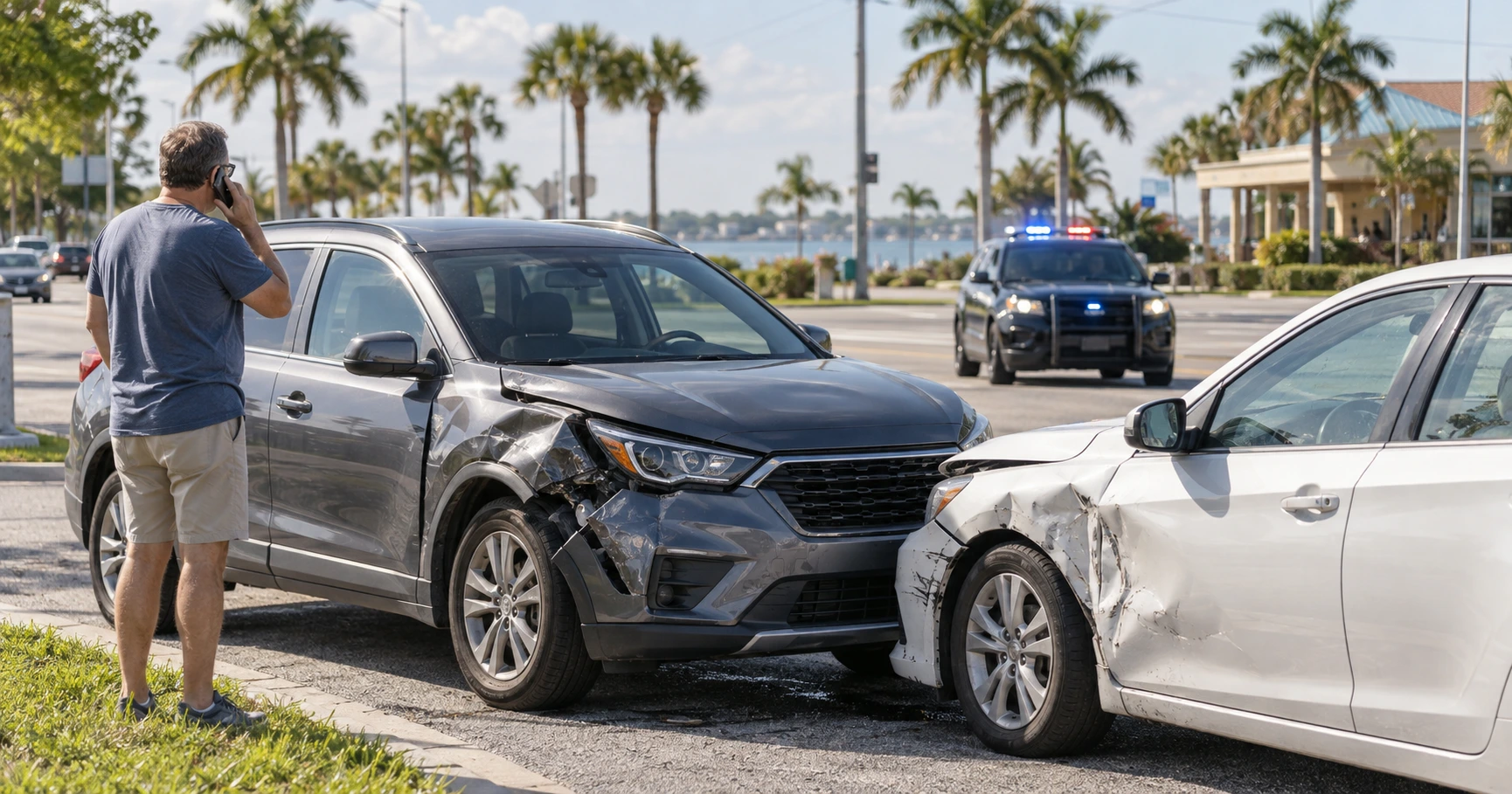
You were just driving through Tampa when the blue lights came on. Now an officer is asking to search your car — and you’re not sure whether you can say no, how long they can keep you there, or what happens if you refuse. Here’s what Florida law actually says before you answer another question.
TL;DR — QUICK SUMMARY
- You have a constitutional right to refuse consent to a search of your vehicle during a Tampa traffic stop.
- Police generally need your consent, a warrant, or probable cause (a recognized exception) before they can legally search your car.
- An officer can detain you only for the time reasonably needed to handle the stop — they cannot hold you indefinitely without reasonable suspicion or probable cause.
- As of October 2025, Florida’s Second District Court of Appeal — which covers Tampa — ruled that the smell of cannabis alone no longer gives police probable cause to search your car.
- Consenting to a search can cost you a strong legal challenge later, so talk to a lawyer before you agree to anything.
The Reyes Firm
Stopped and Searched in Tampa?
Get clear answers about your rights after a traffic stop or vehicle search. Had a bad day?
Can police hold you while they get a warrant to search your car in Tampa?
Yes, but only within limits. An officer can detain you for the reasonable time it takes to investigate the stop, and in some situations may hold your vehicle while they apply for a warrant, but they cannot keep you indefinitely without probable cause or reasonable suspicion that you’ve committed a crime.
If you refuse a search, an officer who genuinely believes there is evidence in the car can try to secure a warrant, and that may mean waiting at the scene for a while. In practice, unless they have a specific reason to think there is something significant in your vehicle, most officers will not go through the warrant process over a routine traffic stop. The U.S. Supreme Court has made clear that a stop cannot be stretched out beyond the time needed to handle the reason for the stop unless police develop independent, reasonable suspicion of another crime.
⚠️ Before You Consent: You are never required to consent to a search of your vehicle. If you agree, you may give up one of the strongest tools a defense lawyer has — the ability to challenge an unlawful search and ask a court to throw out whatever was found. Stay calm, stay polite, and clearly decline. Then call a lawyer.
Do you have to let police search your car during a Tampa traffic stop?
No. You do not have to consent to a search of your vehicle. The Fourth Amendment protects you against unreasonable searches and seizures, and being pulled over for speeding or a broken taillight does not, by itself, give an officer the right to search your car.
You can decline politely and plainly: “Officer, I don’t consent to any searches.” Declining is not an admission of guilt, and the fact that you refused cannot be treated as evidence that you did something wrong. If you’re unsure about what happened during your own stop, the team at The Reyes Firm can walk you through it.
Watch: Your Rights If Police Want to Search Your Car in Tampa
In this short video, attorney Edward Reyes explains what really happens when an officer asks to search your vehicle and how to protect yourself.
If a stop has left you facing charges or unsure of your rights, The Reyes Firm is available to talk it through.
What reasons can police use to search your car anyway?
Even after you refuse, police can still search your vehicle if they have a legally recognized basis, and officers often look for one. Common justifications include:
- Probable cause (the automobile exception). If police have probable cause to believe the car contains evidence of a crime, they can search it without a warrant.
- A DUI investigation. An officer may claim you show signs of impairment, order you out of the vehicle, and investigate from there.
- An outstanding warrant. A records check that turns up a warrant changes the situation entirely.
- Plain view. Anything illegal that an officer can see from outside the car can justify a search.
- Search incident to arrest. If you’re lawfully arrested, police may search areas within reach.
- An inventory (impound) search. If you’re arrested — even over something minor — and the car is impounded, police can inventory its contents.
For years, the smell of marijuana was its own shortcut to a search. That is exactly the pretext that is now changing in the Tampa area.
💡 Did You Know? For years an officer who said they smelled marijuana could search your car on that basis alone. That changed for Tampa drivers in 2025. In Williams v. State (Oct. 1, 2025), Florida’s Second District Court of Appeal — which covers Hillsborough County and the Tampa Bay area — ruled that the odor of cannabis by itself no longer establishes probable cause, because legal hemp and medical marijuana smell identical to illegal cannabis. A later decision, Cherfils v. State (Dec. 2025), explains that odor combined with other facts can still justify a search. Source: Williams v. State, No. 2D2023-2200 (Fla. 2d DCA 2025).
Should you consent to a search to avoid being arrested?
Usually not, and here is the hard tradeoff. Refusing a search sometimes means you may still be detained or arrested for a few hours while police sort things out, and that can mean an uncomfortable night before you bond out.
But consenting to dodge that short-term discomfort can cost you far more later. Once you consent, you generally give up the right to argue the search was illegal. If you stay quiet and decline, and the search turns out to be unlawful, your lawyer may be able to get the evidence suppressed, which can mean reduced charges or even a dismissal. A rough night can be the price of keeping a defense in your pocket. No outcome is ever guaranteed, and every stop is different, which is exactly why you should speak with a lawyer as soon as possible.
🛡️ Your Rights Under the Constitution: The Fourth Amendment protects you against unreasonable searches and seizures, and Florida courts enforce it. You have the right to refuse consent, the right to remain silent, and the right to a lawyer. An officer may not prolong your stop beyond the time reasonably needed to handle it without independent justification. If your car was searched without consent, a warrant, or valid probable cause, a Tampa attorney can ask the court to suppress what was found.
What are the 5 steps to take if police want to search your car in Tampa?
These 5 steps protect your rights and your future. The order matters.
- Stay calm and keep your hands visible. Be polite. Don’t argue, resist, or reach for anything suddenly. How you behave is recorded on dashcam and bodycam, and it matters later.
- Clearly decline consent. Say it plainly: “Officer, I do not consent to a search.” You can repeat it calmly. Declining is your right and is not evidence of guilt.
- Don’t answer questions beyond identifying yourself. Hand over your license, registration, and insurance. Beyond that, you can say you’d prefer to speak with a lawyer. You are not required to explain where you’ve been or what is in your car.
- Ask whether you’re free to leave. If the officer says yes, you may calmly go. If you’re being detained, ask why, but do not physically resist even if you believe the stop is unlawful. The place to fight an illegal search is in court, not on the roadside.
- Call The Reyes Firm before you sign or agree to anything. Before you waive any rights, a Tampa attorney can review what happened. Call 833-4 BAD DAY for a consultation.
The Reyes Firm
4730 N. Habana Ave., Suite 201, Tampa, FL 33614
Phone: 833-4 BAD DAY | thereyesfirm.com
How The Reyes Firm helps after a Tampa traffic stop
A routine traffic stop that turns into a search can leave you shaken and unsure of what just happened to your rights. You don’t have to figure it out alone.
When you bring your situation to The Reyes Firm, we can:
- Review exactly what happened during your stop, from the moment the lights came on to the moment the search began
- Examine the legal basis for the search, looking at whether the officer had valid consent, a warrant, or genuine probable cause
- Identify red flags, such as a stop that was unlawfully prolonged or a search built on a thin pretext
- Explain your options in plain language so you understand what you’re facing and what comes next
- Stand between you and anyone trying to take advantage of you after a bad day on Tampa’s roads
No lawyer can promise an outcome. What we can promise is that we treat your situation seriously, explain every decision in plain English, and keep you in the loop from start to finish.
Frequently asked questions about police car searches in Tampa
Can I refuse to let police search my car in Florida?
Yes. You have a constitutional right to refuse consent to a search of your vehicle. A traffic stop alone does not give an officer the authority to search your car, and politely declining cannot be used against you as proof of wrongdoing.
Can police hold me while they get a warrant in Tampa?
In some cases, yes. Police can detain you for the time reasonably needed to handle the stop, and if they have probable cause they may secure your vehicle while they seek a warrant. They cannot, however, hold you indefinitely without reasonable suspicion or probable cause of a crime.
Can police still search my car if they smell marijuana in Tampa?
Not on odor alone, at least in the Tampa area. In Williams v. State (Oct. 1, 2025), Florida’s Second District Court of Appeal — which covers Hillsborough County — held that the smell of cannabis by itself no longer establishes probable cause, because legal hemp and medical marijuana smell the same as illegal cannabis. Under the follow-up decision Cherfils v. State (Dec. 2025), odor combined with other specific facts can still justify a search.
Does refusing a search make me look guilty?
No. Asserting your rights is not evidence of a crime. Courts have long recognized that refusing consent cannot, by itself, be treated as suspicious or used to justify a search.
What is an inventory or impound search?
It is a search of a vehicle that has been impounded after an arrest. If police arrest you and tow your car, they are generally allowed to inventory its contents, which is one reason a minor arrest can still lead to a full search of your vehicle.
How long can police detain me during a traffic stop?
Only as long as is reasonably necessary to address the reason for the stop. Police cannot prolong a stop to go fishing for evidence unless they develop independent reasonable suspicion of another crime during the encounter.
What should I do if my car was searched without my consent?
Write down everything you remember as soon as you can and speak with a lawyer quickly. If the search was conducted without consent, a warrant, or valid probable cause, an attorney can file a motion to suppress and ask the court to exclude whatever was found.
Should I talk to a lawyer after a traffic stop or search?
Yes. The sooner you speak with a lawyer, the sooner your rights can be protected. Call The Reyes Firm at 833-4 BAD DAY for a consultation about your situation.

Edward Reyes, Esq. is a Florida Bar-admitted personal injury attorney and the founder of The Reyes Firm in Tampa, Florida. His practice focuses on serious injury and wrongful death cases arising from commercial vehicle crashes, including delivery truck accidents involving FedEx, UPS, Amazon, and other carriers. Edward Reyes, Esq. represents injured Floridians in Tampa and throughout Hillsborough County on a contingency fee basis, meaning clients pay nothing unless the firm recovers compensation for them.
Read more about Edward Reyes.
How Can The Reyes Firm Help You?
If you’ve had a bad day — a car accident, a slip and fall, a trucking crash, or any injury that wasn’t your fault — The Reyes Firm is in your corner. Our Tampa personal injury attorneys offer free consultations and work on a contingency fee basis, which means you pay us nothing unless we win your case.
You shouldn’t have to fight the insurance companies alone. Let us fight for you.
📍 Address: 4730 N. Habana Ave., Suite 201, Tampa, FL 33614
📞 Phone: 833-4 BAD DAY
🌐 Website: Schedule your free consultation today at thereyesfirm.com
Had a bad day? Call The Reyes Firm. We’ll handle the rest.