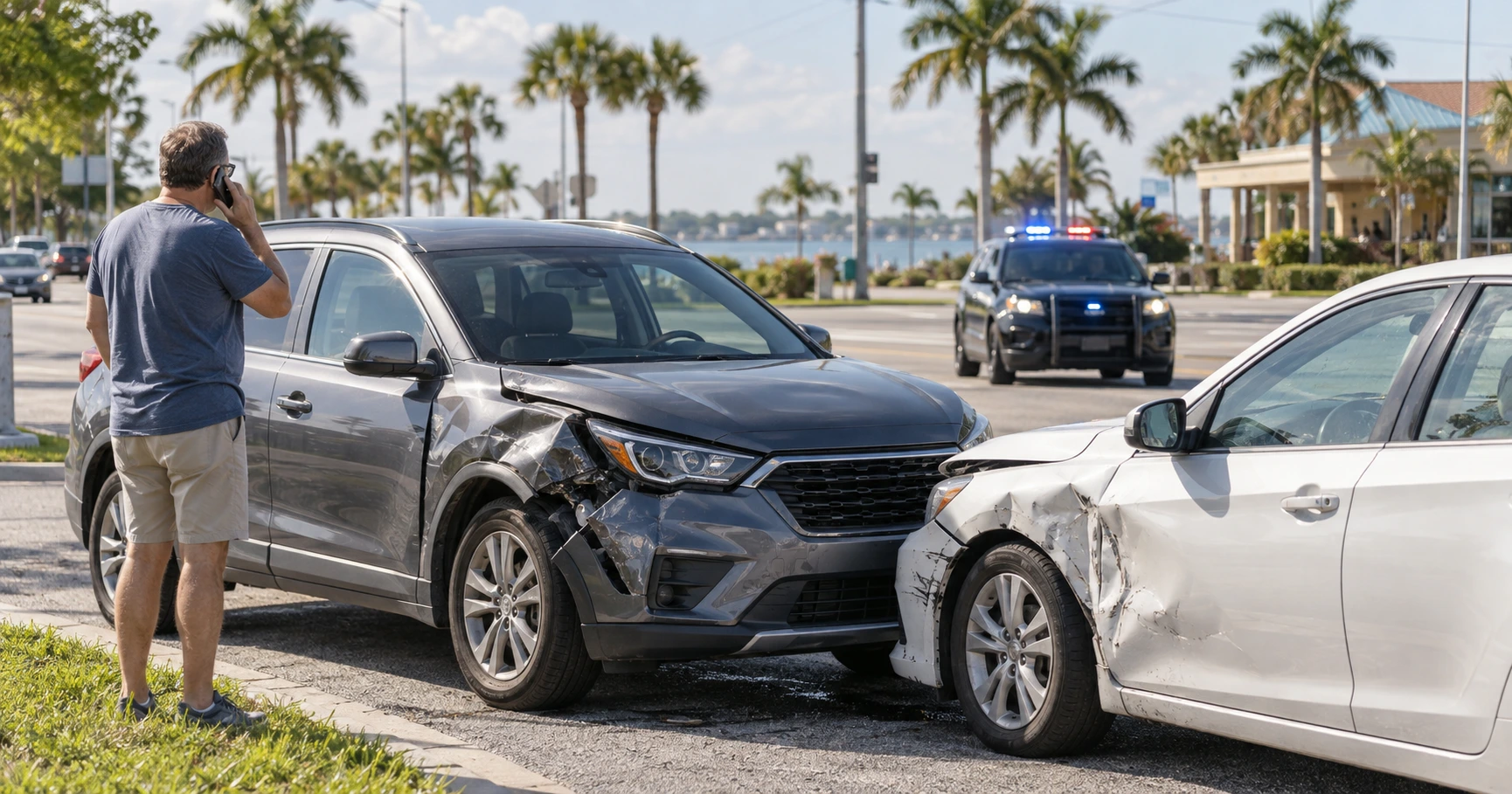
You were just driving through Tampa, minding your own day. Then another driver’s mistake left your car damaged in a crash you didn’t cause. Now you’re staring at a wrecked vehicle, wondering how you’ll get to work, and the insurance adjusters are already deciding how little they can pay you. Here’s what you need to know before you sign anything or accept their first offer.
TL;DR — QUICK SUMMARY
- In Florida, car repairs are paid based on fault, not no-fault — the at-fault driver’s Property Damage Liability coverage is responsible for fixing your vehicle.
- You have two main options: file through your own collision coverage (you pay your deductible up front) or file directly against the at-fault driver’s insurance (no deductible, but slower if liability is disputed).
- If you use your own collision coverage, your insurer can pursue the at-fault party and refund your deductible once it recovers — so you are not stuck paying it permanently.
- Florida property damage claims carry a four-year deadline under Florida Statute § 95.11(3), but any related injury lawsuit must be filed within two years under Fla. Stat. § 95.11(3)(a).
- Florida’s minimum Property Damage Liability coverage is only $10,000, which often will not cover repairs to a newer vehicle — so identifying every source of coverage matters.
The Reyes Firm
Car Damaged in a Tampa Accident That Wasn’t Your Fault?
Get clear next steps on who pays to fix your car and how much you’re owed. Had a bad day?
Who is responsible for fixing your car after an accident in Tampa?
The driver who caused the crash is responsible for the damage to your car — and in Florida, that means their Property Damage Liability insurance should pay to repair or replace your vehicle. This surprises a lot of people, because Florida is known as a “no-fault” state. No-fault only applies to your medical bills and injuries through Personal Injury Protection. When it comes to your car itself, fault still controls who pays.
That distinction matters because it gives you a choice. You can route the repair through your own insurance company, or you can pursue the at-fault driver’s insurer directly. The Reyes Firm, a Tampa personal injury firm that handles crash claims across Hillsborough County and the surrounding region, sees clients pushed toward whichever option is cheaper for the insurance company — not whichever is better for you.
⚠️ Deadline Warning: If you were injured in the crash, Florida law gives you only two years to file a personal injury lawsuit under Florida Statute § 95.11(3)(a). Claims for the damage to your vehicle alone have a longer four-year window, but missing either deadline can permanently end your right to recover. Don’t wait to call a lawyer.
Should you use your own insurance or the at-fault driver’s insurance to fix your car?
Both options can get your car repaired, but they work very differently, and the right one depends on your coverage and how clear fault is. Here’s how each path actually plays out.
Option 1 — Your own collision coverage. If you carry collision coverage, your insurer will arrange the repair quickly, often before fault is even sorted out. The catch is your deductible: you pay it up front before the work is done. The upside is speed and the freedom to choose your own repair shop rather than one the other insurer steers you toward.
Option 2 — The at-fault driver’s Property Damage Liability coverage. If the other driver was clearly at fault, their insurer is legally responsible for your repairs, and you pay no deductible. The trade-off is timing. The at-fault insurer typically sends an adjuster to inspect your car before approving anything, and if they dispute who caused the crash, the repair can stall while they investigate.
When liability is obvious, going through the at-fault driver’s insurer avoids your deductible entirely. When fault is contested or you need your car back fast, your own collision coverage usually gets you moving sooner.
💡 Did You Know? Florida only requires drivers to carry $10,000 in Property Damage Liability coverage under Fla. Stat. § 627.7275. On a newer vehicle, $10,000 often falls far short of the actual repair or replacement cost — which is why identifying every available source of coverage, including your own policy, can be the difference between a full repair and an out-of-pocket loss. Source: Fla. Stat. § 627.7275, leg.state.fl.us.
Does Florida’s no-fault insurance cover car repairs?
No — Florida’s no-fault system does not pay to fix your car. Personal Injury Protection under Florida Statute § 627.736 covers your own medical bills and a portion of lost wages regardless of who caused the crash, but it stops at injuries. The damage to your vehicle is treated as a fault-based property damage claim, separate from your PIP benefits.
This is why two people in the same accident can have very different experiences. Your medical treatment runs through PIP no matter what, while the repair to your car depends entirely on proving who was responsible. Keeping those two claims straight — and making sure neither one is shortchanged — is a large part of what a Tampa car accident attorney does.
Who pays if the other driver was clearly at fault?
When the other driver caused the crash, their Property Damage Liability insurer owes you the cost to repair your vehicle, or its fair value if it’s totaled. If you go through your own collision coverage instead, your insurer can then pursue the at-fault party through a process called subrogation — and once it recovers, it refunds your deductible to you. So even if you pay the deductible at the shop, you are not necessarily stuck with that cost forever.
You may also be owed more than just repairs. If your vehicle loses market value because it now has a documented accident on its history, you may have a diminished value claim against the at-fault driver. Serious crashes that total a vehicle or cause significant injuries often involve overlapping coverage questions; our Tampa catastrophic accident attorneys handle exactly those situations.
🛡️ Your Rights Under Florida Law: Under Florida Statute § 768.81, your compensation is reduced by your share of fault, and you may be barred from recovery if you are found greater than 50% responsible for the crash. An experienced Tampa car accident lawyer works to protect the facts, challenge unfair blame, and keep your percentage of fault as low as the evidence allows.
What if your car is a total loss?
If repairing your car would cost more than the vehicle is worth, the insurer declares it a total loss and pays you its actual cash value instead of fixing it. Actual cash value is what your specific car — same year, make, model, mileage, and condition — was worth on the open market the moment before the crash, not what you still owe on it and not what a replacement costs today.
This is a common flashpoint. Insurers frequently open with a lowball valuation, leaning on the cheapest comparable vehicles they can find. You have the right to push back with your own evidence: recent maintenance records, upgrades, low mileage, and comparable local listings. If you owe more on your loan than the payout, gap insurance — if you have it — covers the difference.
What steps should you take to get your car fixed after a Tampa accident?
These five steps protect both your vehicle claim and any injury claim. The order matters.
- Call 911 and get an official crash report. A police report documenting the other driver’s fault is the single most useful piece of evidence for a property damage claim. Write down the report number before you leave the scene.
- Photograph everything. Take clear photos of all vehicle damage, the other car and its license plate, the position of the vehicles, skid marks, and the surrounding scene. These images anchor your version of events if the at-fault insurer later disputes liability.
- Get an independent repair estimate. Don’t rely solely on the insurer’s adjuster. An estimate from a shop you trust gives you a baseline to compare against, especially if the insurer’s number seems low or steers you to a preferred shop.
- Do not accept the first offer or sign a release. The opening offer is rarely the full value of your repairs, diminished value, or rental costs. Once you sign a release, you waive the right to seek anything more, even if hidden damage surfaces later.
- Call The Reyes Firm before you settle. If fault is disputed, your car is totaled, or you were also injured, have a Tampa car accident lawyer review the claim before you agree to anything. Call 833-4 BAD DAY for a free consultation.
The Reyes Firm
4730 N. Habana Ave., Suite 201, Tampa, FL 33614
Phone: 833-4 BAD DAY | thereyesfirm.com
How The Reyes Firm handles your car accident claim
When a crash leaves you without a working car — and maybe injured on top of it — life splits into before and after. The at-fault driver’s insurance company already has adjusters protecting their bottom line. We make sure you have someone protecting yours.
When we take on a car accident claim, we typically:
- Establish fault clearly, gathering the crash report, scene photos, witness statements, and any available traffic or surveillance footage so the at-fault insurer can’t shift blame onto you
- Pursue the full property damage value, including repairs, diminished value, rental car costs while your vehicle is out of service, and the proper actual cash value if your car is totaled
- Coordinate your repair and injury claims so your PIP benefits and any bodily injury claim move forward alongside the vehicle claim without one undercutting the other
- Handle the deductible recovery, making sure your own insurer pursues subrogation and refunds your deductible once it recovers from the at-fault party
- Take over all insurance communication, shielding you from adjusters who push quick, low settlements before you understand what your claim is actually worth
No lawyer can promise a specific outcome. What we can promise is that we treat your claim as what it is — your right to be made whole after someone else’s mistake — and that we explain every decision in plain language and keep you informed throughout. We serve clients across Tampa and Hillsborough County.
Frequently asked questions about fixing your car after a Tampa accident
Who pays to fix my car after a car accident in Florida?
The at-fault driver’s Property Damage Liability insurance is responsible for repairing or replacing your vehicle. You can also use your own collision coverage to get repairs started faster, in which case you pay your deductible up front and your insurer pursues the at-fault party to recover it.
Does my PIP / no-fault coverage pay for car repairs in Florida?
No. Personal Injury Protection under Fla. Stat. § 627.736 covers your medical bills and part of your lost wages regardless of fault, but it does not pay for vehicle damage. Car repairs are handled as a separate, fault-based property damage claim.
Do I have to pay my deductible if the other driver caused the crash?
If you file through the at-fault driver’s insurer, you generally pay no deductible. If you use your own collision coverage, you pay the deductible first, but your insurer can recover it from the at-fault party through subrogation and refund it to you once the recovery comes through.
Can I choose my own repair shop in Florida?
Yes. An insurer can recommend a shop, but you are not required to use it. You have the right to take your vehicle to a repair shop you trust, and it’s often wise to get an independent estimate to compare against the insurer’s figure.
What is a diminished value claim?
Even after a quality repair, a vehicle with a documented accident on its history is usually worth less than it was before the crash. A diminished value claim seeks compensation for that lost market value from the at-fault driver’s insurer, on top of the repair cost itself.
How long do I have to file a property damage claim in Florida?
Property damage claims to your vehicle generally carry a four-year statute of limitations under Florida Statute § 95.11(3). If you were also injured in the crash, any personal injury lawsuit must be filed within two years under Fla. Stat. § 95.11(3)(a) — so the injury deadline is the more urgent one to watch.
What if the at-fault driver’s $10,000 coverage isn’t enough to fix my car?
Florida only requires $10,000 in Property Damage Liability, which may not cover a newer or higher-value vehicle. In that situation, your own collision coverage, underinsured motorist property damage coverage if you carry it, and a direct claim against the at-fault driver may all come into play. A Tampa car accident attorney can help identify every available source of recovery.
What if I was also injured in the crash, not just my car?
Then you likely have two claims running at once — a property damage claim for your vehicle and a bodily injury claim for your medical costs, lost wages, and pain and suffering. These follow different rules and different deadlines, and it’s worth having a lawyer coordinate them so neither is undervalued. Contact The Reyes Firm to review both.

Edward Reyes, Esq. is a Florida Bar-admitted personal injury attorney and the founder of The Reyes Firm in Tampa, Florida. His practice focuses on serious injury and wrongful death cases arising from commercial vehicle crashes, including delivery truck accidents involving FedEx, UPS, Amazon, and other carriers. Edward Reyes, Esq. represents injured Floridians in Tampa and throughout Hillsborough County on a contingency fee basis, meaning clients pay nothing unless the firm recovers compensation for them.
Read more about Edward Reyes.
How Can The Reyes Firm Help You?
If you’ve had a bad day — a car accident, a slip and fall, a trucking crash, or any injury that wasn’t your fault — The Reyes Firm is in your corner. Our Tampa personal injury attorneys offer free consultations and work on a contingency fee basis, which means you pay us nothing unless we win your case.
You shouldn’t have to fight the insurance companies alone. Let us fight for you.
📍 Address: 4730 N. Habana Ave., Suite 201, Tampa, FL 33614
📞 Phone: 833-4 BAD DAY
🌐 Website: Schedule your free consultation today at thereyesfirm.com
Had a bad day? Call The Reyes Firm. We’ll handle the rest.