You had every right to be on that road. Then a driver who wasn’t paying attention changed your life in a second. Now you are dealing with injuries, medical bills, and an insurance company that would rather blame you than pay you. Here is what Florida law says about your rights after a bike accident injury, and what to do next.
The Reyes Firm
Injured in a Bike Accident in Tampa?
Get an advocate who knows cyclists have the right of way too. Had a bad day?
Cycling is a great way to commute and stay active in Florida, but it carries real risk. The state consistently ranks among the most dangerous in the nation for cyclists, with thousands of injuries and deaths reported each year. Understanding your rights, your insurance, and the steps that protect your claim can make a substantial difference in your recovery.
Can you sue a driver after a bike accident in Florida?
Yes, when a driver’s negligence causes your crash, Florida law allows you to pursue compensation for your injuries. This right rests on a key point many cyclists do not know: under Florida Statute § 316.2065, a person riding a bicycle has all the rights and all the duties of the driver of any other vehicle. You are not a guest on the road. You belong there.
That means a driver who speeds, drives distracted, fails to yield, or passes you unsafely can be held responsible for the harm they cause, just as if they had struck another car.
⚠️ Deadline Warning: Under Florida Statute § 95.11(3)(a), you generally have two years from the date of your crash to file a personal injury lawsuit. Missing this deadline almost always means losing your right to recover anything. Don’t wait to call a lawyer.
Why are bike accidents so common in Florida?
Florida’s warm weather encourages year-round cycling, which also means more time sharing the road with traffic. Most crashes trace back to a driver’s mistake or to infrastructure that was never built with cyclists in mind. The most common causes include:
- Drivers failing to yield, especially when turning across a bike lane or at an intersection
- Unsafe passing, when a driver gives a cyclist less than the three feet Florida law requires
- Reckless, speeding, and distracted driving, which leaves a driver unable to react in time
- Poor road conditions and missing or inadequate bike lanes
- Hit-and-run incidents, where a driver strikes a cyclist and flees the scene
Many of these crashes happen in congested urban areas where cyclists have no choice but to ride alongside vehicles. Recognizing the risks helps, but no amount of caution makes a careless driver careful.
What are the most common bike accident injuries?
A bike crash can cause anything from scrapes to life-changing trauma, because a cyclist has almost no protection from the impact. The most frequent injuries include:
- Head injuries. Concussions cause dizziness, confusion, and headaches, while a traumatic brain injury can lead to lasting cognitive damage affecting memory, speech, and motor function. A helmet reduces this risk but does not eliminate it, so get evaluated after any blow to the head.
- Fractures. Collarbones break often in falls, wrists and hands from instinctive bracing, and legs and ribs in high-impact collisions. Many require surgery and months of physical therapy.
- Spinal cord damage. Severe crashes can cause herniated discs, nerve damage, or paralysis. A spinal cord injury is among the most devastating outcomes, and immediate medical attention is critical.
- Road rash. Sliding across pavement causes deep abrasions that can lead to infection, nerve damage, and permanent scarring, and severe cases may need skin grafts.
- Internal injuries. Internal bleeding and organ damage are not always visible and can be fatal if untreated. Dizziness, weakness, or severe abdominal pain calls for emergency care.
The worst crashes produce catastrophic injuries requiring lifelong care, and some are fatal, leaving families to pursue a wrongful death claim.
What should you do after a bike accident injury?
The steps you take right away protect both your health and your claim. Get medical attention even if your injuries seem minor, because concussions and internal bleeding often show no symptoms at first, and a treatment gap gives insurers an argument that you were not really hurt.
From there, build your record. Photograph your injuries, your bike, the vehicle, and the scene, including road conditions and any hazards. Collect the driver’s insurance and license plate details along with contact information for any witnesses, and note the time, location, and weather. File a police report, which creates official documentation for your claim and, in a hit-and-run, helps law enforcement track down the driver.
💡 Did You Know? Florida’s PIP coverage follows the person, not the vehicle. If you own a car with Personal Injury Protection, that coverage may pay a portion of your medical bills even though you were riding a bicycle when a driver hit you. Many injured cyclists never realize they have this benefit. Source: Fla. Stat. § 627.736.
Who pays your medical bills after a bike accident in Florida?
The answer surprises most cyclists. Because Florida’s no-fault Personal Injury Protection follows the person rather than the vehicle, your own auto policy may be the first place your medical bills go, even though you were on two wheels. If you do not own a vehicle, you may be covered under a resident relative’s policy.
PIP has real limits, though. Under Florida Statute § 627.736, it pays 80% of reasonable medical expenses up to a $10,000 cap, and the full limit applies only when a qualified provider finds you suffered an emergency medical condition. For a serious bike injury, that rarely covers much, which is why a claim against the at-fault driver matters. If the driver fled or had no insurance, your own uninsured motorist coverage may become the path to recovery.
Who is liable, and what if you were partly at fault?
Liability usually rests with the driver, but Florida examines the conduct of everyone involved. A driver who passes with less than three feet of clearance under Florida Statute § 316.083, runs a signal, or turns across your path has likely breached their duty of care. Because cyclists carry the same duties as drivers, your own conduct can also come into play.
Being partly at fault does not end your claim. Florida uses a modified comparative negligence rule, so your compensation is reduced by your percentage of fault rather than eliminated, unless you are found more than half responsible. Insurers know this, and they lean on stereotypes about cyclists to shift as much blame onto you as they can.
🛡️ Your Rights Under Florida Law: Under Florida Statute § 768.81, your compensation is reduced by your share of fault, and you may be barred from recovery if you are found greater than 50% responsible. Not wearing a helmet does not automatically bar an adult’s claim, but insurers may raise it, and an experienced Tampa bicycle accident lawyer works to keep your assigned fault as low as the evidence allows.
How much compensation can you get for a bike accident injury?
There is no fixed figure, and any source promising one should be treated with skepticism. What your claim is worth depends on the specific harm you suffered, and recoverable damages typically include current and future medical expenses, lost wages and reduced earning capacity, pain and suffering, and property damage to repair or replace your bike.
The biggest factors are the severity and permanence of your injuries, the total cost of your care, how much work you miss, the insurance available, and your share of fault. For severe or permanent injuries, a life care plan can project the long-term cost of future treatment so your claim reflects what you will truly need. A lawyer can give you a realistic assessment only after reviewing your medical records and the facts of your crash, and no attorney can promise a particular result.
Watch: Your Rights After a Bike Accident in Tampa
If you prefer to hear it explained, the short video below covers cyclist rights and the first steps after a crash.
When you are ready to talk through your own situation, The Reyes Firm offers free consultations with no obligation.
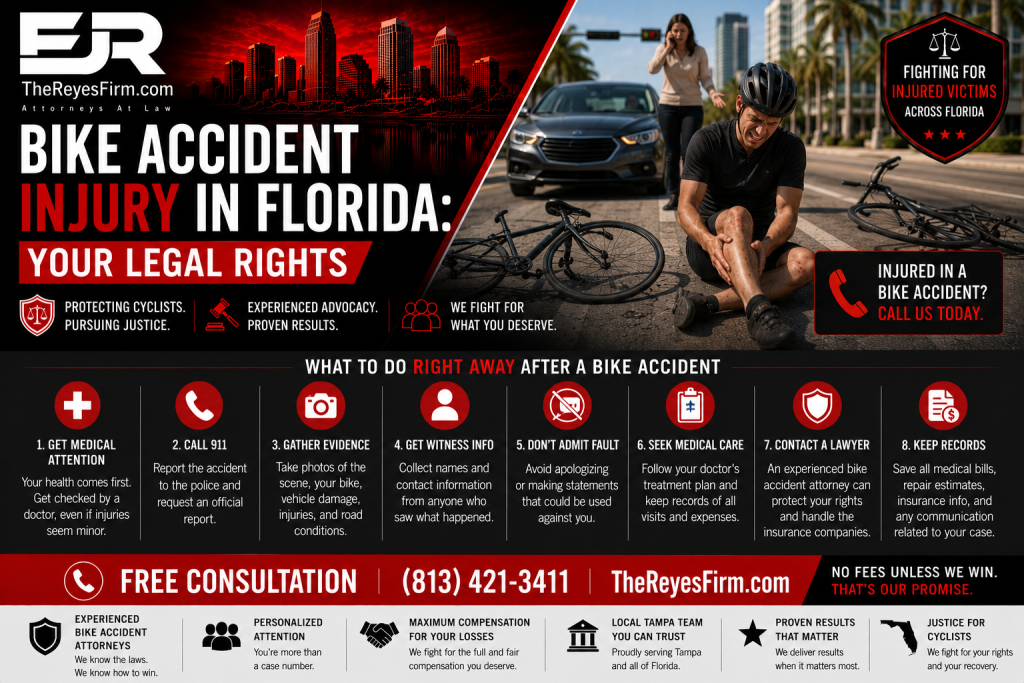
What are the 5 steps to take after a bike accident in Tampa?
These five steps protect your health and your legal case. The order matters.
- Get to safety and call 911. Move out of traffic if you can, and make sure police respond so there is an official report naming the driver and documenting the scene.
- Get medical care the same day. Even if you feel okay, get checked. Head and internal injuries can take 24 to 72 hours to show symptoms, and prompt treatment links your injuries to the crash.
- Document everything and keep your bike. Photograph the vehicle, your bike, the road, and your injuries, and collect the driver’s information plus witness contacts. Do not repair or discard your bike, since the damage is evidence.
- Do not admit fault or give a recorded statement. The driver’s insurer will look for anything that shifts blame to you. You are not required to give a recorded statement before speaking with a lawyer.
- Call The Reyes Firm before accepting any offer. Once you sign a release, you waive the right to pursue more. Call 833-4 BAD DAY for a free consultation.
The Reyes Firm
4730 N. Habana Ave., Suite 201, Tampa, FL 33614
Phone: 833-4 BAD DAY | thereyesfirm.com
How The Reyes Firm handles your bike accident case
When a driver’s carelessness puts a cyclist in the hospital, the insurance company often starts by blaming the rider. We push back on that, throughout Tampa and Hillsborough County, and make sure your side of the story is heard.
When we take on a bike accident case, we typically:
- Investigate the crash thoroughly, gathering the police report, scene photos, dashcam or surveillance footage, and witness statements before they disappear
- Confront the bias against cyclists head on, building a factual record that shows the driver caused the crash, whether by unsafe passing, failing to yield, or distraction
- Sort out your insurance, identifying whether your own PIP applies, and pursuing uninsured motorist coverage when a driver flees or has no policy
- Preserve your bike and gear as evidence, since the damage pattern often helps prove how the collision happened
- Work with medical experts to document the full scope of your injuries and your long-term treatment and care needs
- Handle all insurance negotiation on your behalf, countering lowball offers and preparing your case as if it will go to trial
No lawyer can promise an outcome. What we can promise is that we treat your case as the serious matter it is, and we never assume you were at fault just because you were on a bike.
Frequently asked questions about bike accidents in Florida
Do cyclists have the same rights as drivers in Florida?
Yes. Under Fla. Stat. § 316.2065, a person riding a bicycle has all the rights and all the duties that apply to the driver of any other vehicle. That legal status is the foundation of a cyclist’s injury claim against a negligent driver.
What is Florida’s three-foot law for passing cyclists?
Under Fla. Stat. § 316.083, a driver overtaking a bicycle must pass at a safe distance of at least three feet. A driver who passes too closely and causes a crash can be held responsible for the resulting injuries.
Does my car insurance cover me if I am hit while riding a bike?
Often, yes. Florida PIP follows the person, so if you own a vehicle with PIP, that coverage may pay a portion of your medical bills even though you were cycling. If you do not own a vehicle, a resident relative’s policy may apply.
How long do I have to file a bike accident claim in Florida?
Under Fla. Stat. § 95.11(3)(a), you generally have two years from the date of the crash to file a personal injury lawsuit. Because evidence fades quickly, it is wise to speak with a lawyer well before that deadline.
Does Florida law require cyclists to wear a helmet?
Under Fla. Stat. § 316.2065, only riders under 16 are legally required to wear a helmet. Adults are not required to, and choosing not to wear one does not automatically bar a claim, though a helmet remains one of the best protections against a serious head injury.
What if the driver who hit me fled the scene?
File a police report right away, since law enforcement may be able to identify the driver. Even if they are never found, your own uninsured motorist coverage may provide compensation, so it is important to speak with a lawyer about every policy that could apply.
How much is my bike accident case worth?
Case value depends on the severity and permanence of your injuries, your medical costs, lost income, available insurance, and your share of fault. Be wary of any source quoting settlement ranges, since only a review of your specific records can produce a realistic assessment.
Should I accept the insurance company’s first offer?
Usually not. First offers are typically far below what a claim is worth, and accepting one means giving up the right to seek more. Have a lawyer review any offer before you respond, especially while you are still treating your injuries.

Edward Reyes, Esq. is a Florida Bar-admitted personal injury attorney and the founder of The Reyes Firm in Tampa, Florida. He represents people injured by the negligence of others in cases involving bicycle accidents, car crashes, and other serious injuries throughout Tampa and the surrounding counties. Edward Reyes, Esq. handles bicycle and personal injury claims on a contingency fee basis, meaning clients pay nothing unless the firm recovers compensation for them.
Read more about Edward Reyes.
How Can The Reyes Firm Help You?
If you’ve had a bad day, whether a car accident, a slip and fall, a trucking crash, or any injury that wasn’t your fault, The Reyes Firm is in your corner. Our Tampa personal injury attorneys offer free consultations and work on a contingency fee basis, which means you pay us nothing unless we win your case.
You shouldn’t have to fight the insurance companies alone. Let us fight for you.
📍 Address: 4730 N. Habana Ave., Suite 201, Tampa, FL 33614
📞 Phone: 833-4 BAD DAY
🌐 Website: Schedule your free consultation today at thereyesfirm.com
Had a bad day? Call The Reyes Firm. We’ll handle the rest.
The information in this blog post is for general informational purposes only and does not constitute legal advice. Reading this article does not create an attorney-client relationship with The Reyes Firm. Every case is unique. If you have been injured in a bicycle accident, consult a licensed Florida personal injury attorney about your specific situation.