
Legal

Use your Health Insurance for Hospitals
After A Car Accident, After an Accident, For Parents, For Teens, Health, Legal, Our Community, Why we serve

Use your Health Insurance for Hospitals

So you go to the hospital, what do you do next? You have health insurance. You don’t have auto insurance. Let’s say you have health insurance but go to the hospital or you go to a primary care doctor, or something like that. You could use your health insurance, if you have health insurance, there’s pros and cons with using your health insurance. The pro is, if the hospital bill is, let’s say $10,000 and I’m making up numbers here, but they have a health insurance rate meaning that the health insurance has a pre-negotiated rate with that hospital to reduce the rate, so if you give them your health insurance information, they have to reduce that $10,000 bill to whatever the negotiated rate may be. So let’s say, for example, the negotiated rate is $1,500. Instead of paying $10,000, your health insurance is paying $1,500. At the end of the settlement, we have to reimburse your health insurance back, it’s called subrogation. We have to reimburse them back $1,500, but your hospital bill’s paid off. On the other flip side of it, if you did not use your health insurance or do not have insurance, they want their full $10,000. So we have to reimburse them back the $10,000. Florida’s a no-fault state, your auto insurance covers up to $10,000 in medical coverages, but there’s usually a percentage that’s not covered and deductible. Tampa personal injury lawyer Edward Reyes represents people in Tampa and Hillsborough County, Florida who have suffered an injury in an incident or accident type of accident. Speak Directly to Me, At No Cost, Today 813.421.3411 For the hospitals, they always want all their money upfront, not upfront but at the settlement. So if you have health insurance, it’s really important, use your health insurance wherever you can, especially when big-ticket items like the hospital, and then at the end of the settlement we’ll work on negotiating those bills, that way we can pay off the health insurance lean, because the health insurance wants their money back, because they’re paying for something that wasn’t accident-related, sorry paying for something that wasn’t health-related, but was accident-related. If you have any questions on this, feel free to give us a call, 813 421 3411. (Transcript from the video, transcribed but not reviewed)


My Friend’s Cousin Made 1 Trillion Dollar
After A Car Accident, After an Accident, Legal, Settlement, Why we serve

My Friend’s Cousin Made 1 Trillion Dollar

If they’re in the same car accident, but that may be the first accident their injuries may be substantially different, the insurance company may be different as well, the adjusters may be different. So every case is a little bit different. It’s very difficult to compare one person to one person. It’s like DNA because everybody is actually different in their own ways. Every settlement’s going to be different, that’s why they’re separated. Whenever you hear the comment, my friend made 50,000, 100,000, or whatever the number may be, one they may be lying, off the top. Two, it could also be that their situation is different or very unique, specifically to them. We work with your conditions, we work with your history, we work with your damages, in order for us to come up with value and fight for you to get as much money as possible in your pocket for recovery. Tampa personal injury lawyer Edward Reyes represents people in Tampa and Hillsborough County, Florida who have suffered an injury in an incident or accident type of accident. Speak Directly to Me, At No Cost, Today 813.421.3411 But again, everybody is a little bit different, so if you’re hearing people talk about somebody’s third cousin to the fourth, it’s not factual because everybody is a little bit different. Plus, everybody likes to blemish a little bit and make their settlements a little bit higher than what they typically are. If you have any questions on this, feel free to give us a call at 813-421-3411. (Transcript from the video, transcribed but not reviewed)

Are Teens Charged Differently
For Parents, For Teens, Legal, Our Community, Police Interaction, Teen Accidents, Why we serve

Are Teens Charged Differently?

Are the rights of teenagers different? It depends on the age, what advice would you give a parent or what happens in those scenarios, I guess it depends on the crime. At what point do they become, juvenile, at what point do they become adults and is it after 18 So, this is a common issue. So for anyone out there who’s got teenage children, we’ll note teenagers get in trouble. Now, teenagers do all sorts of things because they’re immature, their frontal cortex hasn’t developed yet, they’re experimenting with life, which means frequently committing, things that are crimes. They certainly come into contact with law enforcement, frequently. Now obviously, if your kid’s a UT student and they’re 18 or a University of South Florida student and they’re 18, there’s not much you can do other than, you know, shake your head and hire a lawyer. Please, hire a lawyer. But if your child is a juvenile, you can certainly talk to them, and probably the thing you should say is, “Please, I’m begging you, don’t commit any crimes. “I’m begging you not to commit any crimes.” If my kids are watching this, please don’t commit any crimes. Understanding Things However, they have to understand the same thing, the same rule that I said about traffic stops. When they come into contact with law enforcement, they have to be polite, short and consent to nothing. Now law enforcement has additional rules that they’re supposed to follow when dealing with juveniles and that’s anyone under the age of 18. They not only have to Mirandize them if they’re going to interrogate them, but they also have to go through what’s called the Ramirez Factors. Also, they’re obligated to attempt to contact an adult, parent or guardian. However, their attempt can be, I think the word would “desultory.” This is, they can make a phone call and no one can answer and they’ll just go on about their business, because of what they would say is the exigency of their job. But they are obligated to make, like sort of, a good faith attempt to talk to an adult before questioning a juvenile. Although, that’s, depending on the age and maturity of the child. So they go through the Ramirez Factors, they ask the child, you know, “How old are you? “What grade and the school have you gotten to? “Can you read and write?” To determine whether or not the child is, a child or a teenager, almost an adult. Tampa personal injury lawyer Edward Reyes represents people in Tampa and Hillsborough County, Florida who have suffered an injury in an incident or accident type of accident. Speak Directly to Me, At No Cost, Today 813.421.3411 That being said, tell your kids, “If you’re in trouble and law enforcement wants to “question you, be polite, don’t get angry, short, “consent to nothing.” That’s it. That’s probably the same advice you should give to everybody. Call us at 813.421.3411 for more information. (Transcript from the video, transcribed but not reviewed)

DUI Hearing
Accident Injuries & why, After A Car Accident, After an Accident, Car accident, Drugs, DUI/DWI, florida cities we serve, For Parents, For Teens, Legal, Our Community, Why we serve

Do I Need A DUI Hearing?

Some attorneys are very gung ho. Especially since there are several attorneys who are very experienced DUI attorneys here in Tampa who are very gung ho about doing these DUI hearings. It’s sort of an older generation to do that. My theory on it is, it may be useful. It’s not the be-all and end-all. If you need to back out on the road, you need to get back out on the road. Tampa personal injury lawyer Edward Reyes represents people in Tampa and Hillsborough County, Florida who have suffered an injury in an incident or accident type of accident. Speak Directly to Me, At No Cost, Today 813.421.3411 Call us at 813.421.3411 for more information. (Transcript from the video, transcribed but not reviewed)

Suspended License Issues
FAQ, For Parents, For Teens, Legal, Our Community, Police Interaction, Why we serve

Suspended License Issues

Driving with a suspended license happens quite a bit. What can somebody do if they get stopped, for whatever reason, tail light, whatever the case is, and they do get a ticket, or in trouble for driving with a suspended license, or license revoked. Let’s say they didn’t know about it. What could happen to them? What could somebody do in that scenario? As a quick aside on that, generally speaking, if it’s a financial obligation or an insurance issue that’s caused the license to become suspended, you may well not know. You might have gotten one of these red light tickets, it came to the address, you never saw it, eventually went into default, they put a D6 on your driver’s license. And so now your license is suspended, you have no idea. Maybe you do know. You wouldn’t readily admit anything to a police officer. Kowing the Difference There’s a huge difference between a suspended without knowledge ticket and a criminal suspended with knowledge ticket. So one’s an infraction and one’s a criminal offense. The only difference is the officer said, “Did you realize your license was suspended?” And you said, “Yeah I did know that.” So suddenly you went from a non-criminal, simple infraction ticket, to having a criminal charge. Be careful of what you say to law enforcement because you don’t want to be the one to hang yourself. But, either way, here in Hillsborough County, the general practice of the state attorney’s office, is to drop those tickets if you get your license back. Tampa personal injury lawyer Edward Reyes represents people in Tampa and Hillsborough County, Florida who have suffered an injury in an incident or accident type of accident. Speak Directly to Me, At No Cost, Today 813.421.3411 And also the general practice in the magistrate is to drop the tickets if you get your license back, for those civil infractions. In Pinellas county, they’ll amend it to a non-criminal infraction, or a criminal case to a non-criminal infraction if you get your license back. For more information, call us at 813.421.3411. (Transcript from the video, transcribed but not reviewed)
Gemini_Generated_Image_qfokqiqfokqiqfok
FAQ, For Parents, For Teens, Legal, Our Community, Why we serve

How can An Attorney Help you with Your Suspended License?

Your license was suspended — maybe over unpaid tickets, a missed court date, child support arrears, or too many points — and now the DHSMV holds the key to your freedom to drive. The Reyes Firm works with Floridians who need a real legal strategy to cut through the bureaucracy, pull debts back from collections, and get back on the road. Here’s what an attorney can actually do for you — and why acting before you catch a criminal charge matters more than most people realize. TL;DR — QUICK SUMMARY Florida law under Florida Statute § 322.34 makes driving with a knowingly suspended license a criminal offense — a second-degree misdemeanor on the first offense and a third-degree felony by the third offense. An attorney can petition courts to recall debts from collections and negotiate directly with creditors, often saving you more than the attorney’s fee. If your license was suspended over child support delinquency, a lawyer can arrange a purge hearing and payment agreement with the Florida Department of Revenue to fast-track reinstatement. Proactively addressing your suspension before you’re pulled over — rather than after you’re charged — gives you significantly more legal options and costs far less in fines, fees, and potential criminal exposure. Under Florida Statute § 95.11(3)(a), the two-year personal injury statute of limitations applies if you were injured in a crash caused by another driver’s negligence, even if you were also cited for a suspended license at the time. The Reyes Firm Suspended License Holding You Back in Tampa? Get clear answers on your reinstatement options. Had a bad day? Let’s fix it. Contact Us Now Fla. Stat. § 322.34 Governs driving while license suspended in Florida 2024 Florida Statutes 2nd Degree Misd. 1st knowing DWLS offense — criminal charge Fla. Stat. § 322.34(2)(a) 3rd Degree Felony Habitual Traffic Offender driving while revoked Fla. Stat. § 322.34(5) 2 Years Personal injury statute of limitations in Florida Fla. Stat. § 95.11(3)(a) What can a Tampa attorney actually do to help you get your suspended license back? An attorney can do things about a suspended Florida driver’s license that most people simply can’t do efficiently on their own — and in many cases the savings far outweigh the legal fee. The most common scenario involves fines and fees that have been turned over to collections agencies like Penn Credit. Once a debt goes to collections, the DHSMV will not reinstate your license until it’s resolved. An attorney can appear before a judge to have those debts recalled from collections and negotiate a resolution directly, bypassing the collection agency markup entirely. Child support delinquency is another major driver of license suspensions in Florida. Under Florida Statute § 322.058, the Department of Revenue can suspend your license for falling behind on payments. An attorney can request a purge hearing and work out a payment agreement with the Child Support Program that satisfies the DHSMV requirement for reinstatement — often faster and on better terms than trying to navigate the system alone. Old accident liens are a third area where legal help makes a measurable difference. If you have unresolved liens from prior crashes on your driving record, an attorney can negotiate those figures down before they block reinstatement. The goal in every case is the same: remove each specific barrier holding your license, not just pay the first fee that comes up. ⚠️ Don’t Wait Until You’re Charged: Under Florida Statute § 322.34, knowingly driving with a suspended license is a criminal offense. A first offense carries up to 60 days in jail and a $500 fine. A third offense can be charged as a felony. Addressing your suspension proactively — before you’re pulled over — is far easier and less expensive than fighting both a criminal case and a license reinstatement at the same time. Why is a Florida suspended license so much more serious than people expect? Most people treat a suspended license like a paperwork problem. Florida law treats it as a potential criminal matter — and the escalation happens faster than most drivers realize. Under Florida Statute § 322.34, if you drive without knowing your license is suspended, it’s a civil infraction punishable by a fine. But if you know your license is suspended and drive anyway, a first offense is a second-degree misdemeanor, a second offense is a first-degree misdemeanor, and a third offense can be elevated to a third-degree felony. The real danger is the Habitual Traffic Offender designation. Under Florida Statute § 322.264, accumulating certain traffic convictions within a five-year period — including multiple DWLS citations, even civil ones — can result in HTO classification. Once designated a Habitual Traffic Offender, your license is revoked for five years, and driving while revoked as an HTO is a third-degree felony from the first stop. Many people acquire HTO status unknowingly by simply paying civil DWLS citations without ever fixing the underlying suspension. The financial consequences compound quickly too. Each stop adds reinstatement fees, potential court costs, and insurance rate increases. A criminal conviction creates a permanent record visible to employers, lenders, and landlords. Getting ahead of the suspension — before it becomes a charge — is almost always the better path. 💡 Did You Know? Florida law creates a critical distinction between civil and criminal DWLS. Under Fla. Stat. § 322.34(1), driving without knowledge of your suspension is a civil traffic infraction. But once you’ve been stopped and cited — even for the civil version — a subsequent stop can be charged criminally, because the prior citation establishes you had notice. An attorney can challenge the “knowledge” element and work to resolve the underlying suspension before it gets worse. Watch: How can an Attorney Help you with Your Suspended License?  What are the most common reasons Florida suspends a driver’s license? Florida suspends licenses for a wide range of reasons, and many people don’t realize their driving privilege is at risk until they’re pulled over. Understanding the specific reason for your

Why Do You Need A Ticket Lawyer
FAQ, Felony, Legal, Police Interaction, Why we serve

Why Do You Need A Ticket Lawyer?

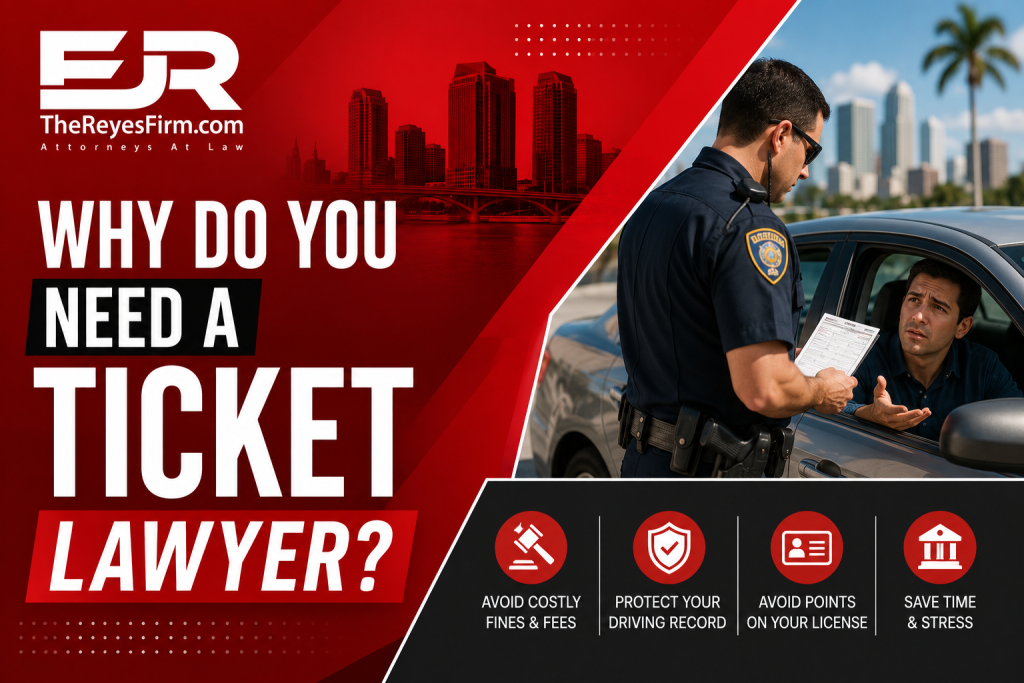
You were just driving home like any other day. Then the lights flashed behind you, and now there’s a traffic citation sitting on your dashboard with a fine, a court date, and a deadline. The easy move feels like just paying it and forgetting about it. Here’s why that “easy” move can quietly cost you far more than the ticket itself. TL;DR — QUICK SUMMARY Just paying a Florida traffic ticket is a guilty plea. It puts points on your license and can push your insurance rates up for years. You have only 30 days from the date of the citation to act, under Florida Statute § 318.14(4) — pay, elect driving school, or request a hearing. A basic speeding ticket adds at least 3 points to your record, and 12 points in 12 months triggers a license suspension under Fla. Stat. § 322.27. Driver improvement school can keep points off your record, but you can only use it once every 12 months and five times in your lifetime. A ticket lawyer can review the citation for defects, set it for a hearing, test whether the officer shows up, and negotiate to lower costs and avoid points — often without you ever stepping into court. The Reyes Firm Got a Traffic Ticket in Tampa? Before you pay it and take the points, get clear next steps. Had a bad day? Contact Us Now 30 Days To act before your options close Fla. Stat. § 318.14(4) 12 Points In 12 months = license suspension Fla. Stat. § 322.27 3 Points Added by a basic speeding ticket FLHSMV point schedule 5 Times Lifetime cap on driving school Fla. Stat. § 318.14(9) Why is just paying a Florida traffic ticket a mistake? Paying a Florida traffic ticket is the same thing as pleading guilty. The moment your payment clears, the violation is treated as a conviction, points are added to your driving record, and that record follows you. It feels like the cheapest, fastest way to make the problem disappear — but in most cases it’s the most expensive choice you can make. People ask all the time why anyone would pay an attorney a hundred or a hundred-fifty dollars to handle a ticket instead of just paying the fine. The answer is simple: the fine is almost never the real cost. The real cost is the points, the insurance hike that follows, and the risk to your license if you collect more violations down the road. A ticket that costs you $250 today can cost you far more over the next several years in higher premiums alone. ⚠️ Deadline Warning: Under Florida Statute § 318.14(4), you generally have just 30 days from the date your citation is issued to pay, elect driving school, or request a hearing. Miss that window and you can face a delinquent fee, a hold on your license, and the loss of options that were still on the table. Don’t wait to call a lawyer. What can a ticket lawyer actually do to fight your ticket? A ticket lawyer can do several things you usually can’t do effectively on your own. The first is the simplest: read the ticket. We look at the citation to see whether there’s a defect — a wrong statute, a missing detail, a problem with how it was written or served — that could get the whole thing dismissed before it ever reaches a hearing. If the ticket holds up on its face, we can set it for court and test the State’s case. That means seeing whether the officer shows up, and if they do, whether they can actually prove every element of the violation. Wouldn’t you rather pay nothing on the ticket and walk away clean? If we can get it dismissed, you’ve saved the fine, the points, and the insurance fallout all at once. And if the case can’t be dismissed — the officer appears, the paperwork is in order — we can still negotiate. In many cases a lawyer can work with the prosecutor or the magistrate to lower your court costs and, just as importantly, keep the points off your record. No lawyer can guarantee a result, but for the vast majority of routine tickets, protecting your points is a very achievable goal. If you’d rather not handle this yourself, you can always hire an attorney to take it off your plate. Watch: Why Do You Need a Ticket Lawyer? In this short video, Tampa attorney Edward Reyes breaks down exactly why paying a ticket is rarely the bargain it looks like — and what a lawyer can do instead. If you’ve already received a ticket in Hillsborough County, The Reyes Firm can review it for free and tell you whether it’s worth fighting. How do points from a Florida traffic ticket affect your insurance? Points are the bridge between a traffic ticket and a bigger insurance bill. Under Florida Statute § 322.27, the state assigns point values to violations — generally 3, 4, or 6 points depending on severity — and a basic speeding ticket alone adds at least 3 points. Your insurance company watches your driving record, and once points land on it, they have every reason to raise your premium at renewal. Points also stack up against your license. Accumulate 12 points within 12 months and your license is suspended for up to 30 days. Reach 18 points within 18 months and the suspension can stretch to three months; 24 points within 36 months can mean a suspension of up to a year. The whole point of fighting a ticket is to stop that first set of points from ever attaching. 💡 Did You Know? A single 3-point speeding ticket can raise your auto insurance premium for years, and the added cost often dwarfs the original fine. Under Fla. Stat. § 322.27, those points also count toward the 12-points-in-12-months threshold that triggers an automatic license suspension. Source: FLHSMV, flhsmv.gov. Should you take driving school

Charged with Domestic Violence
Family Law, FAQ, For Parents, For Teens, Legal, Why we serve

Charged with Domestic Violence: What To Do?

What happens if somebody has caused domestic violence to somebody else and somebody calls? What things do you look at to help them if the attacker or the alleged attacker called you or called the firm, how could they be represented? Let’s say it did happen. Let’s say it’s a fraudulent, well, not fraudulent, but let’s say it’s a bogus claim if we can hear both sides of that the defense. Well, I take all comers, which is to say if somebody comes into my office and says, “I’ve been charged with domestic violent battery,” this question will never come out of my mouth: “Did you commit the domestic violence battery?” So, some people are in a position where they did, and some people are in a position where the alleged victim, or maybe not even the alleged victim, maybe a third party, is pressing the claim for some ulterior reason. This happens for all sorts of reasons: to gain an advantage of child support, to gain an advantage in divorces, and at the end of the day, there’s always issues approval. We really want to know, what I want to know isn’t whether or not anything happened, but could the state prove it? Finding the Evidence So, what I want to know is what evidence is there that a battery occurred? And remember, in Florida, we have a very powerful standard ground law, so the question is: A) Was the alleged victim battered? and B) If the alleged victim was battered, was it a case of mutual combat or self-defense on the part of the defendant? And remember, the state must overcome that, so in my experience, it’s very difficult frequently for the state to overcome that. Domestic violence charges are some of the most common, probably outside of traffic charges, they’re the most common misdemeanor charges that we see. Domestic violence charges are very common and the reason for that is because law enforcement feels they’re in an obligation to make an arrest when they’re called, so they’re very aggressive in making the arrest and once an arrest has been made, the case takes on a life of its own. What Needs to Be Done? So, we get these a lot and they’re frequently very marginal cases. Now, again, we guarantee nothing. A case could be opened and shut, and if that’s the case, my job is really to get you the best deal possible. Frequently in these cases, diversion is available. If the state can prove it, you can take a diversion. Tampa personal injury lawyer Edward Reyes represents people in Tampa and Hillsborough County, Florida who have suffered an injury in an incident or accident type of accident. Speak Directly to Me, At No Cost, Today 813.421.3411 If the state can’t, but I’m not going to push any client to take any deal at all, because frequently, these cases are very marginal and a lot of them end up getting dropped by the state. The state drops, I would say in my experience, the majority of the cases once an attorney comes in and presses them on it. Call us today at 813.421.3411 for help. (Transcript from the video, transcribed but not reviewed)

Gemini_Generated_Image_9869ba9869ba9869
Car Search, FAQ, Legal

Should I Allow an Officer to Search My Car?

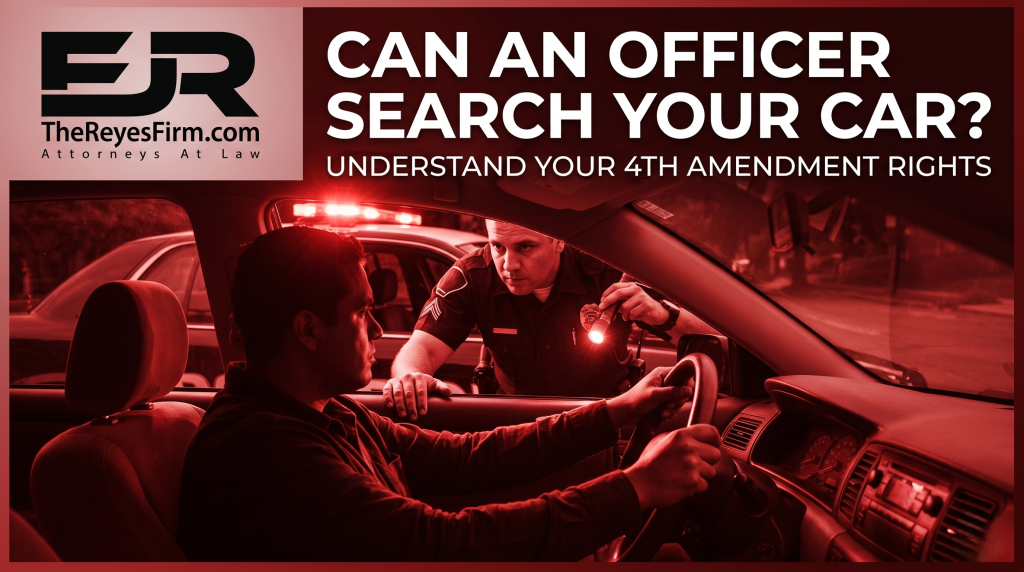
A routine traffic stop can turn into something much more serious in seconds. Before you say a word — or let an officer open a single door — you need to know exactly what your rights under Florida law are, because what you do (or don’t do) in the next two minutes can follow you for years. TL;DR — QUICK SUMMARY You have the right under the Fourth Amendment to the U.S. Constitution to refuse consent to a warrantless vehicle search — and you should always exercise that right politely. In Florida, officers generally need a warrant, your consent, or a recognized legal exception (such as probable cause or a search incident to arrest) to search your vehicle lawfully. Saying “I do not consent to a search” is not an admission of guilt — it is a protected legal right, and courts recognize the difference. Even if an officer searches your car over your objection, do not physically resist; instead, stay calm, preserve your objection on the record, and contact an attorney immediately. If a traffic stop or vehicle search led to an accident, injury, or civil rights violation, you may have legal options — call 833-4 BAD DAY to speak with The Reyes Firm today. The Reyes Firm Know Your Rights After a Traffic Stop in Tampa? Get clear answers about your legal options after a stop, search, or injury. Had a bad day? Contact Us Now 4th Amendment protects against unreasonable searches U.S. Constitution 2 Years Florida statute of limitations for personal injury Fla. Stat. § 95.11(3)(a) $0 Cost to consult with The Reyes Firm Contingency fee basis No Consent required — you always have the right to refuse Florida & Federal Law Should you allow an officer to search your car in Florida? No — in almost every situation, you should politely but clearly decline consent to a vehicle search. This is not about hiding anything. It is about exercising a constitutional right that exists precisely to protect innocent people from overreach. The Fourth Amendment to the U.S. Constitution protects you from unreasonable searches and seizures, and Florida courts consistently uphold your right to refuse consent. Officers are trained to ask for consent precisely because consent is the easiest way for them to conduct a search without a warrant, probable cause, or any other legal justification. When you say “yes,” you waive your protections entirely. When you say “I do not consent to a search” calmly and clearly, you preserve your rights and put the burden back on the officer to justify the search through a valid legal exception. The most important thing to understand: refusing to consent is not suspicious. Courts have repeatedly ruled that exercising your Fourth Amendment rights cannot be used as evidence of guilt. You are doing exactly what the law entitles you to do. ⚠️ Deadline Warning: Under Florida Statute § 95.11(3)(a), you have two years from the date of any injury — including one that occurs during or after a traffic stop — to file a personal injury lawsuit. Missing this deadline almost always means losing your right to recover anything. Don’t wait to call a lawyer. When can a Florida officer legally search your car without your consent? Florida law and federal constitutional law recognize several exceptions that allow officers to search a vehicle without your consent and without a warrant. Knowing these helps you understand when an officer is acting within the law — and when they may not be. Probable cause. If an officer has specific, articulable facts suggesting your vehicle contains evidence of a crime — including smelling marijuana (though Florida’s marijuana laws have evolved significantly), seeing contraband in plain view, or a drug-detecting K-9 alerting to your vehicle — they may have grounds to search without your consent. Search incident to a lawful arrest. If you are lawfully arrested, officers may search the area within your immediate reach inside the vehicle. However, this authority is narrower than many people assume after the U.S. Supreme Court’s decision in Arizona v. Gant (2009). Plain view doctrine. If an officer can clearly see contraband or evidence of a crime from a lawful vantage point — like through your window — they may seize it and that observation may justify a broader search. Inventory search. If your vehicle is being lawfully impounded, officers may conduct a standardized inventory search of its contents before towing. Exigent circumstances. In rare situations involving imminent danger, the destruction of evidence, or active pursuit of a fleeing suspect, officers may be authorized to act without a warrant. The key point: if none of these exceptions applies, the officer needs either a warrant or your voluntary consent. If you did not give consent and no valid exception existed, any evidence found may be suppressed under the exclusionary rule. 💡 Did You Know? Florida has seen significant legal activity around the question of what constitutes “voluntary” consent during a traffic stop. Courts evaluate factors like whether the person was in custody, whether they were told they could refuse, and the officer’s tone and demeanor. Simply feeling pressured to agree — even without an explicit threat — can be enough to challenge the voluntariness of consent in court. Watch: Should You Let Police Search Your Car in Florida?  What should you actually say if an officer asks to search your car? Keep it simple, keep it calm, and keep it consistent. The exact words matter less than the clarity and composure of your refusal. Something like: “Officer, I do not consent to a search of my vehicle.” That’s it. You do not need to explain yourself, raise your voice, or argue about the law. Here is what you should and should not do during a traffic stop search request: Do remain calm and keep your hands visible at all times. Do clearly state that you do not consent to a search, using those words specifically. Do comply with lawful orders (like producing your license, registration, and

Can a Cop Make Me Stay
Car Search, DUI/DWI, FAQ, Legal, Police Interaction, Why we serve

Can a Cop Make Me Stay?

Now on that same thing, because a lot of people out there they feel like they can’t leave. Law enforcement, they have more power over the person they’re pulling over as far as authority goes. A lot of times they come to the car and many people are scared. So, they feel like they can’t tell a cop no. What would happen if they tell a law enforcement officer, “No, you can’t search my car”? What can that law enforcement officer do? There are two things. One thing could be they can probably try to get a search warrant or if you can talk to us through that. The second thing is, what happens if that client, that person, says, “No, you cannot search my car”? I know that’s a fear for many people. Well, this is where the rubber meets the road or where theory and practice diverge because people feel like they are frequently overawed by the presence of a police officer, or it makes them very angry. Many people are very angered by being stopped by a police officer and interrogated and subject to search by a police officer. In either of these cases, people are going to make the wrong decision. If the person is overawed by the police officer, the person’s going to answer any questions, consent to anything, when it’s not necessary. Alternately, when people get upset, they quickly escalate the situation and before they know it, they get charged with a resisting a police officer. Now, it’s crazy to think this, but there are frequently resisting police officer charges with no other charges. So, the question becomes, what were they resisting? Well, if you ever watched any of these videos, you can YouTube escalation with a police officer. Things can escalate very quickly. That’s why always be polite. There’s no reason to escalate the situation. Officers frequently escalate the situation themselves. Tampa personal injury lawyer Edward Reyes represents people in Tampa and Hillsborough County, Florida who have suffered an injury in an incident or accident type of accident. Speak Directly to Me, At No Cost, Today 813.421.3411 No matter how upset they get, you have to stay calm, which is a very difficult thing to do. Your fight or flight reaction is clearly kicking in. It’s a very fraught situation, but you have to take deep breaths, and you have to stay calm, even if the officer doesn’t. Call us at 813.421.3411 for more information. (Transcript from the video, transcribed but not reviewed)
Scroll to Top