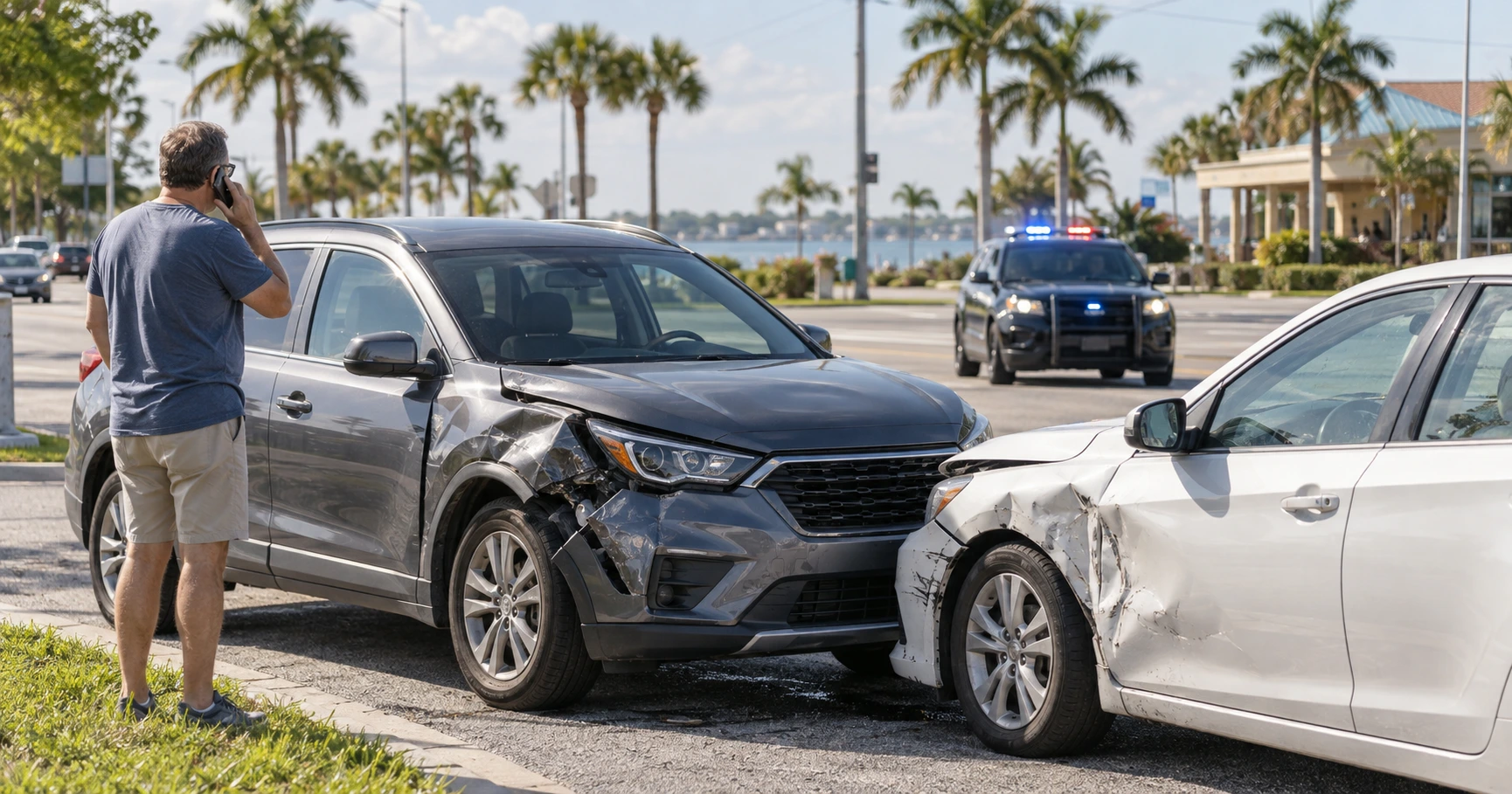
You were just in a car accident in Tampa — and now your doctor’s office is telling you that your PIP coverage only paid 80% of your medical bills. The other 20% is sitting on your kitchen table, and you have no idea who’s supposed to pay it. Here’s what Florida law actually says about that gap, and what your options are.
TL;DR — QUICK SUMMARY
- Florida’s Personal Injury Protection (PIP) insurance covers 80% of reasonable and necessary medical expenses up to the $10,000 policy limit — leaving a 20% gap you may owe out of pocket unless other coverage applies.
- If another driver caused your accident, their bodily injury liability (BIL) coverage — or a lawsuit against them — can cover the 20% gap and any costs beyond your PIP limit.
- Your health insurance may cover the unpaid 20%, but coordination of benefits rules and subrogation rights can complicate how that works.
- Under Florida Statute § 95.11(3)(a), you have two years from the date of your crash to file a personal injury lawsuit to recover that gap and all other damages from an at-fault driver.
- Medical providers cannot legally balance-bill you for amounts above the PIP fee schedule unless you signed an assignment of benefits or a separate agreement — knowing this can protect you from improper bills.
The Reyes Firm
Confused About Your PIP Bills After a Tampa Crash?
Get clear answers about the 20% gap and who should really be paying it. Had a bad day?
What is Florida’s PIP 20% gap and do you have to pay it?
Florida’s Personal Injury Protection law requires that your auto insurance cover 80% of reasonable and necessary medical expenses — and only 80%. That 20% remainder is what people call the “PIP gap.” Whether you personally owe it depends on several factors: who caused the accident, what other insurance you carry, and what agreements you signed with your medical provider.
Florida is a no-fault state, which means after a car accident, your own PIP coverage pays first — regardless of who was at fault. Under Florida Statute § 627.736, every Florida driver must carry at least $10,000 in PIP coverage, and that coverage pays 80% of covered medical costs and 60% of lost wages. The 20% gap on medical bills is built into the statute itself — it’s not a billing error and it’s not optional. The question is who ends up responsible for covering it.
If the accident was someone else’s fault, you may have a legal claim against the at-fault driver that covers the 20% gap, all medical costs beyond your $10,000 PIP limit, lost income, pain and suffering, and more. That’s where a Tampa personal injury attorney can make a real difference.
⚠️ Deadline Warning: Under Florida Statute § 95.11(3)(a), you have two years from the date of your crash to file a personal injury lawsuit against the at-fault driver. If you’ve been carrying the 20% gap yourself and another driver was responsible, waiting too long could permanently close the door on recovery. Call a lawyer before that deadline passes.
How does Florida PIP insurance actually work after a car accident?
Florida PIP works by paying directly to your medical providers — not to you — based on a statutory fee schedule. When you receive treatment after an accident, your provider bills your PIP insurer. The insurer pays 80% of the allowable amount under the fee schedule. The remaining 20% is either written off by the provider, covered by your health insurance, or billed to you depending on what agreements are in place.
There are a few important things to understand about how PIP processes your bills:
- The fee schedule controls what’s “reasonable.” Florida PIP doesn’t simply pay 80% of whatever a provider charges. It pays 80% of the amount set by the Medicare fee schedule or 200% of Medicare — whichever applies to the provider. If a provider charges more than the schedule allows, PIP will not cover the excess, and the provider generally cannot bill you for the difference under Florida law.
- Emergency vs. non-emergency treatment matters. Under Fla. Stat. § 627.736, if your injury is classified as an emergency medical condition (EMC), you can access the full $10,000 PIP limit. If your treating provider does not certify an EMC, your accessible PIP benefit is capped at $2,500. This is one of the most misunderstood and financially damaging aspects of Florida PIP.
- You must seek treatment within 14 days. Florida law requires that you seek initial medical treatment within 14 days of the accident to be eligible to use your PIP benefits at all. Missing this window means losing your PIP coverage entirely — regardless of how serious your injuries are.
Watch: Do You Pay 20% After a Car Accident?
Who pays the 20% PIP gap — you, your health insurer, or the at-fault driver?
The answer depends on your specific situation, and there’s no single rule that applies to every accident victim. The 20% gap can be absorbed in several different ways.
Option 1 — The at-fault driver’s bodily injury liability coverage. If another driver caused your accident, their liability insurance may cover your 20% co-pay, all medical expenses above your $10,000 PIP limit, lost wages not covered by PIP, and pain and suffering damages. Florida does not require drivers to carry bodily injury liability (BIL) insurance, but many drivers do carry it — and if they do, it’s often the best source of recovery for your gap costs.
Option 2 — Your health insurance. If you have private health insurance, an employer plan, Medicare, or Medicaid, your health insurer may pick up the 20% co-pay after PIP pays its 80%. However, your health insurer may have subrogation rights, meaning they can seek reimbursement from any settlement you receive from the at-fault driver. An attorney can help you navigate this properly so you don’t end up repaying more than you should.
Option 3 — A personal injury lawsuit. If the at-fault driver is uninsured or underinsured, or if your damages significantly exceed available insurance limits, a lawsuit may be the best path. Under Florida Statute § 768.81, Florida follows a modified comparative fault rule — your recovery is reduced by your own percentage of fault, and you are barred from recovering anything if you are found more than 50% responsible for the crash.
Option 4 — Your medical provider writes it off. Many providers participating in PIP fee schedules have agreed not to bill patients for the 20% co-pay as a condition of that participation. If your provider accepted assignment of your PIP benefits and participates in the fee schedule, they generally cannot pursue you for the remainder.
💡 Did You Know? Florida does not require drivers to carry bodily injury liability insurance. According to insurance industry data, Florida consistently ranks among the top states in the nation for uninsured drivers. If the driver who hit you has no BIL coverage, your own Uninsured Motorist (UM) coverage — if you purchased it — may be your best option for recovering the 20% gap and full damages. Always consult an attorney before assuming there’s no coverage available.
What happens when your medical bills go beyond the $10,000 PIP limit?

The $10,000 PIP limit is exhausted faster than most accident victims expect. A single ambulance ride, an emergency room visit, a few follow-up appointments, and imaging can easily push past $10,000 — especially for injuries involving the spine, soft tissue, or head. Once PIP is exhausted, you are personally responsible for remaining medical bills unless other sources of coverage apply.
This is where the gap stops being 20% and becomes 100% of everything above $10,000. If you suffered a serious injury in a crash caused by someone else, you need to understand the full picture of coverage available to you:
- The at-fault driver’s bodily injury liability (BIL) policy — this is typically the primary source for damages beyond PIP
- Your own underinsured motorist (UIM) coverage — kicks in when the at-fault driver’s BIL limits are too low to cover your damages
- Your health insurance — secondary coverage after PIP, subject to subrogation
- Medical payments (MedPay) coverage — optional add-on to your auto policy that pays 100% of medical bills regardless of fault, with no 20% gap
If you don’t have UM/UIM coverage and the at-fault driver has no BIL policy or inadequate limits, your options narrow significantly. A Tampa car accident attorney can conduct a full coverage investigation to find every available source of compensation before you assume you’re stuck paying those bills yourself.
What should you do right now if you’re holding unpaid medical bills after a Tampa car accident?
Don’t pay anything or sign anything until you understand the full picture. These four steps protect your finances and your legal rights.
- Request an itemized bill and an explanation of benefits (EOB) from your PIP insurer. Compare what was billed, what PIP paid, and what the insurer says is your responsibility. Errors in PIP processing are common, and some bills that show up as “patient responsibility” should have been absorbed under the fee schedule.
- Do not pay the 20% before consulting an attorney if another driver caused the crash. If the other driver is at fault, their liability coverage — or a lawsuit — may cover your gap entirely. Paying out of pocket before exploring these options can complicate your eventual recovery.
- Do not sign any release or settlement offer from the other driver’s insurance company. Once you sign, you lose the right to pursue further compensation — including future medical bills related to the accident. Insurance adjusters move fast after crashes. Their offer is designed to close your claim cheaply, not to make you whole.
- Call The Reyes Firm for a free consultation. There’s no cost and no obligation. We’ll review your coverage, identify every available source of recovery, and tell you plainly what your options are. Call 833-4 BAD DAY or schedule your free case review online.
The Reyes Firm
Confused About Your PIP Bills After a Tampa Crash?
Get clear answers about the 20% gap and who should really be paying it. Had a bad day?
How The Reyes Firm helps Tampa accident victims recover the 20% PIP gap and more
When The Reyes Firm takes on a car accident case involving PIP gaps and outstanding medical bills, our job is to build a complete picture of every dollar you’re owed — not just what’s been billed so far. Injuries evolve. Future care needs to be calculated. And the at-fault driver’s insurance company already has professionals working to minimize what they pay you.
When we handle your case, we typically:
- Conduct a full insurance coverage investigation, identifying the at-fault driver’s BIL limits, your own UM/UIM coverage, any MedPay coverage, and applicable health insurance — so no available dollar goes unclaimed
- Review all PIP billing and EOBs to identify improper balance-billing, underpayments, or fee schedule violations that you may have been incorrectly told are your responsibility
- Work with your medical providers to manage liens and negotiate medical bills so that your net recovery — what you actually keep — is maximized
- Calculate your full damages, including the 20% PIP gap, amounts beyond the $10,000 PIP limit, future medical care, lost wages, loss of earning capacity, and pain and suffering
- Handle all communication with insurance adjusters so you are not pressured into a recorded statement or a lowball settlement before you know what your case is actually worth
- Prepare your case for trial if necessary — because insurance companies pay more when they know your attorney is ready to go to the courthouse
We work on a contingency fee basis. That means you pay us nothing unless we recover compensation for you. No upfront costs, no hourly bills — just results.
🛡️ Your Rights Under Florida Law: Under Florida Statute § 768.81, if you are partially at fault for your crash, your damages are reduced proportionally — but you can still recover as long as you are 50% or less at fault. Insurance adjusters routinely try to inflate your share of fault to reduce the payout. An experienced Tampa car accident attorney works to keep the facts straight and protect your recovery.
Frequently asked questions about Florida PIP coverage and the 20% gap
Does Florida PIP insurance cover 100% of my medical bills?
No. Florida’s PIP statute, Fla. Stat. § 627.736, covers 80% of reasonable and necessary medical expenses — not 100%. The remaining 20% is the “PIP gap.” Whether you personally owe that 20% depends on who caused the accident, what other insurance applies, and what agreements exist with your medical provider.
Can the at-fault driver’s insurance cover my 20% PIP gap in Florida?
Yes, if the at-fault driver carries bodily injury liability (BIL) insurance. Their BIL policy can compensate you for the 20% gap, medical costs above your $10,000 PIP limit, lost wages beyond PIP’s 60% coverage, and non-economic damages like pain and suffering. If the at-fault driver has no BIL coverage, your own uninsured motorist coverage may apply instead.
What if my medical bills exceed my $10,000 PIP limit after a Tampa car accident?
Once your PIP limit is exhausted, you are responsible for remaining bills unless other coverage picks them up. The at-fault driver’s BIL coverage, your own UIM policy, your health insurance, or a personal injury lawsuit may cover the excess. Serious injuries — fractures, spinal injuries, traumatic brain injuries — routinely generate bills far exceeding $10,000, which is why pursuing a claim against the at-fault driver is so important.
Can a medical provider bill me for the 20% PIP gap?
It depends. If your provider accepted assignment of your PIP benefits and participates in the Florida fee schedule, they are generally prohibited from balance-billing you for the 20% difference between the fee schedule amount and their full charge. However, if you signed a separate agreement with the provider accepting personal responsibility for the gap, you may owe it. Always read what you sign at intake before treatment begins.
How long do I have to sue the at-fault driver for my PIP gap and other damages in Florida?
Under Florida Statute § 95.11(3)(a), you have two years from the date of your car accident to file a personal injury lawsuit. This deadline is strict — courts almost never grant extensions, and missing it typically means losing your right to any recovery from the at-fault driver entirely.
Does Florida require drivers to carry bodily injury liability insurance?
No. Florida only requires drivers to carry PIP and property damage liability (PDL) coverage. Bodily injury liability is not mandatory for most Florida drivers. This means if the driver who hit you has no BIL policy, their insurer has no obligation to pay your medical bills. In that situation, your own UM/UIM coverage becomes critical — which is one reason attorneys strongly recommend carrying it.
What is the 14-day rule and how does it affect my PIP claim in Florida?
Florida law requires you to seek initial medical treatment within 14 days of a car accident to qualify for PIP benefits. If you wait longer than 14 days before seeing a doctor, your PIP insurer can deny your entire claim — regardless of the severity of your injuries. Always seek medical evaluation immediately after a crash, even if you feel fine, and let the doctor determine whether treatment is necessary.
What if my PIP runs out and the at-fault driver is uninsured in Tampa?
If the at-fault driver carries no bodily injury liability insurance and your PIP is exhausted, your own uninsured motorist (UM) coverage — if you purchased it — steps in to cover remaining medical expenses, lost wages, and pain and suffering. If you don’t have UM coverage, options are more limited but not necessarily exhausted. Call The Reyes Firm at 833-4 BAD DAY to discuss what avenues remain in your specific situation.
Should I accept the insurance company’s first settlement offer to cover my PIP gap?
In most cases, no — especially if you are still treating, have future medical needs, or have not yet fully understood the extent of your injuries. The first offer from an insurance adjuster is almost always designed to close your claim quickly and cheaply. Once you sign a release, that’s final. A Tampa personal injury attorney can evaluate whether the offer reflects your actual damages before you make a decision that cannot be undone.

Edward Reyes, Esq. is a Florida Bar-admitted personal injury attorney and the founder of The Reyes Firm in Tampa, Florida. His practice focuses on serious injury and wrongful death cases arising from commercial vehicle crashes, including delivery truck accidents involving FedEx, UPS, Amazon, and other carriers. Edward Reyes, Esq. represents injured Floridians in Tampa and throughout Hillsborough County on a contingency fee basis, meaning clients pay nothing unless the firm recovers compensation for them.
Read more about Edward Reyes.
How Can The Reyes Firm Help You?
If you’ve had a bad day — a car accident, a slip and fall, a trucking crash, or any injury that wasn’t your fault — The Reyes Firm is in your corner. Our Tampa personal injury attorneys offer free consultations and work on a contingency fee basis, which means you pay us nothing unless we win your case.
You shouldn’t have to fight the insurance companies alone. Let us fight for you.
📍 Address: 4730 N. Habana Ave., Suite 201, Tampa, FL 33614
📞 Phone: 833-4 BAD DAY
🌐 Website: Schedule your free consultation today at thereyesfirm.com
Had a bad day? Call The Reyes Firm. We’ll handle the rest.
The information in this blog post is for general informational purposes only and does not constitute legal advice. Reading this article does not create an attorney-client relationship with The Reyes Firm. Every case is unique. If you have been injured in a car accident and have questions about your PIP coverage or unpaid medical bills, consult a licensed Florida personal injury attorney about your specific situation.