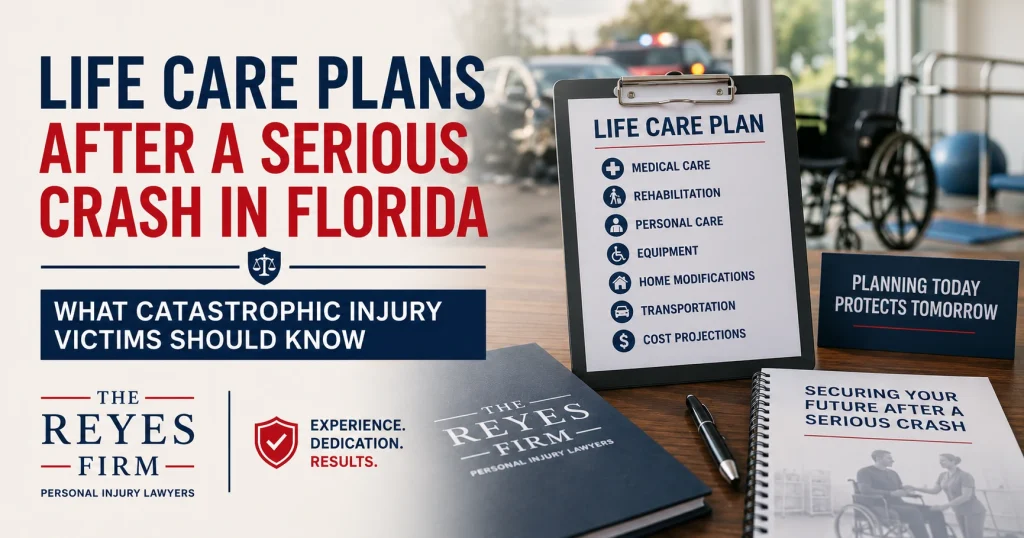
A life care plan explains the future medical care, support, equipment, and costs an injured person may need after a catastrophic injury in Florida. A strong life care plan in a Florida truck accident claim can help prove the full cost of long-term medical needs when a crash causes life-changing harm.
Key Takeaways
- Future care needs proof.
- Truck crashes can cause lifelong harm.
- PIP rarely covers catastrophic care.
- Early legal help protects evidence.
⚠️ Important: Do not settle a catastrophic injury claim before future medical needs are clear. Once a case settles, the insurance company usually does not pay more later if new surgeries, therapy, home care, or long-term support become necessary.
What Is a Life Care Plan After a Catastrophic Injury in Florida?
A life care plan is a detailed roadmap for future care. It explains what an injured person may need after a catastrophic injury.
The plan may include medical treatment, therapy, medication, equipment, home care, and home changes. It also estimates the cost of those needs.
After a truck accident, treatment may not end after the first hospital visit. Some people need years of medical support.
In our experience handling catastrophic injury cases in Florida, this planning can be critical. It helps show the difference between current bills and future reality.
Why Does a Life Care Plan Matter in a Catastrophic Injury Claim?
A life care plan matters because future care may be expensive. It helps prove those costs with medical evidence.
Insurance companies often focus on current bills. That can leave out future surgeries, therapy, nursing care, and daily support.
A life care plan may help document:
- Future medical treatment
- Rehabilitation needs
- Long-term medication
- Home health support
- Mobility equipment
- Transportation limits
- Home accessibility needs
- Ongoing specialist care
A strong plan gives the claim structure. It also helps explain why a life care plan Florida truck accident case may involve much more than emergency room bills.
When Is a Life Care Plan Needed After a Catastrophic Injury?
A life care plan is often needed when injuries are severe, permanent, or medically complex. It is especially useful when care may continue for years.
Catastrophic injuries can happen in truck accidents, car crashes, motorcycle crashes, pedestrian accidents, falls, and other serious incidents. These injuries can change a person’s life in seconds.
A plan may be helpful after:
- Traumatic brain injuries
- Spinal cord injuries
- Amputations
- Severe burns
- Multiple fractures
- Paralysis
- Chronic pain
- Organ damage
- Serious orthopedic injuries
If the injury affects work, mobility, memory, independence, or daily care, future planning matters. Our legal team at The Reyes Firm looks beyond the first medical bill.
For broader legal guidance, victims may benefit from speaking with a catastrophic injury lawyer Florida families trust after serious accidents.
What Does a Life Care Plan Usually Include?
A life care plan usually includes medical care, support services, equipment, and projected costs. Each item should connect to the crash-related injury.
| Life Care Plan Category | Common Examples |
| Medical care | Future surgeries, specialist visits, follow-up exams |
| Rehabilitation | Physical, occupational, and speech therapy |
| Medication | Pain medicine, nerve medication, medical supplies |
| Equipment | Wheelchairs, braces, walkers, hospital beds |
| Home support | Nursing care, aides, personal care help |
| Home changes | Ramps, bathroom changes, wider doorways |
| Transportation | Modified vehicle needs, medical transport |
| Care coordination | Case management and long-term planning |
The goal is clarity. The plan should show what care is needed, why it is needed, and what it may cost.
Who Creates a Life Care Plan?
A trained life care planner usually creates the plan. This person often has nursing, rehabilitation, or case management experience.
The life care planner may review:
- Emergency records
- Hospital records
- Surgical reports
- Therapy notes
- Imaging reports
- Medication lists
- Specialist opinions
- Daily living limitations
The planner may also speak with treating doctors. This helps connect future care needs to medical evidence.
In major injury cases, lawyers may also involve economists. An economist can help calculate future costs over time.
How Does a Life Care Plan Help Prove Future Medical Expenses?
A life care plan helps prove future medical expenses by making them specific. It explains the expected care, frequency, duration, and cost.
A general statement is often weak. For example, “the victim may need therapy” does not explain much.
A stronger plan may explain the type of therapy, number of visits, expected duration, and medical reason. That makes the future cost easier to understand.
This can matter during settlement talks. It can also matter if the case goes to trial.
What Florida Laws Affect Life Care Plan Claims?
Florida law affects deadlines, fault, insurance benefits, and medical expense evidence. These rules can shape the value of a serious crash claim.
Florida Statute § 95.11 gives many negligence claims a two-year filing deadline. This makes timing important after a serious truck accident.
Florida Statute § 768.81 follows modified comparative negligence. In many negligence cases, a party found greater than 50 percent at fault may not recover damages.
Florida Statute § 627.736 governs personal injury protection, also called PIP. PIP benefits are limited and often do not cover catastrophic future care.
Florida Statute § 768.0427 addresses evidence used to prove past and future medical expenses in personal injury and wrongful death cases. This makes careful medical documentation important.
Can PIP Cover a Full Life Care Plan?
No, PIP usually cannot cover a full life care plan. Serious truck crash injuries often exceed basic PIP benefits.
PIP may help with early medical bills. But it is not designed to fund lifelong care.
That is why a serious injury claim may look beyond PIP. Other responsible parties may include:
- The truck driver
- The trucking company
- A vehicle owner
- A maintenance company
- A cargo loading company
- Another negligent driver
A life care plan can help show why the claim involves more than early treatment.
How Are Life Care Plans Different in Truck Accident Cases?
Truck accident life care plans are often more complex because the injuries are often severe. The legal case may also involve several companies and insurance policies.
The injury side may require medical experts. The liability side may require trucking evidence.
Important evidence may include:
- Driver logs
- Black box data
- Maintenance records
- Safety policies
- Cargo records
- Delivery schedules
- Dash camera footage
- Hiring and training records
At The Reyes Firm, our legal team looks at both sides. The medical future and crash evidence must work together.
How Can a Life Care Plan Help a Traumatic Brain Injury Claim?
A life care plan can help explain the future effects of a brain injury. It may show the need for therapy, supervision, medication, and cognitive care.
A traumatic brain injury claim Florida truck accident victims bring may involve symptoms that are not obvious at first. These may include memory loss, mood changes, headaches, sleep problems, and trouble focusing.
Future care may include:
- Neurology visits
- Neuropsychological testing
- Speech therapy
- Cognitive therapy
- Mental health support
- Medication management
- In-home supervision
- Work restrictions
In our experience, brain injury cases need careful documentation. Small daily changes can have a major life impact.
How Can Future Surgery Affect a Florida Personal Injury Claim?
Future surgery can affect a claim because it may increase medical costs, recovery time, and pain. It may also affect work ability and daily independence.
Surgery alone does not decide case value. The full impact matters.
Important factors may include:
- Type of surgery
- Medical necessity
- Recovery time
- Permanent limitations
- Risk of future procedures
- Impact on work
- Pain and suffering
- Long-term therapy needs
For related guidance, injured people may want to review resources about surgery case value Florida personal injury claims. That topic can help explain why medical proof matters after serious crashes.
What Evidence Supports a Strong Life Care Plan?
Strong evidence supports a strong life care plan. The plan should rely on medical records, expert opinions, and real daily limitations.
Helpful evidence may include:
- Emergency room records
- Diagnostic imaging
- Surgical records
- Specialist notes
- Therapy records
- Pain management records
- Medication history
- Functional capacity evaluations
- Family caregiver observations
- Photos or videos of limitations
Daily life evidence can be powerful. It helps show how the injury affects normal tasks.
Can the person bathe alone? Can they drive? Can they work? Can they sleep? These details matter.
How Do Insurance Companies Challenge Life Care Plans?
Insurance companies often challenge life care plans by calling them too expensive or speculative. They may also claim the care is unrelated to the crash.
Common arguments include:
- The injury is not permanent.
- The future care is unnecessary.
- The cost estimates are too high.
- Cheaper care is available.
- A pre-existing condition caused the problem.
- The crash did not cause every limitation.
This is why the plan must be well supported. Medical evidence should connect each recommendation to the injury.
When Should a Lawyer Consider a Life Care Plan?
A lawyer may consider a life care plan once the long-term injury picture becomes clearer. But legal preparation should begin much earlier.
Some injuries need time to stabilize. Doctors may need months to understand the full outcome.
Still, waiting too long can hurt the case. Records can disappear. Witnesses can become harder to find. Deadlines can pass.
Early legal help allows the evidence to be preserved while treatment continues.
How Can a Life Care Plan Affect Settlement Value?
A life care plan can help make settlement value more accurate. It shows the future cost of living with serious injuries.
Without it, a claim may focus too much on past bills. That can undervalue the case.
A serious truck accident settlement may consider:
- Past medical bills
- Future medical care
- Lost income
- Reduced earning ability
- Pain and suffering
- Disability
- Loss of independence
- Family impact
A life care plan is not the only factor. But it can be one of the most important tools in a catastrophic injury claim.
What Happens If the Injured Person Cannot Return to Work?
If the injured person cannot return to work, the claim may include lost earning capacity. This means the injury reduced the person’s ability to earn income.
A life care plan can show physical or cognitive limits. A vocational expert may explain job restrictions.
An economist may then calculate long-term income loss. This can be especially important for younger victims.
For deeper guidance, injured workers may also need information about lost earning capacity Florida personal injury claims. This issue often appears in catastrophic truck accident cases.
What If the Victim Needs Long-Term Home Care?
Long-term home care may be included when medically necessary. This can involve nursing care, personal care, or daily living support.
Some victims need help with:
- Bathing
- Dressing
- Cooking
- Medication reminders
- Mobility
- Wound care
- Transportation
- Household tasks
Family members often carry this burden. A life care plan can help document how much support the person truly needs.
What If the Victim Had a Pre-Existing Condition?
A pre-existing condition does not automatically end a claim. The key question is whether the crash worsened the condition.
For example, someone may have had mild back pain before the crash. A truck accident may turn that condition into a disabling injury.
Medical records are important here. Doctors can explain what changed after the crash.
Insurance companies often use pre-existing conditions to reduce claims. Clear evidence can help push back.
How Can The Reyes Firm Help With a Life Care Plan Claim?
The Reyes Firm can help build the evidence needed to prove future care. Our legal team works to show the full impact of serious injuries.
This may include:
- Reviewing medical records
- Preserving trucking evidence
- Identifying all liable parties
- Working with medical experts
- Coordinating life care plan review
- Calculating long-term damages
- Handling insurance communications
- Preparing the case for negotiation or trial
Our goal is simple. We help injured people protect their future after a bad day.
FAQs About Life Care Plans After Catastrophic Injuries in Florida
How much does a life care planner cost?
The cost depends on injury complexity, records, expert time, and whether testimony is needed. In many injury cases, case expenses are handled through the legal claim.
Can a life care plan be changed later?
Yes. A life care plan can be updated if the person’s medical condition, treatment needs, or cost projections change.
Does a life care plan guarantee a higher settlement?
No. It does not guarantee a result, but it can help prove future medical needs with stronger detail.
Will the defense hire its own life care planner?
Sometimes. Insurance companies may use defense experts to dispute future care needs or projected costs.
Does life expectancy affect a life care plan?
Yes. Life expectancy can affect how long future care costs are projected.
Can a life care plan include transportation costs?
Yes. It may include medical transport, modified vehicle needs, or travel for necessary care.
Is a life care plan used only at trial?
No. It may also be used during settlement negotiations, mediation, and case valuation.
Can a life care plan include mental health care?
Yes. Mental health care may be included when crash-related trauma, anxiety, depression, or PTSD is medically supported.
What happens if future care costs are underestimated?
The injured person may run out of settlement funds later. This is why future care should be reviewed before settlement.
Can a life care plan include future caregiver burnout?
It may address the need for paid care when family caregiving is not sustainable. This depends on the medical and functional evidence.

Edward Reyes, Esq., is a Florida Bar-admitted personal injury attorney and the founder of The Reyes Firm in Tampa, Florida. He represents injured people and families in serious personal injury cases, including truck accidents, catastrophic injury claims, long-term medical care cases, life care planning issues, and lost earning capacity claims. The Reyes Firm serves Tampa, South Shore, Riverview, Brandon, Plant City, and communities across Hillsborough County.
How Can The Reyes Firm Help After a Catastrophic Injury?
If a catastrophic injury left you or someone you love facing future surgery, therapy, home care, or lost income, The Reyes Firm can help you understand what your claim may need to include. Our Tampa personal injury attorneys help injured people after serious crashes, including truck accidents, build claims that account for long-term medical needs, life care planning, catastrophic injuries, and lost earning capacity.
You should not have to guess what your future care may cost or fight the insurance company alone. We offer free consultations and work on a contingency fee basis, which means you pay no attorney’s fees unless we recover compensation for you.
📍 Address: 4730 N. Habana Ave., Suite 201, Tampa, FL 33614
📞 Phone: 833-4 BAD DAY
🌐 Website: Schedule your free consultation today at thereyesfirm.com
Had a bad day? Call The Reyes Firm. We’ll help you plan for what comes next.
This article is for general information only. It is not legal advice.