What You Need to Know
- Depending on how you were hurt, responsibility may fall on the transport company, the driver, the vehicle owner, or another driver.
- An unsecured wheelchair, a hard stop, or a faulty lift can lead to a claim, and federal rules require securement systems and driver assistance.
- If Medicaid paid for your care, it may have a claim against part of your recovery, so check before you sign anything.
- Most Florida negligence lawsuits have a two-year deadline, computed from the injury date and requiring verification by a lawyer.
- Take photos, save the ride records, and talk with a lawyer before you give any statement to an insurer.
Had a bad day? Call The Reyes Firm at 833-4 BAD DAY.
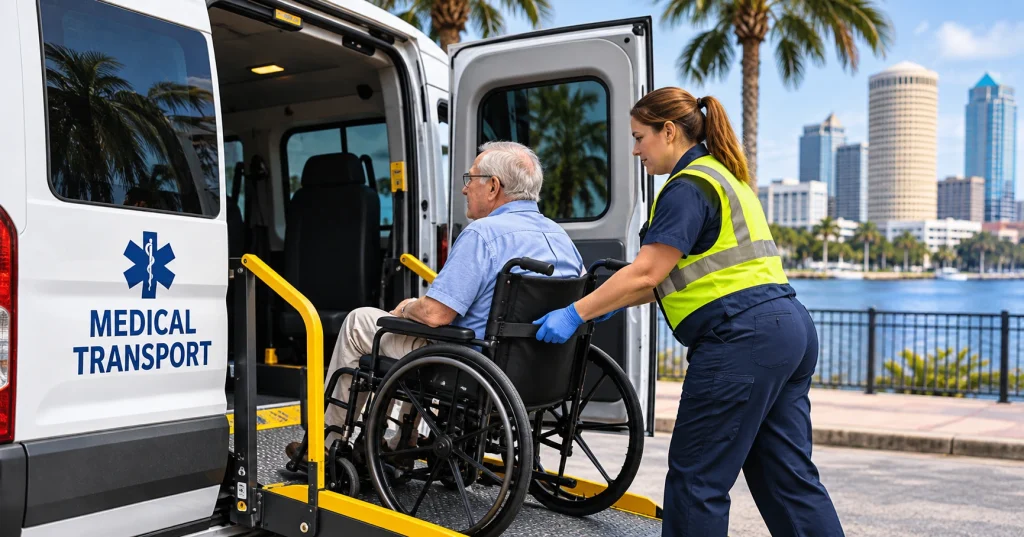
A ride to a medical appointment should never end in an injury. If you or someone you love was hurt in a wheelchair van, a non-emergency transport vehicle, or another medical transport van accident, you likely have two big questions: who is responsible, and who pays?
The answer depends on how it happened. A loose strap, a hard stop, a broken lift, or a crash with another car can point to different people and different rules. Some vans belong to private companies. Others run through government or Medicaid programs, and that changes the claim.
This guide from The Reyes Firm in Tampa explains the questions families ask most, using Florida and federal sources. It is general information, not legal advice, and every case turns on its own facts.
Who is responsible if you are hurt in a medical transport van in Florida?
The company that ran your ride, its driver, the van’s owner, or another driver may be responsible, depending on what caused your injury. Florida lets a court divide fault among everyone involved and reduce your recovery by your own share, under Fla. Stat. § 768.81.
Florida calls this comparative negligence. If a court finds you partly at fault, your recovery shrinks by your share. In most negligence cases, a person found more than 50 percent at fault is barred from recovering (§ 768.81(6)). That bar does not apply to medical negligence claims under chapter 766.
Here is how the way you were hurt can point to different people:
| How you were hurt | Who may be responsible | What may matter |
|---|---|---|
| Wheelchair not secured | The transport company, the driver | Securement equipment, driver help, training records |
| Sudden stop or unsafe driving | The driver, the company, another driver who caused the stop | Driver records, trip data, other vehicle details |
| Fall on the lift or ramp | The company, whoever kept the lift in working order | Lift inspection and repair records |
| The van hit your car | The van driver, the company that runs the van | Crash report, insurance, your own PIP coverage |
| Van run by a government service | Special claim rules may apply | Written notice rules, damage caps |
Some vans belong to private companies, so a ride can raise the same questions as any company vehicle accident. Others are run by government services or tied to Medicaid ride programs. Claims against government entities follow special rules under Fla. Stat. § 768.28, so who runs the van matters early.
⚠️ Warning: Deadlines. Florida’s general deadline to file a negligence lawsuit is two years under Fla. Stat. § 95.11(5)(a), and wrongful death claims also carry two years under § 95.11(5)(e). Which deadline applies, when it starts, and any exceptions depend on your facts. Claims against government-run services have separate notice rules. Treat any date as a computed estimate that a lawyer must verify, not a final deadline.
What if a wheelchair was not secured correctly?
The company that ran the ride, or its driver, may be responsible if an unsecured wheelchair caused your injury. Federal rules for covered services require a securement system that keeps the wheelchair in place, and staff must help with securement, ramps, and lifts when needed or asked. See 49 CFR § 37.165.
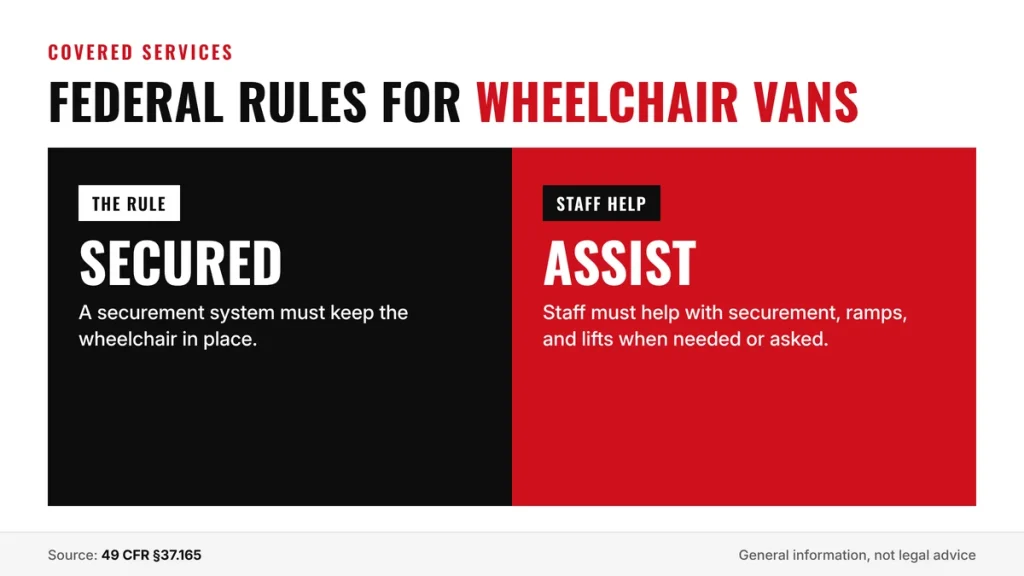 Federal rules for covered services call for securement and staff help. General information, not legal advice.
This rule covers public and private entities. Its reach to a specific company depends on the type of service, so that is one of the first things to check.
Questions an investigation may ask:
- Was the wheelchair locked down with a working securement system?
- Did the driver check the chair before the van moved?
- Did the driver help with the ramp or lift when you or your family asked?
- Was the equipment maintained and in good working order?
If your ride came through Florida’s transportation disadvantaged program, state rule Fla. Admin. Code R. 41-2.006 also says drivers must offer boarding help, including securement. That rule applies to that program, not to every private van company.
What if the driver stopped hard, or you were hurt on the lift or getting in?
You may have a claim against the driver, the company, or both if careless driving, a hard stop, or a faulty lift hurt you. Who is responsible depends on what caused the fall or crash, and Florida law lets fault be shared among everyone involved under Fla. Stat. § 768.81.
Picture a rider in a wheelchair van heading north on I-275 into Tampa when traffic stops short. The van brakes hard and the rider slides. Was the van following too closely? Did another driver cut in? The answer shapes who may be responsible.
Evidence that can matter after a stop or lift injury:
- Trip records, including pickup time, route, and the dispatcher’s notes
- Lift inspection, repair, and maintenance records
- Camera footage from inside or outside the van, if any exists
- Seat belt and securement use
- Names and details of any other driver or witness
Ask the company to keep these records. Records can be lost or overwritten if no one asks early.
🛡️ Your Rights Under Florida Law: Help getting on, off, and secured. Under 49 CFR § 37.165, covered public and private transportation entities must use a securement system that keeps your wheelchair in place, and staff must help with securement systems, ramps, and lifts when you need or ask for it. Coverage of a specific company depends on the facts. If you or your family asked for help and did not get it, write down what happened and when.
Who pays: the transport company’s insurance, Medicaid, or you?
The at-fault party’s insurance may pay for your losses, and if Medicaid paid for your care, it may be repaid from your recovery. Florida treats Medicaid as the payer of last resort and gives it a claim against settlements, under Fla. Stat. § 409.910.
Medicaid also pays for many rides. The Florida Agency for Health Care Administration says Medicaid covers medically necessary non-emergency transportation when there is no other way to get to care. That covers the ride. It does not decide who pays when the ride goes wrong.
Medicaid does not stop you from bringing a claim. It may claim part of what you recover. How that works under § 409.910:
- Attorney fees and costs come out first.
- Medicaid may then recover half of what remains, up to what it paid. The formula counts the attorney fee at 25 percent for that calculation.
- Payment or a deposit in trust is due within 60 days after you receive notice and the proceeds.
- You may challenge the amount by petition within 21 days, and you must prove your case by clear and convincing evidence.
- Releasing the at-fault party without involving the agency can create lien problems, so have a lawyer review any release first.
On insurance, some operators in Florida’s transportation disadvantaged program must carry at least $200,000 per person and $300,000 per incident under rule 41-2.006. That rule is program-specific. We don’t assume what coverage any private company carries, and finding the policies is part of the investigation.
What if a medical transport van hit your car?
You may be able to recover from the van driver and the company that runs the van, and your own Florida personal injury protection (PIP) coverage may pay first for medical bills. PIP is set out in Fla. Stat. § 627.736.
Under the text we reviewed, PIP works like this:
- Benefits are up to $10,000, or $2,500 if a doctor finds no emergency medical condition.
- It pays 80% of medical bills and 60% of lost income.
- You generally need to begin treatment within 14 days. That is a condition of coverage, not a lawsuit deadline.
Your policy and the vehicle you were in determine whether PIP applies. A lawyer should confirm the current text and your policy.
PIP does not cover everything. You may still have a claim against the van driver and the company, and fault can still be shared under § 768.81. A delivery or cargo van brings different questions, which our guide to a cargo van accident in Tampa explains. Our guide to a farmworker bus or van injury covers another kind of company ride.
What should families do first, and what evidence matters?
Get medical care first, then write down who ran the ride, which van it was, and what happened. Photograph your injuries, the van, the straps or lift, and the scene. Keep every bill and ride record. Do not sign anything or give a recorded statement until you talk with a lawyer.
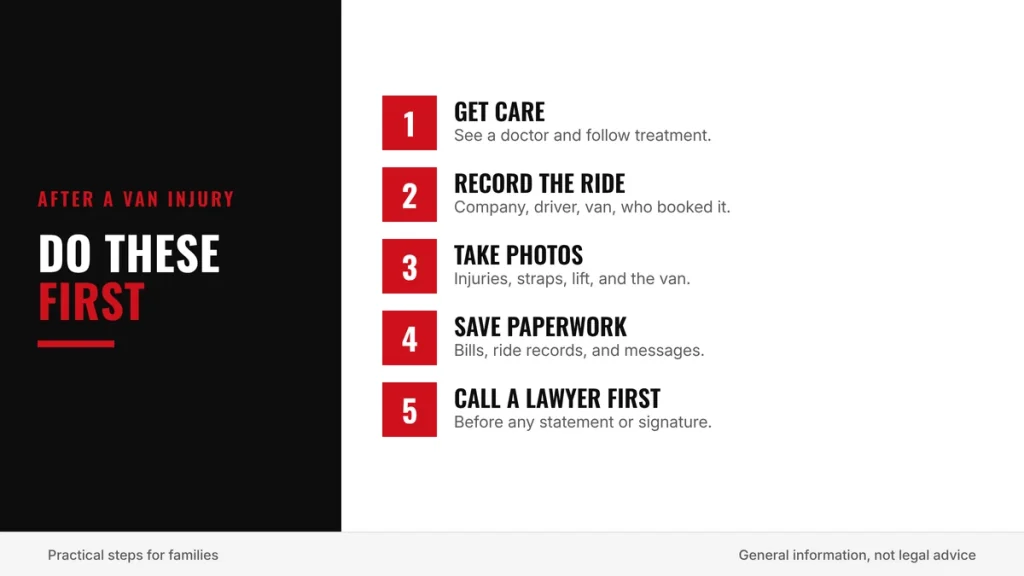
Evidence families in Tampa, Riverview, Brandon, Plant City, and across Hillsborough County often need:
- The company name, driver name, and van number or plate
- The ride booking or confirmation, and who arranged the ride
- Photos of injuries, the lift or ramp, the straps, and any damage
- Medical records and every bill
- Messages with the dispatcher or the company
- Names and phone numbers of witnesses
| Do | Do not |
|---|---|
| See a doctor and follow treatment | Sign a release or a form you have not read |
| Save records and photos | Give a recorded statement before talking with a lawyer |
| Ask the company in writing to keep its records | Guess about your injuries or who caused them |
| Keep notes on pain and missed work | Post about the injury on social media |
If your ride was to or from care in Sun City Center or elsewhere on the South Shore, the same steps apply.
How The Reyes Firm Handles Your Medical Transport Van Accident Case
The Reyes Firm is a Tampa personal injury firm serving Tampa, Riverview, Brandon, Plant City, and communities across Hillsborough County. When a family calls after a medical transport van accident, we start by listening to what happened, then we move quickly to protect the evidence.
Here is the work we do on a case like yours:
- Investigate the ride. We look at how the trip was booked, who ran it, who owned the van, and what happened before, during, and after the injury.
- Identify who may be responsible. This can include the transport company, the driver, the vehicle owner, or another driver, and each may have different insurance and rules.
- Gather the evidence. We request trip records, securement and lift maintenance records, and any camera footage, and we collect photos, witness details, and medical records.
- Review the coverage. We look for liability policies, your own PIP coverage when it applies, and any Medicaid claim against your recovery.
- Document your injuries and losses. We work with your records to show how the injury changed your health, your care, and your daily life.
- Handle the insurance calls. You do not have to deal with an adjuster alone.
- Prepare for what comes next. We build each case for settlement talks and prepare as if it may go to trial.
Our office is at 4730 N. Habana Ave., Suite 201, Tampa, FL 33614. Call 833-4 BAD DAY to talk about your situation. We take cases involving a commercial vehicle accident in Florida, and every case starts with the facts of your ride.
Frequently Asked Questions About Medical Transport Van Accidents
Does a medical transport company have a higher duty of care than a regular driver?
Sometimes. If the company is a common carrier, Florida’s standard jury instruction on common carriers (No. 401.6) says it may owe the highest degree of care consistent with how it carries passengers. Courts have not settled that every wheelchair or non-emergency van is a common carrier, so the answer depends on the facts. A lawyer will look at how the service actually operates.
Does it matter if the van belongs to a private company, a hospital, or a government service?
Yes, it can. A private company is generally sued under the regular negligence rules, while a government-run service follows Fla. Stat. § 768.28, which, in the text we reviewed, includes written notice rules and damage caps. Who owns the van does not by itself show who was at fault, because the facts decide that. Tell your lawyer early who ran the ride and who booked it.
Does Medicaid take part of my settlement?
It may. Under Fla. Stat. § 409.910, Medicaid can seek repayment from a recovery for what it paid for your injury care. After attorney fees and costs, the formula lets Medicaid recover up to half of what remains, capped at what it paid, and you can challenge the amount within 21 days. A lawyer should handle any lien notice.
How long do I have to file a claim?
For most Florida negligence claims, the lawsuit deadline is two years under Fla. Stat. § 95.11(5)(a), and wrongful death claims also carry two years under § 95.11(5)(e). Claims against government-run services have separate notice rules. Treat any date as computed from your injury date and requiring verification, and do not wait to find out.
Does my own Florida PIP insurance pay first if a transport van hit my car?
Often it may. Under Fla. Stat. § 627.736, PIP can pay up to $10,000 in benefits, or $2,500 if a doctor finds no emergency medical condition, and you generally need to begin treatment within 14 days. Whether PIP applies depends on your policy and the vehicle you were in.
Do I need a lawyer if the transport company’s insurer calls me?
You can talk with a lawyer before you talk with the insurer, and many people do. An adjuster works to protect the company and its insurer, not you. Do not give a recorded statement or accept an offer until a lawyer has reviewed it. The Reyes Firm offers free consultations.
What should I avoid signing or saying after a transport van injury?
Avoid signing a release, settlement papers, or any form you have not had reviewed, because a release can affect a Medicaid claim under § 409.910. Avoid guessing about what caused the injury, and keep posts about it off social media. Stick to the facts you know when you describe what happened.

Edward J. Reyes, Esq., is an attorney at The Reyes Firm in Tampa, Florida. He is admitted to practice law in Florida. His practice focuses on personal injury cases, including commercial vehicle and catastrophic injury claims.
How Can The Reyes Firm Help You?
If you’ve had a bad day — a car accident, a slip and fall, a trucking crash, or any injury that wasn’t your fault — The Reyes Firm is in your corner. Our Tampa personal injury attorneys offer free consultations and work on a contingency fee basis, meaning you pay nothing unless we win your case.
You shouldn’t have to fight the insurance companies alone. Let us fight for you.
📍 Address: 4730 N. Habana Ave., Suite 201, Tampa, FL 33614
📞 Phone: 833-4 BAD DAY
🌐 Website: Schedule your free consultation today at thereyesfirm.com
Had a bad day? Call The Reyes Firm. We’ll handle the rest.
Legal Disclaimer: This article provides general information only. It is not legal advice and does not create an attorney-client relationship between you and The Reyes Firm. Laws change, and every case depends on its own facts. Talk with a licensed Florida attorney about your situation.