You called an Uber to be safe, or you were just driving through Tampa when a Lyft ran the light. Either way, you are hurt, and the insurance question is stranger than any ordinary crash: whose policy even applies? With rideshare, the answer can swing from a driver’s personal coverage to a $1 million policy depending on a single detail. Here is how ridesharing affects liability in Florida, and why the moment of the crash changes everything about your rideshare accident claim.
The Reyes Firm
Hurt in an Uber or Lyft Crash in Tampa?
Which policy applies can change everything. We can help. Had a bad day?
Rideshare has changed how Tampa gets around, and for many people it is a safer choice than driving after a night out. But that convenience comes with a coverage system unlike anything in a normal crash. When an Uber or Lyft is involved, the single most important question is not who owns the car, but what the driver’s app was doing at the instant of impact.
How does ridesharing affect liability in Florida?
Ridesharing affects liability by tying the available insurance coverage to the driver’s status at the moment of the crash. Florida regulates companies like Uber and Lyft, known legally as transportation network companies, under Florida Statute § 627.748, which sets specific minimum coverage requirements for different phases of a driver’s work.
That means two crashes that look identical can involve completely different insurance. A collision caused by a rideshare driver who was off the clock is handled by their personal policy alone. The same collision moments after they accept a ride may be covered by a $1 million policy. Understanding those phases is the key to knowing where your compensation comes from.
What are the three insurance periods for Uber and Lyft?
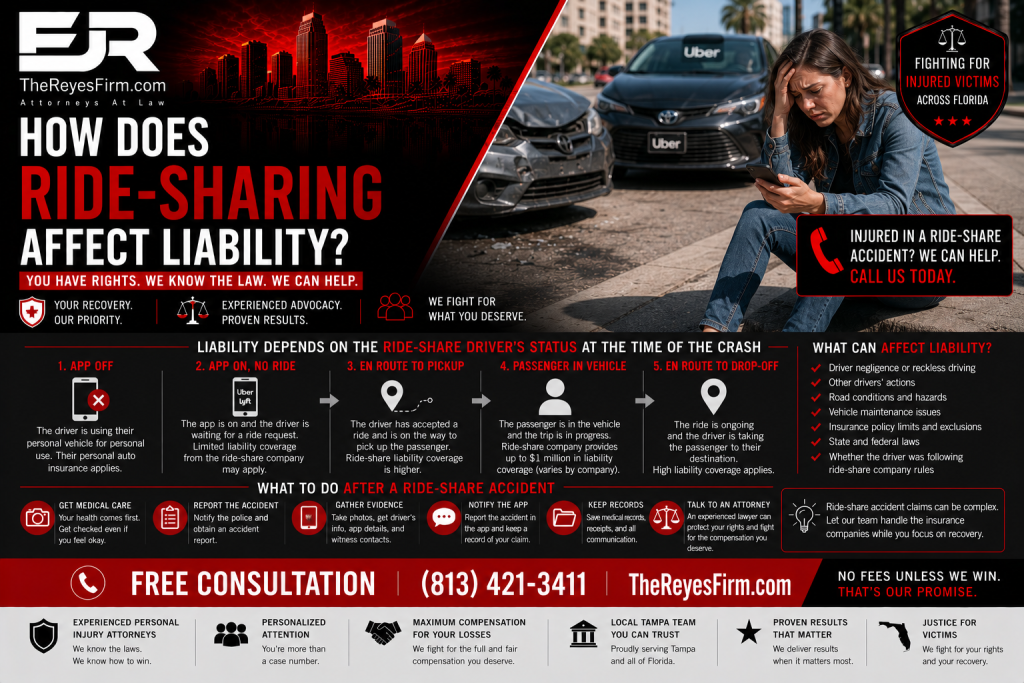
Florida law divides a rideshare driver’s activity into phases, and coverage rises as the driver moves from simply having the app open to actually carrying a passenger. There are three practical periods to understand:
- App off. When the driver is not logged on to the rideshare app, they are just a regular driver. Only their personal auto insurance applies, and Uber or Lyft provides no coverage.
- Logged on, waiting for a ride. Once the driver is logged on and available but has not yet accepted a request, Florida requires primary liability coverage of at least $50,000 for death or bodily injury per person, $100,000 per incident, and $25,000 for property damage, along with personal injury protection and uninsured motorist coverage.
- Engaged in a prearranged ride. From the moment the driver accepts a ride request, through driving to pick you up, and until the passenger is dropped off, a much larger policy of at least $1 million in liability coverage applies.
The jump from the middle period to the last one is enormous, from $50,000 per person to $1 million. That gap is why pinning down the driver’s exact status is often the single most important step in a rideshare claim.
Why does the moment of the crash matter so much?
Because the driver’s status decides which policy, and how much coverage, is available to you. A serious injury can easily exceed a $50,000 per-person limit, so whether the driver had accepted a ride seconds before the crash can be the difference between a claim that is fully covered and one that is not. This is also why rideshare companies and their insurers pay close attention to exactly when a driver logged on, logged off, and accepted a ride.
There is a second reason the details matter, and it surprises many people. A rideshare driver’s own personal auto policy may not fill the gap you expect it to, because personal policies are generally not written to cover driving for hire.
💡 Did You Know? Many rideshare drivers’ personal auto policies specifically exclude coverage while they are driving for Uber or Lyft, and Florida law expressly allows insurers to write that exclusion. That is exactly why the company’s statutory coverage tiers matter so much, since the driver’s own policy may provide nothing at all during rideshare activity. Source: Fla. Stat. § 627.748(8)(b).
Can you sue Uber or Lyft directly?
Usually not in the way people expect. Under Florida law, rideshare drivers are generally treated as independent contractors rather than employees, and the statute limits a company’s vicarious liability simply for operating the app and connecting drivers with riders. In most cases, you are not suing Uber or Lyft as an employer. You are pursuing the insurance coverage that applies to the driver’s phase of work.
Notably, Florida law also specifies that a rideshare company and its drivers are not common carriers, which is a different status than a public bus. That does not leave you without options, though. The right path is usually to identify every applicable policy, from the company’s coverage to the driver’s insurance to your own, and pursue the ones that apply. Sorting out which coverage governs, and whether personal or commercial insurance applies, can be genuinely complicated, and our guide to commercial versus personal insurance after a Florida crash explains why.
🛡️ Your Rights Under Florida Law: Under Fla. Stat. § 627.748, an injured person has real leverage. In a claims investigation, the rideshare company must promptly provide the precise times the driver logged on and off in the 12 hours before and after the crash, and the driver must disclose whether they were logged on or on a prearranged ride. That information is often the key to unlocking the correct coverage, and an experienced Tampa injury lawyer knows how to demand it.
What if you were a passenger, another driver, or a pedestrian?
The same period-based system applies no matter who you are, which is good news for injured people. If you were a passenger during a ride, the driver was by definition engaged in a prearranged ride, so the $1 million coverage tier applies to your injuries. If you were in another vehicle, on a bicycle, or on foot when a rideshare driver hit you, your access to coverage depends on that driver’s status at the moment of the crash, the same three periods described above.
When the rideshare driver was not at fault, your claim proceeds against whoever caused the crash, and your compensation may be reduced by any share of fault assigned to you under Florida Statute § 768.81. And if the at-fault party does not carry enough insurance, your own uninsured or underinsured motorist coverage may help. Because a rideshare crash can involve a catastrophic injury, identifying every available policy is critical.
⚠️ Deadline Warning: Under Florida Statute § 95.11, you generally have two years from the date of a rideshare crash to file a personal injury lawsuit. This was shortened from four years in March 2023. Rideshare claims can be complex, with multiple insurers pointing at each other, so the sooner you involve a lawyer, the better protected you are.
Watch: How Does Ridesharing Affect Liability?
If you prefer to hear it explained, the short video below covers how ridesharing affects liability after a crash in Florida.
When you are ready to talk through your own situation, The Reyes Firm offers free consultations with no obligation.
What should you do after a rideshare crash in Tampa?
These five steps protect your health and your claim at the same time. The order matters.
- Get medical care right away. Prompt treatment protects your health and documents your injuries, and Florida generally requires initial care within 14 days to access Personal Injury Protection benefits.
- Screenshot the ride in the app. If you were the passenger, capture the trip details, the driver’s information, and the ride status while you still have them, since that record helps establish the coverage period.
- Document the driver’s status. Note whether the driver had a passenger, was heading to a pickup, or was between rides, and get the driver’s name, the company, and insurance information.
- Do not give a recorded statement or accept a quick offer. Multiple insurers may be involved, and you are not required to give a recorded statement before speaking with a lawyer.
- Call The Reyes Firm. Rideshare claims are complex, and the coverage details matter enormously. Call 833-4 BAD DAY for a free consultation.
The Reyes Firm
4730 N. Habana Ave., Suite 201, Tampa, FL 33614
Phone: 833-4 BAD DAY | thereyesfirm.com
How The Reyes Firm handles your rideshare accident case
Rideshare claims combine unusual coverage rules, multiple insurers, and companies that know exactly how to limit what they pay. We handle all of it for you, throughout Tampa and Hillsborough County.
When we take on a rideshare accident case, we typically:
- Establish the driver’s exact status at the moment of the crash, demanding the log-on and log-off records the rideshare company is required to provide
- Identify every applicable policy, from the company’s coverage tier to the driver’s insurance to your own uninsured or underinsured motorist coverage
- Pursue the correct coverage period, so a serious injury is not squeezed into a lower limit when a larger policy should apply
- Handle the multiple insurers who often point at one another to avoid paying, keeping that pressure off you
- Address comparative fault, protecting the facts so responsibility lands on the parties who actually caused the crash
- Calculate full damages, covering past and future medical care, lost wages, and the real impact of your injuries
No lawyer can promise an outcome. What we can promise is that we understand how these unusual cases work, explain every step in plain language, and fight to reach the coverage you are owed. In the most serious cases, we bring the same care and determination to every claim.
Frequently asked questions about rideshare accidents in Florida
Who pays if an Uber or Lyft driver hits me?
It depends on what the driver was doing. If the app was off, their personal insurance applies. If they were logged on but had not accepted a ride, a $50,000 per-person coverage tier applies. If they had accepted a ride, a $1 million policy applies under Fla. Stat. § 627.748.
How much insurance coverage is available in a rideshare crash?
Under Florida law, at least $50,000 per person and $100,000 per incident applies while a driver is logged on and waiting, and at least $1 million applies once the driver has accepted a ride, through dropping the passenger off. When the app is off, only the driver’s personal policy applies.
Can I sue Uber or Lyft directly?
Usually not as an employer, because rideshare drivers are generally independent contractors and Florida law limits the company’s vicarious liability for simply operating the app. In most cases you pursue the insurance coverage that applies to the driver’s phase of work rather than suing the company itself.
What if the rideshare driver’s app was off?
Then only the driver’s personal auto insurance applies, and Uber or Lyft provides no coverage. This is one reason the driver’s status at the moment of the crash is so important, and why documenting it matters.
Does it matter whether I was the passenger?
If you were the passenger, the driver was by definition on a prearranged ride, so the $1 million coverage tier applies to your injuries. If you were in another car or on foot, coverage depends on the rideshare driver’s status at the time of the crash.
What if the rideshare driver wasn’t the one at fault?
Then your claim proceeds against whoever caused the crash, and your own uninsured or underinsured motorist coverage may apply if that party lacks enough insurance. Your recovery can be reduced by any share of fault assigned to you under Fla. Stat. § 768.81.
How do I prove which coverage period applied?
Florida law requires the rideshare company to provide the precise times the driver logged on and off in the 12 hours around the crash, and the driver must disclose their status. A lawyer can demand these records, and screenshots from the app can help as well.
How long do I have to file a rideshare accident claim?
The general deadline to file a negligence lawsuit in Florida is two years under Fla. Stat. § 95.11. Because rideshare claims often involve several insurers and disputed coverage, it is wise to act well before that deadline.

Edward Reyes, Esq. is a Florida Bar-admitted personal injury attorney and the founder of The Reyes Firm in Tampa, Florida. He represents people injured by the negligence of others in cases involving car accidents, rideshare crashes involving Uber and Lyft, truck collisions, and other serious injuries throughout Tampa and the surrounding counties. Edward Reyes, Esq. handles personal injury claims on a contingency fee basis, meaning clients pay nothing unless the firm recovers compensation for them.
Read more about Edward Reyes.
How Can The Reyes Firm Help You?
If you’ve had a bad day, whether a car accident, a slip and fall, a trucking crash, or any injury that wasn’t your fault, The Reyes Firm is in your corner. Our Tampa personal injury attorneys offer free consultations and work on a contingency fee basis, which means you pay us nothing unless we win your case.
You shouldn’t have to fight the insurance companies alone. Let us fight for you.
📍 Address: 4730 N. Habana Ave., Suite 201, Tampa, FL 33614
📞 Phone: 833-4 BAD DAY
🌐 Website: Schedule your free consultation today at thereyesfirm.com
Had a bad day? Call The Reyes Firm. We’ll handle the rest.
The information in this blog post is for general informational purposes only and does not constitute legal advice. The statute described here contains conditions and exceptions not fully summarized above, and insurance coverage varies by policy and circumstance. Reading this article does not create an attorney-client relationship with The Reyes Firm. Every case is unique. If you have been injured in a rideshare, Uber, or Lyft accident, consult a licensed Florida personal injury attorney about your specific situation.