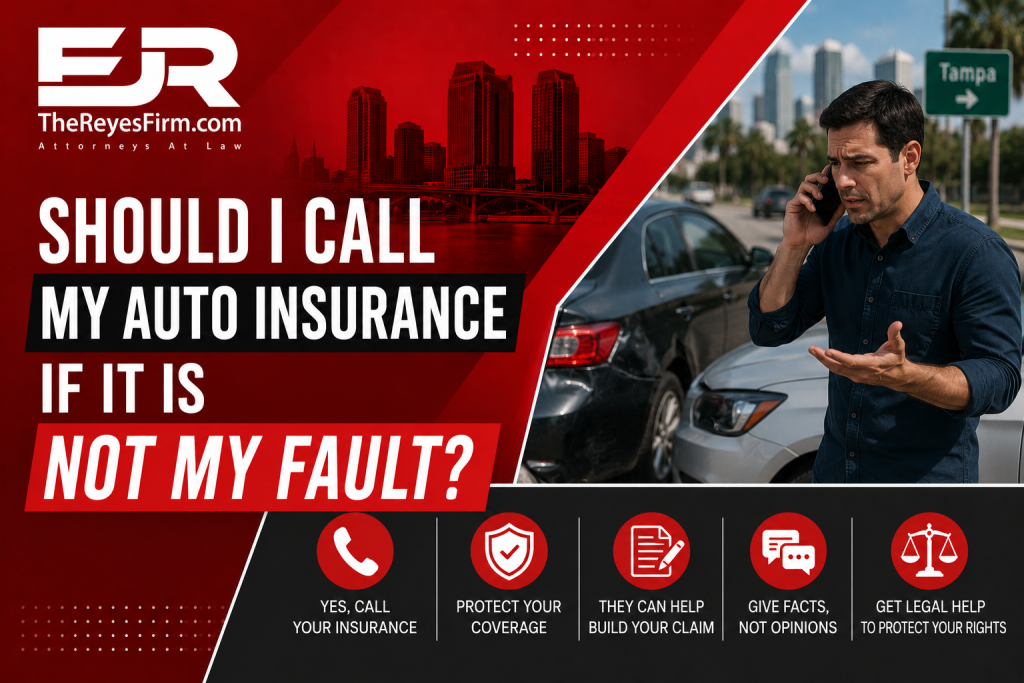
You were just going about your day. Then someone rear-ended you at a red light. It clearly wasn’t your fault, so calling your own insurance company feels backwards, maybe even risky. In Florida, though, that phone call is one of the most important things you can do, and here’s why.
TL;DR — QUICK SUMMARY
- Yes, you should call your own auto insurer even when the crash wasn’t your fault, because Florida is a no-fault state.
- Your Personal Injury Protection (PIP) coverage pays the first portion of your medical bills regardless of who caused the accident.
- You must seek medical treatment within 14 days of the crash, or you can lose your PIP benefits entirely.
- Reporting an accident you didn’t cause should not raise your rates, and most policies require you to report promptly anyway.
- Under Florida Statute 95.11(3)(a), you generally have two years to file an injury lawsuit, but the deadlines that bite first are your insurer’s reporting and treatment windows.
The Reyes Firm
Hurt in a Tampa Crash That Wasn’t Your Fault?
Get clear next steps and protect your PIP benefits. Had a bad day?
Should you call your own auto insurance if the accident wasn’t your fault?
Yes. In Florida, you should report the crash to your own insurer even when another driver clearly caused it. That feels counterintuitive, but it comes down to one fact: Florida is a no-fault auto insurance state. Your own policy is designed to step in first, no matter who was to blame.
Reporting promptly does two things. It opens your Personal Injury Protection (PIP) benefits so your medical bills start getting paid, and it satisfies the notice requirement built into nearly every auto policy. Wait too long, and you risk both your benefits and a dispute with your own company over late reporting.
At The Reyes Firm, a Tampa personal injury law firm, the most common mistake we see after a not-at-fault crash isn’t saying too much. It’s saying nothing at all to the one insurer that’s actually obligated to help you first.
⚠️ Deadline Warning: Under Florida Statute § 95.11(3)(a), you generally have two years from the date of your crash to file a personal injury lawsuit. But your PIP coverage requires medical treatment within 14 days, so the clock that runs out first is usually the one on your benefits. Don’t wait.
What is Florida’s no-fault system and how does PIP work?
Florida’s no-fault system means that after most car accidents, your own insurance pays your initial medical expenses and lost wages, regardless of who caused the crash. The coverage that does this is Personal Injury Protection, and every Florida auto policy is required to carry it.
Under Florida Statute § 627.736, PIP provides a minimum of $10,000 in coverage and typically pays 80% of reasonable medical bills and 60% of lost wages, up to that limit. It applies whether you were rear-ended, sideswiped, or hit by a driver who ran a stop sign. The trade-off for this quick, fault-free coverage is that PIP comes with strict rules, and the strictest is the deadline to get care.
Because PIP has a cap, it often isn’t enough to cover a serious injury. When your damages exceed your PIP limits, you may be able to pursue the at-fault driver for the rest, which is where the no-fault system ends and a liability claim begins.
💡 Did You Know? Florida’s 14-day rule is one of the most important deadlines after a crash. Under Fla. Stat. § 627.736, you must receive initial medical care within 14 days of the accident to be eligible for PIP benefits at all. Miss that window and your own insurer can deny the entire claim, even if your injuries are real and serious. Source: Fla. Stat. § 627.736.
Watch: Should I Call My Auto Insurance If It’s Not My Fault?
This short video explains why Florida drivers need to report a crash to their own insurer even when someone else caused it, and how the no-fault system shapes what happens next.
If you’re unsure what to say to either insurance company, The Reyes Firm offers free consultations, so you can call 833-4 BAD DAY before you make the call.
Will calling my own insurer raise my rates or count against me?
This is the fear that keeps people from making the call, and it’s largely unfounded for a crash you didn’t cause. Filing a PIP claim after a not-at-fault accident is exactly what the coverage exists for, and insurers are limited in how they can treat policyholders who report accidents that weren’t their fault.
What can actually hurt you is the opposite choice. Failing to report can violate your policy’s notice requirement, give your insurer a reason to question the claim later, and leave your medical bills unpaid while the 14-day window closes. The downside of calling is small. The downside of staying quiet can cost you your benefits.
If an adjuster, yours or the other driver’s, starts asking for a recorded statement or pressing for details, that’s a different matter. You can decline to give a recorded statement until you’ve spoken with a lawyer.
Do I still deal with the at-fault driver’s insurance company?
Often, yes, but carefully. Your PIP covers the first layer of your expenses. When your injuries are serious enough to exceed those limits, a claim against the at-fault driver’s insurer is how you pursue the rest, including the portion of medical bills PIP didn’t pay, full lost wages, and pain and suffering.
That second insurer has no duty to look out for you, and its adjuster is working to pay as little as possible. In a serious or catastrophic crash, the difference between handling that claim alone and having a lawyer value it properly can be life-changing. This is the stage where having representation matters most.
🛡️ Your Rights Under Florida Law: Under Florida Statute § 768.81, your compensation is reduced by your share of fault, and you may be barred from recovery if you are found more than 50% responsible for the crash. Even when you didn’t cause the accident, the at-fault insurer may try to shift blame onto you, and a Tampa car accident lawyer works to keep your percentage of fault as low as the evidence allows.
What are the 6 steps to take after a not-at-fault crash in Tampa?
These six steps protect your health, your PIP benefits, and any claim against the at-fault driver. The order matters.
- Call 911 and get a police report. An official report documenting the other driver’s fault is one of the strongest pieces of evidence you can have. Note the report number before you leave the scene.
- Get medical care within 14 days. See a doctor promptly to preserve your PIP benefits and to link your injuries to the crash. Adrenaline hides pain, and conditions like whiplash often surface a day or two later.
- Report the crash to your own insurer. Open your PIP claim and satisfy your policy’s notice requirement, but keep your account factual and brief.
- Document everything. Photograph the vehicles, the scene, and your injuries. Save medical bills, repair estimates, and proof of any missed work.
- Don’t give a recorded statement or sign a release. Whether it’s your insurer or the other driver’s, decline recorded statements and don’t sign anything until a lawyer reviews it.
- Call The Reyes Firm before settling. A Tampa car accident attorney will protect your PIP claim, value your full case, and handle the at-fault insurer for you. Call 833-4 BAD DAY for a free consultation.
The Reyes Firm
4730 N. Habana Ave., Suite 201, Tampa, FL 33614
Phone: 833-4 BAD DAY | thereyesfirm.com
How The Reyes Firm handles your not-at-fault accident claim
When you’ve been hurt by someone else’s mistake, you shouldn’t have to learn Florida’s no-fault rules on the fly while you’re trying to heal. We handle the system so you can focus on recovery.
When we take on a not-at-fault car accident claim, we typically:
- Protect your PIP benefits, making sure your claim is filed correctly and on time so your medical bills are covered from the start
- Handle communication with both insurers, shielding you from recorded-statement requests and pressure tactics from your own company and the at-fault driver’s
- Establish the other driver’s fault, gathering the police report, scene photos, witness statements, and medical records to build a clear picture of what happened
- Value your full claim, including the medical costs and lost wages PIP doesn’t fully cover, future treatment, and the impact on your daily life
- Pursue the at-fault driver’s insurer, challenging unfair blame and preparing the case as if it will go to trial, which is often what moves a fair offer
No lawyer can promise an outcome. What we can promise is that you won’t navigate two insurance companies alone after an accident you didn’t cause. We explain every step in plain language, and because we work on a contingency fee basis, you pay nothing unless we recover compensation for you.
Frequently asked questions about not-at-fault accidents in Tampa
If the accident wasn’t my fault, why do I have to use my own insurance?
Because Florida is a no-fault state. Under Fla. Stat. § 627.736, your own PIP coverage pays your initial medical bills and a portion of lost wages regardless of who caused the crash. It’s the fastest way to get your treatment covered while a fault claim plays out.
Will my rates go up if I report a crash I didn’t cause?
Reporting a not-at-fault accident generally should not increase your premiums, and most policies require you to report promptly regardless. The bigger risk is failing to report, which can jeopardize both your PIP benefits and your standing with your own insurer.
What is Florida’s 14-day rule?
Florida law requires you to seek medical treatment within 14 days of a crash to qualify for PIP benefits. If you wait longer than two weeks to see a doctor, your insurer can deny your PIP claim entirely, even for legitimate injuries.
What if my injuries cost more than my PIP coverage?
PIP has a $10,000 minimum cap, which often isn’t enough for a serious injury. When your damages exceed your PIP limits, you may be able to pursue the at-fault driver’s insurance for the remaining medical bills, full lost wages, and pain and suffering.
Should I talk to the at-fault driver’s insurance company?
Be cautious. The other driver’s insurer has no duty to protect you and is focused on paying as little as possible. A Tampa attorney can handle that communication so you don’t say something that’s later used to reduce your claim.
How long do I have to file a claim after a Florida car accident?
Under Fla. Stat. § 95.11(3)(a), you generally have two years from the date of the accident to file a personal injury lawsuit. The practical deadlines, though, your 14-day treatment window and your policy’s reporting requirement, arrive much sooner.
Do I really need a lawyer if it clearly wasn’t my fault?
Clear fault doesn’t guarantee a fair payout. Insurers still minimize claims, dispute the severity of injuries, and try to shift blame. A lawyer protects your benefits, values your full case, and handles both insurers, and the consultation is free.

Edward Reyes, Esq. is a Florida Bar-admitted personal injury attorney and the founder of The Reyes Firm in Tampa, Florida. His practice focuses on serious injury and wrongful death cases arising from commercial vehicle crashes, including delivery truck accidents involving FedEx, UPS, Amazon, and other carriers. Edward Reyes, Esq. represents injured Floridians in Tampa and throughout Hillsborough County on a contingency fee basis, meaning clients pay nothing unless the firm recovers compensation for them.
Read more about Edward Reyes.
How Can The Reyes Firm Help You?
If you’ve had a bad day — a car accident, a slip and fall, a trucking crash, or any injury that wasn’t your fault — The Reyes Firm is in your corner. Our Tampa personal injury attorneys offer free consultations and work on a contingency fee basis, which means you pay us nothing unless we win your case.
You shouldn’t have to fight the insurance companies alone. Let us fight for you.
📍 Address: 4730 N. Habana Ave., Suite 201, Tampa, FL 33614
📞 Phone: 833-4 BAD DAY
🌐 Website: Schedule your free consultation today at thereyesfirm.com
Had a bad day? Call The Reyes Firm. We’ll handle the rest.