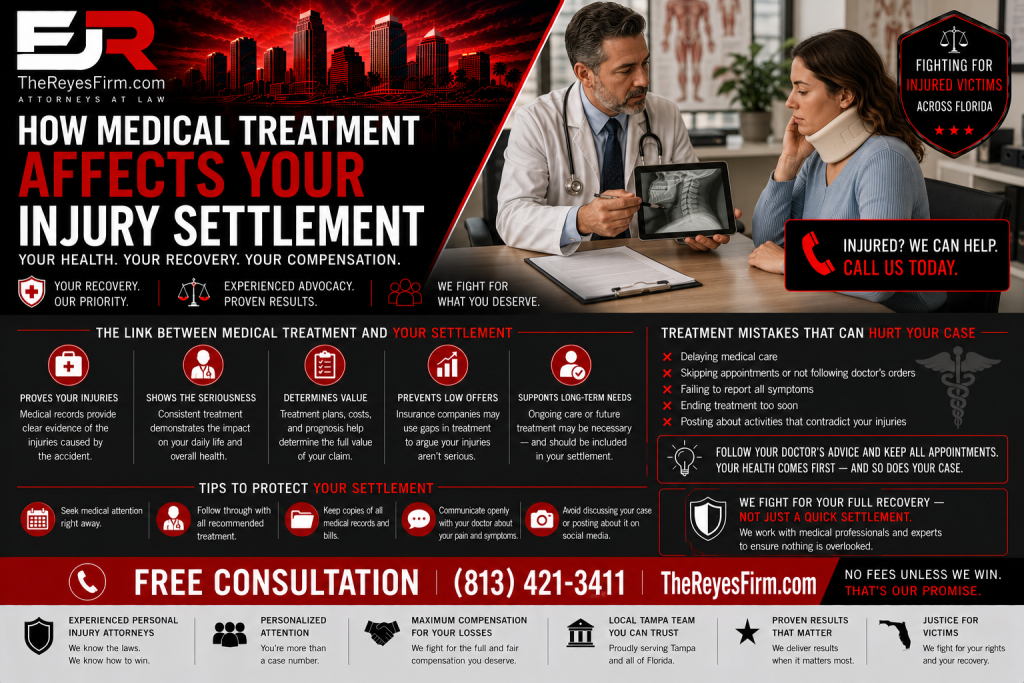
You know medical treatment matters for your health after a crash. What surprises many people is how much it matters for their settlement. In a Florida injury claim, the care you receive does more than help you heal, it becomes the evidence that decides what your case is worth. Here is how medical treatment and documentation shape your injury settlement, and why gaps in your care can quietly cost you.
The Reyes Firm
Making Sure Your Injury Is Documented Right?
Your medical records can make or break your claim. Had a bad day?
After a crash, most people think about medical care purely in terms of getting better, as they should. But if someone else caused your injuries, there is a second reality worth understanding: an insurance company will eventually decide what to pay based largely on your medical records. What those records show, and what they leave out, has a direct effect on your settlement.
How does medical treatment affect your injury settlement?
Medical treatment affects your settlement because your medical records are the primary evidence of your injury. They establish that you were hurt, that the crash caused it, and how serious it is. Without that documentation, you may have a genuine injury and still struggle to prove it, because to an insurance company, an injury that is not in the medical record effectively did not happen.
This is why two people with similar injuries can end up with very different settlements. The one whose treatment is thoroughly documented has the evidence to support full compensation. The one who toughed it out, skipped care, or has a thin medical file is left arguing without proof. The treatment itself, and the record it creates, is what gives your claim its foundation.
Why are medical records the foundation of your claim?
Medical records do three jobs at once in an injury claim. They connect your injury to the crash, which lawyers call causation, by showing that you sought care for specific problems right after the accident. They document the nature and severity of your injury, from the initial diagnosis through every test, treatment, and follow-up. And they create a timeline that tells the story of your recovery in a way an adjuster or a jury can follow.
Contrast that with the alternative. If you wait weeks to see a doctor, or never fully explain your symptoms, the record becomes ambiguous, and ambiguity is exactly what an insurer uses to pay less. A clear, consistent medical record does not just describe your injury, it protects your ability to be compensated for it. This is closely tied to identifying the true source of your pain, which our guide to where injuries come from after a car accident explains.
What happens if you have gaps in your treatment?
Gaps in treatment are among the most damaging things to an injury claim, and they are also among the most common. When you miss appointments, delay care, or stop treating before you have recovered, you create holes in the record that insurers are trained to exploit. Their argument is simple and effective: if you were really hurt, you would have kept treating, so the gap must mean you were fine.
That argument is often unfair, since people miss appointments for all kinds of ordinary reasons, work, childcare, cost, or simply feeling a bit better for a while. But fair or not, a gap gives the insurer ammunition to discount your injury and reduce your settlement. The most reliable way to avoid this is to follow the treatment plan your doctor sets and to keep your appointments until you are formally released from care.
💡 Did You Know? A gap in your medical treatment is one of the first things an insurance adjuster looks for. If you stop treating or miss appointments, they will argue that you must have recovered or were never seriously hurt, and use that gap to justify a lower settlement, even when the real reason you missed care had nothing to do with how you felt.
How does medical documentation affect what you can recover?
Your recovery in an injury claim generally falls into two categories, and medical documentation drives both. The first is economic damages, the concrete costs, and your medical bills are a central part of this. The documented cost of your treatment, past and future, is a direct component of what you are owed, which is one reason a complete billing record matters.
The second is non-economic damages, meaning pain and suffering and the impact on your life. In a Florida car accident case, this is where documentation becomes especially important, because you generally cannot recover for pain and suffering unless your injury meets a legal threshold, such as a permanent injury. Your medical records, and your doctors’ findings, are what establish whether that threshold is met.
🛡️ Your Rights Under Florida Law: Under Florida Statute § 627.737(2), you generally cannot recover for pain and suffering in a car accident case unless a doctor documents a permanent injury, significant permanent scarring or disfigurement, or significant and permanent loss of an important bodily function. Your medical treatment and records are what establish this, which is why proper documentation directly affects your right to full compensation.
Does the type of treatment matter?
It can. Treatment that is guided and documented by medical professionals generally carries more evidentiary weight than informal self-care. When your doctor orders imaging, refers you to a specialist, or prescribes physical therapy, each step both addresses your injury and adds objective documentation to your file. Diagnostic findings, specialist opinions, and a consistent course of care paint a far stronger picture than a single visit followed by silence.
Transitions between providers matter too. If you move from an emergency room to a primary doctor to a specialist, a smooth, connected record is stronger than scattered visits with long unexplained gaps. Again, the underlying principle is not to seek treatment you do not need, but to make sure the genuine care you do receive is properly documented and connected.
What if your injury seemed minor at first?
This is where the health side and the claim side meet. Many serious injuries feel minor at first, because adrenaline masks pain and some conditions take days to surface. From a health standpoint, that is why getting checked promptly matters, a topic we cover in our guide to whether you need medical attention after a minor accident, along with Florida’s 14-day rule for PIP benefits.
From a claim standpoint, the same lesson applies for a different reason. An injury you dismissed as minor, and therefore never documented, is an injury you generally cannot be compensated for, no matter how much trouble it causes you later. Getting evaluated early does double duty: it protects your health, and it creates the record that protects your claim if that minor-seeming injury turns out to be serious.
⚠️ Deadline Warning: Under Florida Statute § 95.11, you generally have two years from the date of your crash to file a personal injury lawsuit, a deadline shortened from four years in March 2023. Building a well-documented medical record takes time, so the sooner you begin proper treatment and involve a lawyer, the stronger your position.
Watch: Should You Always Get a Medical Consultation After an Accident?
If you prefer to hear it explained, the short video below covers why a medical consultation after an accident matters, both for your health and for your claim.
When you are ready to talk through your own situation, The Reyes Firm offers free consultations with no obligation.
How can you protect your settlement through your medical care?
These five steps protect your health and the value of your claim at the same time. The order matters.
- Get appropriate care for your genuine injuries, and follow your doctor’s plan. Proper treatment for real injuries is both good for your health and the foundation of your claim. Let medical need, not litigation, guide your care.
- Do not skip appointments or stop treating early. Continue your care until your doctor formally releases you, because gaps in treatment are used to minimize your injury.
- Tell your doctors about every symptom. Mention all your pain and problems, even ones that seem minor, so the record fully reflects your injury rather than part of it.
- Keep all of your medical records and bills. These documents are your evidence, and having them organized supports both your economic and non-economic damages.
- Call The Reyes Firm. We turn your medical records into a documented, well-supported claim. Call 833-4 BAD DAY for a free consultation.
The Reyes Firm
4730 N. Habana Ave., Suite 201, Tampa, FL 33614
Phone: 833-4 BAD DAY | thereyesfirm.com
How The Reyes Firm uses your medical records to build your claim
Strong medical documentation does not organize and present itself, and turning a stack of records into a persuasive claim is a real part of a lawyer’s work. We handle that for you, throughout Tampa and Hillsborough County.
When we build an injury claim, we typically:
- Gather your complete medical records and bills, so nothing about your treatment or its cost is missing from your claim
- Use the records to prove causation and severity, connecting your injury to the crash and showing how serious it truly is
- Work with your providers and medical experts to document permanency where it applies, which supports your claim for pain and suffering
- Counter the insurer’s attempts to minimize your injury, including arguments built on treatment gaps, under Florida’s comparative fault framework in Florida Statute § 768.81
- Calculate your full damages, using your bills for economic losses and your documented injury to support non-economic damages
- Coordinate with your treatment timeline, since reaching maximum medical improvement is a key point we explain in our guide to the pre-suit phase
No lawyer can promise an outcome, and we do not give medical advice. What we can promise is that we treat your medical record as the foundation it is, present it thoroughly, and fight for the full compensation your documented injury supports.
Frequently asked questions about medical treatment and injury settlements
How does medical treatment affect my settlement?
Your medical records are the primary evidence of your injury, establishing that you were hurt, that the crash caused it, and how serious it is. Because insurers base their offers largely on that documentation, the treatment you receive and record directly affects your settlement.
Why do medical records matter so much to my claim?
They prove causation, document severity, and create a timeline of your recovery. An injury that is well documented can be supported and compensated, while an injury with a thin or gap-filled record is far easier for an insurer to dispute or discount.
What happens if I have a gap in my treatment?
Insurers often argue that a gap means you recovered or were never seriously hurt, and they use it to reduce your settlement. The best way to avoid this is to follow your doctor’s treatment plan and keep your appointments until you are formally released.
Does following my treatment plan matter for my claim?
Yes. Consistent treatment that your doctor directs both supports your recovery and documents the severity of your injury. It also removes the gaps and inconsistencies that insurers rely on to pay less.
How do medical bills factor into my settlement?
Your medical bills are a core part of your economic damages, representing the documented cost of your care, both past and future. A complete billing record supports this portion of your claim directly.
Do I need a permanent injury to recover pain and suffering?
Generally, yes. Under Fla. Stat. § 627.737(2), recovering pain and suffering in a car accident case usually requires a permanent injury or similar threshold, and your medical records and your doctors’ findings are what establish whether it is met.
Should I get extra treatment just to increase my settlement?
No. Treatment should be guided by genuine medical need, not by a claim. Seeking unnecessary care is the wrong approach and can undermine your credibility. The goal is to properly document the real treatment you need, so your claim reflects the true extent of your injury.
How long do I have to file my claim?
The general deadline to file a negligence lawsuit in Florida is two years under Fla. Stat. § 95.11. Because building a strong medical record takes time, it is wise to begin proper treatment and consult a lawyer well before that deadline.

Edward Reyes, Esq. is a Florida Bar-admitted personal injury attorney and the founder of The Reyes Firm in Tampa, Florida. He represents people injured by the negligence of others in cases involving car accidents, truck crashes, and other serious injuries throughout Tampa and the surrounding counties. Edward Reyes, Esq. handles personal injury claims on a contingency fee basis, meaning clients pay nothing unless the firm recovers compensation for them.
Read more about Edward Reyes.
How Can The Reyes Firm Help You?
If you’ve had a bad day, whether a car accident, a slip and fall, a trucking crash, or any injury that wasn’t your fault, The Reyes Firm is in your corner. Our Tampa personal injury attorneys offer free consultations and work on a contingency fee basis, which means you pay us nothing unless we win your case.
You shouldn’t have to fight the insurance companies alone. Let us fight for you.
📍 Address: 4730 N. Habana Ave., Suite 201, Tampa, FL 33614
📞 Phone: 833-4 BAD DAY
🌐 Website: Schedule your free consultation today at thereyesfirm.com
Had a bad day? Call The Reyes Firm. We’ll handle the rest.
The information in this blog post is for general informational purposes only and is neither medical advice nor legal advice. Decisions about medical treatment should be based on your health and made with a qualified healthcare provider, not on a legal claim. Reading this article does not create an attorney-client relationship with The Reyes Firm. Every case is unique. If you have been injured in a car accident that wasn’t your fault, consult a licensed Florida personal injury attorney about your specific situation.