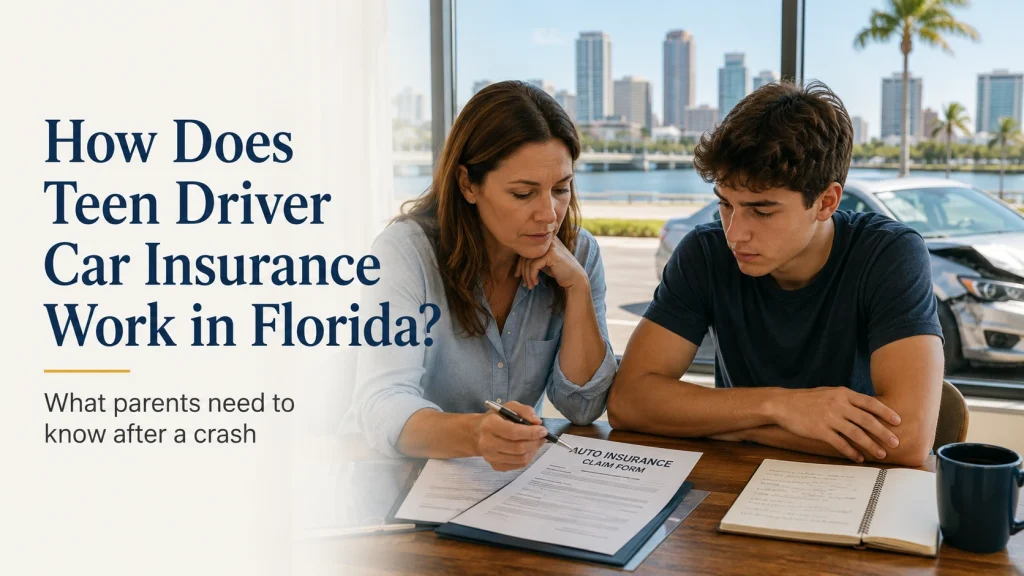
In Florida, teen drivers’ claims are covered under the parents’ auto policy through Personal Injury Protection (PIP) for medical bills, regardless of fault. If the teen caused injuries to others, Bodily Injury Liability applies. Claims can be denied entirely if the teen wasn’t listed on the policy before the crash.
Quick Summary
- Florida is a no-fault state. Your PIP pays your teen’s medical bills first, up to $10,000, regardless of fault.
- If your teen wasn’t listed on your policy, the insurer can legally deny the entire claim.
- Florida Statute 322.09 makes you personally liable for your teen’s negligence the moment you sign their license application.
- The Dangerous Instrumentality Doctrine means you can be sued beyond your policy limits as the vehicle owner.
- If someone was seriously hurt, call a personal injury attorney before giving any insurer a recorded statement.
What does Florida car insurance actually cover when a teen driver crashes?
Florida’s no-fault PIP coverage pays 80% of your teen’s medical expenses and 60% of lost wages up to your $10,000 policy limit, regardless of who caused the crash. Property damage to the other vehicle falls under your PDL coverage. Injuries your teen caused to others require Bodily Injury Liability, which Florida does not mandate.
What is PIP, and how does it apply to my teen driver?
Personal Injury Protection is Florida’s no-fault medical coverage, governed by Florida Statute 627.736. It covers your teen, whether they caused the crash or not. Florida requires a minimum PIP of $10,000 per person.
PIP pays:
- 80% of reasonable medical expenses, including ER, imaging, and follow-up care
- 60% of lost wages if your teen misses work due to injuries
- Up to $5,000 in death benefits if the crash is fatal
One critical rule: your teen must seek medical care within 14 days of the crash to qualify for the full $10,000 PIP benefit. Miss that window, and the benefit drops to $2,500 for non-emergency conditions.
What does Property Damage Liability cover?
Florida requires a minimum of $10,000 in Property Damage Liability (PDL) coverage. If your teen rear-ends another vehicle, PDL pays to repair or replace that car. PDL does not cover your teen’s own vehicle. That requires Collision coverage, which is optional in Florida but often required by lenders.
What if the other driver had no insurance?
Florida’s uninsured motorist rate sits at approximately 20.6%, according to the Insurance Research Council’s 2023 data. If an uninsured driver hits your teen, your own Uninsured Motorist (UM) coverage steps in, but only if you purchased it. UM coverage is optional in Florida and must be rejected in writing if you don’t want it.
⚠️ Warning — Florida Statute § 627.736: Florida’s $10,000 PIP minimum sounds protective, but a single ER visit for a teen with a head injury can exceed that limit before discharge. For serious crashes, PIP is a starting point, not a finish line. Bodily Injury Liability gaps and UM gaps can leave families personally exposed when damages are significant.
What happens if your teen wasn’t listed on your policy?
If your teen had their license, drove regularly, and you never added them to your policy, the insurer can deny the claim on the basis of material misrepresentation. A Named Driver Exclusion under Florida Statute 627.747 can also bar coverage entirely. Denial means you personally face the other driver’s damages.
Why do insurers deny claims for unlisted teen drivers?
Insurance companies price risk at the time you buy coverage. Teen drivers statistically crash more than any other age group. In 2024, FLHSMV reported 82,447 crashes involving teen drivers in Florida, resulting in 102 teen driver fatalities and 38 teen passenger fatalities. When you don’t add your teen, the insurer never prices their risk into your premium. That’s the grounds for denial.
What is a Named Driver Exclusion in Florida?
A Named Driver Exclusion is a formal policy endorsement that removes a specific person from all coverage under the policy. Under Florida Statute 627.747, insurers can require this exclusion for high-risk household members. If your teen was excluded, either by your signature or by a policy change you may not have fully understood, the policy pays nothing when they’re driving.
What to do if your claim is denied for this reason:
- Request the denial in writing immediately
- Ask for a copy of the signed Named Driver Exclusion form
- If you never signed an exclusion, the insurer may not have legal grounds to deny
- Contact a personal injury attorney before accepting any denial as final
🛡️ Your Rights Under Florida Statute § 627.747: A Named Driver Exclusion must be signed by the policyholder to be enforceable in Florida. If your insurer claims your teen was excluded but cannot produce a signed exclusion form with your signature, that denial may be challengeable. Don’t treat a denial letter as the final word before speaking with a licensed Florida attorney.
Who does Florida law hold responsible when a teen causes serious harm?
Florida law creates two separate layers of parental liability. Florida Statute 322.09 makes parents personally responsible for a teen’s negligence from the moment they sign the license application. The Dangerous Instrumentality Doctrine makes vehicle owners strictly liable for crashes caused by anyone they permit to drive their car, regardless of fault or presence at the scene.
What is Florida Statute 322.09, and what does it mean for parents?
When you signed your teen’s driver’s license application, you assumed legal responsibility for any negligence or willful misconduct they committed behind the wheel. That liability stays in place until your teen turns 18, even after they receive a full Class E license at 16.
Under Florida Statute 322.09, the injured party can sue you directly as the parent or guardian who signed the consent form. Your teen’s negligence becomes your legal exposure.
What is Florida’s Dangerous Instrumentality Doctrine?
The Dangerous Instrumentality Doctrine is a Florida common law principle established by the Florida Supreme Court in 1920 and confirmed as recently as 2023 in Emerson v. Lambert, 374 So. 3d 756. It holds that vehicle owners are strictly liable for harm caused when they voluntarily allow someone to drive their car.
Key facts about this doctrine:
- You don’t have to be in the car when the crash happens
- You don’t have to know the driver was dangerous
- Ownership plus permission equals liability
- The doctrine applies even to adult children driving a parent’s vehicle
How much can parents be sued for under this doctrine?
Under Florida Statute 324.021, if your teen is uninsured or carries less than $500,000 in combined coverage, you, as the vehicle owner, can be held liable for up to an additional $500,000 in economic damages beyond what your insurance pays.
Here is what that exposure looks like in practice:
| Scenario | Your Insurance Pays | Potential Personal Exposure |
|---|---|---|
| Teen at fault, other driver suffered minor injuries | Up to policy limits | Low if BI coverage is adequate |
| Teen at fault, other driver suffered serious injuries | Up to policy limits | Up to $500,000 additional economic damages |
| Teen at fault, multiple victims, judgment exceeds limits | Policy limits only | Remaining judgment balance personally |
This is not a theoretical risk. It is the legal framework that governs every serious teen-driver crash in Tampa and across Hillsborough County.
💡 Did You Know — FLHSMV 2024: Florida recorded 82,447 teen driver crashes in 2024, with 102 teen driver fatalities and 38 teen passenger fatalities, according to FLHSMV’s 2024 By the Numbers report. Hillsborough County, home to Tampa, consistently ranks among Florida’s most crash-dense counties. These crashes happen on I-4, I-75, and I-275 every week.
What are the exact steps to file a claim after a teen driver crash in Florida?
File a claim by first securing the scene and calling 911, then collecting documentation, notifying your insurer promptly, seeking medical care within 14 days, and contacting a personal injury attorney if injuries are involved. Florida’s two-year statute of limitations under Florida Statute 95.11 governs how long you have to file a lawsuit.
Step-by-step claim process after a teen driver crash in Florida
- Secure safety and call 911. Get everyone to a safe location. Call 911 immediately if there are injuries, and request a police response even for minor crashes. A police report documents the scene while facts are fresh.
- Gather information at the scene. Collect the other driver’s name, license number, insurance company, policy number, and license plate. Photograph both vehicles from multiple angles, road conditions, skid marks, and any visible injuries. Get witness names and contact information.
- Seek medical care within 14 days. Florida Statute 627.736 requires initial medical treatment within 14 days of the crash to access the full $10,000 PIP benefit. Adrenaline masks pain. A same-day evaluation creates the medical record that connects injuries to the crash.
- Notify your insurer promptly. Your policy requires you to report the crash. Do that. However, you are not required to give a detailed recorded statement to the other driver’s insurer before consulting an attorney.
- Request the police report. In Florida, crash reports involving injuries or property damage over $500 are filed with FLHSMV. Obtain a copy for your records.
- Document all expenses. Keep records of every medical bill, prescription, missed workday, and out-of-pocket cost related to the crash. These form the foundation of your damages claim.
- Contact a personal injury attorney. If the crash involved injuries to any person other than your teen, if the other driver is claiming serious harm, or if your insurer is pushing back on coverage, get legal representation before the situation escalates.
What Should Parents Know After a Teen Driver Crash in Florida?
In this video, Tampa personal injury attorney Edward Reyes explains what families should understand after a teen auto accident, including why pain may not appear right away, why quick insurance checks can be risky, and how medical treatment and accident claims usually move forward.
Key takeaway: After a teen driver crash, do not rush into a settlement or accept money before understanding the medical issues, insurance coverage, and legal risks involved.
What deadlines do I need to know about?
| Deadline | Timeframe | Governing Law |
|---|---|---|
| Initial medical treatment for PIP | 14 days from crash | Florida Statute 627.736 |
| PIP benefit payment from the insurer | 30 days after a clean claim | Florida Statute 627.736 |
| Personal injury lawsuit filing | 2 years from the crash date | Florida Statute 95.11 |
| Property damage lawsuit filing | 4 years from the crash date | Florida Statute 95.11 |
Missing any of these deadlines can permanently end your legal options, regardless of how strong your case is.
What will a teen driver claim cost you in premiums going forward?
Adding a teen driver to your Florida policy typically raises your annual premium by $1,500 to $5,000 or more. An at-fault claim adds a surcharge that most Florida insurers apply for three to five years. A DUI conviction triggers SR-22 requirements and can result in policy cancellation, forcing you into the high-risk insurance market.
How much will my premium increase after a crash involving a teen driver?
Premium increases after a teen crash depend on several factors:
- Your teen’s age and gender (16-year-old males carry the highest surcharges)
- Your current coverage levels and insurer
- Your ZIP code within Tampa or Hillsborough County
- The vehicle your teen drives
- Fault determination in the crash
A single at-fault claim involving a teen driver can increase your annual premium by 40% to 60% or more. Most Florida insurers apply that surcharge for three to five years, meaning one crash can cost your family significantly over time.
What happens if my teen gets a DUI in Florida?
A teen DUI in Florida triggers consequences well beyond a premium increase:
- License suspension, with zero tolerance for drivers under 21 with a BAC of 0.02% or higher under Florida Statute 322.2616
- Mandatory SR-22 certificate filed with FLHSMV before driving privileges are restored
- Many standard insurers will cancel the policy entirely after a teen DUI
- Replacement coverage in the high-risk market carries significantly higher premiums
- The SR-22 filing requirement typically stays in place for three years
Are there discounts that survive a teen driver claim?
Some discounts can offset premium increases even after a claim:
- Good student discount: Available to teens maintaining a B average or better. Most insurers keep this discount active as long as the grade requirement is met.
- Driver’s education credit: Completing an approved Florida driver’s education course can reduce premiums and typically survives a first claim.
- Telematics programs: Usage-based insurance programs that monitor driving behavior can reduce premiums if your teen drives safely after the incident.
- Defensive driving course: Completing a course after a crash can sometimes reduce surcharges. Ask your insurer directly.
One warning insurers won’t volunteer: if the crash results in a judgment against you under the Dangerous Instrumentality Doctrine that exceeds your policy limits, your insurer’s obligation ends at those limits. The remaining judgment is yours personally. That’s the strongest argument for carrying higher liability limits and an umbrella policy the moment a teen driver enters your household.
How The Reyes Firm Handles Your Teen Driver Accident Case
When a teen driver crash puts your family in a difficult position, we treat it as exactly that, not a routine fender-bender claim. Here’s what we do.
- Preserve evidence immediately. We send preservation requests for dashcam footage, traffic camera recordings, and event data recorder information from both vehicles before that data is overwritten or lost.
- Identify every party with legal responsibility. We examine vehicle ownership, who signed the license application, what coverage is in place, and what the policy exclusions actually say. Under Florida’s Dangerous Instrumentality Doctrine, more than one party may carry liability.
- Protect your family from the other insurer. We stand between you and the other side’s adjusters and attorneys, so you stop taking calls from people whose job is to minimize what they pay you.
- Document the full scope of damages. For serious injuries, we work with medical and economic experts to capture current treatment costs, future care needs, lost earning capacity, and the real impact on your family’s daily life.
- Prepare as if the case goes to trial. Insurers settle differently when they know you’re ready to go to court. We prepare from day one.
- Keep you informed in plain language. Every decision gets explained before we make it. You’re never left wondering where your case stands.
No attorney can guarantee an outcome. What we can promise is that your case gets the preparation and commitment we’d want for our own family.
The Reyes Firm 4730 N. Habana Ave., Suite 201, Tampa, FL 33614 833-4 BAD DAY thereyesfirm.com
Frequently Asked Questions
Does my regular car insurance automatically cover my teen driver in Florida?
Your teen is generally covered if they’re a licensed household resident listed on your policy. Coverage doesn’t extend automatically to unlisted household members who drive regularly. If your teen has had their license for months and you haven’t added them, your insurer may treat that as a material misrepresentation and deny claims involving them.
What if my teen only has a learner’s permit and gets in a crash?
A permit holder is typically covered under the parent’s policy as a listed household member. However, if they were driving without the required licensed adult supervisor in the vehicle, the insurer may challenge the claim as a policy violation. Florida Statute 322.09 still applies. You signed responsibility for their actions when you signed the permit application.
Can the other driver’s family sue me personally if my teen caused the crash?
Yes. Under Florida Statute 322.09 and the Dangerous Instrumentality Doctrine, injured parties can pursue you directly as both the parent who signed the license and the owner of the vehicle. If the judgment exceeds your insurance limits, the remaining balance becomes your personal obligation.
What if my insurer denies the claim because my teen wasn’t listed?
Request the denial in writing immediately. Ask for a copy of any Named Driver Exclusion form bearing your signature. If you never signed an exclusion, the insurer may not have valid grounds to deny. A personal injury attorney can review the policy language and the circumstances of the crash to identify coverage arguments the insurer hasn’t acknowledged.
How long do I have to file a claim or lawsuit after my teen’s crash in Florida?
Florida Statute 95.11 gives you two years from the crash date to file a personal injury lawsuit. For PIP benefits, you must seek initial medical treatment within 14 days under Florida Statute 627.736, or you lose access to the full $10,000 benefit. These deadlines are firm.
Will my teen’s crash affect my insurance for years?
Most Florida insurers apply an at-fault accident surcharge for three to five years. In serious claims, your insurer may not renew your policy at all. A teen DUI conviction triggers SR-22 requirements and often forces families into the high-risk insurance market with substantially higher premiums.
What should my teen say to the police at the scene?
Your teen should provide their name, license, registration, and insurance information as required by Florida law. They should describe what they observed factually and avoid speculating about fault or speed. They should not apologize at the scene, as apologies can be used as admissions. In serious crashes, it’s acceptable to tell the officer they’d like to speak with an attorney before giving a detailed statement.
Does The Reyes Firm serve Brandon, Riverview, and Plant City?
Yes. The Reyes Firm serves Tampa and the South Shore communities, including Brandon, Riverview, Plant City, and communities across Hillsborough County. We also handle cases along the I-4 and I-75 corridors. Our office is located at 4730 N. Habana Ave., Suite 201, Tampa, FL 33614. Call us at 833-4 BAD DAY.

Edward Reyes, Esq., is a Florida Bar-admitted personal injury attorney and founder of The Reyes Firm in Tampa, Florida. He represents families injured in car crashes, teen driver accidents, and commercial vehicle collisions across Hillsborough County and the Tampa Bay region. His practice focuses on holding insurance companies and negligent parties accountable when Tampa families are navigating serious crashes without professional help.
Read more about Edward Reyes.
How Can The Reyes Firm Help You?
If you’ve had a bad day — a car accident, a slip and fall, a trucking crash, or any injury that wasn’t your fault — The Reyes Firm is in your corner. Our Tampa personal injury attorneys offer free consultations and work on a contingency fee basis, which means you pay us nothing unless we win your case.
You shouldn’t have to fight the insurance companies alone. Let us fight for you.
📍 Address: 4730 N. Habana Ave., Suite 201, Tampa, FL 33614
📞 Phone: 833-4 BAD DAY
🌐 Website: Schedule your free consultation today at
thereyesfirm.com
Had a bad day? Call The Reyes Firm. We’ll handle the rest.
This article is provided for general informational purposes only and does not constitute legal advice. Reading this content does not create an attorney-client relationship between you and The Reyes Firm or Edward Reyes, Esq. Florida law and insurance policy terms vary by situation. The facts of your specific case determine your legal rights and options. If you’ve been involved in a crash involving a teen driver in Tampa, Hillsborough County, or anywhere in Florida, contact a licensed Florida personal injury attorney to discuss your circumstances.