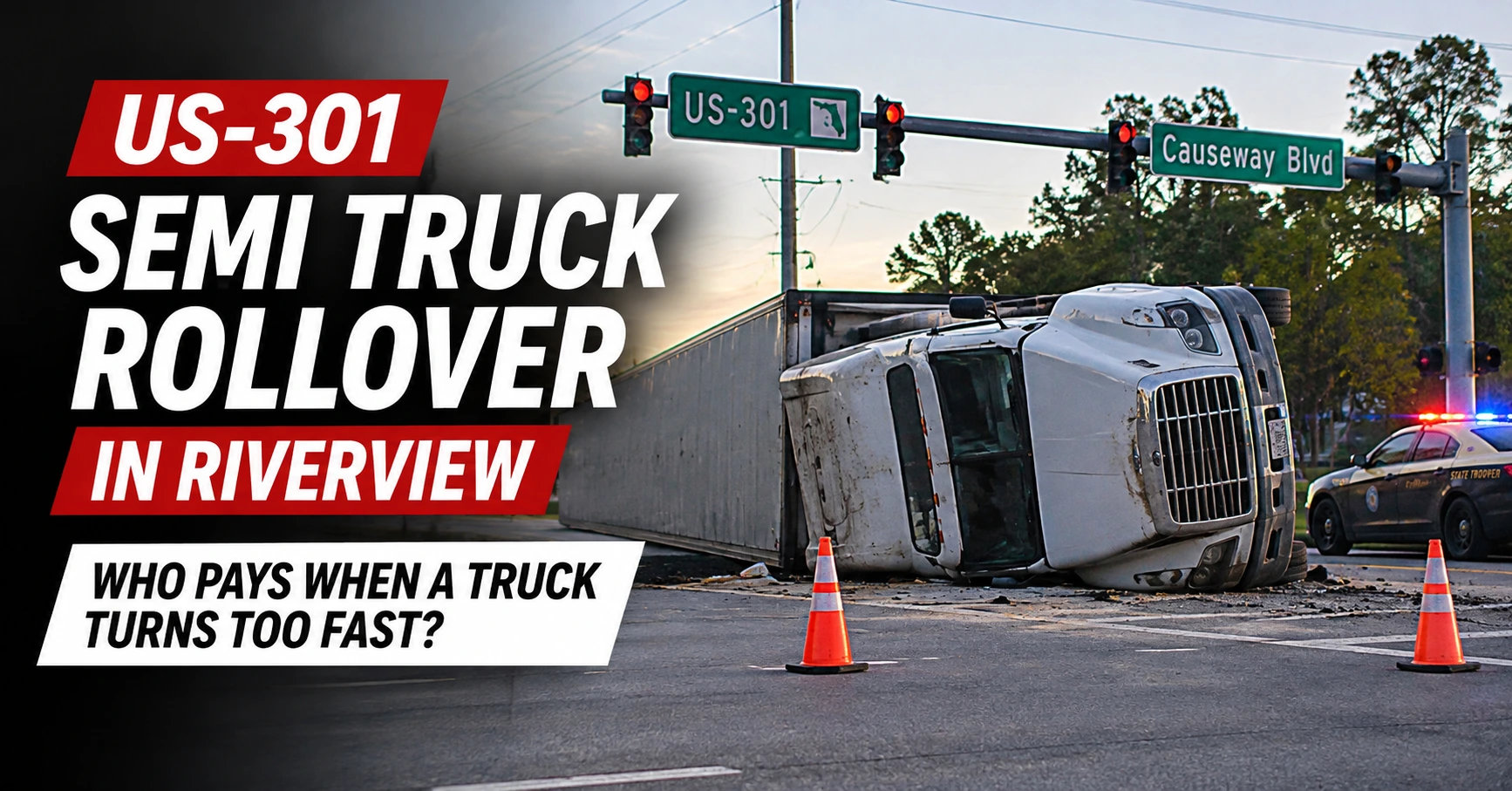
Large commercial vehicles are vital to Tampa’s economy, but when accidents happen the consequences are often devastating. Unlike standard passenger cars, semi-trucks and other commercial vehicles can weigh up to 40 tons, meaning even a low-speed crash can cause catastrophic injuries and major property damage. Because trucking operations involve strict federal and state regulations and multiple parties—from drivers and trucking companies to maintenance shops and cargo loaders—investigating what caused a crash requires specialized expertise. If you’ve been hurt in a truck or commercial vehicle accident, The Reyes Firm is here to help you get answers and fair compensation.
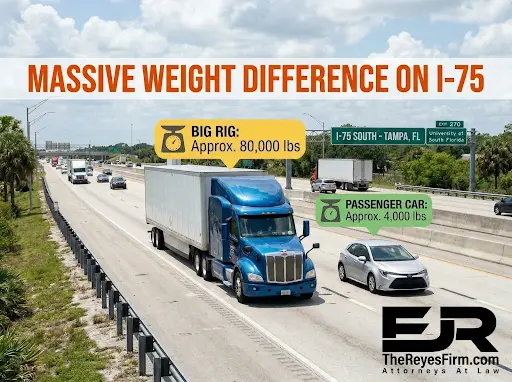
A semi-truck on I-75 highlights the weight difference between big rigs and passenger cars.
Quick Summary
- Big rigs can weigh up to 80,000 pounds, so collisions with passenger cars often cause life‑changing injuries and extensive damage.
- Driver fatigue, distracted driving and speeding are among the leading causes of truck crashes in Tampa.
- Neglected maintenance — such as faulty brakes, worn tires and defective equipment — and overloading make crashes more likely.
- Driving under the influence remains a serious problem despite strict testing rules for commercial drivers.
- Multiple parties may share liability, including the driver, trucking company, maintenance shop, cargo loader and equipment manufacturer.
- Evidence like police reports, electronic data recorders, driver logs, maintenance records and witness statements is vital to prove fault.
Why truck & commercial vehicle accidents are so dangerous
Commercial trucks and buses dwarf standard passenger vehicles. A fully loaded semi may weigh 20 to 30 times more than a car, so it takes much longer to stop and transfers far greater force in a collision. These vehicles also have large blind spots and higher centers of gravity, making rollovers and underride crashes more likely. When a crash does occur, occupants of smaller vehicles often suffer life‑changing injuries or worse.
Common causes of truck & commercial vehicle accidents
Most truck crashes are preventable. They stem from human error, mechanical neglect or unsafe operating conditions. Below are the main causes of truck and commercial vehicle accidents in Tampa and across Florida.
- Driver fatigue: Long hours and tight delivery schedules can lead truck drivers to push past their limits. Fatigue slows reaction times and impairs judgment, making drowsy driving a serious hazard.
- Distracted driving: Using a phone, eating, adjusting navigation or in‑cab controls can take a driver’s eyes and mind off the road. At highway speeds, even a momentary distraction can cause disaster.
- Speeding & aggressive driving: Speeding reduces a driver’s ability to stop in time to avoid a collision. Aggressive maneuvers like tailgating and cutting off other vehicles can cause rear‑end or side‑impact crashes and rollovers.
- Neglected maintenance: Trucking companies must inspect and service their vehicles regularly. Faulty brakes, worn‑out tires and defective equipment are common causes of crashes. Maintenance records often reveal whether a carrier ignored warning signs.
Watch: Tampa Truck Accident Video
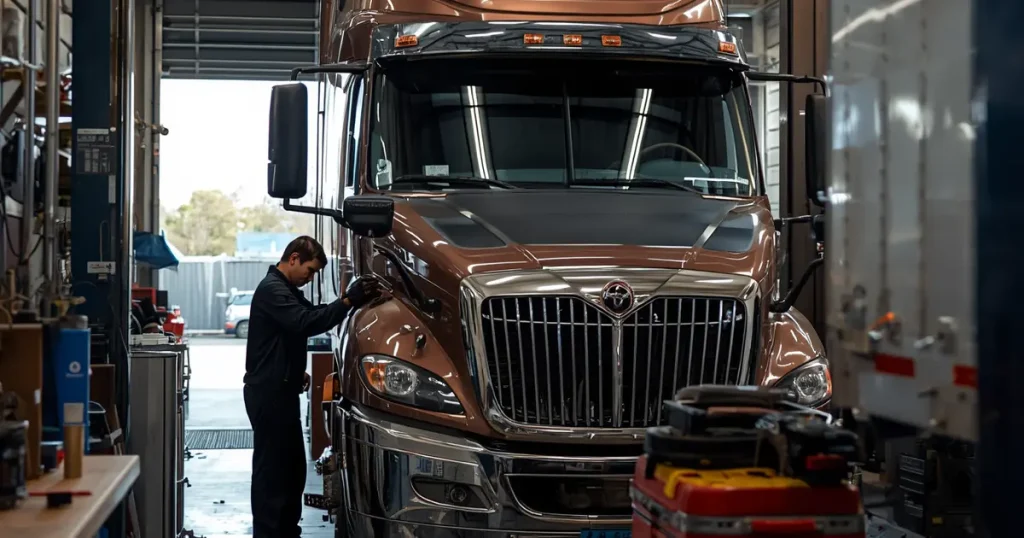
A technician inspects a truck’s brakes and tires. Mechanical failures like worn pads and defective components often play a role in serious crashes.
- Driving under the influence: Alcohol and drugs severely impair reaction time and decision‑making. Commercial drivers are subject to strict testing rules, but some still get behind the wheel while impaired, putting everyone at risk.
- Overloaded or improperly loaded trucks: Loading a trailer beyond its weight limit or failing to secure cargo can affect a truck’s stability, braking ability and steering. Overloaded trucks are prone to tipping over or jackknifing, especially on curves and inclines.
| Key takeaway: Driver error is common, but poorly maintained equipment and improper loading also cause many truck accidents. If you suspect mechanical failure, send a spoliation letter quickly so the trucking company preserves the evidence. (what is a spoliation letter?) |
Types of injuries in truck accidents
Because of the massive forces involved, crashes with commercial vehicles tend to cause catastrophic injuries. Common injuries include:
- Traumatic brain injuries (TBIs) that affect memory, cognition and behavior
- Spinal cord injuries that may result in partial or total paralysis
- Multiple fractures and broken bones requiring surgery and long recovery
- Internal organ damage that may not be immediately apparent
- Amputations caused by crushing forces or severe lacerations
- Fatal injuries leading to wrongful death claims
Who can be held liable?
Truck accident claims often involve multiple defendants. Potentially liable parties include the driver, the trucking company, the company that loaded the cargo, a maintenance or repair shop, the manufacturer of a defective part, or even a government agency responsible for road design or maintenance. A thorough investigation is needed to identify all sources of compensation.
Key evidence needed to prove fault
Getting compensated after a truck crash requires more than a police report. Key evidence may include:
- Photographs and video of the accident scene, vehicle damage and road conditions
- Electronic data recorder (“black box”) data showing speed, braking and throttle inputs
- Driver logbooks and electronic logging devices (ELDs) showing hours of service and rest breaks
- Truck inspection and maintenance records to prove negligent upkeep
- Cargo loading documents and weight tickets
- Statements from eyewitnesses and expert accident reconstructionists
Florida laws & deadlines
Florida law imposes unique requirements on truck accident claims. Failing to follow these rules can jeopardize your case. Keep these deadlines in mind:
- PIP 14‑day rule: You must seek initial medical care within 14 days of the crash to receive personal injury protection (PIP) benefits. (§627.736)
- Serious injury threshold: You can recover for pain and suffering only if a doctor certifies a permanent injury, significant and permanent scarring or disfigurement, or death. (§627.737)
- Modified comparative fault: You cannot recover compensation if you were more than 50% at fault for the accident. (§768.81)
- Two‑year statute of limitations: Most negligence claims for personal injury must be filed within two years of the accident. (§95.11)
- Crash report privilege: Statements made to law enforcement for crash reports are privileged and cannot be used against you in court. (§316.066)
- Federal safety regulations: Commercial vehicle operators must comply with federal safety rules in 49 C.F.R. parts 382–386 and 390–397, which are adopted into Florida law. (§316.302)
Stay mindful of deadlines – missing them could jeopardize your right to compensation.
| Information point: Florida recently shortened the time limit for filing negligence claims from four years to two. Make sure to act promptly to protect your rights. |
Steps to take after a truck accident
- Call 911 and report the accident immediately.
- Move to a safe location if you can do so without injury.
- Seek medical attention right away, even if you feel fine, and follow up within 14 days.
- Document the scene with photos and video of the vehicles, skid marks, road conditions and any injuries.
- Exchange contact and insurance information with the truck driver and collect the trucking company’s details.
- Get names and contact information from witnesses.
- Request a copy of the crash report from law enforcement.
- Keep copies of all medical records, bills and receipts related to your injuries.
- Send a spoliation letter to preserve black‑box data, driver logs and maintenance records.
- Consult an experienced truck accident attorney before speaking with insurance adjusters or signing any releases.
How The Reyes Firm can help you
Our legal team understands the unique challenges of truck and commercial vehicle cases. We offer a free consultation to evaluate your claim and explain your options. If we take your case, we will conduct a thorough investigation, gather critical evidence, consult experts and negotiate aggressively with insurance companies. We work on a contingency fee basis—meaning you owe nothing unless we obtain compensation for you. Call us at (813) 300-0300 or visit our contact page for a free case review.
Frequently asked questions
- What should I do first after a truck accident?
Call 911, move to a safe area if possible and seek medical attention. Document the scene and collect contact information from the driver and witnesses before contacting a lawyer.
- Why are truck accident injuries more severe than car crashes?
Commercial trucks weigh many times more than passenger vehicles and often carry heavy cargo, so the forces involved in a crash are greater. Occupants of smaller vehicles tend to sustain catastrophic injuries.
- What evidence can prove a truck driver was fatigued?
Driver logbooks, electronic logging devices and black‑box data show hours of service. Witness statements and surveillance footage may also reveal signs of fatigue.
- How is distracted driving proven in a truck accident case?
Cell phone records, dash‑cam footage and witness testimony can show that a driver was texting, eating or otherwise distracted at the time of the crash.
- Why is speeding so dangerous for trucks?
Because of their size and weight, trucks need more distance to stop. Speeding increases the likelihood of rollovers, jackknifes and rear‑end collisions.
- What counts as improper maintenance?
Failure to inspect and repair brakes, tires, steering and other vital systems. Maintenance records often show when a trucking company ignored known defects.
- Can I sue if the driver was drunk or on drugs?
Yes. Impaired driving is illegal, and both the driver and the trucking company may be held liable if they failed to enforce drug and alcohol policies.
- What if the truck was overloaded or improperly loaded?
Overloaded trailers and unsecured cargo can cause a truck to tip or jackknife. Liability may extend to the company that loaded the cargo.
- Who else may be liable besides the driver?
Other defendants may include the carrier, the owner of the tractor or trailer, maintenance shops, loading companies, parts manufacturers and government entities responsible for road safety.
- How long do I have to file a claim?
Most negligence claims must be filed within two years under Florida law. Some exceptions apply, so speak with a lawyer as soon as possible.
- What if I’m partly at fault?
Florida’s modified comparative fault law allows you to recover damages only if you are 50% or less at fault. Your compensation will be reduced by your percentage of fault.
- What is a spoliation letter and why is it important?
A spoliation letter notifies the trucking company to preserve evidence like black‑box data, driver logs and maintenance records. Without it, critical evidence may be lost or destroyed.
- Do I need a lawyer for a truck accident case?
Yes. Trucking companies and insurers are aggressive. An experienced attorney can gather evidence, identify all liable parties and fight for the compensation you deserve.
- How much does it cost to hire The Reyes Firm?
We work on a contingency fee basis, so you pay nothing up front and no legal fees unless we recover compensation for you.
- How long will my truck accident case take?
The timeline varies depending on the investigation, negotiations and whether the case goes to court. An attorney can give you a better estimate based on the specifics of your claim.