What You Need to Know
- Federal rules require post-crash testing only after certain commercial vehicle accidents.
- A fatal crash generally triggers testing even when the truck driver receives no citation.
- Alcohol testing has an eight-hour limit, while controlled-substance testing has a 32-hour limit.
- A positive or negative result does not decide the entire Tampa truck accident case by itself.
- Testing records, collection times, delay explanations, and company policies should be preserved quickly.
Had a bad day? Call The Reyes Firm at 833-4 BAD DAY.
The testing clock may already be running after a serious commercial truck crash. If you were injured, post-crash drug and alcohol testing may reveal what the driver had in their system and if the trucking company followed federal safety rules.
These records are usually controlled by the carrier, laboratory, medical review officer, or government agency. A Tampa truck and commercial vehicle accident attorney can act quickly to preserve them before delays, retention rules, or company procedures make the investigation harder.
If you are searching for a truck accident lawyer Tampa residents can call after a serious collision, ask how the firm investigates federal testing requirements and company-controlled evidence.
What Are Post-Crash Drug and Alcohol Tests After a Truck Accident?
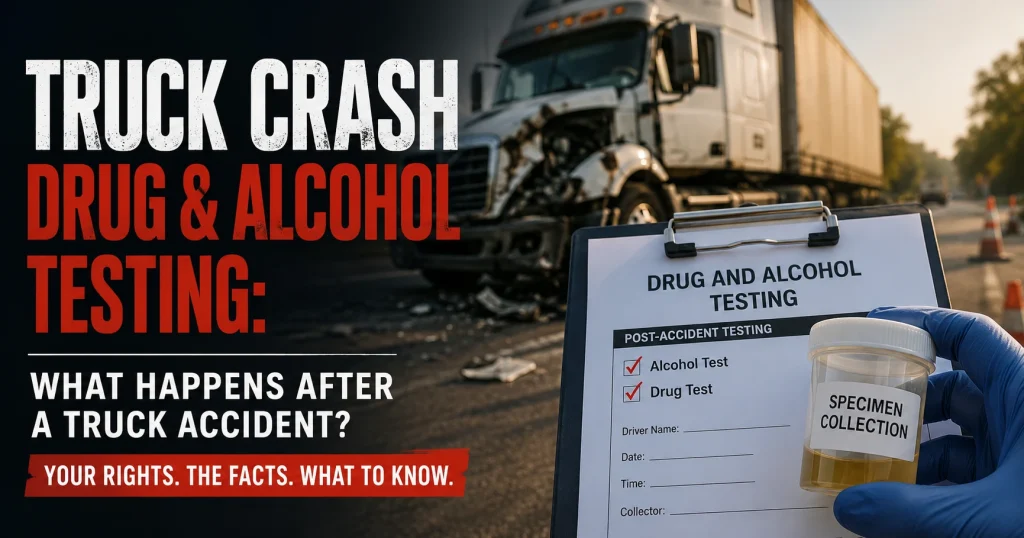
Post-crash drug and alcohol tests are federally regulated tests that may be required after certain commercial vehicle crashes. They can show a driver’s alcohol concentration or detect specific controlled substances under DOT procedures. They also create a timeline that may reveal if the carrier followed required testing rules.
The Federal Motor Carrier Safety Administration, or FMCSA, requires laboratory testing for five drug classes:
- Marijuana.
- Cocaine.
- Opiates and opioid derivatives.
- Amphetamines and methamphetamines.
- Phencyclidine, commonly called PCP.
DOT alcohol tests identify an alcohol concentration of 0.02 or higher. The testing procedures are different from the roadside observations, field sobriety tests, or criminal investigation that police may conduct.
A law-enforcement breath, blood, or urine test can sometimes satisfy the federal requirement when it follows applicable standards, and the employer obtains the result. 49 C.F.R. § 382.303 explains when government test results may qualify.
When Must a Trucking Company Order Testing After a Crash?
A trucking employer must order post-crash testing after a fatal crash involving a covered commercial driver. Testing is also required after some injury or tow-away crashes when the commercial driver receives a qualifying moving-traffic citation within the federal time window. Not every Tampa truck accident automatically triggers testing.
The basic FMCSA testing chart works like this:
Type of crash | Citation required before employer testing? | Testing required? |
| A person dies | No | Yes |
A person receives immediate medical treatment away from the scene | Yes | Yes |
| A vehicle has disabling damage and must be towed | Yes | Yes |
Injury or tow-away crash with no qualifying driver citation | Not applicable | Generally no under this rule |
The citation timing also matters. The federal rule refers to a citation issued to the commercial driver within eight hours for alcohol testing and within 32 hours for controlled-substance testing.
A company may have a broader internal policy, but its private policy does not change the minimum federal trigger. The crash report, citations, medical transport records, and tow records should all be reviewed together.
⚠️ Warning: Under 49 C.F.R. § 382.303, an employer must document why a required alcohol test was not completed within two hours. Alcohol-testing attempts stop after eight hours. Controlled-substance testing attempts stop after 32 hours, and the employer must preserve an explanation for the delay. These records may become key evidence.
What Can the Test Results Show in a Tampa Truck Accident Case?
Test results can show the alcohol concentration measured at collection, the presence of specified drugs or metabolites above federal cutoffs, and the time the sample was taken. They may support a larger investigation, but a result alone does not decide fault, impairment at impact, or the cause of the Tampa crash.
A post-crash result may help answer questions such as:
- Was alcohol detected at or above a reported concentration?
- Did the laboratory report a positive result for a covered drug class?
- How long after the collision was the sample collected?
- Did the carrier meet the federal testing deadline?
- Did the driver remain available for required testing?
- Did the employer document a delay or missed test?
- Did police conduct a separate breath, blood, or urine test?
A positive result can be important, but the full timeline still matters. Investigators may need expert review to assess collection time, laboratory procedures, medications, confirmation testing, and the relationship between the result and the driver’s actions.
A negative result also does not close the investigation. It does not rule out fatigue, distraction, speeding, unsafe maintenance, poor supervision, or another safety failure.
FLHSMV’s preliminary 2024 report counted 46,651 commercial motor vehicle crashes and 315 fatalities in Florida. Across all vehicle categories, the agency separately recorded 4,814 alcohol-confirmed crashes and 450 drug-confirmed crashes. The impairment categories are not truck-specific and should not be used to assume impairment in an individual case.
💡 Did You Know? NHTSA reported that 4 percent of large-truck drivers involved in fatal crashes in 2023 had a blood alcohol concentration of 0.08 or higher. Federal regulations use a lower 0.04 threshold for operating a commercial motor vehicle. Source: NHTSA, Traffic Safety Facts: Large Trucks, 2023 Data.
What Testing Records Should Be Preserved After a Truck Crash?
A complete investigation should seek more than the final positive or negative result. The testing timeline, collection forms, chain-of-custody documents, laboratory report, medical review officer records, citations, tow records, and explanations for delay can show if the carrier followed the rule and handled the evidence correctly.
Important records may include:
- Alcohol testing forms and instrument results.
- Drug-testing custody and control forms.
- Laboratory screening and confirmation reports.
- Medical review officer communications.
- The exact collection date and time.
- Records explaining a test completed after two hours.
- Records explaining a missed eight-hour or 32-hour deadline.
- Driver instructions and company testing policies.
- Police, hospital, ambulance, citation, and tow records.
- Communications between the carrier, driver, testing site, and laboratory.
These records should be compared with other truck evidence. That may include dashcam footage, electronic logging device data, GPS records, dispatch messages, cell phone records, black box data, and witness statements.
The broader Tampa truck accident lawyer guide explains why many forms of carrier-controlled evidence must be protected quickly. The company may begin building its defense within hours of the crash.
How Can Missing or Delayed Testing Affect a Truck Accident Claim?
Missing or delayed testing may show that the carrier failed to follow a federal safety duty, especially when the crash met the testing trigger. It does not automatically prove that the driver used drugs or alcohol. The gap must be compared with police evidence, witness accounts, video, electronic data, and company records.
An investigation should first determine:
- Did the crash involve a covered commercial motor vehicle on a public road?
- Did the crash cause a fatality, immediate treatment away from the scene, or disabling tow-away damage?
- Did the driver receive the required moving-traffic citation?
- When did the employer learn about the crash?
- When did testing begin?
- What reason did the employer record for any delay?
- Did law enforcement conduct a separate test?
Florida Statute § 316.302 applies many federal commercial motor vehicle rules to trucks operating on Florida roads. Exemptions and intrastate rules may affect a specific driver, vehicle, or trip, so the vehicle’s use and regulatory status must be confirmed.
A failure to test may support questions about company training, supervision, reporting, and compliance. It should be investigated alongside other FMCSA violations after a Tampa truck accident, not treated as automatic proof of intoxication.
🛡️ Your Rights: Florida Statute § 95.11(5)(a) generally provides two years to file an action founded on negligence. Testing records, video, electronic data, and witness memories may become harder to obtain much sooner. You have the right to speak with a qualified Florida attorney before giving a recorded statement to the trucking company’s insurer.
How The Reyes Firm Handles Your Post-Crash Testing Evidence Case
The Reyes Firm handles serious truck and commercial vehicle cases with focus, speed, and trial readiness. When post-crash testing may matter, we work to identify the testing trigger, preserve every related record, and compare the results with the full crash evidence.
We serve Tampa and the South Shore communities.
The Reyes Firm
4730 N. Habana Ave., Suite 201
Tampa, FL 33614
833-4 BAD DAY
Serving Tampa, Riverview, Brandon, Plant City, and communities across Hillsborough County.
Here is how we handle these cases:
- We listen first. You tell us what happened, what hurts, and what concerns you about the driver or trucking company.
- We investigate the testing trigger. We review fatalities, medical transport, disabling damage, citations, vehicle status, and the driver’s commercial duties.
- We preserve the complete testing file. We seek collection records, laboratory reports, medical review officer communications, company policies, and explanations for delays.
- We build the full timeline. We compare the crash time, citation time, sample collection, dispatch messages, medical care, and law-enforcement activity.
- We investigate every responsible party. The driver, motor carrier, employer, vehicle owner, contractor, or another company may control relevant records.
- We document your damages carefully. We gather medical records, wage information, future-care evidence, and proof of how the injuries affect your life.
- We hold insurers accountable. We handle their requests and challenge efforts to minimize missing evidence or your injuries.
- We prepare the case for trial. We build the claim with the records, witnesses, and qualified experts needed for a serious commercial vehicle case.
No test result can replace a complete investigation. Our work focuses on what the evidence shows, what may be missing, and who had a duty to preserve it.
Frequently Asked Questions
Do all truck crashes in Tampa require a drug and alcohol test?
No. Federal testing is generally triggered by a fatality or by certain injury and tow-away crashes involving a qualifying citation to the commercial driver. The truck, driver, trip, and crash circumstances must also fall within the applicable regulation.
Does a positive drug test prove the truck driver caused the crash?
Not by itself. A positive result may become important evidence, but the collection time, covered substance, driver conduct, crash reconstruction, and other evidence still need review. Fault must be based on the complete facts.
What happens when the carrier misses the eight-hour alcohol deadline?
The employer must stop trying to conduct the federal alcohol test after eight hours and prepare a record explaining why it was not completed. That explanation may help show how the carrier responded after the crash.
Can I obtain the truck driver’s testing results myself?
The carrier, laboratory, medical review officer, or law-enforcement agency may control the records. Some records may require formal requests, litigation discovery, or a subpoena. Early preservation demands can help prevent avoidable loss.
Does a negative drug or alcohol test end my Tampa truck accident case?
No. A negative test does not rule out speeding, fatigue, distraction, maintenance failures, unsafe loading, or company negligence. The result is only one part of the investigation.
How soon should I contact a truck accident lawyer after a Tampa crash?
Contacting a lawyer early may help preserve test records, camera footage, electronic data, and witness information. Florida generally provides two years for a negligence action, but evidence can disappear long before that deadline.

Edward Reyes, Esq. is a Florida Bar-admitted personal injury attorney and the founder of The Reyes Firm in Tampa. His practice focuses on truck accidents, commercial vehicle crashes, and serious injury claims. He helps injured people understand complex evidence and insurance issues in clear terms.
How Can The Reyes Firm Help You?
If you’ve had a bad day — a car accident, a slip and fall, a trucking crash, or any injury that wasn’t your fault — The Reyes Firm is in your corner. Our Tampa personal injury attorneys offer free consultations and work on a contingency fee basis, which means you pay us nothing unless we win your case.
You shouldn’t have to fight the insurance companies alone. Let us fight for you.
📍 4730 N. Habana Ave., Suite 201, Tampa, FL 33614
Had a bad day? Call The Reyes Firm. We’ll handle the rest.
This article provides general information and is not legal advice. Reading it does not create an attorney-client relationship with The Reyes Firm or any attorney. Past results do not guarantee a similar outcome. Speak with a qualified Florida attorney about the facts and deadlines that apply to your circumstances.