WHAT YOU NEED TO KNOW
- In Florida, you may be able to sue the trucking company, not just the driver, after a serious commercial truck crash.
- Trucking company liability in Florida crash cases often involves driver conduct, company safety failures, vehicle ownership, and federal trucking rules.
- Key evidence, such as ELD data, black box data, dashcam video, and maintenance records, can disappear quickly without a preservation letter.
- Florida recorded 46,651 commercial motor vehicle crashes and 315 fatalities in 2024, according to preliminary FLHSMV data.
- Under Florida Statute §95.11(5)(a), most negligence lawsuits must be filed within 2 years. Had a bad day? Call The Reyes Firm. 833-4 BAD DAY.
You didn’t expect to be here. One moment, you were driving home on I-275, and the next, a fully loaded 18-wheeler changed everything. The pain is real. The bills are already coming. The insurance calls may already feel overwhelming.
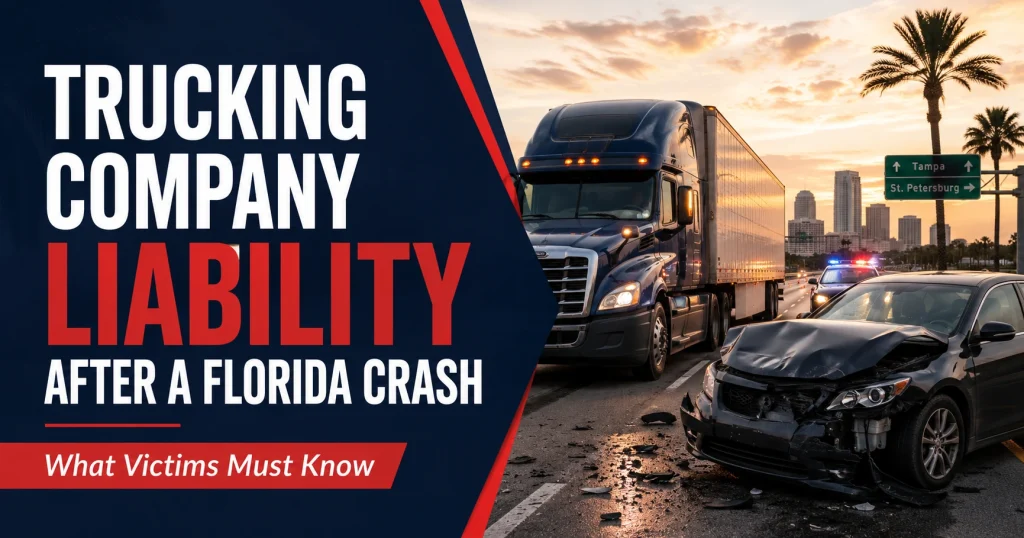
In a trucking company liability Florida crash case, the driver may not be the only party responsible. The company that hired the driver, owned or controlled the truck, set the route, handled maintenance, or ignored safety rules may also be legally responsible.
The moment a crash happens on I-4, I-75, I-275, or another Tampa road, the trucking company’s insurance team starts protecting its side. You need someone protecting you just as fast.
Can You Sue a Trucking Company in Florida After a Crash?
Yes. You can sue a trucking company after a Florida crash if the driver was working for the company or if the company’s own failures helped cause the wreck. These cases often involve vicarious liability, negligent hiring, poor supervision, unsafe maintenance, or violations of federal trucking regulations.
Vicarious liability means one party may be responsible for another person’s actions. In truck accident cases, this often means the company may be responsible if its driver caused the crash while doing job-related work.
A trucking company may also be liable for its own choices. This can include hiring an unsafe driver, keeping a dangerous driver on the road, skipping maintenance, ignoring hours-of-service limits, or failing to train drivers.
A Tampa truck accident attorney can help preserve evidence before the trucking company’s systems overwrite key data. That matters because truck crash cases often depend on company records, not just what happened at the crash scene.
⚠️ Warning: Under Florida Statute §95.11(5)(a), most negligence lawsuits must be filed within 2 years. This includes many Florida personal injury claims. If you miss the deadline, you may lose your right to seek compensation, even if the trucking company caused the crash. Source: Florida Statutes.
What Is Florida’s Dangerous Instrumentality Doctrine?
Florida’s Dangerous Instrumentality Doctrine can make a vehicle owner legally responsible when that owner allows someone else to operate the vehicle and that person causes harm through negligent driving. In truck crash cases, this rule may matter when a carrier, owner, or related company controlled the commercial vehicle.
The doctrine is not just about bad hiring. It focuses on ownership, permission, and control. If a company owned the truck or had legal control over it, that fact may help establish liability.
This rule can also matter when a company tries to shift blame by calling the driver an independent contractor. Florida courts may look beyond the label and examine who controlled the truck, the route, the load, and the work.
Commercial truck cases in Tampa often involve layered business structures. A carrier may lease equipment. A driver may work under a contract. A broker may arrange the shipment. That’s why the full ownership and control chain must be investigated.
How Can FMCSA Violations Help Prove Trucking Company Negligence?
FMCSA violations can serve as strong evidence of negligence in a Florida truck accident case. If a trucking company breaks federal safety rules and that violation contributes to a crash, those records may help show that the company failed to act safely.
The Federal Motor Carrier Safety Administration regulates many parts of commercial trucking. These rules cover hours of service, driver qualification files, drug and alcohol testing, inspection duties, maintenance records, cargo securement, and insurance requirements.
Common violations that may support a trucking company negligence claim include:
- Hours-of-service violations: The company allowed or pressured the driver to stay behind the wheel too long.
- Missing or altered ELD records: The company failed to track driving time or failed to preserve required records.
- Driver qualification problems: The company hired or kept a driver who did not meet safety standards.
- Maintenance failures: The company allowed a truck with unsafe brakes, tires, lights, or steering parts onto the road.
- Cargo securement failures: The company or loading party failed to secure cargo safely.
Federal rules require motor carriers to keep ELD records and supporting documents for 6 months. Federal maintenance rules also require certain vehicle maintenance records to be kept for 1 year and for 6 months after the vehicle leaves the carrier’s control.
💡 Did You Know? NHTSA’s 2023 Large Trucks Fact Sheet reported that 70% of people killed in large-truck crashes were occupants of other vehicles, not the truck itself. That is why these cases often involve serious injuries to people in passenger cars. Source: NHTSA CrashStats.
Why Does Evidence Preservation Matter After a Florida Truck Crash?
Evidence preservation matters because key trucking records can disappear, get overwritten, or become harder to obtain soon after a crash. A preservation letter tells the trucking company, insurer, and related parties to save the records that may prove what happened.
This letter is also called a litigation hold letter. It should demand preservation of black box data, ELD logs, dashcam footage, driver qualification files, drug and alcohol testing records, inspection records, maintenance records, dispatch messages, and load documents.
Important truck crash evidence may include:
| Evidence Type | Why It Matters |
| ELD records | Shows driving time, rest breaks, and possible fatigue |
| Black box data | May show speed, braking, throttle, and impact details |
| Dashcam footage | May show the truck’s movement before the crash |
| Driver qualification file | Shows hiring, training, violations, and safety history |
| Maintenance records | Shows brake, tire, light, steering, and repair issues |
| Dispatch records | Shows routes, pressure, timing, and delivery demands |
| Cargo records | Shows weight, securement, loading, and shipper details |
The trucking company’s insurance team does not wait. They start working fast. The Reyes Firm is built to move quickly, secure critical evidence, and build a case before the company’s defense becomes the only story in the file.
⚖️ Your Rights: Florida Statute §768.81 uses a modified comparative negligence rule. If you are more than 50% at fault, you may not recover damages in covered negligence cases. If you are 50% or less at fault, your recovery may be reduced by your share of fault. Source: Florida Statutes.
Who Else Can Be Liable Beyond the Trucking Company?
Several parties may share responsibility for a Florida truck crash. A complete investigation may look at the driver, carrier, truck owner, freight broker, shipper, loader, maintenance provider, and manufacturer. The goal is to identify every party whose choices helped cause the crash.
A freight broker may be involved if it selects an unsafe carrier. A shipper or loader may be involved if the cargo was overloaded or poorly secured. A maintenance company may be involved if it cleared an unsafe truck for service.
A manufacturer may be involved if a defective part contributed to the crash. Brake defects, tire failures, coupling problems, and steering issues can raise product liability questions.
In Tampa and the South Shore communities, commercial truck crashes often involve routes through I-4, I-75, I-275, Brandon, Riverview, Plant City, and communities across Hillsborough County. These cases can involve several companies, several insurers, and several layers of fault.
Watch: Who Can You Sue After a Trucking Accident?
In this video, local attorney Edward Reyes explains why a semi-truck accident claim may involve more than the driver. Depending on the facts, liability may extend to the trucking company, vehicle owner, trailer owner, dispatcher, loading party, or another company involved in the shipment.
Video summary: Truck accident cases can involve several responsible parties, not just the driver. A full investigation may review the carrier, vehicle owner, trailer owner, dispatcher, loading company, and other related businesses.
What Compensation Can You Recover After a Florida Truck Crash?
You may be able to recover economic and non-economic damages after a Florida truck crash. Economic damages cover financial losses. Non-economic damages cover the human impact of the crash, including pain, suffering, and loss of normal life.
Economic damages may include:
- Emergency care
- Hospital bills
- Surgery
- Physical therapy
- Future medical care
- Lost wages
- Loss of future earning ability
- Vehicle damage
Non-economic damages may include physical pain, emotional distress, loss of enjoyment of life, scarring, disfigurement, and loss of companionship.
In rare cases involving intentional misconduct or gross negligence, punitive damages may be available under Florida Statute §768.72. In a fatal truck crash, surviving family members may have a wrongful death claim under Florida Statute §768.21.
For many commercial carriers, FMCSA insurance requirements start at $750,000 for for-hire property carriers with vehicles weighing 10,001 pounds or more carrying non-hazardous freight. Higher limits may apply for certain hazardous materials or passenger carriers.
How The Reyes Firm Handles Your Trucking Company Liability Case
When a trucking company is involved, the hours after the crash matter. The Reyes Firm moves quickly because trucking cases are not ordinary injury claims. They involve federal rules, company records, insurance layers, and evidence that can disappear.
When we take on a trucking company liability case, we:
- Send preservation letters fast. We notify the trucking company, insurer, ELD provider, maintenance contractors, and related parties to preserve black box data, ELD logs, driver files, dashcam footage, drug testing records, and dispatch messages.
- Investigate the full liability chain. We look beyond the driver and examine the carrier, truck owner, broker, shipper, loader, maintenance provider, and related business entities.
- Review FMCSA safety records. We look for prior crashes, failed inspections, hours-of-service violations, driver fitness issues, and unsafe maintenance patterns.
- Work with the right experts. We may involve accident reconstruction specialists, trucking safety experts, medical experts, and economic experts to prove what happened and how it changed your life.
- Examine driver history. We review qualification files, employment records, training records, prior violations, and signs that the company should not have put that driver on the road.
- Analyze insurance coverage. We look at primary policies, excess coverage, umbrella coverage, and any MCS-90 issues that may affect recovery.
- Build the case around your real loss. We do not stop at the first hospital bill. We look at your future care, your work, your family, and your ability to live the life you had before the crash.
We are not a warehouse for cases. We are built for hard commercial vehicle claims. When a trucking company’s defense team is already protecting its side, you need a law firm that understands the rules, moves faster than the adjusters, and prepares the case for what it is truly worth.
The Reyes Firm. 4730 N. Habana Ave., Suite 201, Tampa, FL 33614. 833-4 BAD DAY.
Frequently Asked Questions
Can I sue the trucking company if the driver caused the crash?
Yes. In Florida, you may be able to sue the trucking company if the driver caused the crash while working. You may also have a direct claim against the company for unsafe hiring, poor training, bad supervision, or unsafe maintenance.
What is the 51% rule in a Florida truck accident case?
Florida’s 51% rule means you cannot recover damages in covered negligence cases if you are more than 50% at fault. If you are 50% or less at fault, your damages may be reduced by your share of fault. This rule comes from Florida Statute §768.81.
How long do I have to file a truck accident lawsuit in Florida?
Most Florida negligence lawsuits must be filed within 2 years under Florida Statute §95.11(5)(a). The deadline usually starts on the date of the crash. You should not wait because trucking evidence can disappear long before the lawsuit deadline.
What is a preservation letter in a truck accident case?
A preservation letter tells the trucking company and related parties to save evidence. This may include ELD logs, black box data, dashcam video, maintenance records, drug testing records, and driver files. Sending this letter quickly can protect evidence before systems overwrite it.
Can a trucking company avoid liability by calling the driver an independent contractor?
Not always. Florida courts can look at control, ownership, permission, routes, assignments, and daily operations. If the company controlled key parts of the work, the independent contractor label may not end the liability analysis.
What is the MCS-90 endorsement?
The MCS-90 is a federal endorsement tied to certain motor carrier insurance policies under 49 CFR §387.15. In qualifying public liability cases, an insurer may be required to satisfy a judgment even when coverage defenses exist. Your attorney should review the policy, carrier status, and facts before relying on it.
What if the trucking company has a poor safety record?
A poor safety record can help show that the crash was part of a larger safety problem. Prior inspections, violations, crashes, and out-of-service orders may support claims for negligent hiring, negligent retention, poor supervision, or unsafe maintenance.
Does Florida no-fault insurance apply to truck accident cases?
Yes, your PIP coverage may apply first if you were in a covered Florida vehicle. But serious truck accident injuries often exceed PIP limits quickly. A claim against the trucking company may seek damages beyond your own no-fault benefits.

This article was written by Edward Reyes, Esq., founder of The Reyes Firm and a member of The Florida Bar. Edward focuses his practice on catastrophic personal injury and wrongful death cases involving commercial vehicles, 18-wheelers, delivery trucks, and company-operated fleets across Tampa, Hillsborough County, and the South Shore communities. His work on trucking company liability cases includes reviewing FMCSA records, black box data, insurance coverage, and multi-party fault issues.
Read more about Edward Reyes.
How Can The Reyes Firm Help You?
If you’ve had a bad day, a car accident, a slip and fall, a trucking crash, or any injury that wasn’t your fault, The Reyes Firm is in your corner. Our Tampa personal injury attorneys offer free consultations and work on a contingency fee basis, which means you pay us nothing unless we win your case.
You shouldn’t have to fight the insurance companies alone. Let us fight for you.
📍 4730 N. Habana Ave., Suite 201, Tampa, FL 33614
Had a bad day? Call The Reyes Firm. We’ll handle the rest.
The information provided in this article is for general educational purposes only and does not constitute legal advice. Reading this article does not create an attorney-client relationship between you and The Reyes Firm or Edward Reyes, Esq. Every case is different, and outcomes depend on the specific facts and circumstances involved. Florida law and federal regulations change over time. Do not rely on this article as a substitute for consultation with a qualified Florida personal injury attorney. Past results do not guarantee future outcomes. If you were injured in a truck accident in Tampa or anywhere in Florida, contact a licensed attorney to discuss your specific situation.