What You Need to Know
- More than one party may share responsibility after a truck hits you in a Florida work zone, including the driver, the trucking company, a road contractor, and a government agency. The facts decide who is responsible.
- A road contractor working on an FDOT project has a legal shield under Fla. Stat. 337.195, but the shield has exceptions, including a failure to follow the traffic control plans.
- Claims against FDOT and other state agencies follow special notice rules and damage caps under Fla. Stat. 768.28.
- Deadlines depend on who you are claiming against. The dates in this guide are computed from the statutes as they read today and need to be confirmed for your situation.
- A traffic ticket does not prove civil fault, and Florida law bars recovery for a person found more than 50 percent at fault for their own harm.
Had a bad day? Call The Reyes Firm at 833-4 BAD DAY.
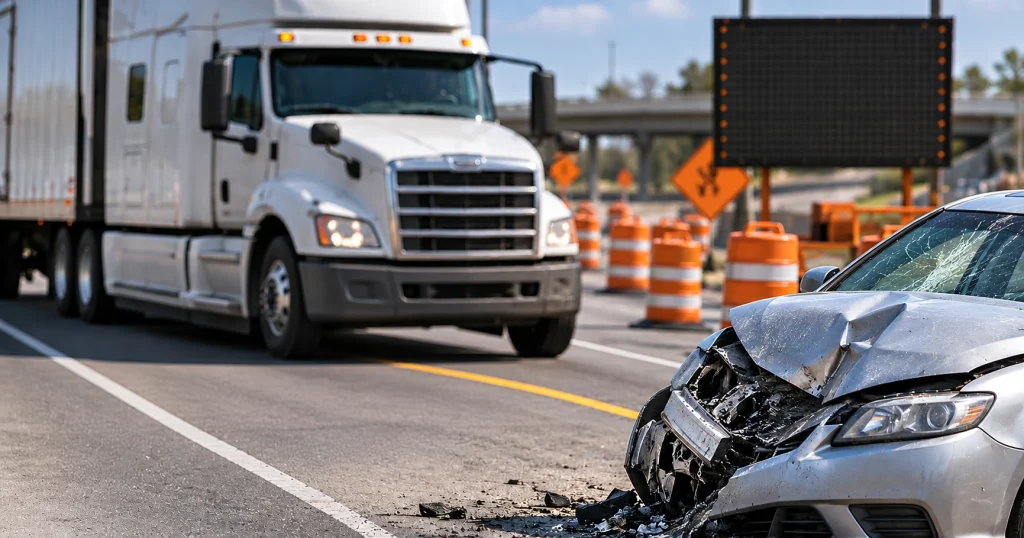
One minute you are slowing for orange barrels and a lane shift. The next, a truck is in your path, and your life has changed. A work zone accident can leave you with injuries, medical bills, and one hard question: who is responsible?
The answer is rarely simple. A work zone can involve a truck driver, a trucking company, a road contractor, an engineer, and a government agency. Each follows different rules, and each may point to someone else.
This guide explains who may be liable after a truck hits you in a Florida work zone, how contractor and state claims work, which traffic rules apply to truck drivers, and which deadlines may apply. It is general information for drivers in Tampa and across the South Shore. For one local example of a construction zone crash, read our report on the Howard Frankland Bridge construction zone crash.
Who is liable if a truck hits me in a Florida work zone?
Several parties may share responsibility, including the truck driver, the trucking company, the truck owner, a road contractor, and a government agency. Under Fla. Stat. 768.81(6), a person found more than 50 percent at fault for their own harm may not recover damages, so each party’s share of fault matters.
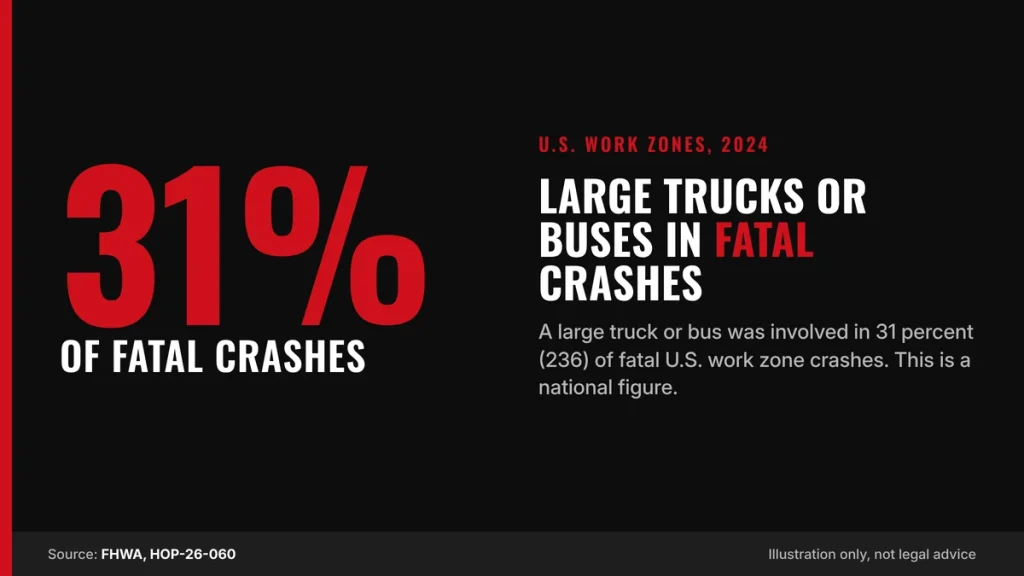
Truck crashes in work zones are not rare. The Federal Highway Administration reported that work zone crashes killed 850 people across the United States in 2024. Large trucks or buses were involved in 31 percent (236) of those fatal work zone crashes. That is a national figure, not a Florida figure. You can read the data in the FHWA work zone factsheet.
Here is how each party may fit in:
- The truck driver. A driver who fails to use reasonable care may be responsible for the resulting harm.
- The trucking company. A company may be responsible for what its driver does on the job, depending on the facts. A company is not automatically liable.
- The truck owner. Ownership can matter when a truck belongs to someone other than the driver’s employer.
- A road contractor. Its responsibility is limited in some cases. See the next section.
- A government agency. Claims against the state have their own rules. See the FDOT section below.
Florida also sets safety rules for commercial vehicles. Under Fla. Stat. 316.302, commercial vehicle owners and drivers must follow federal safety regulations. Some smaller trucks that operate only in Florida and carry no placarded hazardous materials are exempt from part of that rule, so the truck’s size and use matter.
Facts that decide who is liable
Before anyone can name a responsible party, an investigation needs answers to questions like these:
- Who owned the truck, and who was the driver working for at the time?
- Was the project for FDOT, a county, or a city?
- Was a lane closed, and how was the closure marked?
- Was the traffic control plan followed?
- Were there warning signs, cones, or flaggers where the crash happened?
- Do the truck’s records show anything about speed, hours of service, or maintenance?
Bring whatever you know to the first conversation with an attorney. Small details can change who answers for the crash.
Can I sue the road contractor over a confusing lane closure in Florida?
Possibly, but Florida law gives contractors on FDOT projects a conditional shield. Under Fla. Stat. 337.195(3), a contractor that complied with its contract documents is not liable for injury, except for a latent defect it created or a failure to follow the traffic control plans.
That shield is narrower than many people think. Here is what the statute says in plain English:
- The general rule. A contractor that was complying with the material contract documents is not liable to a claimant for personal injury, property damage, or death.
- The exceptions. The shield does not cover a latent condition, defect, error, or omission the contractor created. It also does not cover a failure to comply with the traffic control plans required by the contract documents.
- The verdict form. Under subsection (5), a party that is immune may not be named on the verdict form.
- Impaired or reckless drivers. Under subsection (2), in a construction zone, a driver who was impaired or who drove recklessly may be presumed to be the sole cause of the crash in a suit against the department or its contractors. The presumption can be overcome by showing gross negligence or intentional misconduct.
- Design engineers. Under subsection (4), an engineer is presumed to have met the standard of care if its plans followed Department design standards.
A confusing lane closure raises two questions. Did the traffic control plan call for that layout? And was the plan actually followed on the road? The answers often sit in contract documents, inspection records, and photos taken soon after the crash.
The shield applies to contractors working for the department (FDOT), including subcontractors, so a county or city project may follow different rules. An attorney should confirm the current version of this statute and whose contract covered the project before you rely on it.
Can I make a claim against FDOT or the state after a work zone crash?
In many cases, yes, but state claims follow special rules. Under Fla. Stat. 768.28, Florida waives sovereign immunity for torts only to the extent the statute allows, which means notice requirements and damage caps apply to claims against agencies like FDOT.
As the statute reads today, these are the main limits:
| Rule | What the statute says | Section |
|---|---|---|
| Damage caps | $200,000 for one person and $300,000 per incident | 768.28(5)(a) |
| Punitive damages and pre-judgment interest | Not allowed | 768.28(5)(a) |
| Written notice | To the agency and to the Department of Financial Services within 3 years | 768.28(6)(a) |
| Wrongful death notice | To the Department of Financial Services within 2 years | 768.28(6)(a) |
| Agency silence | Treated as a denial after 6 months (90 days for wrongful death) | 768.28(6)(d) |
| Lawsuit | Within 4 years for general claims | 768.28(14) |
The time limit is paused while the agency reviews your claim. A wrongful death suit follows Fla. Stat. 95.11(5).
One more detail matters on state road projects. Under subsection (10)(e), a firm that monitors or inspects state road work is treated as an FDOT agent while acting within its contract. A firm that designs or builds the project is not.
Lawmakers have considered changing these limits, so the numbers can move. Check the current text of the statute before relying on any figure.
⚠️ Warning: State claims have their own clock. Under Fla. Stat. 768.28(6)(a), a written claim must reach the agency and the Department of Financial Services within 3 years, and a wrongful death claim must reach the Department of Financial Services within 2 years. The period is paused while the agency reviews the claim, and a case with more than one defendant may follow more than one deadline. Do not wait to ask an attorney about your dates.
What special rules do truck drivers follow in a Florida work zone?
Truck drivers follow the same work zone laws as everyone else, plus federal safety rules for commercial vehicles. Under Fla. Stat. 316.302(1), commercial vehicle owners and drivers must follow federal safety regulations, and Fla. Stat. 316.306 bans handheld phone use in work zones.
These are the main rules to know:
| Law | What it requires | Limits to know |
|---|---|---|
| Fla. Stat. 316.079 | Drivers must yield to a pedestrian worker or flagperson in maintenance or construction work when reasonably and lawfully notified by a flagperson and a warning sign or device | Narrow. It does not cover every lane closure |
| Fla. Stat. 316.306 | No handheld phone use in work zone areas when construction personnel are present or equipment is operating on or next to the road | Moving violation with 3 points. Hands-free and first-offense options exist |
| Fla. Stat. 316.126(1)(b) | Move over or slow down for a road or bridge maintenance or construction vehicle with warning lights on the roadside | Applies when advance signs and channelizing devices are absent. The move-over rule applies when safe on roads with two or more lanes in the driver’s direction |
| Fla. Stat. 316.0745 | FDOT adopts the traffic control device manual, and public bodies must follow it | Covers signs and devices. It does not address contractor liability |
A broken rule can help show that someone was careless. It does not settle the whole case. Investigators still look at speed, visibility, signs, lane layout, and what each party did.
💡 Did You Know? In 2023, Florida recorded more than 16,012 work zone crashes, 74 fatalities, and 294 serious injuries, according to the Florida Department of Transportation, which cites the 2023 Florida Traffic Crash Facts report. This is a statewide figure for work zone crashes of all kinds, not only truck crashes.
How long do I have to file a claim after a work zone crash in Florida?
The deadline depends on who you are claiming against. Under Fla. Stat. 95.11(5)(a), a negligence suit against a private party generally must be filed within 2 years for claims that arose after March 24, 2023. Claims against state agencies follow Fla. Stat. 768.28.
These dates are computed from the statutes as they read today. They are not final for any person’s case, and an attorney must confirm them.
| Claim | Time period | Authority | Notes |
|---|---|---|---|
| Negligence suit against a private party | 2 years | 95.11(5)(a) | For claims that arose after March 24, 2023. Older claims keep 4 years |
| Wrongful death suit | 2 years | 95.11(5)(e) | An exception may apply in some cases |
| Notice of claim to a state agency | 3 years | 768.28(6)(a) | Also goes to the Department of Financial Services |
| Wrongful death notice to the state | 2 years | 768.28(6)(a) | Goes to the Department of Financial Services |
| Suit against the state after denial | 4 years | 768.28(14) | Wrongful death follows 95.11(5) |
| First medical care for PIP | 14 days | 627.736(1)(a) | A treatment deadline, not a lawsuit deadline |
| Telling an employer about a work injury | 30 days | 440.185(1) | Exceptions apply, including employer knowledge |
| Workers’ compensation petition | 2 years | 440.19(1) | Timing rules can differ if benefits were paid |
The 2-year period applies to claims against private parties like a driver or a trucking company. A claim that also involves FDOT or a county can follow more than one clock at once. That is why early legal review matters.
What should I do after a work zone crash near Ruskin or Tampa?
Get medical care first, then protect the evidence. Under Fla. Stat. 627.736, personal injury protection medical benefits apply when you receive initial care within 14 days after the crash. Call 911, report the crash, and document the work zone before it changes.
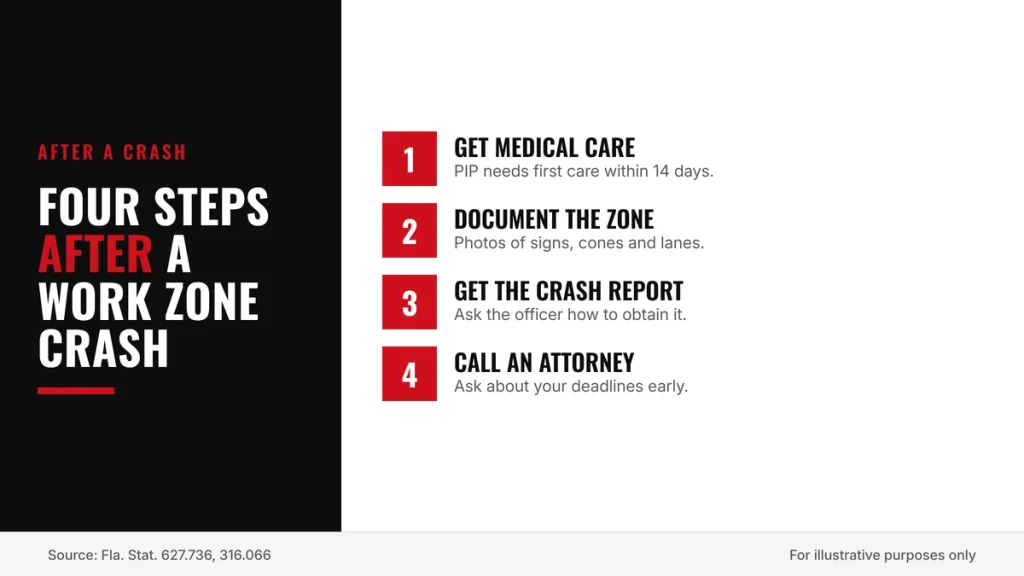
These steps apply in Ruskin, Riverview, Brandon, and anywhere else in Hillsborough County.
Do:
- Call 911 and get medical care, even if you feel fine.
- Photograph the signs, cones, barrels, lane shifts, and truck markings before they change.
- Ask the officer how to get the crash report.
- Write down what you remember while it is fresh.
- Keep every medical bill and record.
- Call an attorney before you give a recorded statement to an insurance company.
Don’t:
- Guess about who caused the crash.
- Post about the crash on social media.
- Sign a release before you understand it.
- Wait to ask about your deadlines.
🛡️ Your Rights Under Florida Law: Under Fla. Stat. 316.066, the officer must submit a long-form crash report within 10 days after the investigation is completed when the crash involves death, injury, a complaint of pain, a vehicle needing a wrecker, or a commercial vehicle. The report is confidential for 60 days, but the parties, their legal representatives, and their insurers can get it right away. Limits and exceptions apply.
How The Reyes Firm Handles Your Work Zone Truck Accident Case
The Reyes Firm handles work zone truck accident cases with speed, careful preparation, and a clear plan. We move quickly to preserve evidence, identify every responsible party, review available insurance, and get ready for settlement talks or trial when the case calls for it.
Here is how we help:
- We listen first. We start with what happened to you and what you need.
- We investigate the crash. We look at the road, the signs, the lane layout, and the truck.
- We preserve important evidence. That can include traffic control plans, contract documents, inspection records, driver logs, truck data, and photos.
- We identify each potentially responsible party. That may include a driver, a trucking company, a contractor, or a government agency.
- We locate available insurance and coverage. We review commercial policies, your own coverage, and other sources.
- We document your injuries. We gather records that show your treatment and how the crash changed your life.
- We track the deadlines. Claims against private parties and government agencies can follow different clocks.
- We prepare for settlement and trial. We build each case to be ready for either path.
We help injured people in Tampa and the South Shore communities, serving Tampa, Riverview, Brandon, Plant City, and communities across Hillsborough County.
The Reyes Firm
4730 N. Habana Ave., Suite 201
Tampa, FL 33614
833-4 BAD DAY
thereyesfirm.com
To learn more about how we handle commercial vehicle crashes, visit our Tampa truck and commercial vehicle accident attorney page.
Frequently Asked Questions About Florida Work Zone Truck Accidents
What is the 51% rule in Florida, and does it apply to a work zone crash?
Under Fla. Stat. 768.81(6), in a negligence action, a person found more than 50 percent at fault for their own harm may not recover any damages. Medical negligence cases are excluded. The rule came from a 2023 law change (chapter 2023-15), so an attorney needs to confirm how it applies to your crash.
Does my own insurance pay first after a work zone crash?
Personal injury protection, or PIP, is part of your own auto policy. Under Fla. Stat. 627.736, PIP medical benefits apply when you get initial care within 14 days after the crash. Benefits are limited to $10,000 in medical and disability benefits, and medical reimbursement is limited to $2,500 if no emergency medical condition is found. PIP may not cover all of your losses, so other claims may matter.
What if I was working in the work zone when a truck hit me?
If you were on the job, workers’ compensation may apply. Under Fla. Stat. 440.11(1), workers’ compensation is generally the exclusive remedy against your employer, with exceptions. Under Fla. Stat. 440.39(1), you may also pursue a third party, such as a truck driver, through a lawsuit, and the insurance carrier may have a lien on a recovery. Tell your employer about the injury within 30 days under Fla. Stat. 440.185(1).
Does a ticket for the truck driver mean the driver is legally at fault?
No. A traffic ticket is not proof of fault in a civil injury claim. A citation records what an officer concluded at the scene, and a fine is a penalty. Your claim depends on the full evidence, including the crash report, photos, witness accounts, and records.
What records can show how the work zone was set up?
Several records may help. Under Fla. Stat. 337.195(1), the contractor’s protection turns on the contract documents and traffic control plans, so those papers can matter a great deal. Inspection records, daily work logs, photos, video, and the truck’s own records may also help. These items can be lost quickly, so ask an attorney how to preserve them.
Do double fines in work zones matter for my claim?
Not by themselves. Under Fla. Stat. 318.18(3)(e), a speeding fine is doubled in a posted construction zone, but only if the posting gives the speed limit and the doubling notice and construction personnel are present, or equipment is operating on or next to the road. A fine is a penalty. It is not a finding of fault in your injury claim.
How do I get my crash report after a work zone crash?
Start by asking the officer at the scene which agency will hold the report. Under Fla. Stat. 316.066, the report is confidential for 60 days, but the parties, their legal representatives, and their insurers can get it right away. An attorney can also help you request it.
Is the trucking company responsible for what its driver did in a work zone?
A company may be responsible for its driver’s work-related negligence, depending on the facts. Who employed the driver, who owned the truck, and what the driver was doing at the time can all matter. A company is not automatically liable just because its truck was involved.

Edward Reyes, Esq. founded The Reyes Firm and is admitted to The Florida Bar. His practice focuses on serious personal injury cases, including motor vehicle crashes and catastrophic injuries. He represents injured people in Tampa and communities across Hillsborough County.
How Can The Reyes Firm Help You?
If you’ve had a bad day — a car accident, a slip and fall, a trucking crash, or any injury that wasn’t your fault — The Reyes Firm is in your corner. Our Tampa personal injury attorneys offer free consultations and work on a contingency fee basis, meaning you pay nothing unless we win your case.
You shouldn’t have to fight the insurance companies alone. Let us fight for you.
📍 Address: 4730 N. Habana Ave., Suite 201, Tampa, FL 33614
📞 Phone: 833-4 BAD DAY
🌐 Website: Schedule your free consultation today at thereyesfirm.com
Had a bad day? Call The Reyes Firm. We’ll handle the rest.
Legal Disclaimer: This article provides general information about Florida law. It is not legal advice and does not create an attorney-client relationship. Every case is different, laws change, and deadlines depend on the facts. Speak with a licensed attorney about your situation.