
October 31, 2019

To Blow or Not To Blow
After A Car Accident, After an Accident, Car accident, DUI/DWI, Police Interaction, Road Accidents, Why we serve

To Blow or Not To Blow: Make the Right Decision

The most common question is, “do I blow or not blow?” The answer is maybe. Obviously, if you refuse there are a few problems with refusal. Now frequently you hear the blanket advice from everybody, like: “Refuse everything.”That’s not necessarily the case. Now, the field sobriety exercises, which are the first stage of the investigation, you can refuse those. You can always refuse those anytime. Those exercises, which are divided attention exercises are sometimes called field sobriety tests. They’re not tests, they’re exercises. But you can refuse them even if you’ve refused before, even if you’ve gotten a DUI before, you can refuse to take those. Now, if you refuse to take those it is very likely that you will be arrested. However, the officers have made up their minds, no matter what they say. They’ve made up their mind from the time they’ve done the horizontal gaze nystagmus. Now, maybe you’re a ballerina, maybe you’re a person who’s very athletic, and you’re very likely to be able to do okay at field sobriety exercises, the average middle-aged, overweight person couldn’t probably do them in a reasonable way. This is kind of difficult under any circumstances. So, you’re probably not going to look good on them, and the officer has probably made up his mind already. Is It Negative to Refuse? So, refusing doesn’t really have any negative impact other than the immediate impact of you going to be arrested for DUI. The more nuanced question becomes the second question, which is: do you refuse to blow? Now, if you refuse to blow, instead of a six-month driver’s license suspension if you blow over .08, you’ll be looking at a one-year driver’s license suspension. Also, it’s a safe harbor you can only use the one time because it’s a misdemeanor of the first to be punishable by a year in jail if you use it a second time. So frequently, people who refuse to blow before and gotten a reckless driving, then they refuse to blow again the second time they get a DUI, now, the State might not be able to prove the DUI, but they can certainly prove the refusal. The refusal could get up to a year in jail just on its own, so that becomes a problem. So, it’s not a cure-all. Now, just sort of a second thing, if you blow over .08, but under a .15, so in that in-between stage, you’re not looking at super-enhancements. If you blow a .15 or above, you’re looking, even on your first DUI, you’re looking at mandatory interlock. You’re also looking at an increased fine. So, I mean, if you’ve had a real night, you might seriously want to consider just eating the refusal. If you think it’s close, if you think maybe you’ve had three beers, maybe had four beers. Maybe you want to blow and see if you’re close to .08. – It’s like rolling the dice. You might want to roll the dice on that. Dealing with your DUI But you know, let me put it this way, if it’s you’re first DUI and you know in your heart how this is going to go down, you can make the call. If it’s your second DUI you’re basically stuck blowing because you can’t eat, you can’t take that refusal a second time. So, you might want to keep it in your back pocket. You have to make the game-time decision at a time when it’s pretty fraught, but no one can make that decision for you. Now, moving on to the next day, so, you’ve taken the ride, you’ve spent the night in jail, you get out in the morning, you feel like crap, you have to go hire an attorney. Somewhere along the way, they told you they were going to suspend your driver’s license, either for a year or for six months depending on whether you blew or refused. Now, you have some options. You have your ticket. They’ve taken away your driver’s license, you can drive on that ticket for 10 days, and you can do any of three things in those 10 days. You can: do nothing, and then the license suspension kicks in. So, it’s going to be a 30-day hard suspension for a blow, or a 90-day hard suspension for refusal, after which you’re eligible to go get a hardship license or a BPO, Business Purpose Only license. Whatever you do, don’t do anything. Call us first. You have 10 days. You can certainly make up your mind in 10 days between the other two options. The option most people do and I’m not saying it’s a bad option, it’s probably a good option and you have to make up your mind for you, is people want to get back out on the road really quick. In which case all you have to do is sign up for DUI school, go down to the DMV on Hillsboro with the receipt and they will give you your hardship license right away. You waive your right to a hearing; you get your hardship license. Now you can only do that on your first DUI, they are certain restrictions, and a lot of people they just want to get back out on the road right away, go do that. Get into DUI school as quick as possible, get that done because a lot of times you’ll want to get the DUI school done regardless of what happens with your case. Tampa personal injury lawyer Edward Reyes represents people in Tampa and Hillsborough County, Florida who have suffered an injury in an incident or accident type of accident. Speak Directly to Me, At No Cost, Today 813.421.3411 Calling A Lawyer The second option, which depending on how your DUI went down, obviously if this is not a first DUI you have to go for this option, but you may have strategic reasons you want to take this other option anyway if
File a car accident claim in Tampa
After A Car Accident, After an Accident, Car accident, Police Interaction, Why we serve

Can you file a car accident claim in Tampa if you were hurt?

You were just going about your day, driving home through Tampa, when another driver blew a light or drifted into your lane and turned a routine trip into a Tampa car accident that changed everything. Now you’re in pain, your car is wrecked, and the other driver’s insurance company is already working to protect its bottom line. Here’s what you need to know before you say another word to them. TL;DR — QUICK SUMMARY In Florida, the driver who caused your crash can be held financially responsible for your medical bills, lost wages, and other losses once their negligence is proven. Evidence disappears fast. Skid marks fade, dashcam and surveillance footage gets overwritten, and witnesses forget, so the days right after your crash matter more than most people realize. Florida uses modified comparative negligence, so your compensation is reduced by your share of fault, and you recover nothing if you are found more than 50% responsible. You generally have two years from the date of the crash to file a personal injury lawsuit under Florida Statute 95.11(3)(a). Miss that window and you almost always lose your right to recover anything. Florida is a no-fault state, so your own PIP coverage pays first up to $10,000, but serious injuries can open the door to a full claim against the at-fault driver. The Reyes Firm Hurt in a Car Accident in Tampa? Get clear next steps after a serious crash. Had a bad day? Contact Us Now 381,210 Florida traffic crashes in 2024 FLHSMV By the Numbers 2024 3,184 People killed in FL crashes, 2024 FLHSMV By the Numbers 2024 2 Years Florida statute of limitations Fla. Stat. 95.11(3)(a) $10,000 Florida minimum PIP coverage Fla. Stat. 627.736 Can you file a car accident claim in Tampa if you were hurt? Yes. If another party’s negligence caused your crash, Florida law lets you pursue compensation for the harm they caused you. Because Florida is a no-fault state, your own Personal Injury Protection (PIP) coverage pays your first medical bills and a portion of lost wages regardless of who caused the crash. But PIP is capped, and it rarely covers the full cost of a serious injury. When your injuries cross Florida’s “serious injury” threshold, you can step outside the no-fault system and file a claim directly against the at-fault driver for the rest of your losses, including the medical bills PIP didn’t cover, future treatment, lost income, and pain and suffering. Crashes that cause catastrophic, life-altering injuries almost always belong in this category. The first step is understanding which path your case falls into, and that turns on the medical facts, not on what an adjuster tells you over the phone. ⚠️ Deadline Warning: Under Florida Statute § 95.11(3)(a), you have two years from the date of your crash to file a personal injury lawsuit. Missing this deadline almost always means losing your right to recover anything. Don’t wait to call a lawyer. Why do Tampa car accident cases move faster than you think? Because the evidence that proves your case starts disappearing within hours of the crash. The story your case can tell tomorrow is weaker than the one it can tell today. Skid marks wash away. Debris gets swept off the road. The other driver’s car gets repaired or sent to salvage, taking its damage and any onboard data with it. Dashcam files and nearby business surveillance footage are often overwritten on a rolling 24-to-72-hour cycle. Witnesses who were certain about what they saw at the scene grow fuzzy within days. Meanwhile, the at-fault driver’s insurer is not waiting. An adjuster may call you within a day or two, friendly and helpful, asking for a “quick recorded statement” while you’re still rattled and on pain medication. Acting early is how you keep the facts on your side instead of theirs. 💡 Did You Know? According to FLHSMV’s 2024 “By the Numbers” report, Florida recorded 381,210 traffic crashes in 2024, more than 1,000 every single day, and 3,184 people were killed. Source: FLHSMV By the Numbers 2024, flhsmv.gov. Note: 2024 crash numbers are preliminary. Watch: What to do after a car accident in Tampa This short video walks through the first moves that protect both your health and your claim after a Tampa crash. If you have questions after watching, The Reyes Firm offers free consultations and can review your situation the same day you call. Who is liable after a car accident in Tampa? Usually the at-fault driver, but liability can reach further than the person behind the wheel. Florida law allows more than one party to share responsibility for a single crash, and finding every responsible party is often what determines whether there is enough insurance coverage to actually pay for your injuries. Depending on how your crash happened, the parties who may share liability can include the driver who hit you, an employer if that driver was working at the time, and the vehicle’s owner if they lent their car to someone they knew was unfit to drive. Under Florida’s dangerous instrumentality doctrine, reflected in Florida Statute § 324.021, a vehicle owner can be held responsible for the negligent operation of their vehicle by someone they allowed to drive it. In some cases, a government entity responsible for a dangerous roadway, or a company whose defective part contributed to the crash, may also be on the hook. When a crash takes a life, surviving family members may have a separate wrongful death claim for their own losses. 🛡️ Your Rights Under Florida Law: Under Florida Statute § 768.81, your compensation is reduced by your share of fault, and you may be barred from recovery if you are found greater than 50% responsible for your own harm. An experienced Tampa car accident lawyer works to protect the facts, challenge unfair blame, and keep your percentage of fault as low as the evidence allows. What is a Tampa car accident claim worth? It depends, and any lawyer who quotes you

Steps to take after a car accident
Accident Injuries & why, After A Car Accident, After an Accident, Blog, Car accident, For Parents, For Teens, Injury, Legal, Road Accidents, Why we serve

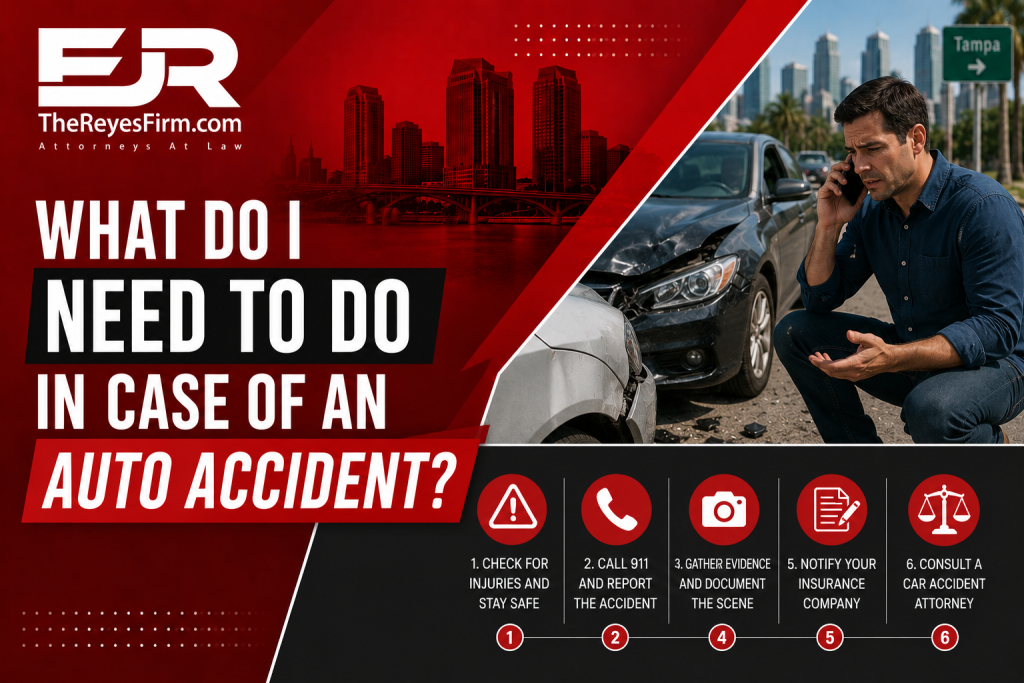
What Do I Need To Do in Case of an Auto Accident?

You were just going about your day. Then a crash happened in an instant, and now your heart is pounding and your mind is racing. What you do in the next few minutes, and the next few days, can shape your health, your claim, and how the whole thing turns out. Here’s exactly what to do. TL;DR — QUICK SUMMARY Get to safety, check for injuries, and call 911 so there’s an official record of the crash. Document everything: take photos and video of the vehicles, the scene, and your injuries, and collect witness names and numbers. Find out if the other driver was working for Uber, Lyft, or another rideshare or delivery service, because that can open additional insurance coverage. You don’t always need the ER, but you must seek medical care within 14 days to protect your Florida PIP benefits. Under Florida Statute 95.11(3)(a), you generally have two years to file an injury lawsuit, but evidence and benefit deadlines come much sooner. The Reyes Firm Just Been in a Crash in Tampa? Get clear next steps and protect your claim from day one. Had a bad day? Contact Us Now 14 Days Deadline to seek care for PIP benefits Fla. Stat. 627.736 2 Years Florida injury filing deadline Fla. Stat. 95.11(3)(a) $10,000 Florida minimum PIP coverage Fla. Stat. 627.736 $0 Upfront cost with a contingency fee firm The Reyes Firm What should you do immediately after an auto accident in Tampa? First, get yourself and your passengers to safety, then call 911. Even when a crash seems minor, an official police report creates the documentation you’ll rely on later, and an officer can call for medical help if anyone is hurt. Everything else flows from those first two moves: be safe, and make the crash official. From there, your job at the scene is simple to remember and easy to forget in the moment: document what happened and protect your health. The driver who hit you may be apologetic now and tell a very different story to the insurance company later, so the evidence you gather today is what holds the truth in place. At The Reyes Firm, a Tampa personal injury law firm, we’ve seen strong claims weakened by a few missing photos and weak claims saved by a single witness phone number. The difference is what you do in the first hour. ⚠️ Deadline Warning: Under Florida Statute § 95.11(3)(a), you generally have two years from the date of your crash to file a personal injury lawsuit. Evidence disappears far faster than that, though, and your PIP benefits require treatment within 14 days. The sooner you act, the stronger your case. Why does documenting the scene matter so much? Because liability often comes down to evidence, not memory. Photos, video, and witness accounts capture the facts before they can be disputed, and they’re the foundation of any claim against the at-fault driver. Use your phone to capture as much as you safely can: the position of both vehicles, the damage to each, the license plates, the other driver’s insurance and registration, traffic signals and signs, skid marks, and any visible injuries. Take wide shots and close-ups. Shoot video that pans across the whole scene. If anyone saw what happened, get their name and phone number, because witnesses leave quickly and are hard to track down later. Call law enforcement so there’s a police report. The report may not be admissible at trial, but it carries real weight before a lawsuit, helping establish liability and giving you something solid to point to if the other driver later changes their story. 💡 Did You Know? Florida’s 14-day rule is one of the most important deadlines after a crash. Under Florida Statute § 627.736, you must receive initial medical care within 14 days of the accident to be eligible for Personal Injury Protection (PIP) benefits, which provide a $10,000 minimum regardless of fault. Miss that window and your own insurer can deny the claim. Source: Fla. Stat. § 627.736. Watch: What Do I Need to Do in Case of an Auto Accident? In this short video, attorney Edward Reyes walks through the quick, practical things every Florida driver should do right after a crash to protect their health and their claim. If you have questions the video doesn’t cover, The Reyes Firm offers free consultations, so you can call 833-4 BAD DAY any time. Do you have to go to the hospital after a car accident? Not always, but you do need to be seen by a medical provider, and soon. If you’re seriously hurt, go to the emergency room without hesitation. If your injuries feel minor but you have any pain, you don’t necessarily need a costly ER visit just to create a record. A walk-in clinic or urgent care can document your condition and start treatment. What you should not do is wait it out. Adrenaline masks pain, and injuries like whiplash, concussions, and soft-tissue damage often don’t surface for a day or two. Getting checked promptly does two things at once: it protects your health, and it preserves your PIP benefits under Florida’s 14-day rule. A gap between the crash and your first treatment is one of the first things an insurer uses to argue you weren’t really injured. What if the other driver was working for Uber or Lyft? This is an easy detail to miss and an important one to catch. If the driver who hit you was logged into Uber, Lyft, or a delivery app at the time, additional commercial insurance coverage may apply on top of the driver’s personal policy. That can significantly change the resources available to cover your injuries. So at the scene, note whether the other vehicle has rideshare or delivery decals, and if it’s safe to ask, find out whether the driver was on a trip. Rideshare accident claims involve layered coverage and corporate insurers, which makes them more complex than a standard two-car crash and a

Will your rates go up
After A Car Accident, Settlement

Will your Rates Go Up After A Car Accident?

Someone else ran the light. Your car is wrecked, your neck hurts, and somewhere in the back of your mind a smaller worry is nagging at you: is this going to cost me on my insurance? It is a fair question, and Florida law has a clearer answer than most people realize. Here is what can and cannot happen to your rates after a car accident that was not your fault. The Reyes Firm Not Your Fault? Know What Your Insurer Can’t Do Protect your claim and your policy at the same time. Had a bad day? Contact Us Now Substantial Fault Standard required to surcharge you Fla. Stat. § 626.9541(1)(o)3. 8 Ways To qualify for surcharge reimbursement Fla. Stat. § 626.9541(1)(o)3.b. 24 Hours To report a hit-and-run and qualify Fla. Stat. § 626.9541(1)(o)3.b. 14 Days Deadline to seek care for PIP Fla. Stat. § 627.736(1)(a) The fear of a rate hike is real, and insurers do not go out of their way to correct it. But Florida has specific consumer protections written into its insurance code that most drivers have never heard of. Knowing them changes how you handle the days after a crash, and in particular whether you make the one mistake that costs people the most. Will your insurance rates go up after a car accident that wasn’t your fault? Typically they should not, because it was not your fault. That is not just common sense, it is Florida law. An insurer generally may not impose or request an additional premium, or refuse to renew your policy, solely because you were involved in a motor vehicle accident, unless its file contains information from which it determines in good faith that you were substantially at fault. The phrase that matters there is substantially at fault. Being in a crash is not enough. Filing a claim is not enough. The insurer needs an actual, good-faith, documented basis in its file that you caused it. If it does not have that, the surcharge is not supposed to happen. What does Florida law actually prohibit? The protection lives in Florida Statute § 626.9541, which defines unfair methods of competition and unfair or deceptive insurance practices. Several provisions matter to a driver who was just hit: No surcharge or nonrenewal without substantial fault. Under § 626.9541(1)(o)3., an insurer generally cannot raise your premium on liability, PIP, medical payments, or collision coverage, or refuse to renew, solely because you were in an accident, absent a good-faith determination of substantial fault. No surcharge at all on comprehensive or uninsured motorist coverage. Under § 626.9541(1)(o)10., an insurer may not impose an additional premium for comprehensive or UM coverage solely because you were in an accident or convicted of a moving violation. There is no fault exception written into that one. You can demand their proof. Under § 626.9541(1)(o)5., on your request, the insurer and the licensed agent must supply you with the complete proof of fault or other criteria justifying the additional charge or cancellation. That last point is quietly powerful. If your premium jumps and you were not at fault, you are entitled to ask the company to show its work. 💡 Did You Know? If an insurer does surcharge you or refuse to renew after an accident, Florida law requires it to tell you, right in the premium or nonrenewal notice, that you may be entitled to reimbursement of that amount or renewal of the policy. The obligation to inform you is on them, not on you to discover it. Source: Fla. Stat. § 626.9541(1)(o)3.b. What if your insurer surcharges you anyway? Florida law spells out eight specific situations in which you are entitled to have that surcharge reimbursed, or the policy renewed, if you can demonstrate that the operator involved in the accident was: Lawfully parked. Reimbursed by, or on behalf of, the person responsible for the accident, or holds a judgment against that person. Struck in the rear by another vehicle headed in the same direction, and was not convicted of a moving traffic violation in connection with the accident. Hit by a hit-and-run driver, if the accident was reported to the proper authorities within 24 hours after discovering it. Not convicted of a moving traffic violation in connection with the accident, while the driver of the other vehicle was convicted of one. Finally adjudicated not liable by a court of competent jurisdiction. Issued a traffic citation that was dismissed or nolle prossed. Not at fault, as shown by a written statement from the insured establishing facts demonstrating lack of fault, which the insurer’s file does not rebut with a good-faith determination of substantial fault. Look closely at number four. Reporting a hit-and-run within 24 hours is not just good practice, it is what preserves this specific protection. And number three covers one of the most common crash types on Florida roads: getting rear-ended. Can your insurer refuse to renew your policy after an accident? Not for a single at-fault accident. Florida law provides that an insurer may not fail to renew a policy where the insured has had only one accident in which he or she was at fault within the current three-year period. An insurer may still nonrenew for reasons unrelated to accidents, and the protection does not extend to a driver with three or more accidents, regardless of fault, in the most recent three-year period. So one crash, even one you caused, should not by itself end your policy. A pattern is a different conversation. Why might your rates go up anyway? Being protected from a not-at-fault surcharge is not the same as being protected from every increase. A few things can move your premium regardless of what happened in your crash: Statewide and territory rate changes. Insurers adjust rates across whole regions based on claim frequency, repair costs, litigation trends, and fraud. That increase hits everyone in the area, not just you, and it is not a surcharge tied to your accident. Other drivers in your

Scroll to Top