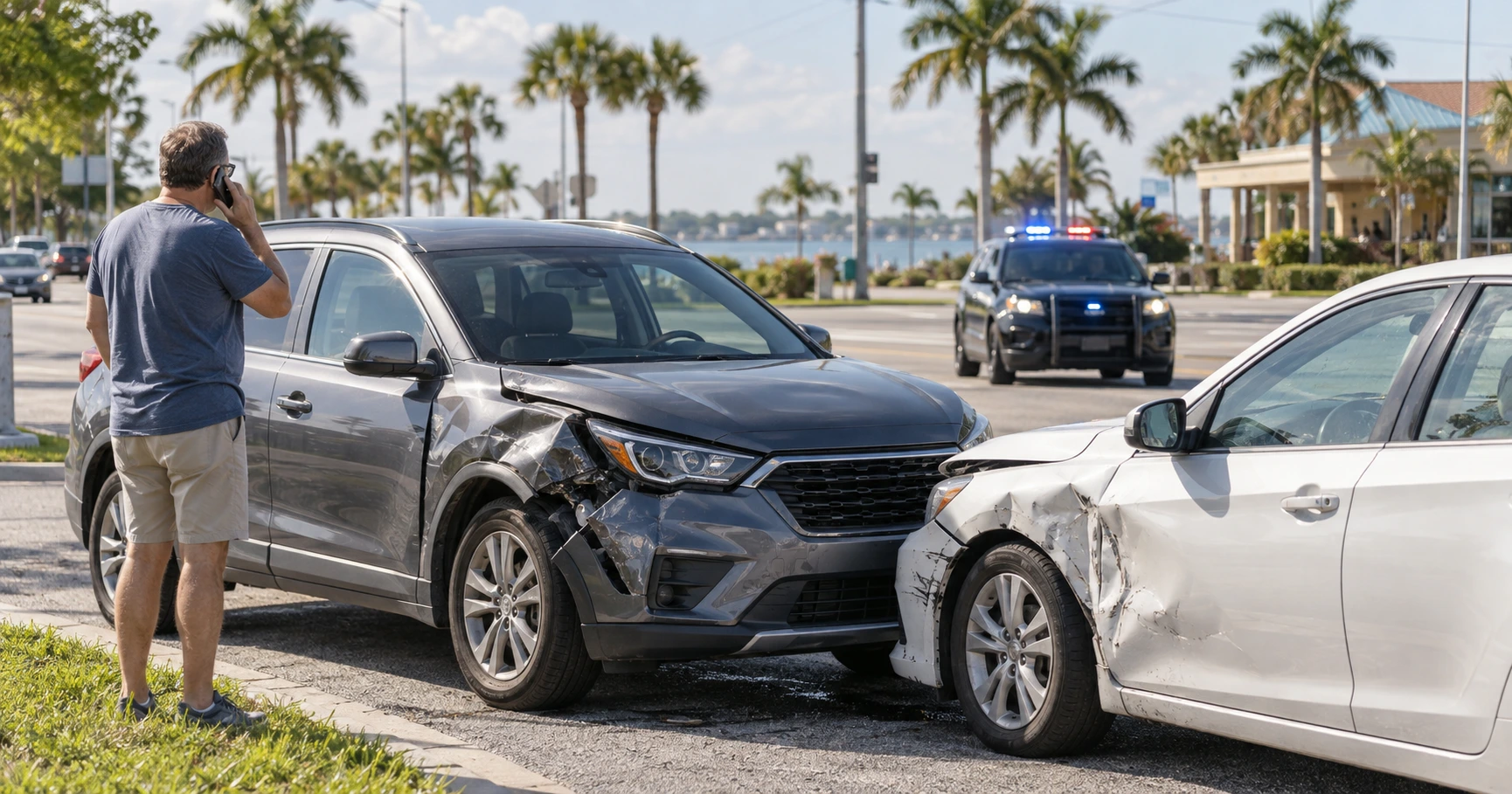
Someone else ran the light. Your car is wrecked, your neck hurts, and somewhere in the back of your mind a smaller worry is nagging at you: is this going to cost me on my insurance? It is a fair question, and Florida law has a clearer answer than most people realize. Here is what can and cannot happen to your rates after a car accident that was not your fault.
The Reyes Firm
Not Your Fault? Know What Your Insurer Can’t Do
Protect your claim and your policy at the same time. Had a bad day?
The fear of a rate hike is real, and insurers do not go out of their way to correct it. But Florida has specific consumer protections written into its insurance code that most drivers have never heard of. Knowing them changes how you handle the days after a crash, and in particular whether you make the one mistake that costs people the most.
Will your insurance rates go up after a car accident that wasn’t your fault?
Typically they should not, because it was not your fault. That is not just common sense, it is Florida law. An insurer generally may not impose or request an additional premium, or refuse to renew your policy, solely because you were involved in a motor vehicle accident, unless its file contains information from which it determines in good faith that you were substantially at fault.
The phrase that matters there is substantially at fault. Being in a crash is not enough. Filing a claim is not enough. The insurer needs an actual, good-faith, documented basis in its file that you caused it. If it does not have that, the surcharge is not supposed to happen.
What does Florida law actually prohibit?
The protection lives in Florida Statute § 626.9541, which defines unfair methods of competition and unfair or deceptive insurance practices. Several provisions matter to a driver who was just hit:
- No surcharge or nonrenewal without substantial fault. Under § 626.9541(1)(o)3., an insurer generally cannot raise your premium on liability, PIP, medical payments, or collision coverage, or refuse to renew, solely because you were in an accident, absent a good-faith determination of substantial fault.
- No surcharge at all on comprehensive or uninsured motorist coverage. Under § 626.9541(1)(o)10., an insurer may not impose an additional premium for comprehensive or UM coverage solely because you were in an accident or convicted of a moving violation. There is no fault exception written into that one.
- You can demand their proof. Under § 626.9541(1)(o)5., on your request, the insurer and the licensed agent must supply you with the complete proof of fault or other criteria justifying the additional charge or cancellation.
That last point is quietly powerful. If your premium jumps and you were not at fault, you are entitled to ask the company to show its work.
💡 Did You Know? If an insurer does surcharge you or refuse to renew after an accident, Florida law requires it to tell you, right in the premium or nonrenewal notice, that you may be entitled to reimbursement of that amount or renewal of the policy. The obligation to inform you is on them, not on you to discover it. Source: Fla. Stat. § 626.9541(1)(o)3.b.
What if your insurer surcharges you anyway?
Florida law spells out eight specific situations in which you are entitled to have that surcharge reimbursed, or the policy renewed, if you can demonstrate that the operator involved in the accident was:
- Lawfully parked.
- Reimbursed by, or on behalf of, the person responsible for the accident, or holds a judgment against that person.
- Struck in the rear by another vehicle headed in the same direction, and was not convicted of a moving traffic violation in connection with the accident.
- Hit by a hit-and-run driver, if the accident was reported to the proper authorities within 24 hours after discovering it.
- Not convicted of a moving traffic violation in connection with the accident, while the driver of the other vehicle was convicted of one.
- Finally adjudicated not liable by a court of competent jurisdiction.
- Issued a traffic citation that was dismissed or nolle prossed.
- Not at fault, as shown by a written statement from the insured establishing facts demonstrating lack of fault, which the insurer’s file does not rebut with a good-faith determination of substantial fault.
Look closely at number four. Reporting a hit-and-run within 24 hours is not just good practice, it is what preserves this specific protection. And number three covers one of the most common crash types on Florida roads: getting rear-ended.
Can your insurer refuse to renew your policy after an accident?
Not for a single at-fault accident. Florida law provides that an insurer may not fail to renew a policy where the insured has had only one accident in which he or she was at fault within the current three-year period. An insurer may still nonrenew for reasons unrelated to accidents, and the protection does not extend to a driver with three or more accidents, regardless of fault, in the most recent three-year period.
So one crash, even one you caused, should not by itself end your policy. A pattern is a different conversation.
Why might your rates go up anyway?
Being protected from a not-at-fault surcharge is not the same as being protected from every increase. A few things can move your premium regardless of what happened in your crash:
- Statewide and territory rate changes. Insurers adjust rates across whole regions based on claim frequency, repair costs, litigation trends, and fraud. That increase hits everyone in the area, not just you, and it is not a surcharge tied to your accident.
- Other drivers in your household. If several people on your policy have been in accidents, that history is part of the picture.
- Your own prior accident history. A driver with repeated crashes is rated differently than one with a clean record.
- Coverage or vehicle changes. Adding a car, adding a driver, changing coverage, or moving can all shift your premium.
The distinction to keep straight is between a surcharge, which is aimed at you because of your accident, and a general rate increase, which applies broadly. Florida’s protections target the first one.
Does using your PIP after a crash raise your rates?
This is the question underneath the question, and it is where people make the costliest mistake. Florida is a no-fault state, so your own Personal Injury Protection under Florida Statute § 627.736 pays your medical bills first, no matter who caused the crash. The other driver’s PIP pays theirs. That is the system working as designed, and PIP is one of the coverages expressly covered by the anti-surcharge protection above.
Some people still avoid treatment because they are afraid that using their benefits will cost them later. That instinct backfires badly. Florida requires you to seek initial medical care within 14 days of the crash to access PIP at all, so waiting can forfeit the coverage you already paid for. Worse, a gap in treatment is the first thing an adjuster points to when arguing your injuries were not serious. You end up hurt, uncovered, and holding a weaker claim, all to avoid an increase that in most cases the law does not permit.
Who pays to fix your car?
Property damage runs on a separate track from your injuries. The at-fault driver’s property damage liability coverage is what pays to repair your vehicle. If that driver has no property damage coverage, or not enough of it, your own collision coverage may step in, subject to your deductible. For the full breakdown of repairs, total loss, and diminished value, along with who pays for your rental car while you wait, we cover that separately.
🛡️ Your Rights Under Florida Law: Under Florida Statute § 768.81, your compensation is reduced by your share of fault, and you may be barred from recovery if you are found greater than 50% responsible. That fault determination does double duty: it drives what your claim is worth and whether your insurer can lawfully surcharge you. Protecting the facts protects both.
Watch: Will Your Rates Go Up After a Car Accident?
If you prefer to hear it explained, the short video below covers what happens to your insurance rates after a Florida car accident.
When you are ready to talk through your own situation, The Reyes Firm offers free consultations with no obligation.
⚠️ Deadline Warning: Under Florida Statute § 95.11, you generally have two years from the date of your crash to file a personal injury lawsuit. This was shortened from four years in March 2023. Worrying about your premium while that clock runs is how good claims get lost.
What are the 5 steps to protect your rates and your claim?
These five steps protect both your policy and your case. The order matters.
- Get medical care within 14 days, ideally the same day. Do not trade your health and your PIP benefits for a rate increase the law probably does not allow anyway.
- Report a hit-and-run within 24 hours. If the other driver fled, reporting it promptly to the proper authorities preserves your right to reimbursement of any surcharge.
- Document that you were not at fault. Get the police report, photos, and witness information. This same evidence supports your injury claim and your written statement of lack of fault to your insurer.
- Read your renewal notice carefully. If your premium went up after a crash you did not cause, ask your insurer in writing for the complete proof of fault justifying the charge, and ask about reimbursement.
- Call The Reyes Firm before you settle anything. The fault determination affects your claim and your policy at once. Call 833-4 BAD DAY for a free consultation.
If you believe an insurer has violated these provisions, you can also file a consumer complaint with the Florida Department of Financial Services.
The Reyes Firm
4730 N. Habana Ave., Suite 201, Tampa, FL 33614
Phone: 833-4 BAD DAY | thereyesfirm.com
How The Reyes Firm handles your car accident case
The same question sits behind your premium and your settlement: who was at fault. Getting that answer right protects you on both fronts, throughout Tampa and Hillsborough County.
When we take on a car accident case, we typically:
- Build the record that you were not at fault, gathering the police report, scene photos, footage, and witness statements before they disappear
- Push back on attempts to shift blame onto you, since an insurer’s fault determination affects your recovery under Florida’s comparative negligence rule
- Coordinate your PIP benefits, so you get treatment promptly within the 14-day window and know what covers your care once that $10,000 is exhausted
- Identify every coverage that applies, including the at-fault driver’s liability coverage, your collision coverage, and your uninsured motorist coverage
- Handle the property damage alongside the injury claim, so repairs, total loss valuation, and your rental are not treated as afterthoughts
- Review any release before you sign it, because a settlement can be drafted more broadly than you realize
No lawyer can promise an outcome, and we do not handle insurance regulatory complaints. What we can promise is that we fight the fault fight properly, explain every step in plain language, and make sure you are not pressured into decisions that cost you later. You can read more about what drives the value of a car accident settlement in our detailed guide.
Frequently asked questions about rates after a Florida car accident
Will my rates go up if the accident wasn’t my fault?
Typically they should not. Under Fla. Stat. § 626.9541(1)(o)3., an insurer generally cannot surcharge you or refuse to renew solely because you were in an accident unless its file supports a good-faith determination that you were substantially at fault.
What does “substantially at fault” mean?
It is the standard Florida law requires before an insurer can surcharge you for an accident. The insurer’s file must contain information from which it determines in good faith that you were substantially at fault, and on your request it must supply you the complete proof justifying the charge.
What can I do if I was surcharged and I wasn’t at fault?
Florida law lists eight situations that entitle you to reimbursement or renewal, including being lawfully parked, being struck in the rear, being hit by a hit-and-run driver reported within 24 hours, or providing a written statement of facts showing lack of fault that the insurer cannot rebut. Ask your insurer in writing.
Does filing a claim raise my rates in Florida?
Filing a claim by itself is not the trigger. The statute focuses on whether you were substantially at fault in the accident, not on whether a claim was made. An insurer generally cannot surcharge you solely because you were involved in a crash.
Will using my PIP benefits raise my rates?
PIP is one of the coverages expressly covered by Florida’s anti-surcharge provision, so an insurer generally cannot raise your PIP premium solely because you were in an accident absent substantial fault. Avoiding treatment to protect your rates usually costs you far more than it saves.
Can my insurer drop me after one accident?
Florida law provides that an insurer may not fail to renew if you have had only one at-fault accident within the current three-year period. That protection does not extend to a driver with three or more accidents, regardless of fault, in the most recent three-year period.
Whose insurance pays for my medical bills after a Florida crash?
Your own PIP pays your medical expenses first, regardless of who caused the crash, and the other driver’s PIP pays theirs. You must seek initial care within 14 days to access those benefits, and if your injuries are serious you may step outside no-fault and pursue the at-fault driver.
Whose insurance pays to repair my car?
The at-fault driver’s property damage liability coverage pays to repair your vehicle. If they do not carry it or do not carry enough, your own collision coverage may apply, subject to your deductible.

Edward Reyes, Esq. is a Florida Bar-admitted personal injury attorney and the founder of The Reyes Firm in Tampa, Florida. He represents people injured by the negligence of others in cases involving car accidents, truck crashes, and other serious injuries throughout Tampa and the surrounding counties. Edward Reyes, Esq. handles car accident and personal injury claims on a contingency fee basis, meaning clients pay nothing unless the firm recovers compensation for them.
Read more about Edward Reyes.
How Can The Reyes Firm Help You?
If you’ve had a bad day, whether a car accident, a slip and fall, a trucking crash, or any injury that wasn’t your fault, The Reyes Firm is in your corner. Our Tampa personal injury attorneys offer free consultations and work on a contingency fee basis, which means you pay us nothing unless we win your case.
You shouldn’t have to fight the insurance companies alone. Let us fight for you.
📍 Address: 4730 N. Habana Ave., Suite 201, Tampa, FL 33614
📞 Phone: 833-4 BAD DAY
🌐 Website: Schedule your free consultation today at thereyesfirm.com
Had a bad day? Call The Reyes Firm. We’ll handle the rest.
The information in this blog post is for general informational purposes only and does not constitute legal advice. Reading this article does not create an attorney-client relationship with The Reyes Firm. Insurance policy terms and individual circumstances vary, and the statutes described here contain conditions and exceptions not fully summarized above. Every case is unique. If you have been injured in a car accident that wasn’t your fault, consult a licensed Florida personal injury attorney about your specific situation.