
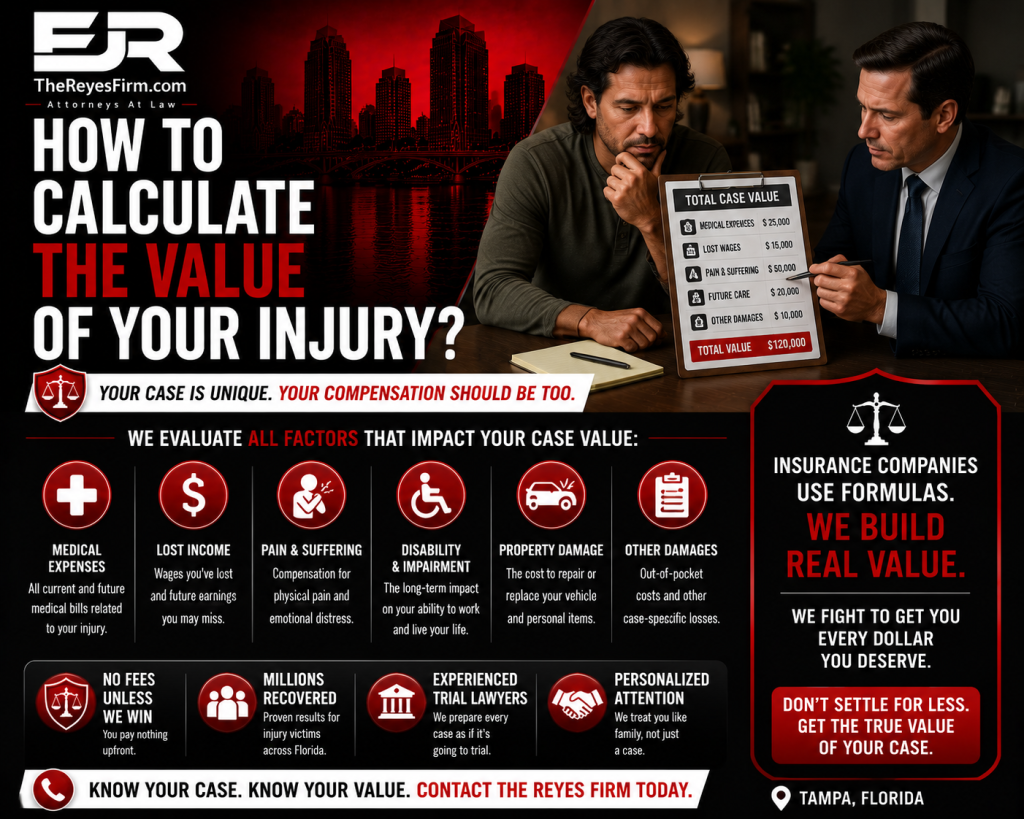
How To Calculate The Value of Your Injury?
After a serious Tampa accident, one question outweighs almost every other: how much is my case actually worth? Put a number too high and the insurer stops taking you seriously. Settle for too little and you are stuck paying for an injury that was never your fault. Here’s how the value of an injury claim is really calculated in Florida, and what quietly raises or lowers that number. TL;DR — QUICK SUMMARY Your claim’s value is the sum of your economic damages and your non-economic damages, then adjusted for your share of fault and the available insurance. Economic damages are documentable losses like medical bills, lost wages, and future care; non-economic damages cover pain, suffering, and lost quality of life. Most insurers start with the multiplier method, adding up your medical bills and multiplying by a number, usually between 1.5 and 5, based on how serious your injury is. In Florida you can only recover pain and suffering from an at-fault driver if your injury meets the permanency threshold under Florida Statute 627.737. Comparative fault and insurance policy limits can shrink what you actually collect, and you have two years to file under Florida Statute 95.11(3)(a). The Reyes Firm Wondering What Your Case Is Worth? Get an honest valuation of your Tampa injury claim. Had a bad day? Contact Us Now 1.5 to 5 Common multiplier applied to your damages Industry standard No Cap On pain and suffering in most FL injury cases Florida law >50% Your fault share that bars recovery Fla. Stat. 768.81 2 Years To file an injury lawsuit Fla. Stat. 95.11(3)(a) How do you calculate the value of a personal injury claim? You calculate the value of an injury claim by adding together two kinds of damages, your economic losses and your non-economic losses, and then adjusting that total for real-world factors like your share of fault and the insurance coverage available. There is no single official formula a court hands you, but insurance companies and experienced attorneys both start from a recognized method and refine it based on the facts of your case. The goal of these damages is to make you whole, meaning to put you back, as much as money can, in the position you would have been in if the injury had never happened. Getting the number right matters in both directions. Aim too high and the insurer assumes you are not serious about settling. Accept too little and you are left covering costs that should have been someone else’s responsibility. What are economic, or special, damages? Economic damages are the losses you can put a receipt to. They include your past and future medical bills, your lost wages, your reduced earning capacity if you cannot work the way you used to, the property damage to your vehicle, and out-of-pocket costs like medication and travel to appointments. In a Florida auto case, your own Personal Injury Protection coverage pays the first portion of these medical bills before you pursue the at-fault party for the rest. The piece people most often undervalue is the future. A catastrophic injury can require surgeries, therapy, and care for years or even a lifetime, and all of that belongs in your claim. Counting only the bills you have already received is one of the fastest ways to settle for far less than your case is worth. What are non-economic, or general, damages? Non-economic damages compensate you for harm that has no invoice: physical pain, mental anguish, the loss of enjoyment of your life, disfigurement, and the strain an injury puts on your relationships. These losses are real, but because they are subjective, they are the hardest part of a claim to value and the part insurers fight the most. In Florida there is an important gate. You can only recover non-economic damages from an at-fault driver if your injury meets the permanency threshold under Florida Statute § 627.737, which generally requires a permanent injury such as a spinal cord injury or a traumatic brain injury. The good news is that Florida does not cap pain and suffering in typical injury cases, so when the threshold is met, the value of these damages is limited by the evidence, not by an arbitrary ceiling. 💡 Did You Know? In a Florida car accident, you cannot recover pain and suffering from the at-fault driver unless your injury meets the permanency threshold in Fla. Stat. § 627.737. When it does, Florida places no cap on non-economic damages in ordinary injury cases, so the value is driven by the strength of your medical evidence. Source: Fla. Stat. § 627.737, leg.state.fl.us. How does the multiplier method work? The multiplier method is the most common starting point for valuing pain and suffering. An adjuster or attorney adds up your economic damages, focusing on your medical bills, and multiplies that total by a number, usually between 1.5 and 5. A minor injury with a full recovery sits near the bottom of that range, while a severe, permanent injury sits near the top, and the result is an estimate of your non-economic damages that gets added to your economic losses. A second approach, the per diem method, assigns a set dollar amount for each day you live with your injury, which works better for shorter-term injuries than for lifelong ones. Both are only starting points. This is also why the free calculators you find online are unreliable, because they cannot weigh permanency, fault, your future prognosis, or the specific facts that move the multiplier up or down. Watch: How injury value is calculated In this short video, attorney Edward Reyes breaks down how the value of an injury claim is calculated and the mistakes that leave money on the table. If you want a clear, honest read on what your case is worth, The Reyes Firm offers free consultations at no cost to you. How do fault and insurance limits change what you actually collect? Two factors can separate what your claim is worth from