After a serious Tampa accident, one question outweighs almost every other: how much is my case actually worth? Put a number too high and the insurer stops taking you seriously. Settle for too little and you are stuck paying for an injury that was never your fault. Here’s how the value of an injury claim is really calculated in Florida, and what quietly raises or lowers that number.
TL;DR — QUICK SUMMARY
- Your claim’s value is the sum of your economic damages and your non-economic damages, then adjusted for your share of fault and the available insurance.
- Economic damages are documentable losses like medical bills, lost wages, and future care; non-economic damages cover pain, suffering, and lost quality of life.
- Most insurers start with the multiplier method, adding up your medical bills and multiplying by a number, usually between 1.5 and 5, based on how serious your injury is.
- In Florida you can only recover pain and suffering from an at-fault driver if your injury meets the permanency threshold under Florida Statute 627.737.
- Comparative fault and insurance policy limits can shrink what you actually collect, and you have two years to file under Florida Statute 95.11(3)(a).
The Reyes Firm
Wondering What Your Case Is Worth?
Get an honest valuation of your Tampa injury claim. Had a bad day?
How do you calculate the value of a personal injury claim?
You calculate the value of an injury claim by adding together two kinds of damages, your economic losses and your non-economic losses, and then adjusting that total for real-world factors like your share of fault and the insurance coverage available. There is no single official formula a court hands you, but insurance companies and experienced attorneys both start from a recognized method and refine it based on the facts of your case.
The goal of these damages is to make you whole, meaning to put you back, as much as money can, in the position you would have been in if the injury had never happened. Getting the number right matters in both directions. Aim too high and the insurer assumes you are not serious about settling. Accept too little and you are left covering costs that should have been someone else’s responsibility.
What are economic, or special, damages?
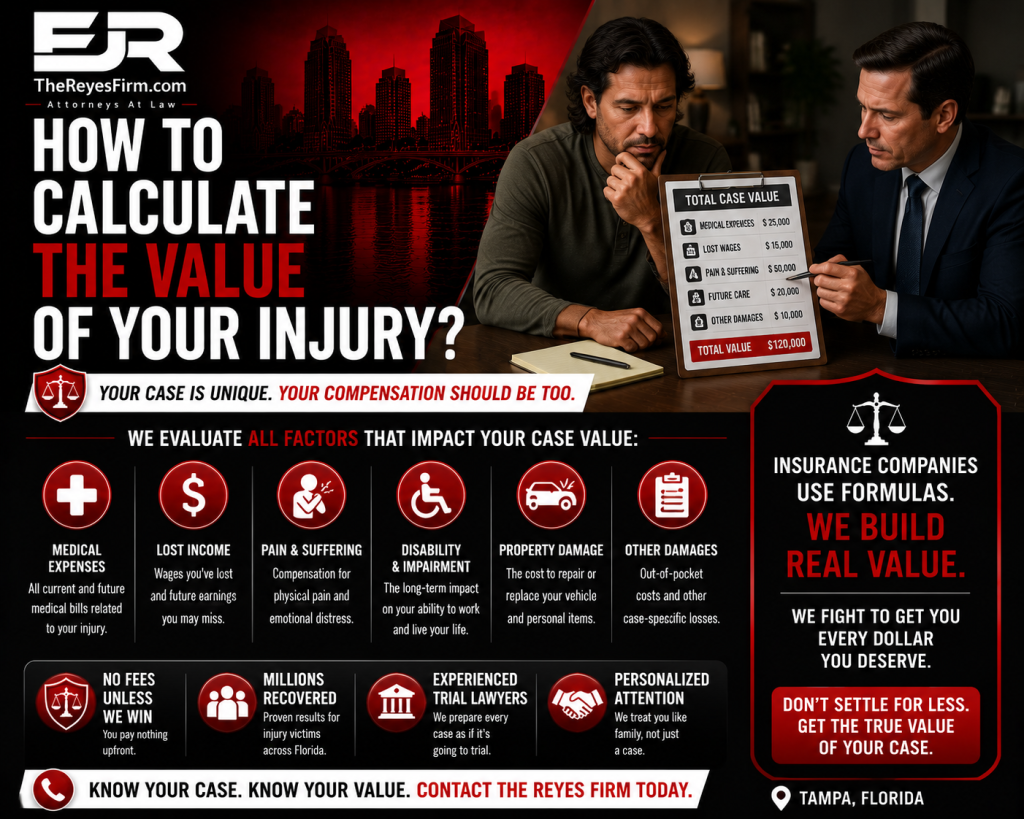
Economic damages are the losses you can put a receipt to. They include your past and future medical bills, your lost wages, your reduced earning capacity if you cannot work the way you used to, the property damage to your vehicle, and out-of-pocket costs like medication and travel to appointments. In a Florida auto case, your own Personal Injury Protection coverage pays the first portion of these medical bills before you pursue the at-fault party for the rest.
The piece people most often undervalue is the future. A catastrophic injury can require surgeries, therapy, and care for years or even a lifetime, and all of that belongs in your claim. Counting only the bills you have already received is one of the fastest ways to settle for far less than your case is worth.
What are non-economic, or general, damages?
Non-economic damages compensate you for harm that has no invoice: physical pain, mental anguish, the loss of enjoyment of your life, disfigurement, and the strain an injury puts on your relationships. These losses are real, but because they are subjective, they are the hardest part of a claim to value and the part insurers fight the most.
In Florida there is an important gate. You can only recover non-economic damages from an at-fault driver if your injury meets the permanency threshold under Florida Statute § 627.737, which generally requires a permanent injury such as a spinal cord injury or a traumatic brain injury. The good news is that Florida does not cap pain and suffering in typical injury cases, so when the threshold is met, the value of these damages is limited by the evidence, not by an arbitrary ceiling.
💡 Did You Know? In a Florida car accident, you cannot recover pain and suffering from the at-fault driver unless your injury meets the permanency threshold in Fla. Stat. § 627.737. When it does, Florida places no cap on non-economic damages in ordinary injury cases, so the value is driven by the strength of your medical evidence. Source: Fla. Stat. § 627.737, leg.state.fl.us.
How does the multiplier method work?
The multiplier method is the most common starting point for valuing pain and suffering. An adjuster or attorney adds up your economic damages, focusing on your medical bills, and multiplies that total by a number, usually between 1.5 and 5. A minor injury with a full recovery sits near the bottom of that range, while a severe, permanent injury sits near the top, and the result is an estimate of your non-economic damages that gets added to your economic losses.
A second approach, the per diem method, assigns a set dollar amount for each day you live with your injury, which works better for shorter-term injuries than for lifelong ones. Both are only starting points. This is also why the free calculators you find online are unreliable, because they cannot weigh permanency, fault, your future prognosis, or the specific facts that move the multiplier up or down.
Watch: How injury value is calculated
In this short video, attorney Edward Reyes breaks down how the value of an injury claim is calculated and the mistakes that leave money on the table.
If you want a clear, honest read on what your case is worth, The Reyes Firm offers free consultations at no cost to you.
How do fault and insurance limits change what you actually collect?
Two factors can separate what your claim is worth from what you actually receive. The first is comparative fault. Under Florida’s rules, your recovery is reduced by your percentage of fault, and if you are found more than 50% responsible, you recover nothing, so insurers work hard to shift blame onto you.
The second is insurance policy limits. Even a high-value claim can be capped in practice by the at-fault party’s available coverage, which is why your own uninsured and underinsured motorist coverage matters so much, and why larger truck and commercial vehicle policies can change the picture entirely. Finding and stacking every applicable policy is often where the real money in a case is won.
🛡️ Your Rights Under Florida Law: Under Florida Statute § 768.81, your compensation is reduced by your share of fault, and you may be barred from recovery if you are found greater than 50% responsible for your own harm. An experienced Tampa injury lawyer works to protect the facts, challenge unfair blame, and keep your percentage of fault as low as the evidence allows.
Why the first offer is rarely the real value of your claim
The insurance company’s first offer almost always arrives early and low, often before you know the full extent of your injuries. Accepting it can feel like relief, but once you sign a release, you give up the right to ask for anything more, even if your condition worsens or new treatment becomes necessary.
The safer path is to wait until you reach maximum medical improvement, the point where your doctors can say how your injury will affect you long term, before you put a final value on your claim. Only then can your future medical costs and lost earning capacity be counted accurately, and only then can you judge whether an offer truly covers what you have lost.
⚠️ Deadline Warning: Under Florida Statute § 95.11(3)(a), you have two years from the date of your injury to file a personal injury lawsuit. Missing this deadline almost always means losing your right to recover anything, no matter how strong your case is. Don’t wait to call a lawyer.
What are the steps to maximize the value of your claim?
You have real influence over your claim’s final value. These steps protect it, and the order matters.
- Track every expense and keep every document. Save medical bills, receipts, pay stubs, and mileage to appointments, because your economic damages are only as strong as the records that prove them.
- Get complete medical care and follow through. The severity and permanency of your injury drive its value, and gaps in treatment give the insurer a reason to argue you were not seriously hurt.
- Wait until you understand your future costs. Do not put a final number on your claim until your doctors can project your future care and any lasting effect on your ability to work.
- Keep a record of how the injury affects your life. Note the activities, sleep, and work you have lost, because that detail is what gives your non-economic damages real weight.
- Find every available insurance policy. Look beyond the at-fault driver to your own uninsured, underinsured, and medical payments coverage, since more coverage can mean more recovery.
- Do not accept the first offer or sign a release. Early offers are designed to close your claim cheaply, and a signed release ends your right to seek anything more.
- Call The Reyes Firm to value your claim properly. An honest, complete valuation is the foundation of a fair recovery. Call 833-4 BAD DAY for a free consultation.
The Reyes Firm
4730 N. Habana Ave., Suite 201, Tampa, FL 33614
Phone: 833-4 BAD DAY | thereyesfirm.com
How The Reyes Firm calculates and fights for the value of your claim
A settlement number is only fair if it reflects everything you have actually lost, now and in the future. The insurance company has people whose job is to make that number as small as possible. We make sure someone is working to make it complete.
When we value and pursue a Tampa injury claim, we typically:
- Document every economic loss, from past and future medical care to lost wages and reduced earning capacity, so nothing is left uncounted
- Build the proof behind your non-economic damages, establishing permanency where it applies and showing the real impact the injury has had on your life
- Apply the right valuation method, using the multiplier or per diem approach where each fits and rejecting the lowball figures insurers try to justify
- Track down every insurance policy, including your own uninsured and underinsured coverage, to expand the compensation actually available
- Push back on blame-shifting, challenging attempts to inflate your share of fault and shrink your recovery
- Prepare every case as if it will go to trial, which is often what moves an insurer to value your claim honestly
No lawyer can promise a specific result. What we can promise is that we will not let your claim be valued at less than it is worth without a fight, and we explain every step in plain language. We help injured people in Tampa and across Hillsborough County on a contingency fee basis, which means you pay nothing unless we recover compensation for you.
Frequently asked questions about calculating injury claim value
How is the value of an injury claim calculated?
You add your economic damages to your non-economic damages, then adjust for your share of fault and the available insurance. Most insurers and attorneys use the multiplier method as a starting point and refine it based on the specific facts.
What is the multiplier method?
You total your economic damages, mainly your medical bills, and multiply by a number usually between 1.5 and 5 based on how severe your injury is. The result estimates your pain and suffering, which is then added to your economic losses.
What is the difference between economic and non-economic damages?
Economic damages are documentable losses like medical bills, lost wages, and property damage. Non-economic damages are intangible losses like pain, suffering, and loss of enjoyment of life, which are harder to put a number on.
Can I get pain and suffering for any injury in Florida?
Not always. In a car accident, you can recover pain and suffering from the at-fault driver only if your injury meets the permanency threshold under Fla. Stat. § 627.737, which generally requires a permanent injury.
Does Florida cap how much I can get for pain and suffering?
In typical injury cases, no. Florida does not place a cap on non-economic damages in ordinary injury claims, so when your injury qualifies, the value is driven by the strength of your evidence rather than a fixed ceiling.
How does being partly at fault affect my settlement?
Under Fla. Stat. § 768.81, your recovery is reduced by your percentage of fault, and if you are found more than 50% at fault, you cannot recover at all. This is why insurers try so hard to shift blame onto you.
Should I use an online injury calculator?
Only as a rough starting point. Online calculators cannot account for permanency, comparative fault, policy limits, or your future costs, so they often produce a number that is far from what your claim is actually worth.
How long do I have to file an injury claim in Florida?
Two years from the date of the injury under Fla. Stat. § 95.11(3)(a). Because evidence fades and the deadline is strict, it is best to speak with a lawyer well before that time runs out.
How much does a Tampa personal injury lawyer cost?
The Reyes Firm works on a contingency fee basis, which means you pay nothing up front and nothing at all unless the firm recovers compensation for you. The initial consultation is free.

Edward Reyes, Esq. is a Florida Bar-admitted personal injury attorney and the founder of The Reyes Firm in Tampa, Florida. His practice focuses on serious injury and wrongful death cases, and on calculating the full value of his clients’ claims so insurance companies cannot settle them short. Edward Reyes, Esq. represents injured Floridians in Tampa and throughout Hillsborough County on a contingency fee basis, meaning clients pay nothing unless the firm recovers compensation for them.
Read more about Edward Reyes.
How Can The Reyes Firm Help You?
If you’ve had a bad day — a car accident, a slip and fall, a trucking crash, or any injury that wasn’t your fault — The Reyes Firm is in your corner. Our Tampa personal injury attorneys offer free consultations and work on a contingency fee basis, which means you pay us nothing unless we win your case.
You shouldn’t have to fight the insurance companies alone. Let us fight for you.
📍 Address: 4730 N. Habana Ave., Suite 201, Tampa, FL 33614
📞 Phone: 833-4 BAD DAY
🌐 Website: Schedule your free consultation today at thereyesfirm.com
Had a bad day? Call The Reyes Firm. We’ll handle the rest.