May 2, 2026

Tampa intersection with company delivery van in traffic, for illustrative purposes only
Blog, Commercial Vehicles, Truck Accidents

Hit by a Company Vehicle Settlement in Tampa: What Affects Your Case Value

Hit by a company vehicle in Tampa? Learn what affects your settlement value, who pays, and how The Reyes Firm fights for maximum compensation. You were doing everything right. Then a van with a company logo on the door ran a red light, or a delivery driver rear-ended you on the interstate, and your whole life changed in a second. Right now, you’re probably dealing with a lot. Doctor visits. Insurance calls you don’t know how to answer. Pain that doesn’t match what anyone is telling you about your injuries yet. And somewhere underneath all of it, a question you don’t quite know how to ask: what is this actually worth, and will anyone take it seriously? Here’s what you need to know. A hit by a company vehicle settlement in Tampa, Florida, works differently from a regular car accident claim. More parties can be held responsible. Higher insurance coverage is usually in play. And the company behind that driver often has professionals working to minimize your claim the moment the crash is reported. Understanding what factors shape your settlement value is the first step to making sure you’re protected. This applies if you were rear-ended by a company vehicle, T-boned by a commercial van, hit by a delivery driver, or injured by any work vehicle on Tampa roads. Quick Summary When a company vehicle hits you in Tampa, the employer can be held liable under Florida’s respondeat superior doctrine, not just the driver. Florida’s dangerous instrumentality doctrine means a company can owe you damages simply because they own the vehicle, even without direct fault. The value of your hit by a company vehicle settlement depends on injury severity, available insurance coverage, evidence quality, and liability clarity. Florida’s statute of limitations under Fla. Stat. 95.11(3)(a) gives you only 2 years from the date of the crash to file a personal injury lawsuit. Had a bad day? Call The Reyes Firm at 833-4 BAD DAY. What Happens Legally When a Company Vehicle Hits You in Florida? When a company vehicle hits you in Florida, you can typically pursue compensation from the driver, the employer, and sometimes additional parties, all at the same time. You don’t have to choose just one. Florida law recognizes two distinct legal doctrines that can hold a company responsible for its driver’s actions. First, respondeat superior, sometimes called vicarious liability, holds an employer responsible for the negligent acts of an employee who was acting within the scope of their job at the time of the crash. Second, Florida’s dangerous instrumentality doctrine holds a vehicle owner liable for any negligent operation of the vehicle by someone driving it with permission, regardless of whether the employer was directly at fault. These two doctrines, working together, are important to you. Respondeat superior covers situations where the driver was on the clock, making deliveries, running a work errand, or traveling between job sites. The dangerous instrumentality doctrine applies to situations in which the employee was driving a company-owned vehicle, even during activities that blur the line between personal and work use. Under Fla. Stat. 324.021, Florida is one of the few states in the country that imposes this strict vehicle owner liability. What this means in practice: companies have greater exposure to coverage in these cases than most people realize. That’s exactly why they move fast to protect themselves after a crash. ⚠️ Warning: Florida’s statute of limitations under Fla. Stat. § 95.11(3)(a) gives you only 2 years from the date of your accident to file a personal injury lawsuit. This deadline was cut from 4 years to 2 years under HB 837, effective March 24, 2023. Miss it, and your claim is gone permanently, no matter how strong your case is. Do not wait. Who Can Be Held Responsible Besides the Driver? In a hit-by-a-company-vehicle case, the driver is rarely the only party with legal exposure. Multiple defendants may owe you compensation, and identifying all of them is one of the most important things your attorney does early in your case. The employer or company that owns the vehicle is almost always the primary target. If the driver was on a delivery run, a sales call, a job site visit, or any task that served the company’s interests, the employer shares liability for the driver’s actions. Florida courts have consistently held that even minor detours during a work task can still fall within the scope of employment. Beyond the direct employer, a third-party maintenance company can be liable if poor vehicle upkeep contributed to the crash. A staffing agency or leasing company can be liable if they placed the driver and retained control over how that driver operated. A cargo loading company can be liable if an improperly loaded vehicle was a factor. In some cases, a vehicle manufacturer can be liable if a mechanical defect contributed to the crash. The reason this matters for your settlement is simple. More liable parties mean more insurance coverage in play. And more coverage typically means a stronger position for your claim. 💡 Did You Know? According to FLHSMV’s By the Numbers 2024 report, Florida recorded 46,651 commercial motor vehicle crashes statewide in 2024, resulting in 315 fatalities. Hillsborough County, where Tampa sits, has one of the highest per-capita commercial motor vehicle injury rates in the state at approximately 59 truck-crash injuries per 100,000 residents, higher than Miami-Dade. Source: FLHSMV What Factors Affect the Value of a Hit by a Company Vehicle Settlement? The settlement value for being hit by a company vehicle comes down to seven factors, and each one can move the number significantly up or down. Severity and permanence of your injuries. This is the single biggest driver of settlement value. Soft tissue injuries that resolve in weeks settle differently than spinal cord damage, traumatic brain injuries, fractures, or injuries requiring surgery. Long-term and permanent injuries carry future medical costs, lost earning capacity, and quality-of-life impacts that courts and insurers calculate into every serious claim. Available insurance coverage. Company
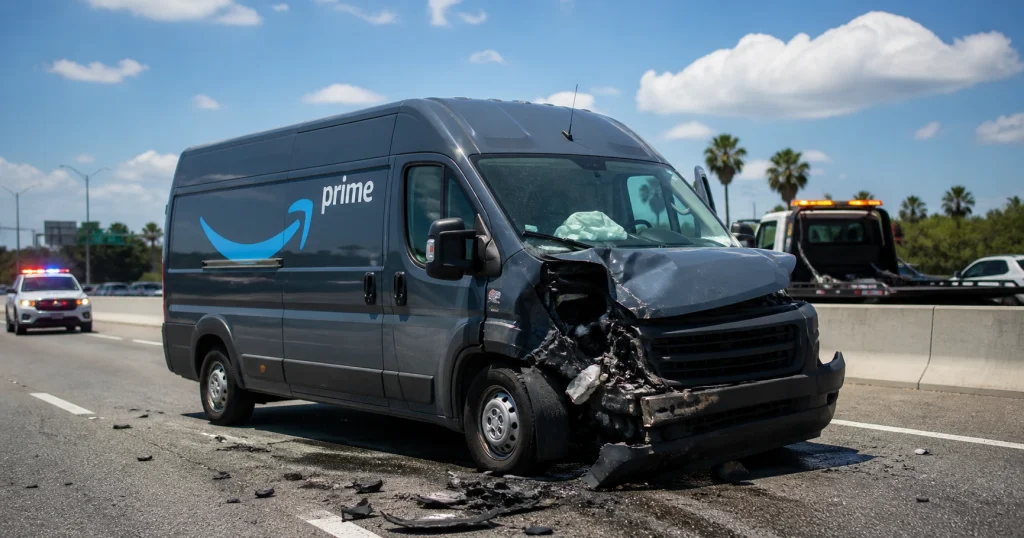
Amazon delivery van involved in a traffic crash on a Florida highway, for illustrative purposes only.
Blog, Commercial Vehicles, Legal, Truck Accidents

Amazon Truck Accident Lawyer in Florida: Who’s Liable and What to Do First

 Hit by an Amazon truck in Florida? Find out who’s liable, what evidence disappears fast, and how to protect your claim. You watched the Amazon logo drive away. Now you’re sitting with a totaled car, a hospital bill you didn’t plan for, and an insurance adjuster calling before you’ve had time to think straight. You’re wondering if Amazon is actually responsible, or if they’ll find some legal way to make it someone else’s problem. They will try. Amazon built a delivery structure specifically designed to do exactly that. But Florida courts are increasingly skeptical of it, and a skilled Amazon truck accident lawyer in Florida can challenge it. The Reyes Firm handles Amazon delivery vehicle crashes across Florida, including crashes on I-75, I-4, and I-275, in Tampa neighborhoods, and in communities across Hillsborough County, Miami-Dade, and Polk County. Amazon delivery volume in Florida has surged in recent years. Every day, thousands of Amazon vans, Sprinter trucks, and semi-trailers move through Tampa streets and Florida highways under extreme pressure to meet delivery quotas. Rushed drivers, overloaded routes, and aggressive scheduling create real danger on roads you drive every day. When that danger turns into a crash, you deserve to know exactly what your rights are and who is responsible. Here’s what you need to know right now. Quick Summary: Hit by an Amazon Truck in Florida? Amazon uses a Delivery Service Partner system designed to shift liability from itself to small contractors, but Florida courts look past that structure when Amazon controls the driver’s work. DSP vehicles must carry $1 million in commercial auto liability coverage. Amazon’s own policy may apply on top of that. The truck’s black box, GPS data, and Mentor app safety scores are critical evidence. Amazon’s contractors can overwrite that data within days without a preservation letter. Florida Statute § 95.11 gives you 2 years from the crash date to file. That clock does not stop for insurance negotiations. Had a bad day? Call The Reyes Firm at 833-4 BAD DAY. The Reyes Firm Hit by an Amazon Truck in Florida? Find out who’s liable before you talk to their insurer. Had a bad day? Get a Free Case Review How Does Amazon Structure Its Deliveries, and Why Does It Matter for Your Claim? Amazon delivers packages through two main programs, and the one that applies to your crash determines how your claim works and how much coverage is available. The Delivery Service Partner program is Amazon’s primary last-mile delivery system. Amazon contracts with hundreds of small companies called DSPs. Those companies hire their own drivers and operate Amazon-branded vans. On paper, the driver works for the DSP, not Amazon. Amazon uses this structure to put a legal buffer between itself and crash liability. In practice, the relationship looks nothing like a typical contractor arrangement: Amazon mandates delivery routes through its app Amazon requires branded uniforms, vehicles, and logos Amazon sets delivery windows and package quotas Amazon monitors driver speed, braking, and phone use through its Mentor app in real time Amazon can terminate a DSP contract at will based on performance metrics Amazon Flex is a separate gig program in which individual drivers use their personal vehicles to make deliveries. Flex drivers are classified as independent contractors. Amazon provides commercial auto liability coverage of up to $1 million per incident while the driver is actively on a delivery route. That coverage ends when the route ends. This distinction matters for your claim because the program type determines which insurance applies, how much coverage is available, and how strong an argument you have for holding Amazon directly responsible. 📊 Did You Know? In 2024, FLHSMV recorded 46,651 commercial motor vehicle crashes across Florida, resulting in 315 fatalities. That’s nearly 9.9% of all traffic crash deaths in the state. Amazon operates thousands of daily delivery routes across Florida through its DSP network. When one of those drivers causes a crash, the liable parties and available coverage can be dramatically different from a standard car accident claim. Source: FLHSMV By the Numbers 2024 (preliminary, as of June 2025). Can You Sue Amazon Directly for a Truck or Delivery Van Accident in Florida? Yes. You can sue Amazon directly, even if the driver worked for a separate DSP. Florida courts allow it, and juries have found Amazon liable under several legal theories. The primary theory is vicarious liability through actual control. Florida follows the respondeat superior doctrine, which holds an employer responsible for a worker’s actions performed within the scope of their employment. When Amazon mandates routes, monitors driver behavior in real time through the Mentor app, sets delivery quotas that pressure drivers to speed, and can terminate the entire DSP contract based on performance, courts treat that level of control as employer conduct regardless of what the contract calls the driver. A second theory applies specifically in Florida. The dangerous instrumentality doctrine holds that when a vehicle owner permits another person to operate their vehicle, the owner can be held vicariously liable for harm caused during that operation. When Amazon owns or leases the branded van and permits a DSP or its driver to operate it, this doctrine may apply directly. A third theory is negligent selection and retention. If Amazon chose a DSP with a history of safety violations or continued using a DSP whose drivers had prior incidents, Amazon may be independently liable for that choice. People ask all the time whether anyone has actually won a lawsuit against Amazon. The answer is yes, and the verdicts are significant. In August 2024, a Georgia jury found Amazon 85% responsible for a crash that seriously injured a child and awarded the family $16.2 million. A separate jury returned a $44.6 million verdict against Amazon, including $30 million in punitive damages, after Amazon disputed liability all the way through trial. These cases rejected Amazon’s independent contractor defense after juries examined the actual working relationship. Amazon is not a passive defendant. Their legal team will direct your claim to

Scroll to Top