
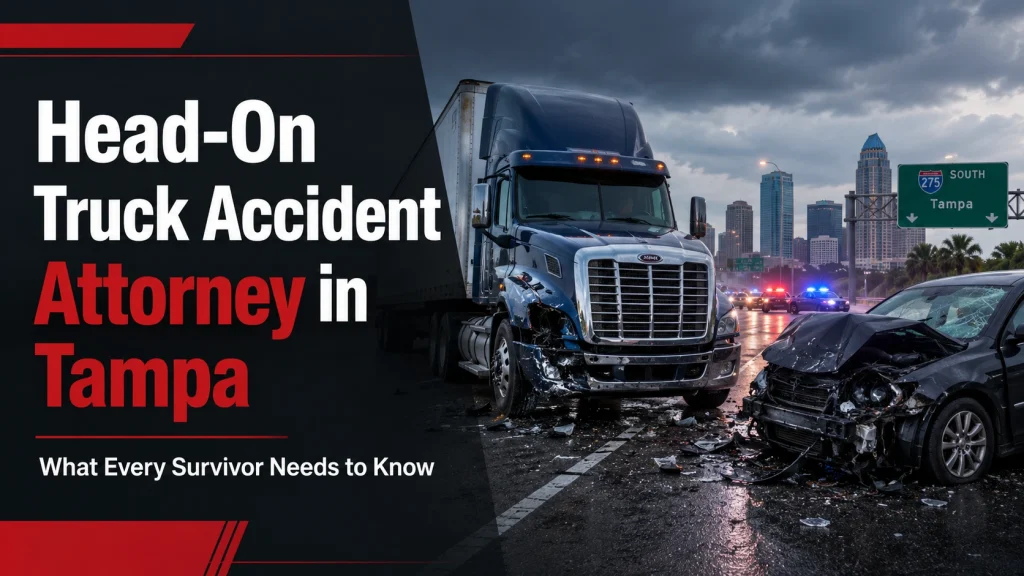
Head-On Truck Accident Attorney in Tampa: What Every Survivor Needs to Know
You were driving. Maybe it was I-275 at rush hour, or a two-lane road near Brandon or Plant City. Then it happened. A semi crossed the center line, or came the wrong way, and hit you head-on. In the seconds after that kind of crash, nothing makes sense. Your airbags deployed. The car crumpled. Everything went quiet. Head-on collisions with large trucks are different from every other kind of accident. An 80,000-pound tractor-trailer hits your car with combined closing speeds that can exceed 100 miles per hour. Your car weighs about 4,000 pounds. The laws of physics do the rest, and the legal fight that follows is just as lopsided, unless you have the right people in your corner. The Reyes Firm represents families in Tampa and the South Shore communities who are dealing with the fallout from serious commercial vehicle crashes. This article will walk you through everything you need to know: what causes these crashes, who is responsible under Florida and federal law, what evidence disappears fast, and what your case may be worth. The Reyes Firm Hurt in a Head-On Truck Accident in Tampa? Get clear next steps after a serious head-on semi-truck, tractor-trailer, or commercial vehicle crash. Had a bad day? Schedule a Free Consultation Quick Summary Head-on crashes with large trucks are among the deadliest collisions on Florida roads. In 2024, FLHSMV recorded 46,651 commercial motor vehicle crashes, resulting in 315 fatalities statewide. NHTSA 2023 data shows 32.1% of two-vehicle fatal truck crashes involve a direct front-to-front impact. Commercial carriers deploy rapid-response legal teams to crash scenes within hours. You need representation just as fast. Florida’s statute of limitations for personal injury negligence claims is 2 years under Florida Statute 95.11(4)(a), as amended by HB 837 on March 24, 2023. Wrongful death claims also have a 2-year statute of limitations. Had a bad day? Call The Reyes Firm. 833-4 BAD DAY. Key Facts at a Glance Florida recorded 46,651 commercial motor vehicle crashes and 315 fatalities in 2024, according to FLHSMV. NHTSA reported 5,472 deaths in U.S. crashes involving large trucks in 2023. Hillsborough County recorded 3,083 commercial motor vehicle crashes, 916 injuries, and 16 fatalities in 2023. Most Florida negligence-based personal injury claims now have a 2-year deadline under Florida Statute § 95.11. Many interstate motor carriers must carry at least $750,000 in financial responsibility under 49 CFR Part 387. Why Are Head-On Truck Crashes So Dangerous? Head-on truck crashes are disproportionately fatal because the force of impact combines both vehicles’ speeds at once. NHTSA 2023 data shows 32.1% of two-vehicle fatal truck crashes involve front-to-front contact. At highway speeds, an 80,000-pound tractor-trailer delivers roughly 20 times the kinetic energy of a passenger car crash at the same speed. In 2023, large truck crashes killed 5,472 people nationwide, according to NHTSA. Of those fatalities, the vast majority were not truck occupants. They were people in passenger vehicles. Florida ranked among the top three states for large truck fatality counts that year, behind only Texas and California. That’s not a coincidence given the volume of commercial freight flowing through Hillsborough County every day. Florida’s corridors amplify the danger. I-4 between Tampa and Orlando is one of the most heavily trafficked freight routes in the Southeast. I-275 carries commercial traffic directly through the heart of Tampa, FL. I-75 connects Tampa to the rest of the state along a logistics spine that runs billions of dollars in freight every year. On these roads, a single moment of driver fatigue, a blown tire, or a misjudged overtake can push a 40-ton rig across the center line before any reaction is possible. Head-on truck crashes also look deceptively simple on a police report. Most lists only two vehicles. In reality, these crashes often trace back to a chain of decisions made by a dispatcher, a carrier, a broker, a maintenance provider, or a cargo loader, sometimes days before the collision happened. What Causes Head-On Truck Accidents in Tampa? Head-on truck crashes in Tampa, FL, are commonly caused by driver fatigue, distracted driving, impairment, wrong-way entry, mechanical failure, improper overtaking, and unsecured cargo. Federal regulations under 49 CFR Parts 392, 395, 396, and 393 govern each of these behaviors. Violations of those regulations are direct evidence of negligence. Driver fatigue. Federal hours-of-service rules under 49 CFR Part 395 cap how long a commercial driver can operate before mandatory rest. FMCSA data consistently show fatigue as one of the leading behavioral causes of large-truck crashes. Carriers and dispatchers sometimes push drivers past legal limits or look the other way while logbooks get falsified. When fatigue drifts a truck across the center line on I-275 or a county road near Riverview, the company that built that schedule shares liability for every injury. Distracted driving. Commercial drivers are prohibited from using handheld devices under 49 CFR Part 392.82. At 65 mph, a truck travels the length of a football field in about 3.3 seconds. Glancing at a dispatch message or adjusting a GPS is enough time for the truck to drift into oncoming traffic with zero steering correction. Impairment. Commercial drivers face a legal blood alcohol limit of 0.04%, half the standard for passenger vehicle drivers. Despite that lower threshold, NHTSA’s 2023 data showed a 19% increase in fatalities involving alcohol-impaired large truck drivers compared to 2022. Prescription drug impairment is also a documented factor in commercial crashes. Wrong-way driving. Florida’s interchange designs and low-visibility ramp lighting contribute to wrong-way driving incidents, particularly at night or in the early morning hours when fatigue peaks. A fully loaded tractor-trailer entering a divided highway in the wrong direction leaves almost no room for surviving vehicles to avoid impact. Tire blowouts and mechanical failures. Under 49 CFR Part 396, carriers must conduct pre-trip and post-trip inspections and keep vehicles in roadworthy condition. A blowout caused by a documented defect that was never repaired is not an accident. It is negligence, and it creates direct liability for the maintenance company, the carrier, and the driver. Improper