
Fatal Semi-Truck Crashes in Florida: 7 Rights Your Family Has After a Wrongful Death
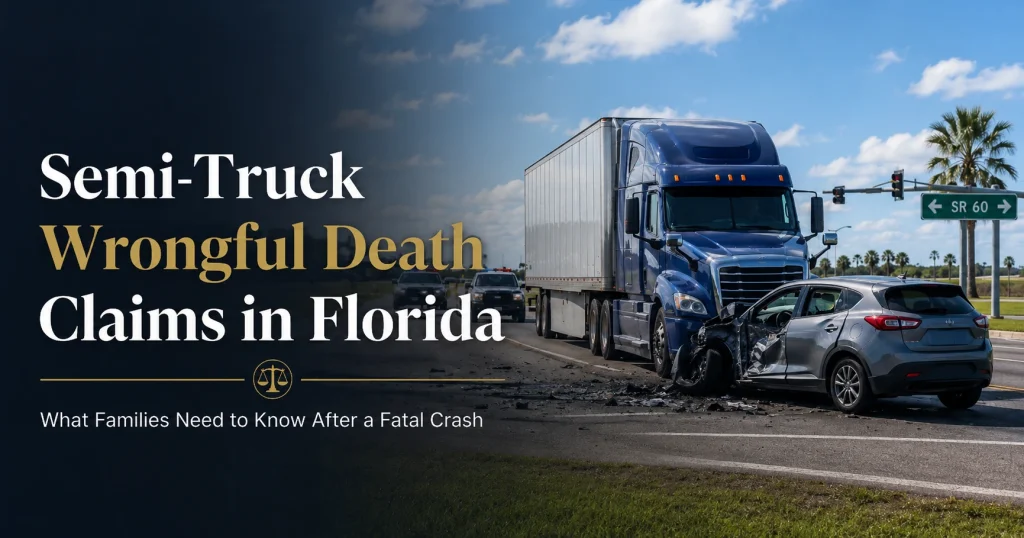
SUMTER COUNTY, FL — May 7, 2026. A 38-year-old Crystal River man died Wednesday morning after a tractor-trailer struck his Kia Soul at the intersection of County Road 470 and State Road 44, according to the Florida Highway Patrol. The crash occurred at approximately 10:30 a.m. The Ocala man driving the semi-truck sustained only minor injuries and was not transported. The Florida Highway Patrol has opened an investigation into the crash. That’s not a number in a report. That’s someone’s husband, son, or father. That Wednesday morning became a before-and-after line for an entire family. Crashes like this one happen on Florida’s rural and suburban roads every single day. A county road meets a state highway. A stop sign. A commercial vehicle is moving fast. A passenger car that never had a chance. If your family is living through something like this right now, this article is for you. Quick Summary A semi-truck or tractor-trailer crash can kill or catastrophically injure a passenger vehicle occupant in seconds, and Florida recorded 46,651 commercial motor vehicle crashes in 2024. Florida law gives families of wrongful death victims the right to pursue compensation from the truck driver, the trucking company, the freight broker, and other responsible parties. Critical evidence, including the truck’s black box data and electronic driver logs, can be overwritten within days after a crash. You have two years from the date of death to file a wrongful death lawsuit in Florida under Florida Statutes Section 95.11, but acting sooner protects the evidence. The Reyes Firm investigates fast, fights hard, and never charges you unless we win. Had a bad day? Call us at 833-4 BAD DAY. Who Can a Family Sue After a Fatal Semi-Truck Crash in Florida? In a Florida semi-truck wrongful death case, your family can pursue claims against every party whose negligence contributed to the crash. That almost always includes more than just the truck driver. Liable parties typically include the truck driver personally, the trucking company or motor carrier that employed or contracted the driver, the freight broker or shipper that set the schedule and load, and the maintenance company if a mechanical failure played a role. Under Florida Statutes Sections 768.19 and 768.20, a wrongful death claim must be brought by the personal representative of the deceased person’s estate on behalf of the estate and the deceased person’s survivors, which may include a spouse, children, and parents. Trucking companies move fast after crashes. Their insurers often have investigators at the scene before a grieving family has even made a phone call. Your family deserves someone fighting just as fast on your side. What Compensation Can a Family Recover in a Florida Wrongful Death Case? Florida’s Wrongful Death Act, under Florida Statutes Section 768.21, spells out exactly what surviving family members can recover. This is not limited to funeral expenses. Compensation can include the loss of support and services the deceased provided, loss of companionship and protection, mental pain and suffering of surviving family members, medical and funeral expenses, and the lost net income the deceased would have earned over their lifetime. A spouse can also claim loss of consortium. The specific amounts depend on the facts of each case, the policy limits involved, and the evidence your attorney builds on your behalf. These are not small numbers in commercial truck cases, because commercial carriers are required to carry significantly higher insurance minimums than private drivers. 🛡️ Your Rights Under Florida Law: Under Florida Statutes Section 768.21, a surviving spouse, eligible children, and parents of a deceased minor may recover for mental pain and suffering caused by a wrongful death. The personal representative of the estate files the lawsuit. You do not have to go through this alone, and you are not limited to a single defendant. The Reyes Firm Video Watch: What Is a Wrongful Death Case in Florida? Local attorney Edward Reyes explains how wrongful death cases work in Florida, including the role of the estate, surviving family members, and the personal representative who brings the claim. Wrongful death claims can involve both the estate and eligible survivors, which is why families should speak with a Florida wrongful death attorney before dealing with the insurance company alone. How Long Does a Family Have to File a Wrongful Death Lawsuit in Florida? You have two years from the date of your loved one’s death to file a wrongful death lawsuit in Florida. Florida Statutes Section 95.11 sets this deadline for wrongful death claims. Two years sounds like a long time. It is not. Evidence disappears fast in truck crash cases. The truck’s electronic control module, sometimes called the black box, records speed, braking, and throttle data, but that data can be overwritten in as little as 30 days. Driver logs, dashcam video, and dispatch communications all have short retention windows. Once that evidence is gone, it is gone. The first thing a truck crash attorney does is send spoliation letters demanding that the carrier preserve everything. That step needs to happen now, not in six months. ⚠️ Warning: Florida Statute § 95.11 generally sets a 2-year deadline to file a wrongful death lawsuit. But critical truck crash evidence, including black box data, electronic logs, and surveillance video, can disappear within days of a crash. Contact a Florida wrongful death attorney immediately to protect your family’s case. Why Are Semi-Truck Wrongful Death Cases Different From Regular Car Accident Claims? A semi-truck wrongful death case is fundamentally different from a standard car crash claim, and the differences all cut against unprepared families. Commercial vehicles operate under a separate body of federal law, specifically the Federal Motor Carrier Safety Regulations enforced by the FMCSA, which governs hours-of-service limits, required inspection schedules, driver qualification files, and drug and alcohol testing. A violation of any one of those regulations can shift liability directly to the carrier. On top of that, commercial carriers typically carry policy limits ranging from $750,000 to $5 million or more, which means their insurers fight