June 3, 2026

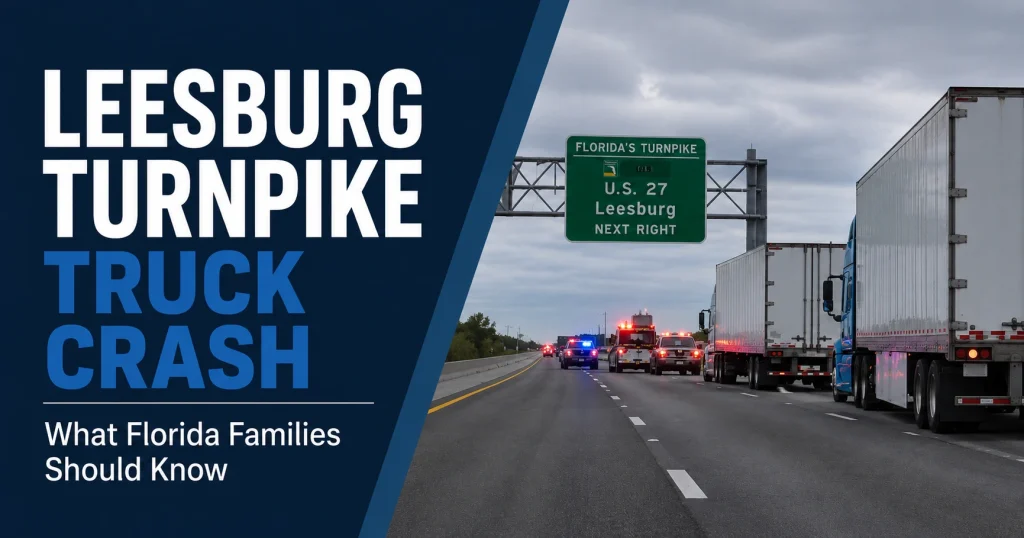
Featured image for an article about a reported semi-truck crash on southbound Florida’s Turnpike near U.S. 27 in Leesburg, Florida, explaining what families should know after a serious commercial vehicle crash.
Blog, News, Truck Accidents

Leesburg Florida Turnpike Semi-Truck Crash: What Families Should Know After a Serious Commercial Vehicle Crash

Quick Summary A crash involving multiple semi-trucks was reported on the southbound Florida Turnpike in Leesburg, just before the U.S. 27 exit in Lake County. According to WESH, the Florida Highway Patrol reported that two people were taken to the hospital, including one person with serious injuries, and the crash remains under investigation. Early reports do not always explain the full cause of a crash, especially when multiple commercial vehicles, roadway debris, and lane closures are involved. For families, this type of crash matters because commercial vehicle cases can involve more evidence than those involving typical passenger vehicle crashes. Depending on the evidence, investigators may review driver actions, vehicle movement, electronic data, maintenance records, company safety practices, and roadway conditions. What Happened in the Leesburg, Florida, Turnpike Crash? According to WESH, a crash involving multiple semi-trucks blocked lanes on Florida’s Turnpike in Leesburg early Thursday morning, May 28, 2026. The crash was reported in the southbound lanes just before the U.S. 27 exit in Lake County. WESH reported that the Florida Highway Patrol said a semi-truck on the shoulder was trying to merge into the outside lane when it moved into the direct path of another semi-truck. FHP said the two semi-trucks collided, and two additional semi-trucks later hit debris from the crash. Two people were taken to the hospital, including one person who suffered serious injuries, according to the report. The crash blocked two right southbound lanes for several hours before the roadblock was cleared. WESH reported that the crash remains under investigation. At this stage, this article does not assume fault or make any final legal conclusion. The facts may change as investigators review the scene, witness statements, vehicle data, and other evidence. Crash Location: Florida’s Turnpike Southbound Near U.S. 27 in Leesburg The crash was reported on the southbound Florida Turnpike near the U.S. 27 exit in Leesburg, Lake County, Florida. What Do We Know About the Crash? Based on the published report, we know the following: The crash happened on the southbound Florida Turnpike in Leesburg. The location was reported just before the U.S. 27 exit in Lake County. Multiple semi-trucks were involved. FHP reported that one semi-truck was moving from the shoulder toward the outside lane. FHP reported that two semi-trucks collided. Two additional semi-trucks reportedly hit debris from the crash. Two people were taken to the hospital. One person reportedly suffered serious injuries. The crash remained under investigation. What we do not know from the early report is equally important. The report does not provide final findings about liability, driver speed, following distance, mechanical condition, visibility, fatigue, maintenance, company policies, or whether any safety regulation was violated. That is why careful wording matters. Early reports can describe what was observed or initially reported, but they do not always explain the full cause. Why Can This Type of Crash Be So Serious? Crashes involving semi-trucks can be especially serious due to the size and weight of these vehicles. When multiple trucks are involved, the danger can increase quickly because a single collision can create debris, sudden lane blockages, secondary impacts, and limited space for other drivers to react. In this reported crash, WESH stated that two additional semi-trucks hit debris after the first collision. That detail matters because debris fields can create a chain of events that investigators may need to reconstruct carefully. A truck crash investigation may consider: Where each truck was positioned before impact Whether a vehicle was stopped, moving, merging, or changing lanes Whether hazard lights or warning devices were used Whether drivers had enough time and distance to react Whether traffic, weather, lighting, or road conditions played a role Whether any mechanical or maintenance issue contributed Whether the debris was avoidable under the circumstances Each of these questions depends on evidence. It is not enough to assume what happened from the first news report. What Makes a Truck or Commercial Vehicle Crash Different? A commercial truck crash can be different from a regular car crash because more parties, records, and safety rules may be involved. In a passenger vehicle crash, the investigation may focus mainly on the drivers and the vehicles. In a semi-truck crash, the investigation may also involve the trucking company, driver qualification records, electronic logging data, maintenance history, dispatch records, cargo records, and company safety practices. Federal rules also require certain commercial drivers and motor carriers to keep hours-of-service records. Electronic logging devices, often called ELDs, synchronize with the vehicle engine to record driving time and help track hours-of-service data, according to the Federal Motor Carrier Safety Administration. Under federal regulations, ELDs automatically record data such as date, time, commercial motor vehicle location information, engine hours, and vehicle miles. That type of information may matter after a serious crash because it can help investigators understand vehicle movement, driver activity, and timing. It does not automatically prove fault, but it may help answer important questions. Related Video: What Should You Do After a Semi-Truck Accident? Truck accidents are rarely simple. This video from The Reyes Firm explains why a semi-truck crash may involve the driver, the trucking company, maintenance issues, and multiple insurance policies, depending on the evidence. Note: This video provides general information about semi-truck accident claims in Florida. It does not discuss the Leesburg crash specifically or determine who was at fault. What Should Families Do After a Serious or Fatal Crash in Florida? After a serious commercial vehicle crash, families are often left with medical questions, insurance calls, vehicle damage, missing information, and emotional stress. The first priority should always be medical care and safety. When possible, families should also try to protect information that may later become important. Practical steps may include: Get medical care immediately.Catastrophic injuries can worsen over time. Medical records also help document what happened after the crash. Request the crash report when available.A crash report may provide initial information about the vehicles, drivers, location, and investigating agency. Save photos, videos, and messages.Keep images of the vehicles, roadway, injuries, debris, insurance
Florida road with a commercial dump truck and emergency vehicles after a crash, for illustrative purposes only
Blog, News, Spanish, Truck Accidents

Choque Fatal con Camión Volquete en Florida: Lo Que las Familias Deben Saber Después de una Muerte por Accidente de Vehículo Comercial

Lo Que Necesitas Saber Un estudiante de último año de preparatoria en Florida murió en un choque reportado entre un sedán Honda y un camión volquete cerca de la escuela South Fork High School en Stuart el 21 de mayo de 2026. La Patrulla de Carreteras de Florida está investigando, por lo que nadie debe asumir culpa o responsabilidad basándose solo en los informes iniciales. Los camiones volquete son vehículos comerciales, y la ley de Florida exige que muchos vehículos comerciales cumplan con reglas de seguridad estatales y federales. En muchos casos de muerte injusta, las familias tienen 2 años para presentar un reclamo bajo la Ley de Muerte Injusta de Florida. ¿Tuviste un mal día? Llámanos. The Reyes Firm. 833-4 BAD DAY. Un joven iba camino a los ensayos de graduación. Horas después, una comunidad de Florida estaba de luto en lugar de celebrar. Según reportes públicos de noticias, un joven de 18 años, estudiante de último año de South Fork High School, falleció el 21 de mayo de 2026, después de que su sedán Honda chocó contra la parte trasera de un camión volquete cerca de la escuela en Stuart, Florida. La Patrulla de Carreteras de Florida está investigando el accidente. Este artículo no asume culpa, no analiza las opciones legales de la familia privada, y no sugiere que The Reyes Firm represente a ninguna persona involucrada en el choque reportado. Mapa del Área del Choque Reportado Los informes públicos ubican el choque cerca de SW Pratt Whitney Road y SW Bulldog Way, cerca de South Fork High School en Stuart, Florida. Este mapa se proporciona únicamente como contexto general de ubicación y no marca la escena exacta del accidente. Mapa del Área Reportada del Accidente Los reportes públicos ubican el accidente cerca de SW Pratt Whitney Road y SW Bulldog Way, cerca de South Fork High School en Stuart, Florida. Este mapa se proporciona únicamente como contexto general de la ubicación y no marca el lugar exacto del accidente. Este artículo usa el incidente reportado para explicar un tema más amplio: lo que las familias de Florida deben saber después de un choque fatal con un camión volquete o un vehículo comercial. Para las familias en Tampa y en todo Florida, estos casos pueden involucrar reglas de vehículos comerciales, investigaciones de seguros que se mueven rápido, y plazos legales estrictos. ¿Quién Puede Ser Investigado Después de un Choque Fatal con un Camión Volquete en Florida? Después de un choque fatal con un camión volquete en Florida, los investigadores pueden ir más allá del conductor y revisar al dueño del vehículo, al transportista, a la empresa de mantenimiento, al contratista, u otras partes vinculadas al camión. Eso no significa que alguien sea automáticamente responsable. Significa que los casos de vehículos comerciales frecuentemente requieren una investigación más profunda que los reclamos por accidentes ordinarios de autos. Los camiones volquete pueden estar sujetos a reglas de seguridad de vehículos comerciales dependiendo de cómo se usen, su peso y su propósito comercial. El Estatuto de Florida § 316.302 aborda las regulaciones de seguridad de vehículos motorizados comerciales, y el FLHSMV establece que la ley de Florida adopta las regulaciones federales de seguridad de transportistas bajo 49 C.F.R. en ciertas operaciones de vehículos comerciales. Una investigación legal puede revisar: Registros de calificación del conductor Historial de inspección del vehículo Registros de mantenimiento y reparación Cámara de tablero o video a bordo Datos del módulo de control electrónico Políticas de seguridad de la empresa Problemas con la carga o el peso Registros de despacho En algunos casos de camiones comerciales, la investigación también puede revisar si un intermediario de carga, un cargador, un contratista, u otra empresa tuvo algún papel en seleccionar, cargar o despachar el vehículo. Un intermediario de carga no es automáticamente responsable después de un accidente, pero la responsabilidad del intermediario puede volverse relevante cuando los hechos muestran una selección negligente del transportista o señales de seguridad ignoradas. Nuestra guía sobre si se puede demandar a un intermediario de carga después de un choque de camión en Tampa explica cómo ese tema puede aplicar en casos de vehículos comerciales en Florida. Para las familias en Tampa, esto importa porque un choque con un vehículo comercial rara vez se trata solo de un momento en la carretera. También puede involucrar lo que ocurrió antes de que el camión comenzara a moverse. ⚠️ Plazo de Muerte Injusta en Florida: 2 Años en la Mayoría de los Casos: La Ley de Muerte Injusta de Florida se encuentra en los Fla. Stat. §§ 768.16 al 768.26. En muchos casos de muerte injusta en Florida, las familias tienen 2 años a partir de la fecha del fallecimiento para presentar una demanda. Las familias deben hablar con un abogado de Florida lo antes posible porque la evidencia puede desaparecer mucho antes de que venza el plazo. ¿Qué Evidencia Puede Importar Después de un Choque con un Camión Volquete? La evidencia importante después de un choque con un camión volquete puede incluir los registros de mantenimiento del camión, las bitácoras del conductor, los informes de inspección, las grabaciones de cámara de tablero, los datos del vehículo, las declaraciones de testigos y las fotos de la escena del accidente. Las familias no deben depender únicamente del informe policial. Un reclamo civil puede requerir una investigación separada enfocada en la responsabilidad, los daños y la cobertura del seguro. La Patrulla de Carreteras de Florida puede investigar el choque y preparar un informe. Ese informe puede ser importante, pero puede no responder todas las preguntas de responsabilidad civil. Un abogado de muerte injusta puede necesitar revisar los registros internos de la empresa de camiones, el historial laboral del conductor, y cualquier evidencia que muestre cómo se mantenía u operaba el vehículo. La evidencia de vehículos comerciales puede moverse rápidamente. Los videos pueden sobrescribirse. Los datos electrónicos pueden perderse. Los vehículos pueden repararse. Por eso los abogados frecuentemente envían cartas de preservación desde el principio. Una carta de preservación solicita

Scroll to Top