Quick Summary
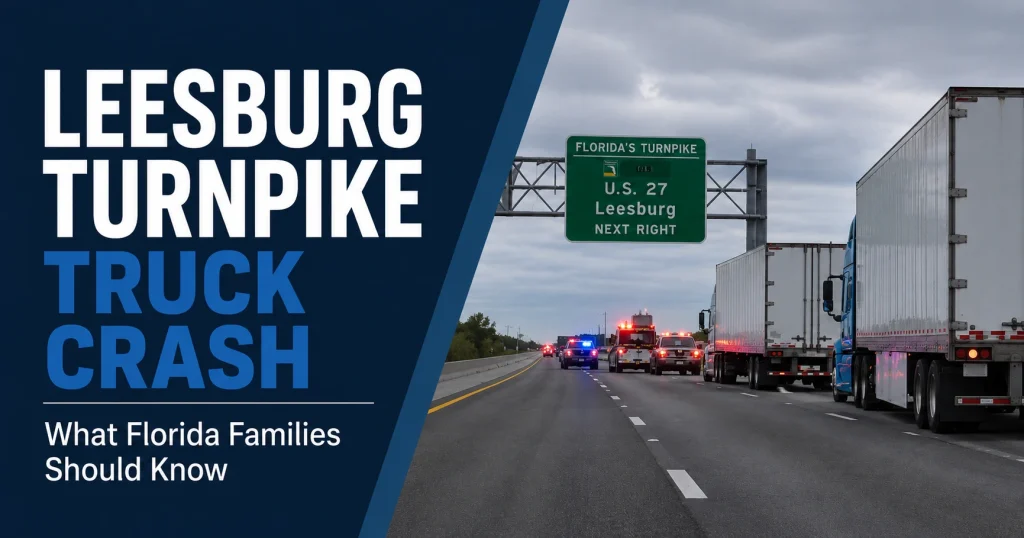
A crash involving multiple semi-trucks was reported on the southbound Florida Turnpike in Leesburg, just before the U.S. 27 exit in Lake County. According to WESH, the Florida Highway Patrol reported that two people were taken to the hospital, including one person with serious injuries, and the crash remains under investigation. Early reports do not always explain the full cause of a crash, especially when multiple commercial vehicles, roadway debris, and lane closures are involved.
For families, this type of crash matters because commercial vehicle cases can involve more evidence than those involving typical passenger vehicle crashes. Depending on the evidence, investigators may review driver actions, vehicle movement, electronic data, maintenance records, company safety practices, and roadway conditions.
What Happened in the Leesburg, Florida, Turnpike Crash?
According to WESH, a crash involving multiple semi-trucks blocked lanes on Florida’s Turnpike in Leesburg early Thursday morning, May 28, 2026. The crash was reported in the southbound lanes just before the U.S. 27 exit in Lake County.
WESH reported that the Florida Highway Patrol said a semi-truck on the shoulder was trying to merge into the outside lane when it moved into the direct path of another semi-truck. FHP said the two semi-trucks collided, and two additional semi-trucks later hit debris from the crash.
Two people were taken to the hospital, including one person who suffered serious injuries, according to the report. The crash blocked two right southbound lanes for several hours before the roadblock was cleared. WESH reported that the crash remains under investigation.
At this stage, this article does not assume fault or make any final legal conclusion. The facts may change as investigators review the scene, witness statements, vehicle data, and other evidence.
Crash Location: Florida’s Turnpike Southbound Near U.S. 27 in Leesburg
The crash was reported on the southbound Florida Turnpike near the U.S. 27 exit in Leesburg, Lake County, Florida.
What Do We Know About the Crash?
Based on the published report, we know the following:
- The crash happened on the southbound Florida Turnpike in Leesburg.
- The location was reported just before the U.S. 27 exit in Lake County.
- Multiple semi-trucks were involved.
- FHP reported that one semi-truck was moving from the shoulder toward the outside lane.
- FHP reported that two semi-trucks collided.
- Two additional semi-trucks reportedly hit debris from the crash.
- Two people were taken to the hospital.
- One person reportedly suffered serious injuries.
- The crash remained under investigation.
What we do not know from the early report is equally important. The report does not provide final findings about liability, driver speed, following distance, mechanical condition, visibility, fatigue, maintenance, company policies, or whether any safety regulation was violated.
That is why careful wording matters. Early reports can describe what was observed or initially reported, but they do not always explain the full cause.
Why Can This Type of Crash Be So Serious?
Crashes involving semi-trucks can be especially serious due to the size and weight of these vehicles. When multiple trucks are involved, the danger can increase quickly because a single collision can create debris, sudden lane blockages, secondary impacts, and limited space for other drivers to react.
In this reported crash, WESH stated that two additional semi-trucks hit debris after the first collision. That detail matters because debris fields can create a chain of events that investigators may need to reconstruct carefully.
A truck crash investigation may consider:
- Where each truck was positioned before impact
- Whether a vehicle was stopped, moving, merging, or changing lanes
- Whether hazard lights or warning devices were used
- Whether drivers had enough time and distance to react
- Whether traffic, weather, lighting, or road conditions played a role
- Whether any mechanical or maintenance issue contributed
- Whether the debris was avoidable under the circumstances
Each of these questions depends on evidence. It is not enough to assume what happened from the first news report.
What Makes a Truck or Commercial Vehicle Crash Different?
A commercial truck crash can be different from a regular car crash because more parties, records, and safety rules may be involved.
In a passenger vehicle crash, the investigation may focus mainly on the drivers and the vehicles. In a semi-truck crash, the investigation may also involve the trucking company, driver qualification records, electronic logging data, maintenance history, dispatch records, cargo records, and company safety practices.
Federal rules also require certain commercial drivers and motor carriers to keep hours-of-service records. Electronic logging devices, often called ELDs, synchronize with the vehicle engine to record driving time and help track hours-of-service data, according to the Federal Motor Carrier Safety Administration.
Under federal regulations, ELDs automatically record data such as date, time, commercial motor vehicle location information, engine hours, and vehicle miles.
That type of information may matter after a serious crash because it can help investigators understand vehicle movement, driver activity, and timing. It does not automatically prove fault, but it may help answer important questions.
Related Video: What Should You Do After a Semi-Truck Accident?
Truck accidents are rarely simple. This video from The Reyes Firm explains why a semi-truck crash may involve the driver, the trucking company, maintenance issues, and multiple insurance policies, depending on the evidence.
Note: This video provides general information about semi-truck accident claims in Florida. It does not discuss the Leesburg crash specifically or determine who was at fault.
What Should Families Do After a Serious or Fatal Crash in Florida?
After a serious commercial vehicle crash, families are often left with medical questions, insurance calls, vehicle damage, missing information, and emotional stress. The first priority should always be medical care and safety.
When possible, families should also try to protect information that may later become important.
Practical steps may include:
- Get medical care immediately.
Catastrophic injuries can worsen over time. Medical records also help document what happened after the crash. - Request the crash report when available.
A crash report may provide initial information about the vehicles, drivers, location, and investigating agency. - Save photos, videos, and messages.
Keep images of the vehicles, roadway, injuries, debris, insurance documents, and any communications about the crash. - Avoid guessing about the fault.
It is normal to want answers quickly, but early reports do not always explain the full cause. - Be careful with insurance statements.
Families should avoid giving recorded statements without understanding how those statements may be used. - Speak with a Florida attorney early.
In commercial vehicle cases, certain evidence may need to be preserved quickly.
If a crash results in a death, Florida’s wrongful death law may apply. Florida Statute § 95.11 includes a two-year deadline for many wrongful death actions. Families should speak with a licensed Florida truck accident attorney about the specific deadline that may apply to their situation.
Florida Statute § 768.21 explains categories of damages that may be available in a wrongful death case, depending on the facts and the survivors involved.
Who May Be Liable After This Type of Crash?
Possible liable parties may include one or more individuals or companies, depending on the evidence.
In a crash involving multiple semi-trucks, the investigation may consider:
- A truck driver
- A trucking company
- A vehicle owner
- A maintenance company
- A cargo loading company
- A parts manufacturer
- Another driver
- A government entity or roadway contractor, in limited circumstances
This does not mean any of those parties is automatically responsible. Liability depends on evidence, legal duties, causation, and damages.
For example, if a commercial vehicle was merging from the shoulder, investigators may consider whether the movement was safe under the circumstances, whether other vehicles had time to react, whether visibility was limited, and whether warning signals or hazard lights were used.
If other trucks struck debris, investigators may also consider following distance, traffic speed, lighting, reaction time, lane position, and whether the debris could reasonably be avoided.
Florida’s comparative fault law may also matter. Under Florida Statute § 768.81, fault may be apportioned among responsible parties, and Florida law includes a modified comparative fault framework.
Because the legal analysis can be complex, families should avoid relying only on an insurance company’s early explanation.
What Evidence Matters Most After a Commercial Truck Crash?
The evidence that matters most depends on the facts, but commercial truck cases often require a deeper investigation than ordinary crash claims.
Important evidence may include:
- Florida Highway Patrol crash report
- Scene photos and videos
- Dashcam or traffic camera footage
- Witness statements
- 911 records
- Truck inspection records
- Driver qualification files
- Driver hours-of-service records
- ELD data
- GPS and dispatch records
- Maintenance and repair records
- Post-crash drug and alcohol testing records, if applicable
- Vehicle damage photos
- Debris field evidence
- Black box or event data recorder information
- Medical records
- Expert accident reconstruction analysis
NHTSA explains that event data recorders capture information related to a crash. In serious vehicle crashes, that type of data may help investigators understand vehicle movement and timing, depending on the system and the records available.
The key is preservation. Some records may be overwritten, deleted, repaired, or lost if action is not taken early.
How The Reyes Firm Handles These Cases
At The Reyes Firm, we understand that families are often searching for answers after a serious truck crash. We also understand that early reports may not tell the whole story.
Our team approaches commercial vehicle cases by focusing on evidence, timing, and accountability. We may help by:
- Reviewing the crash report and early investigation details
- Identifying possible evidence sources
- Sending preservation letters when appropriate
- Communicating with insurance companies
- Reviewing medical documentation
- Investigating possible commercial vehicle safety issues
- Working with experts when needed
- Explaining legal options in plain language
- Helping families understand the process before making major decisions
We do not assume fault before the evidence is reviewed. We also do not guarantee outcomes. Our role is to help families understand what may have happened, what evidence may matter, and what legal options may be available under Florida law.
FAQ
What happened in the Leesburg, Florida, Turnpike semi-truck crash?
According to WESH, multiple semi-trucks were involved in a crash on southbound Florida’s Turnpike in Leesburg, just before the U.S. 27 exit in Lake County. FHP reported that two people were taken to the hospital, including one person with serious injuries. The crash remains under investigation.
Did the news report say who was at fault?
The report included preliminary information from FHP about how the crash occurred, but it did not provide a final legal conclusion about fault. Fault may depend on a full investigation, including vehicle data, witness statements, roadway conditions, driver actions, and other evidence.
Why do multiple semi-truck crashes require careful investigation?
Multiple-truck crashes can involve several vehicles, commercial carriers, insurance companies, debris impacts, electronic records, and potential questions about safety rules. A full investigation may be needed to understand how each impact occurred.
What evidence should be preserved after a semi-truck crash?
Important evidence may include crash reports, photos, videos, ELD data, driver logs, maintenance records, dashcam footage, inspection records, dispatch records, and black box or event data recorder information.
Can a trucking company be responsible for a crash?
A trucking company may be investigated depending on the evidence. Possible issues may include hiring, training, supervision, maintenance, dispatch practices, or safety compliance. However, no trucking company should be accused of liability unless the evidence supports that conclusion.
What is Florida’s wrongful death deadline?
Florida Statute § 95.11 includes a two-year deadline for many wrongful death actions. Families should speak with a licensed Florida truck accident attorney as soon as possible, as deadlines may depend on the facts of the case.
What damages may be available in a Florida wrongful death case?
Florida Statute § 768.21 outlines categories of wrongful death damages that may apply depending on the survivors, the estate, and the facts of the case. This may include certain financial and non-financial losses, but every case is different.
What if more than one party shares fault?
Florida Statute § 768.81 addresses comparative fault. In some cases, fault may be divided among multiple parties depending on the evidence.

Edward Reyes, Esq., is the founder of The Reyes Firm and is admitted to The Florida Bar. He focuses his practice on serious personal injury and wrongful death cases, including commercial vehicle, truck, and company-operated vehicle crashes that cause catastrophic harm to Florida families. Attorney Reyes represents clients in Tampa, Hillsborough County, Pasco County, Hernando County, and surrounding communities.
Read more about Edward Reyes.
How Can The Reyes Firm Help You?
If your family lost someone in a truck crash or serious crash, you should not have to search for answers alone. These cases can involve insurance carriers, electronic evidence, safety rules, and multiple possible defendants.
The Reyes Firm can help investigate what happened, preserve key evidence, communicate with insurance companies, and explain your legal options under Florida law.
Had a bad day? Call The Reyes Firm at
833-4 BAD DAY.
📍 Address: 4730 N. Habana Ave., Suite 201, Tampa, FL 33614
📞 Phone: 833-4 BAD DAY
This article is provided for general informational purposes only and does not constitute legal advice. The information in this article does not create an attorney-client relationship. Every case is unique, and past results do not guarantee future outcomes. If you have been involved in a crash or have lost a family member in a commercial vehicle accident, please consult with a licensed Florida attorney about your specific situation.