
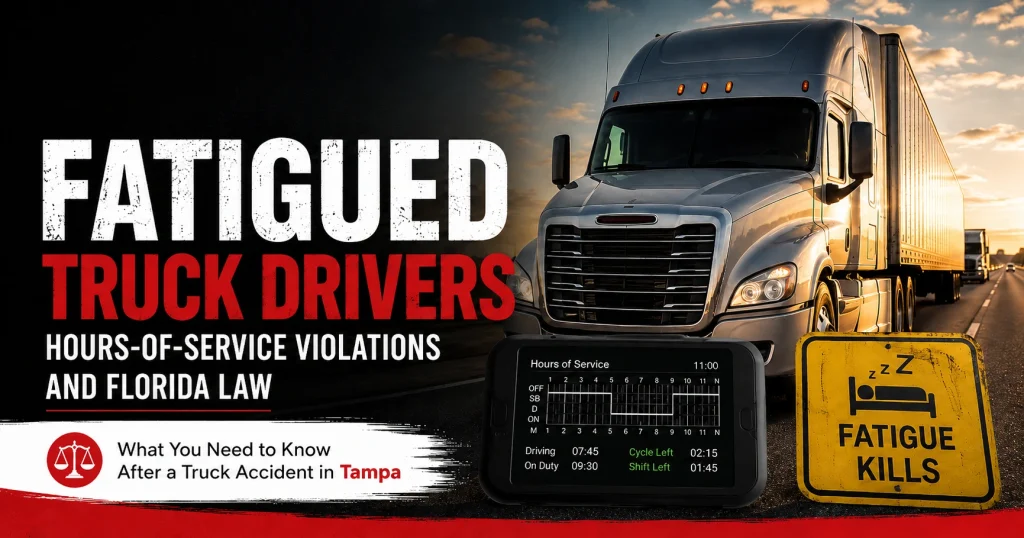
Hours-of-Service Violations and Driver Fatigue: What Tampa Crash Victims Need to Know
Hours-of-service violations and driver fatigue can turn a normal drive into a serious Tampa truck crash. You may be left with pain, missed work, medical bills, and questions about why the truck driver never stopped in time. That stress can grow when the trucking company or insurer moves quickly. They may already be reviewing records, protecting their side, and looking for ways to shift blame. You deserve to know whether the driver stayed on the road too long, skipped rest, or worked under an unsafe schedule. These rules exist because tired truck drivers can put everyone around them at risk. The Reyes Firm Hurt in a Tampa Truck Accident? If driver fatigue or hours-of-service violations may have played a role, get clear next steps. Had a bad day? Schedule a Free Consultation What You Need to Know Federal hours-of-service rules limit how long many commercial truck drivers can drive before they must rest. Driver fatigue can slow reaction time, reduce focus, and increase the risk of serious truck crashes. ELD data, GPS records, fuel receipts, and dispatch records may help show whether a driver stayed on the road too long. Florida generally gives injured people 2 years to file a negligence lawsuit, but key evidence in a truck crash may disappear much sooner. Had a bad day? Call The Reyes Firm at 833-4 BAD DAY. Bottom line: If a tired truck driver caused your crash, early evidence preservation can make a major difference. These points explain why timing, records, and safety rules matter after a truck crash in Tampa. What Are Hours-of-Service Rules? Hours-of-service rules are federal safety rules that limit how long certain truck drivers may drive and work before taking required rest. The Federal Motor Carrier Safety Administration, or FMCSA, enforces these rules. For many property-carrying truck drivers, FMCSA rules include an 11-hour driving limit after 10 consecutive hours off duty, a 14-hour driving window after coming on duty, a 30-minute break requirement after 8 cumulative hours of driving, and 60/70-hour weekly limits. HOS Rule What It Means Why It Matters in a Crash Claim 11-hour driving limit A driver may drive up to 11 hours after 10 straight hours off duty. A violation may suggest the driver stayed behind the wheel too long. 14-hour on-duty window A driver generally may not drive beyond the 14th hour after coming on duty. This can show whether the driver was working beyond a safe shift. 30-minute break rule A driver must take a break after 8 total hours of driving without a qualifying break. Skipped breaks may support a fatigue-related theory of the crash. 60/70-hour weekly limit A driver may not drive once they reach certain weekly on-duty limits. This can reveal a pattern of overwork before the crash. These rules can matter in crashes on I-75, I-4, I-275, the Selmon Expressway, U.S. 301, Dale Mabry Highway, and other Tampa-area roads where commercial trucks move through heavy traffic. When these rules are broken, the next question is how fatigue affects the driver behind the wheel. Why Does Driver Fatigue Make Truck Crashes More Dangerous? Fatigue is not just feeling sleepy. It can affect a driver’s ability to notice danger, react quickly, make safe choices, and control a large vehicle. Delayed reaction time: A tired truck driver may see danger too late, brake too late, or fail to respond to slowing traffic. Lane drift: Fatigue can make it harder for a driver to stay centered in a lane, especially on highways like I-75, I-4, and I-275. Poor judgment: A fatigued driver may follow too closely, misjudge traffic gaps, or make unsafe lane changes. Microsleep: A driver can briefly fall asleep without realizing it, even while moving at highway speed. Did You Know? FMCSA’s Large Truck Crash Causation Study reported that 13% of truck drivers in the study were coded as fatigued at the time of the crash. That risk becomes more serious when the vehicle is an 18-wheeler, box truck, dump truck, delivery truck, or other commercial vehicle. A fully loaded truck needs more time and distance to stop than a passenger car. When fatigue delays reaction time, the result can be a severe rear-end crash, an underride crash, a jackknife crash, a rollover, or a multi-vehicle collision. Once fatigue becomes a possible cause, investigators usually look for specific rule violations. Still have questions? Call The Reyes Firm at 833-4 BAD DAY. The consultation is free, and there’s no obligation. What Are Common HOS Violations After a Truck Crash? Hours-of-service violations can appear in different ways. Some are obvious. Others require a close review of electronic records, dispatch data, and supporting documents. Common HOS Violation What It May Show Driving beyond the 11-hour limit The driver may have stayed on the road longer than allowed. Driving after the 14-hour window The driver may have continued driving after a long workday. Skipping the 30-minute break The driver may not have taken the required rest during the route. Misusing personal conveyance The driver may have marked work-related driving as off-duty time. Editing or falsifying logs The records may not match the driver’s actual route or hours. A single violation does not automatically prove every part of a claim. However, it can become important evidence when it helps explain how the crash happened. It may also show whether the driver or carrier failed to follow safety rules. Those violations matter even more when Florida law connects them to your injury claim. Florida Laws That May Affect Your Truck Accident Claim Florida truck crash claims can involve multiple laws simultaneously. These laws may affect safety rules, filing deadlines, fault arguments, and early insurance benefits. Florida Law Plain-English Meaning Why It Matters Fla. Stat. § 316.302 Florida applies many federal commercial motor vehicle safety rules to commercial vehicles on Florida roads. A violation of a safety rule may help show that a truck driver or carrier failed to exercise reasonable care. Fla. Stat. § 95.11 Most Florida negligence lawsuits must be filed within 2 years.