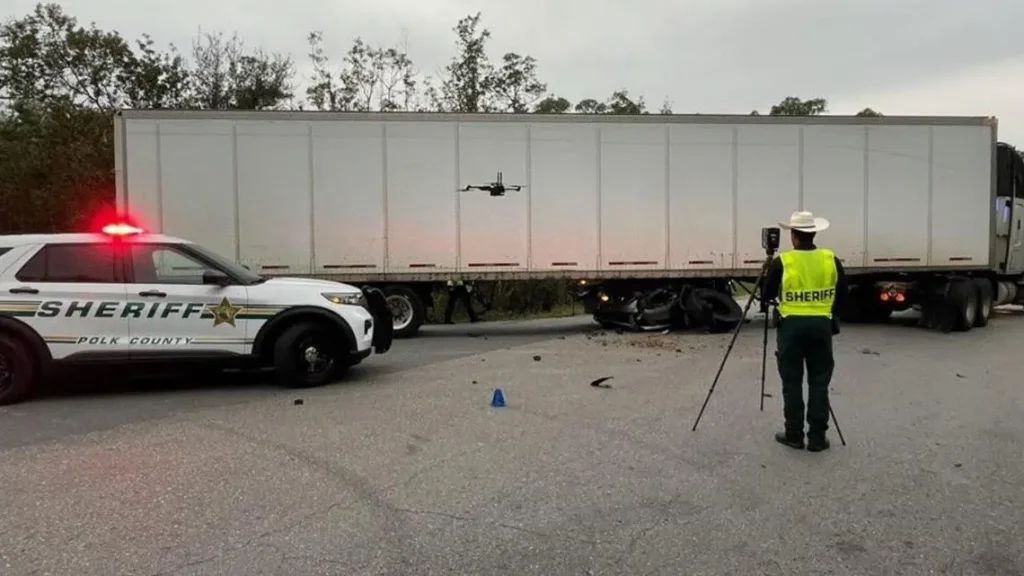
 Crash scene on Deen Still Road in Davenport, Florida. Photo credit: WTSP 10 Tampa Bay
The days after a deadly crash rarely feel “dramatic” in the way people expect. They feel quiet and unreal. Phones keep buzzing, but the mind feels stuck in one moment.
Families also get hit with decisions they did not ask for. A call from an insurance company. A request for paperwork. Someone asks, “Can you explain what happened?” before the family even has the full story.
This guide is meant to slow things down and add structure. It explains what is known so far about the Davenport crash, what steps families can take next, and when it is helpful to speak with a Davenport semi-truck accident lawyer.
News summary: What happened in Davenport on Deen Still Road?
Local reporting, based on information from the Polk County Sheriff’s Office, said the crash happened around 5:45 a.m. at Deen Still Road and Wheeler Road in Davenport.
Deputies said a Freightliner semi-truck pulled out from a sand mine entrance at Wheeler Road and was stretched across Deen Still Road while attempting to turn. A 2018 Nissan Sentra traveling eastbound struck the side of the trailer and went underneath it.
The driver of the Sentra, a 61-year-old man from Zephyrhills, died at the scene. The roadway was closed for about four hours while investigators worked.
Important note: Early details can change as investigators confirm measurements, witness statements, and physical evidence. Families should treat initial news reports as preliminary until the investigation is complete.
Why crashes with semi-trucks can be so dangerous on local roads
A semi-truck crash is not the same as a crash between two passenger cars. Even if the speed looks “normal,” the size and shape of a tractor-trailer can create risks that smaller vehicles are not built to handle.
Here are a few reasons these crashes can turn deadly:
- Weight and force: A commercial truck can weigh far more than a car. That extra mass changes what happens on impact.
- Longer time to clear a road: A tractor-trailer needs more space and more time to turn or cross lanes.
- Blind spots and visibility: Truck drivers often have large blind zones, especially along the sides and behind the trailer.
- Underride danger: When a car goes underneath a trailer, the top of the car can be crushed. This is sometimes called an underride crash.
In this Davenport case, investigators reported the car went underneath the trailer, which helps explain why the outcome was so severe.
Florida truck crash context: Why this is not “rare” statewide
Families often ask, “How does something like this even happen?” Florida experiences a high number of serious crashes each year, including those involving commercial vehicles.
In FLHSMV’s “By the Numbers 2024” snapshot (noted as preliminary), Florida reported:
- 46,651 commercial motor vehicle crashes
- 315 fatalities in commercial motor vehicle crashes
That does not make any single loss feel smaller. But it does show why careful investigation matters in truck cases. A crash involving a commercial vehicle is a public safety issue and warrants a thorough review.
What families should do in the first 24 to 72 hours
After a fatal or serious semi-truck crash, families are usually trying to grieve and manage practical tasks at the same time. These steps can help protect the family without adding extra stress.
1) Focus on immediate needs first
If anyone survived the crash, medical care comes first. Even if a person feels “mostly okay,” symptoms can show up later, especially with head, neck, and back injuries.
2) Do not rush into recorded statements
Insurance adjusters may request a recorded statement immediately. Families do not have to give one immediately, especially when facts are still unclear and emotions are raw.
A safer approach is simple:
- “We are not ready to give a statement right now.”
- “Please send questions in writing.”
- “We will respond after we review the report.”
3) Start a single folder for paperwork
Families can reduce stress by keeping everything in one place. Helpful items include:
- The crash location and time (as best as known)
- The responding agency name
- Any claim numbers, letters, or emails
- Names and phone numbers of anyone who called about the crash
- Funeral or hospital paperwork (if applicable)
4) Be careful with social media details
It is normal to want to update friends. But posts about fault, speed, injuries, or “what happened” can be misunderstood later. Keeping public posts brief and private is often the safest approach.
How to get the official Florida crash report
Families often feel stuck waiting for answers. The crash report can be a key first step, but it is not always available right away.
FLHSMV says traffic crash reports may take up to 10 days to become available.
The Crash Portal also notes that search results may not include crashes from the last 10 days because law enforcement has 10 days to submit crash reports.
Another detail many families do not know: crash reports are confidential for 60 days, with access limited to designated, eligible parties during that period.
A Davenport semi-truck accident lawyer can help families request the appropriate records, confirm eligibility, and request supporting documents that may not appear in a basic report.
Why the crash report is only the beginning of a truck case
A crash report can be helpful, but it is not the whole story. In a semi-truck case, the most important answers often come from evidence beyond the initial narrative.
That may include:
- Photos and measurements from the scene
- Witness statements
- Vehicle damage patterns
- Any available video from nearby businesses
- Commercial vehicle inspection and maintenance records
- Electronic records tied to the truck’s operation and driver activity
When a crash involves a trailer stretched across a roadway, questions often come up about timing, visibility, lighting, and whether the truck’s movement was safe for that road at that moment.
Who may be responsible after a Davenport semi-truck crash
Many people assume the case is only about the truck driver. Sometimes it is. But commercial crashes often involve multiple layers of responsibility.
Depending on the facts, responsibility may involve:
The truck driver
Examples may include:
- Unsafe turn or crossing
- Distraction
- Fatigue
- Poor judgment about gaps in traffic
The trucking company
A company may be responsible if there were issues such as:
- Unsafe scheduling or pressure
- Poor training
- Failure to follow safety policies
- Weak supervision
The trailer owner or maintenance provider
Trailers are not always owned by the same company that owns the truck. Maintenance and inspection records can matter, especially for lighting, reflective markings, brakes, and safety equipment.
The site operator or property owner
If a truck is exiting a facility, such as a mine entrance, the layout, signage, and traffic flow can become part of the larger safety picture.
A commercial vehicle accident lawyer’s job is to look at the full chain of responsibility, not just the easiest target.
Florida insurance basics families should understand
Even when a crash involves a semi-truck, insurance rules still matter for surviving occupants and their immediate medical needs.
The 14-day rule for PIP medical benefits
Florida’s PIP law ties medical benefits to getting initial services and care within 14 days after the crash.
This rule can surprise people. Someone might feel fine for a week, then experience pain later, and suddenly the insurance process becomes more difficult. That is why early medical evaluation is often recommended for anyone who may have been injured.
“Quick settlement” pressure is common
Families may be contacted quickly, sometimes before the full crash report is available. Insurance companies often move fast because early statements and early agreements can shape what happens next.
A family does not have to rush. It is reasonable to pause and get guidance first.
What to do if an insurance adjuster calls the family
Families often worry they will “mess up” a case by saying the wrong thing. A safe mindset is this: the family’s job is to protect themselves, not to help the insurance company build a story.
A simple script can help:
- “This is a difficult time. We are not ready to discuss details.”
- “Please send any requests in writing.”
- “We will respond after we review the crash report.”
If the adjuster requests a recorded statement, it is acceptable to decline until the family has support.
What families can expect in a wrongful death situation in Florida
When a loved one dies in a crash, families often ask who can take legal action and what losses can be included.
Florida’s Wrongful Death Act states that damages may include losses such as lost support and services, as well as other categories, depending on the survivors and circumstances.
Families also need to understand timing. In many situations, a wrongful death case has a limited filing window, so seeking legal advice early can help the family make informed decisions while evidence is still available.
How fault works in Florida if blame is disputed
Truck cases often involve arguments about fault. Florida has a modified comparative fault rule in many negligence cases. In general terms, a person found to be more than 50% at fault may be barred from recovering damages in that type of claim.
That is one reason early assumptions can be risky. The best approach is to let evidence lead, not pressure.
When it makes sense to call a Davenport semi truck accident lawyer
Some families wait because they do not want to “make it legal.” Others call because they are overwhelmed and want someone to handle the process.
A call may make sense when:
- The crash caused a death or a catastrophic injury
- The family is getting repeated insurance calls
- There are unclear facts or blame shifting
- A commercial vehicle was involved
- The family wants help getting the right documents and understanding the next steps
A lawyer can assist with key tasks, such as record requests, communication, and evidence preservation, so the family can focus on what matters most.
How Can The Reyes Firm Help You
A serious truck crash can leave a family feeling overwhelmed, pressured, and unsure of what to do next. The Reyes Firm helps families regain control by bringing structure to the process and handling the insurance and legal steps with clear guidance.
Here is how The Reyes Firm can help:
- Communicate with insurance companies so the family is not constantly pulled into stressful calls
- Help request and review key records, including crash reports and supporting documents
- Look for all responsible parties, not just the driver
- Build a claim that reflects the real-life impact on the family, not just what a form says
- Explain options step-by-step, without legal jargon or pressure
If the family needs a Davenport semi-truck accident lawyer, The Reyes Firm is ready to listen and help the family understand what comes next.
The Reyes Firm
4730 N. Habana Ave., Suite 201, Tampa, FL 33614
Phone: 833-4 BAD DAY
Had a bad day?
Frequently Asked Questions
How long does a family have to file a lawsuit after a fatal semi-truck crash in Florida?
In Florida, wrongful death claims generally must be filed within 2 years, and most negligence claims are also subject to a 2-year statute of limitations, so it is smart to get legal advice early, even if the family is still waiting on the final crash report.
What if the insurance company says your loved one was partly at fault?
Florida follows a modified comparative fault rule in many negligence cases, meaning recovery can be reduced by a person’s percentage of fault, and it may be barred if the person is found more than 50% at fault.
What is “black box” or ELD data, and how long does it last?
Many trucks store electronic data about speed, braking, and driver activity, but some systems may overwrite or erase data quickly, sometimes around 30 days, so preserving it early can matter.
Can families request 911 call recordings or dispatch notes after a crash?
Often yes, but you usually have to request them from the correct “agency of record” (the local 911 center or agency that received the call), and some recordings may require redactions before release.