Quick Summary
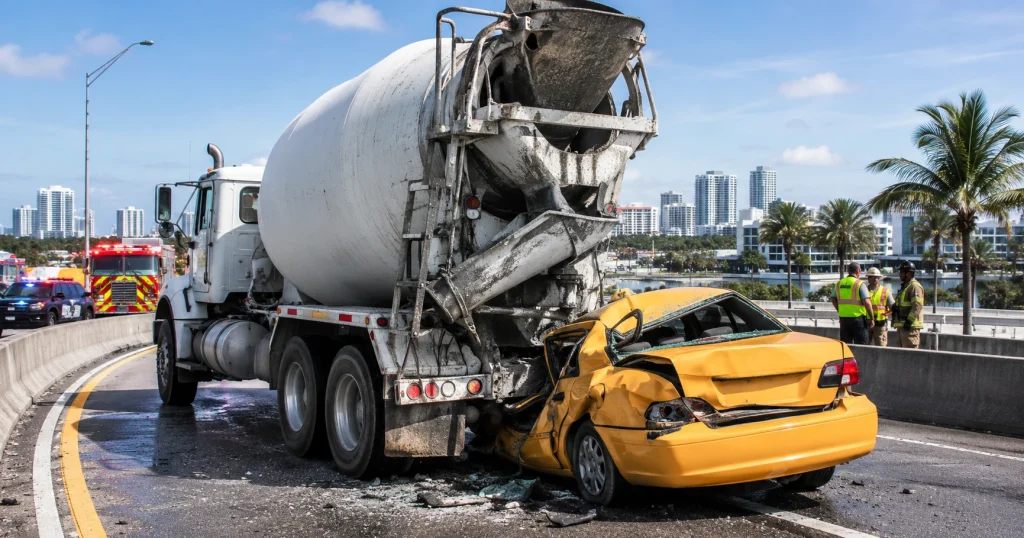
A cement truck and taxi crash on the I-595 ramp to I-95 Southbound in Fort Lauderdale reportedly sent seven people to the hospital, including a child.
Cement trucks are commercial vehicles, which means these cases may involve federal safety rules, company records, electronic driver logs, maintenance files, black box data, and higher insurance coverage than a regular car accident.
In Florida, negligence-based personal injury claims generally must be filed within two years, but key evidence can disappear much sooner.
After a cement truck crash, seek medical care, document the scene, avoid recorded statements, and speak with a lawyer who understands commercial vehicle investigations.
Had a bad day? Call The Reyes Firm at 833-4 BAD DAY.
What Happened in the I-595 Cement Truck and Taxi Crash?
On May 15, 2026, CBS Miami reported that a cement truck and a taxi were involved in a crash on the ramp connecting I-595 to I-95 Southbound in Fort Lauderdale. According to the Florida Highway Patrol, the taxi was stopped in the outside lane when the front of the cement truck collided with the rear of the taxi. Seven people were transported to hospitals, including four adults and one child listed as trauma alerts.
CBS Miami also reported that a hazmat crew responded after fuel leaked from the tractor cab.
This article does not assign fault in that specific crash. The incident serves as a real-world example of why crashes involving cement trucks and commercial vehicles require fast, careful investigation.
Although this crash occurred in Fort Lauderdale, the same commercial vehicle issues are present throughout Florida, including Tampa, Hillsborough County, Riverview, Brandon, Plant City, and along major freight routes such as I-4, I-75, I-275, and the Selmon Expressway.
When a cement truck or concrete mixer is involved in a serious crash, the question is rarely limited to “What did the driver do?” A proper investigation may also look at the company, dispatch records, maintenance history, driver logs, vehicle data, and whether federal or Florida safety rules were followed.
Where Did the Fort Lauderdale Cement Truck Crash Happen?
The crash was reported on the ramp from I-595 to I-95 Southbound in Fort Lauderdale, near the major interchange west of Fort Lauderdale-Hollywood International Airport. This map shows the approximate incident area based on public news reports.
Map shown for general location context only. The exact crash location should be confirmed through the official crash report or investigating agency records.
Why Is a Cement Truck Crash Different From a Regular Car Accident in Florida?
A cement truck crash is different from a regular car accident because cement trucks are commercial vehicles. That means the case may involve federal safety regulations, business records, company policies, inspection requirements, and multiple potential defendants.
In a regular car crash, the main issue is often whether one driver made a mistake. In a cement truck crash, the investigation may also ask:
- Was the driver properly trained?
- Was the truck inspected before the trip?
- Were the brakes, tires, and steering systems maintained?
- Was the driver fatigued or under pressure to meet a delivery deadline?
- Did the company preserve electronic data after the crash?
- Did dispatch records show an unrealistic route or schedule?
- Did a mechanical problem contribute to the collision?
Florida Statute 316.302 states that owners and drivers of commercial motor vehicles operating on Florida public highways are subject to applicable federal safety regulations, including rules found in 49 C.F.R. parts 382-386 and 390-397.
That matters because a cement truck crash is not just a personal injury claim. It may also be a commercial vehicle investigation.
Why Are Cement Truck Crashes So Dangerous?
Cement trucks can cause severe injuries because of their size, weight, height, and stopping distance. A fully loaded concrete mixer can weigh many times more than a passenger vehicle. When a vehicle that heavy hits a car, a taxi, a motorcycle, or a pedestrian, the force can be devastating.
Cement trucks also have unique risk factors, including:
- Longer stopping distances
- Large blind spots
- High center of gravity
- Heavy rotating drum
- Load balance issues
- Tight delivery schedules
- Frequent operation in traffic-heavy areas
- Repeated stops near construction zones, highways, and commercial sites
These factors can make crashes more severe and investigations more complex. For injured people, the most important point is simple: the evidence needs to be preserved quickly.
How Common Are Commercial Vehicle Crashes in Florida?
Commercial vehicle crashes are not rare in Florida. According to FLHSMV data cited in the original draft, Florida recorded 46,651 commercial motor vehicle crashes in 2024, resulting in 315 fatalities.
Nationally, the National Safety Council reports that 5,340 people died in large-truck crashes in 2024. The NSC also reports that 70% of deaths in large-truck crashes were occupants of other vehicles, not the large truck.
That pattern matters in cement truck cases. When a heavy commercial vehicle collides with a smaller passenger vehicle, the occupants of the smaller vehicle often face the most severe consequences.
Who Can Be Held Liable After a Cement Truck Accident in Florida?
Multiple parties may be responsible after a cement truck accident in Florida. The driver may be one part of the case, but the investigation should not stop there.
Depending on the facts, potential liable parties may include:
- The cement truck driver was speeding, distracted, fatigued, impaired, or engaged in unsafe driving, which contributed to the crash
- The concrete company or trucking company, if negligent hiring, poor training, unsafe scheduling, or weak supervision played a role
- A maintenance contractor if brake failure, tire failure, steering problems, or skipped repairs contributed
- A dispatcher or company supervisor if the driver was pressured to meet unrealistic delivery times
- A parts manufacturer if a defective truck component contributed to the crash
- Another driver in a separate vehicle triggered or worsened the collision
In many cement truck cases, the company behind the driver is one of the most important parts of the investigation. Company records may show whether safety rules were followed before the crash.
Watch: Why Cement Truck Accident Liability Can Involve More Than the Driver
In cement truck accident cases, the investigation may look beyond the driver. This video explains why factors such as speed, turning, truck handling, cement loading, and company involvement may affect who can be held responsible after a serious crash.
Video provided for general educational purposes only. Every cement truck accident case depends on the specific facts, available evidence, and applicable Florida law.
What Evidence Matters Most After a Cement Truck Crash?
The most important evidence after a cement truck crash can be overwritten, deleted, repaired, or lost if no one acts quickly.
Key evidence may include:
- ECM, EDR, or “black box” data
- Electronic logging device records
- Driver hours-of-service records
- Dashcam footage
- GPS and telematics data
- Dispatch records
- Driver qualification files
- Maintenance and repair records
- Pre-trip and post-trip inspection reports
- Drug and alcohol testing records
- Photos and videos from the crash scene
- Witness statements
- Police crash reports
- Surveillance footage from nearby roads, businesses, or traffic cameras
FMCSA states that motor carriers must retain records of duty status and supporting documents for six months.
However, other evidence may disappear much faster. Dashcam footage, business surveillance video, and some electronic data systems may be overwritten in days or weeks. That is why early legal action matters.
Why Is a Preservation Letter Important After a Cement Truck Accident?
A preservation letter, sometimes called a spoliation letter, is a formal legal notice demanding that a company preserve evidence related to a crash.
In a cement truck accident case, a preservation letter may demand that the company save:
- Black box data
- ELD records
- Dashcam footage
- Maintenance records
- Driver files
- Inspection reports
- Dispatch communications
- GPS data
- Internal incident reports
- Insurance communications related to the crash
Under Florida law, the loss or destruction of important evidence after a party has a duty to preserve it may lead to legal consequences, including court sanctions or adverse evidentiary inferences, depending on the facts.
The point is simple: the sooner a lawyer sends a preservation demand, the harder it becomes for a company to claim that critical records were lost through routine deletion.
What Should You Do Right Now If a Cement Truck Hits You in Florida?
If a cement truck hits you or someone you love in Florida, take these steps as soon as you can.
1. Call 911 and prioritize safety
Move to a safe location if possible. Call 911 and wait for emergency responders. Cement truck crashes often involve serious injuries, fuel leaks, blocked lanes, and secondary crash risks.
2. Get medical care immediately
Heavy vehicle crashes can cause injuries that do not feel obvious right away. Adrenaline can mask pain. Neck injuries, back injuries, brain injuries, internal injuries, and soft tissue damage may worsen after the crash.
3. Seek medical care within 14 days
Florida PIP benefits generally require injured people to receive initial medical care within 14 days after a crash. Even if a trucking company or another party may ultimately be liable, missing this medical treatment window can create insurance problems.
4. Document the scene if you can
Take photos and videos of:
- Vehicle positions
- Damage to all vehicles
- The cement truck’s company name or markings
- License plates
- Road conditions
- Skid marks
- Debris
- Traffic signs
- Visible injuries
- Nearby cameras
- Witnesses and responders
Do not put yourself in danger to collect evidence.
5. Do not admit fault
Avoid saying anything that could be misunderstood as accepting blame. Stick to the facts when speaking with police and medical providers.
6. Do not give a recorded statement to the trucking company’s insurer
The cement truck company’s insurance adjuster may contact you quickly. You are not required to give a recorded statement to the other side before speaking with a lawyer.
7. Contact a lawyer who handles commercial vehicle cases
Commercial vehicle cases require fast evidence preservation and a different legal strategy than ordinary car accident claims. The company and its insurer may already be investigating. You deserve someone working just as quickly on your side.
The Reyes Firm serves injured people in Tampa, Hillsborough County, the South Shore communities, and throughout Florida.
How Long Do You Have to File a Cement Truck Accident Claim in Florida?
For most negligence-based personal injury cases in Florida, the lawsuit deadline is generally two years from the date of the crash. Florida Statute 95.11 provides a two-year limitations period for negligence actions.
But the lawsuit deadline is not the only deadline that matters.
The evidence clock may be much shorter. Dashcam footage can be overwritten. Trucking records can be lost. Vehicles can be repaired. Witness memories can fade. Electronic records may become harder to obtain with each passing week.
That is why a person injured in a cement truck crash should not wait until the lawsuit deadline is approaching. The strongest cases are often built early, while evidence is still available.
What If the Trucking Company Says You Were Partly at Fault?
Florida uses a modified comparative negligence system. If you are found partly at fault, your compensation may be reduced by your percentage of fault. If you are found more than 50% at fault, you may be barred from recovering damages.
This matters in cement truck cases because trucking companies and insurers may try to shift blame quickly. They may argue that the injured person stopped suddenly, changed lanes, failed to avoid the crash, or otherwise contributed.
A fast investigation can help protect your side of the story. Evidence such as black box data, video footage, skid marks, witness statements, and vehicle damage can show what actually happened.
How The Reyes Firm Handles Cement Truck Accident Cases
When a cement truck or concrete mixer crash causes serious injuries, The Reyes Firm moves quickly to investigate the facts and protect key evidence.
Here is what we do in these cases.
We send preservation letters immediately
We demand that the trucking company, concrete company, maintenance provider, and any related parties preserve key evidence. This may include ECM data, ELD records, dashcam footage, driver files, inspection records, and dispatch communications.
We investigate the company behind the driver
We do not stop at the person behind the wheel. We look at hiring, training, supervision, scheduling, safety policies, maintenance history, and whether the company followed required safety rules.
We review federal and Florida safety compliance
Cement truck cases may involve FMCSA regulations, Florida commercial vehicle laws, inspection requirements, driver qualification rules, and hours-of-service issues.
We work with experts when needed
Some cement truck crashes require accident reconstruction experts, trucking safety experts, medical experts, or life care planners. These experts can help explain how the crash happened and how the injuries will affect the victim’s future.
We build the full damage picture
A serious cement truck crash can affect every part of your life. We evaluate:
- Emergency medical care
- Surgeries and hospitalization
- Follow-up treatment
- Rehabilitation
- Lost income
- Reduced earning capacity
- Pain and suffering
- Permanent disability
- Future medical needs
- The impact on your family and daily life
We deal with the insurance companies for you
Commercial insurers often move fast after a crash. They may try to limit exposure before the injured person knows the full extent of the harm. We handle those communications so you are not pressured into a low settlement.
We prepare every case seriously
No lawyer can guarantee an outcome. What we can promise is that we treat commercial vehicle cases as major legal battles, not routine fender-benders.
Frequently Asked Questions About Florida Cement Truck Accidents
What is the difference between a cement truck crash and a regular truck accident in Florida?
A cement truck is a commercial motor vehicle that may be subject to both Florida law and federal safety regulations. These cases often involve company records, driver logs, black box data, maintenance files, and multiple potential defendants. The evidence is more complex than in a regular car accident.
Can I sue the concrete company, not just the driver?
Yes, depending on the facts. If the driver was working within the scope of employment, the company may be legally responsible. The company may also face direct negligence claims if poor hiring, training, supervision, maintenance, or scheduling contributed to the crash.
What if the cement truck driver were an independent contractor?
The label “independent contractor” does not automatically end the investigation. Florida courts may look at the actual working relationship, including who controlled the driver’s route, schedule, equipment, and work duties. This is a fact-specific issue.
How much is my Florida cement truck accident case worth?
There is no honest single-number answer. Case value depends on the severity of your injuries, medical treatment, lost income, long-term limitations, available insurance coverage, and the strength of the evidence. Serious injury and wrongful death cases may involve substantial damages.
What if I were a passenger in the taxi or another vehicle?
Passengers injured in a cement truck crash may have the right to bring a claim against the at-fault parties. Depending on the facts, that may include the cement truck driver, the trucking or concrete company, another driver, or another responsible business.
How soon should I see a doctor after a cement truck accident in Florida?
You should seek medical care as soon as possible. In Florida, PIP benefits generally require initial medical treatment within 14 days after the crash. Seeing a doctor also creates medical documentation that connects your injuries to the collision.
What evidence should be preserved after a cement truck crash?
Important evidence may include black box data, ELD records, driver logs, dispatch records, dashcam footage, maintenance files, inspection reports, GPS data, driver qualification files, witness statements, and crash scene photos or videos.
Can a cement truck company be responsible for poor maintenance?
Yes. If brake failure, tire failure, steering problems, skipped inspections, or delayed repairs contributed to the crash, the company or a maintenance contractor may be part of the claim.
Do I have to pay The Reyes Firm anything upfront?
No. The Reyes Firm works on a contingency fee basis, which means you pay nothing unless we win your case. Consultations are free.
How quickly should I contact a lawyer after a cement truck crash in Florida?
Contact a lawyer as soon as you are physically able. In serious commercial vehicle cases, the first 24 to 48 hours can be important because video footage, electronic data, and company records may need to be preserved immediately.

Edward Reyes, Esq., is the founding attorney of The Reyes Firm and a member of The Florida Bar. He represents seriously injured people and families in personal injury cases involving commercial vehicles, cement trucks, semi-trucks, delivery vehicles, and other business-owned vehicles across Tampa, Hillsborough County, and throughout Florida.
When a commercial vehicle crash changes someone’s life, Edward Reyes moves quickly to investigate the facts, preserve critical evidence, identify all responsible parties, and help clients pursue full and fair compensation. Read more about Edward Reyes.
How Can The Reyes Firm Help You?
If you were injured in a cement truck crash, concrete mixer accident, or another commercial vehicle collision in Florida, you should not have to face the insurance company alone.
At The Reyes Firm, we help injured people understand their rights, preserve evidence, and pursue compensation after serious crashes.
You pay nothing up front. We only get paid if we win your case.
Had a bad day? Call The Reyes Firm.
The Reyes Firm
📍 Address: 4730 N. Habana Ave., Suite 201, Tampa, FL 33614
📞 Phone: 833-4 BAD DAY
🌐 Website: Schedule your free consultation today
Had a bad day? Call The Reyes Firm. We’ll handle the rest.
The information on this page is for general educational purposes only and does not constitute legal advice. Reading this content does not create an attorney-client relationship between you and The Reyes Firm or Edward J. Reyes, P.A. Every case is different, and outcomes depend on the specific facts and applicable law.
The reference to the May 15, 2026, I-595 crash is based on publicly reported information from CBS Miami and is provided for illustrative and educational purposes only. No commentary on liability or fault in that specific incident is intended or implied. If you have been injured in a commercial vehicle accident in Florida, consult a licensed Florida attorney about your individual situation.
Sources and Legal References
- CBS Miami: I-595 / I-95 Fort Lauderdale cement truck and taxi crash
- Florida Statute § 316.302: Commercial motor vehicles; safety regulations
- Florida Statute § 95.11: Limitations other than for the recovery of real property
- National Safety Council: Large truck crash data
- FLHSMV: Crash and citation reports and statistics