What You Need to Know
- Garbage truck crashes can involve a private hauler, a contractor, the truck owner, a repair shop, or a government agency.
- Hillsborough County says it contracts with private companies for curbside collection, so ownership, employment, and contract records matter.
- Onboard video, route data, inspection reports, and maintenance records can be overwritten, so you should protect evidence quickly.
- Claims against a city, county, or other government body have special written-notice rules and damage limits.
- Most Florida negligence lawsuits must be filed within two years, and government claims follow different rules, so do not wait.
Had a bad day? Call The Reyes Firm at 833-4 BAD DAY.
A garbage truck crash can leave you badly hurt and unsure where to turn. You may not know who owns the truck, who employs the driver, or which insurance company should pay your claim.
A garbage truck accident lawyer can investigate those questions before important evidence disappears. These cases may involve a private waste company, a contractor, a government agency, or several companies connected to the same truck. They can happen on neighborhood streets in Tampa, in Lithia, and in other parts of Hillsborough County.
Because garbage trucks are commercial vehicles, their accident claims often involve company records, maintenance evidence, commercial insurance, and multiple responsible parties. Learn more about how The Reyes Firm handles truck and commercial vehicle accidents in Tampa.
Why Are Garbage Truck Accidents Different From Other Tampa Crashes?
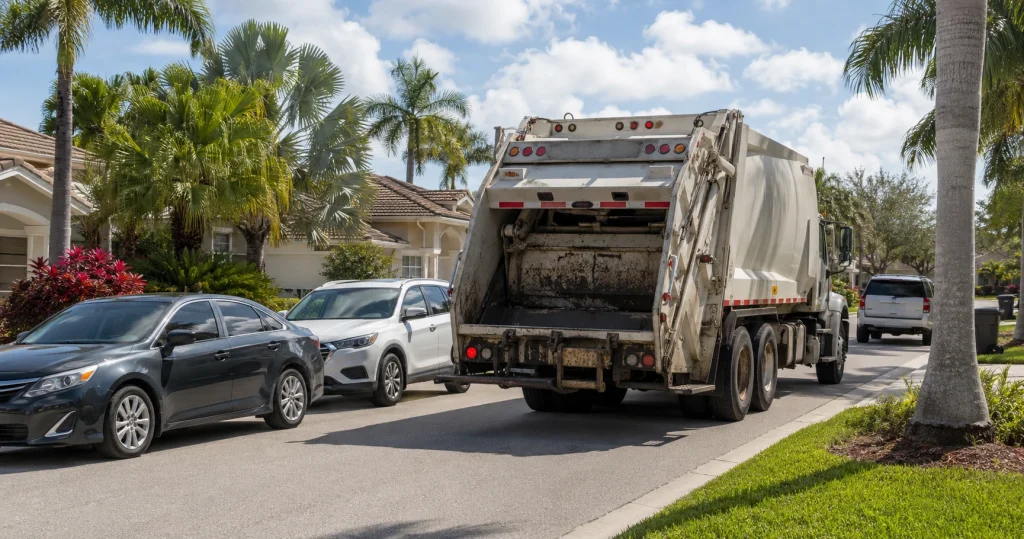
Garbage trucks make frequent stops, reverse through residential areas, and operate close to parked cars, pedestrians, cyclists, and sanitation workers. Their size, blind spots, specialized equipment, and collection schedules create risks that don’t exist in a typical passenger-vehicle accident.
A garbage truck does not have to be an 18-wheeler to qualify as a commercial vehicle. Many garbage and recycling trucks are large single-unit vehicles that carry heavy loads through narrow streets. The same is true on the residential roads of Lithia, Riverview, and other southeastern Hillsborough communities.
They may operate in neighborhoods while residents are:
- Leaving for work or school
- Walking dogs
- Riding bicycles
- Placing containers near the roadway
- Backing out of driveways
- Crossing streets
- Waiting at school bus stops
Garbage trucks also use hydraulic lifts, compactors, alarms, cameras, and other specialized equipment. A failure in any of these systems can put drivers, workers, and nearby residents in danger.
💡 Did You Know?
The Federal Motor Carrier Safety Administration reported that 99 garbage or refuse trucks were involved in fatal crashes nationwide in 2021. Another 1,460 were involved in injury crashes, and 2,520 were involved in towaway crashes involving disabling vehicle damage.
These are national figures for large trucks classified as garbage or refuse vehicles. They are not Tampa-only crash totals. FMCSA’s fatal-crash figures draw from the National Highway Traffic Safety Administration’s Fatality Analysis Reporting System, a nationwide census of fatal traffic crashes. The complete figures appear in FMCSA’s Large Truck and Bus Crash Facts 2021.
What Causes Garbage Truck Accidents in Tampa and Lithia?
Garbage truck accidents often result from unsafe backing, large blind spots, distracted driving, driver fatigue, poor maintenance, or unsafe collection procedures. The police report may not identify the exact cause, so investigators may need to review the truck’s video, route data, maintenance history, and company records.
Unsafe backing
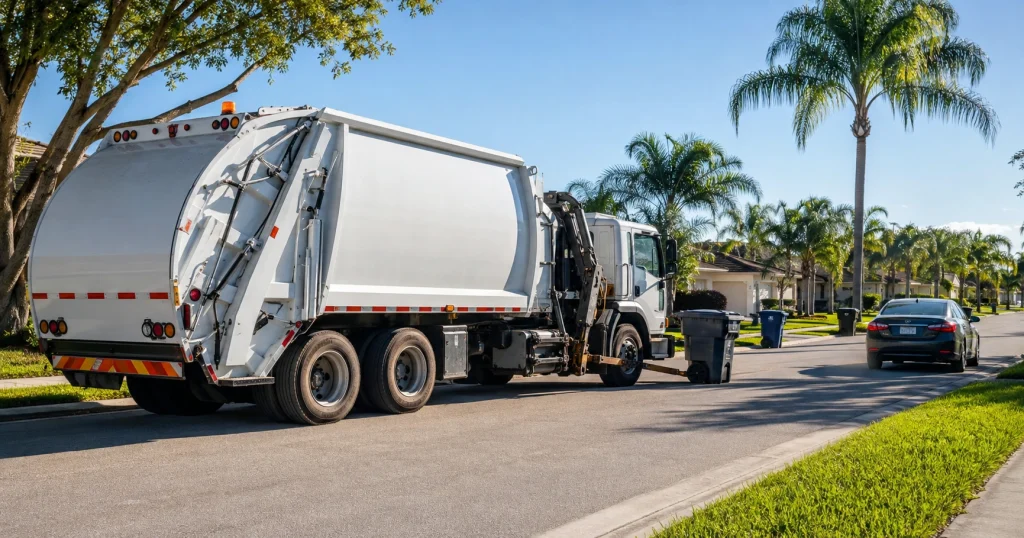
Garbage trucks frequently reverse on residential streets, in apartment complexes, and near commercial properties. The driver may not see a person, bicycle, parked vehicle, or car entering the collection area.
Reverse cameras, mirrors, alarms, and spotters can help reduce this danger. Investigators should determine if these safety measures were available and used.
Blind-spot and wide-turn collisions
A large garbage truck may have blind spots along its sides, directly behind it, and near the front. A driver who fails to check those areas can sideswipe a vehicle, strike a pedestrian, or trap a cyclist during a turn.
Distracted or fatigued driving
Garbage truck drivers may need to watch workers, follow route instructions, monitor equipment, and navigate tight spaces. A cellphone, dispatch message, route device, or in-cab conversation can pull the driver’s attention away from the road.
Early collection schedules and long shifts may also contribute to fatigue.
Poor maintenance
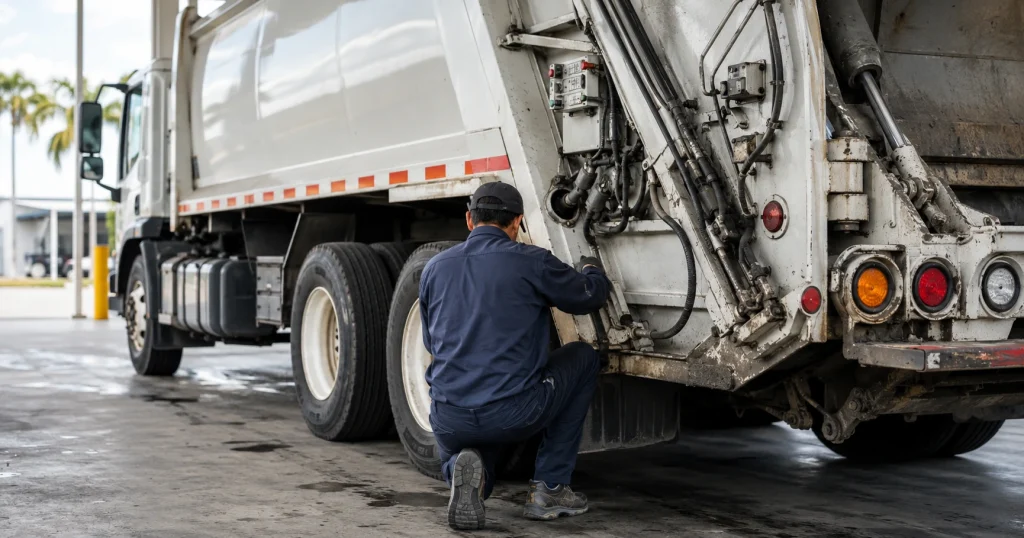
Garbage trucks experience repeated braking, turning, stopping, lifting, and compacting. Companies should inspect and maintain important systems, including:
- Brakes
- Tires
- Lights
- Mirrors
- Reverse alarms
- Cameras
- Hydraulic equipment
- Steering components
Maintenance records can show if a known problem was ignored or a required repair was delayed.
Falling trash or equipment
Loose garbage, tools, containers, or mechanical parts can fall into traffic. A driver may swerve, brake suddenly, or crash without touching the garbage truck.
If trash, equipment, or unsecured material falls from a garbage truck and causes a collision, the claim may involve a truck-lost-load accident, even if the vehicles never make direct contact.
Unsafe company practices
The driver may not be the only person responsible. A waste company or contractor may contribute to a crash by:
- Hiring an unqualified driver
- Providing inadequate training
- Ignoring prior safety complaints
- Setting an unsafe collection schedule
- Failing to inspect the truck
- Keeping defective equipment in service
- Pressuring drivers to complete routes too quickly
A careful investigation looks beyond the person behind the wheel.
Who Can Be Liable for a Garbage Truck Accident in Hillsborough County?
The driver, waste collection company, truck owner, contractor, maintenance provider, equipment manufacturer, or a government agency may be liable. The answer depends on who controlled the driver, owned the truck, maintained its equipment, set the route, and caused or contributed to the crash. Ownership and contract records often decide it.
The garbage truck driver
A driver may be responsible for speeding, unsafe backing, distracted driving, failing to yield, or ignoring a collection safety rule. A citation may support a claim, but a citation is not always required to prove negligence.
The waste collection company
A private sanitation company may be responsible for its employee’s actions while the driver is performing assigned work. The company may also face direct responsibility for unsafe hiring, poor training, weak supervision, or neglected maintenance.
The truck owner
The company shown on the truck may not own it. A separate leasing company, fleet operator, or contractor could control the vehicle and its maintenance.
Ownership records and contracts can help determine which company could have prevented the problem.
A maintenance or repair provider
A repair shop or fleet maintenance contractor may share responsibility if careless work contributed to brake failure, tire failure, defective lighting, or an inoperative warning system.
A manufacturer
A truck, camera, alarm, brake, hydraulic system, or other component may contain a dangerous defect. Product liability claims require evidence connecting the defect to the collision or injury.
A city, county, or government contractor
A garbage truck on a public route is not always government-owned. Hillsborough County says it contracts with private companies for curbside residential and commercial collection, so the truck that hit you may belong to a private company working under a government contract. Other cities and service areas may use different arrangements.
The investigation should determine:
- Who employed the driver
- Who owned the truck
- Who controlled the route
- Who maintained the vehicle
- What the collection contract required
- Which insurance policies apply
| Who controls the truck | What it may mean for your claim | Records to look for |
|---|---|---|
| A government employee driving a government-owned truck | A claim under Florida Statute §768.28, with written notice, procedures, and damage limits | Crash report, agency vehicle records, notice requirements |
| A private hauler working under a government contract | The private company and its insurer may be responsible. Which government rules apply depends on the contract and the facts | Collection contract, insurance policies, driver employment file |
| A private company serving apartments, businesses or private customers | An ordinary negligence claim against the company and its commercial insurer | Company records, maintenance logs, onboard video |
| A leased or fleet-owned truck | The owner, the lessor and the operator may all be named | Registration, lease and fleet records |
🛡️ Your Rights:
Florida Statute §768.28 allows certain negligence claims against the state and its agencies or subdivisions, including counties and municipalities. These claims have special written-notice rules, procedures, defenses, and damage limits.
As published in the statute, the limits are $200,000 per person and $300,000 per incident, and payment above those amounts generally requires a separate legislative act. In 2026, the Legislature passed HB 145 to raise those limits, but the Governor vetoed it, so the limits above remain the published figures as of this update.
Government liability is a technical area of Florida law, so confirm the truck’s ownership and the driver’s employment status before anyone decides which rules apply.
What Should You Do After a Garbage Truck Crash, and What Evidence Matters?
Get medical care, call the police, photograph the scene and the truck, and write down the company name and truck number if you can do so safely. Then protect the evidence the truck operator controls, such as onboard video, route data, and maintenance records, because these can be overwritten or lost.
| Do | Don’t |
|---|---|
| Call 911 and get medical care, even for pain that seems minor | Give a recorded statement to an insurer before getting advice |
| Photograph the truck, its number, the plate, the damage, and the road | Post about the crash on social media |
| Get witness names and look for doorbell or business cameras | Assume the logo on the truck names the owner |
| Write down what happened while you still remember it | Wait to ask about video and route data |
| Keep medical, repair, and wage records | Assume you have more time because a government agency may be involved |
What if the crash happens on a Lithia road and the truck shows no company name?
Photograph the truck number, plate, and any markings, and note the time and street. The crash report, registration records, and information may help identify the owner and operator, and an attorney can send preservation requests once they are known.
Evidence from the scene
Useful scene evidence may include:
- Police crash reports
- Photographs of the vehicles
- Photographs of skid marks and debris
- Damage to nearby property
- Witness names and contact information
- Doorbell or business surveillance footage
- Traffic-camera footage
- The truck’s identifying information
Photographs should capture the entire scene when it is safe to do so. Close-up images of damage are helpful, but wider images can show vehicle positions, sight lines, warning devices, and road conditions.
Records controlled by the truck operator
A waste company or government entity may possess evidence unavailable to the injured person. That evidence may include:
- Onboard video
- Reverse-camera footage
- GPS and telematics data
- Route assignments
- Dispatch messages
- Driver training records
- Prior safety complaints
- Inspection reports
- Maintenance and repair records
- Electronic communication records
- Company safety policies
A Tampa truck accident lawyer can work quickly to request onboard video, inspection reports, driver records, route information, and other evidence before it is lost.
Contracts and ownership records
Municipal collection contracts can reveal which company controlled the route, employed the workers, maintained the vehicle, and carried insurance.
The logo on the truck may not tell the whole story. Registration records, business agreements, and insurance documents may point to additional responsible parties.
Our guide to commercial vehicle accidents in Tampa explains how records controlled by a driver, employer, contractor, or vehicle owner may affect an injury claim.
Medical and financial evidence
A strong claim must also document how the crash affected the injured person. Relevant evidence may include:
- Emergency room records
- Diagnostic imaging
- Surgery and rehabilitation records
- Medical bills
- Prescription costs
- Wage statements
- Employer records
- Proof of missed work
- Medical opinions about future care
- Documentation of physical limitations
Following the treatment plan can protect your health and create a clear record of your recovery.
What Compensation Can You Recover After a Garbage Truck Accident?
Compensation may cover medical expenses, lost income, property damage, pain, disability, and future losses caused by the crash. The amount depends on the evidence, injury severity, long-term effects, available insurance, responsible parties, and the percentage of fault assigned to each person or company.
Medical expenses
A claim may include the reasonable cost of:
- Emergency transportation
- Hospital care
- Surgery
- Diagnostic testing
- Rehabilitation
- Medication
- Follow-up appointments
- Medical equipment
- Future treatment
Florida’s rules for presenting medical expenses can affect what evidence reaches a jury. Carefully review medical billing and payment records.
Lost income and reduced earning ability
A catastrophic injury may prevent you from working for days, months, or longer. Compensation may include lost wages and reduced future earning ability when supported by employment, medical, and financial evidence.
Property damage
Property damage may include repairs or replacement of a vehicle and damage to personal property inside it. A parked-car claim may still be valid even when the owner was not present during the collision.
Pain and long-term limitations
A garbage truck crash may cause:
- Broken bones
- Head and brain injuries
- Neck and back injuries
- Spinal cord damage
- Internal injuries
- Crush injuries
- Amputations
- Scarring
- Psychological trauma
Non-economic damages may address physical pain, emotional distress, disability, disfigurement, and loss of normal activities.
Wrongful death damages
When a garbage truck accident causes a death, eligible survivors and the estate may have rights under Florida’s Wrongful Death Act, Florida Statutes §§768.19 through 768.21.
Recoverable damages depend on the survivor’s relationship to the deceased and the facts of the case.
Shared fault
Insurance companies may claim that an injured person entered a blind spot, passed the truck unsafely, ignored warning lights, or was distracted.
Under Florida Statute §768.81, a person found more than 50% responsible for a negligence claim generally cannot recover damages. If the person is 50% or less responsible, compensation may be reduced by that percentage of fault.
How Long Do You Have to File a Garbage Truck Accident Claim in Florida?
Most Florida negligence lawsuits must be filed within two years. Claims against a city, county or other government body follow different rules, including written notice to the agency and separate time limits. These deadlines are separate from the practical need to preserve video, route data, witness information and maintenance records, so do not wait.
⚠️ Warning:
Florida Statute §95.11 generally gives an injured person two years to file an action founded on negligence.
A claim against a government entity under §768.28 follows its own timeline. As published, that statute calls for written notice of the claim within three years after it accrues, written presentation of a wrongful death claim to the Department of Financial Services within two years, treats a claim as denied if the agency does not decide it within six months, and requires a lawsuit within four years.
These periods interact, so plan around the shortest deadline that might apply and do not treat any single date as final.
Florida also generally provides two years to file a wrongful death action.
If Florida PIP coverage applies, Florida Statute §627.736 generally requires initial medical services and care within 14 days of the motor vehicle crash. Missing that deadline may affect access to PIP benefits.
Some cases involve exceptions or additional requirements. Don’t assume a government notice period gives you more time to file a lawsuit.
How The Reyes Firm Handles Your Garbage Truck Accident Case
The Reyes Firm handles serious commercial vehicle cases with focus, speed, and detailed preparation. We identify the companies and government entities connected to the truck, preserve evidence, document your losses, and prepare the claim for litigation while you focus on medical care and recovery.
Our work may include:
- Identifying who owned and operated the garbage truck
- Determining who employed and supervised the driver
- Sending preservation demands for onboard video and electronic data
- Reviewing GPS records and route schedules
- Investigating driver training and safety history
- Examining inspection and maintenance records
- Reviewing municipal collection contracts
- Identifying applicable insurance policies
- Documenting medical expenses and lost income
- Consulting qualified experts when needed
- Handling communication with insurers and government entities
- Preparing the case for trial if a fair resolution is not offered
We do not treat a waste management truck accident like a routine car insurance claim. We examine the truck, the route, the operator, the contracts, and every party that had the power to prevent the crash.
The Reyes Firm serves Tampa and the South Shore communities, including Riverview, Brandon, Plant City, Lithia, and communities across Hillsborough County.
The Reyes Firm
4730 N. Habana Ave., Suite 201, Tampa, FL 33614
833-4 BAD DAY
thereyesfirm.com
Frequently Asked Questions About Tampa and Lithia Garbage Truck Accidents
Can I sue if a government garbage truck hit me?
A claim may be possible if a government employee caused the crash while acting within the scope of employment. Florida Statute §768.28 imposes special notice rules, procedures, and damage limits, so confirm the truck’s ownership and the driver’s employment status promptly.
Who collects garbage in Hillsborough County, and does that change my claim?
Hillsborough County says it contracts with private companies for curbside residential and commercial collection. A private hauler may be responsible under ordinary negligence rules, while a government agency has special notice rules and damage limits. Which rules apply depends on who owned and controlled the truck, so contracts and ownership records matter.
What should I do after a garbage truck crash near Lithia?
Get medical care, call the police, and photograph the truck, its number, the damage and the road if you can do so safely. Collect witness names, avoid recorded statements to insurers, and ask an attorney about preserving onboard video and route data as soon as you can.
What if a garbage truck backed into my car?
You may have a claim for property damage and injuries. Photographs, witnesses, reverse-camera footage, onboard video, warning-alarm records, and collection-route information can help establish what happened.
Can I recover compensation if I was partly at fault?
Florida’s modified comparative negligence rule may reduce compensation according to your percentage of responsibility. A person found more than 50% responsible for a negligence claim generally cannot recover damages.
Does PIP cover injuries from a garbage truck accident?
Florida PIP may cover part of a qualifying insured person’s initial medical expenses and lost income, regardless of who caused the crash. You generally must receive qualifying medical care within 14 days to access PIP benefits.
How much is a garbage truck accident case worth?
The value depends on liability, injury severity, medical expenses, future care, lost income, long-term limitations, available insurance, and the parties involved. No responsible attorney can determine the value from the vehicle type alone.
How soon should I contact a garbage truck accident lawyer?
You should act as soon as you reasonably can. Onboard video and route information may be overwritten, the truck may be repaired, witnesses may become difficult to locate, and government notice requirements may apply.

Edward Reyes, Esq. is the founder of The Reyes Firm and is admitted to The Florida Bar. He focuses his practice on serious personal injury cases involving catastrophic harm, car crashes, commercial vehicle accidents, and unsafe property conditions. He represents injured people and families in Tampa and across Hillsborough County.
How Can The Reyes Firm Help You?
If you’ve had a bad day — a car accident, a slip and fall, a trucking crash, or any injury that wasn’t your fault — The Reyes Firm is in your corner. Our Tampa personal injury attorneys offer free consultations and work on a contingency fee basis, meaning you pay nothing unless we win your case.
You shouldn’t have to fight the insurance companies alone. Let us fight for you.
📍 4730 N. Habana Ave., Suite 201, Tampa, FL 33614
Had a bad day? Call The Reyes Firm. We’ll handle the rest.
This article provides general information and is not legal advice. Reading it does not create an attorney-client relationship with The Reyes Firm. Every case is different, and deadlines, liability rules, government-claim requirements, and available compensation depend on the specific facts.