What You Need to Know
- Up to three sources may pay after a farmworker bus accident: workers’ comp, the vehicle’s liability insurance, and another driver’s insurance.
- Workers’ comp may cover a ride to the fields. Whether it applies depends on who controlled the vehicle and when your paid work began.
- Florida’s workers’ comp law defines an employee to include workers who are lawfully or unlawfully employed, though some small farms are exempt, and you may also pursue a negligent third party.
- Tell your employer about the injury within 30 days. Negligence and wrongful death lawsuits generally must be filed within 2 years.
- Farm labor contractors must register, carry vehicle insurance, and meet safety rules, and a missing policy does not automatically end your claim.
Had a bad day? Call The Reyes Firm at 833-4 BAD DAY.
You ride the bus to the fields before sunrise, like every workday. Then a farmworker bus accident changes everything. Now you face medical bills, missed pay, and one big question: who pays?
In Florida, the answer can involve workers’ comp, the vehicle owner’s insurance, and another driver’s insurance. Farm labor contractors, growers, and other drivers may all play a role. A missing policy or a nervous employer does not always end your options.
This guide explains who may pay, when workers’ comp may apply, what insurance farm labor vehicles must carry, and what to do next. This guide provides general information for workers and families in Tampa, Plant City, and across Hillsborough County. It is not advice for your case.
Who Pays if I’m Hurt on a Farmworker Bus or Van in Florida?
Up to three sources may pay. Workers’ comp may provide benefits no matter who caused the crash. The farm labor contractor’s or employer’s vehicle liability insurance may apply. If another driver caused the crash, that driver’s insurance may also pay. Which sources apply depends on who employed you, who ran the vehicle, and what caused the crash.
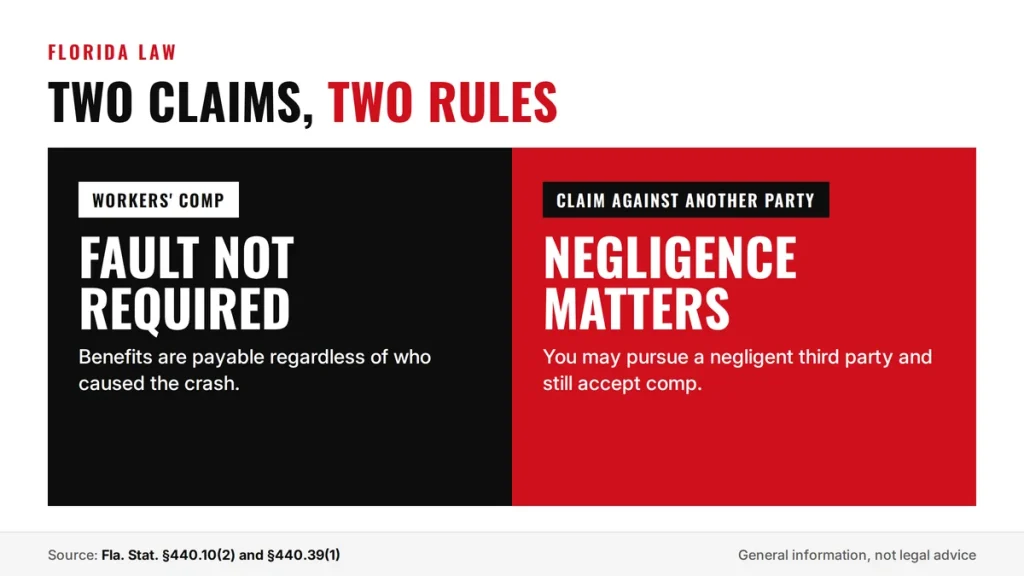 Workers’ comp does not depend on fault. A claim against another party does. Illustration for general information only.
Here is how each source works:
- Workers’ comp. When an employer is covered, and the injury qualifies, Florida makes comp payable regardless of fault (Fla. Stat. 440.10(2)). The next section explains when a ride to work qualifies.
- The vehicle’s liability insurance. A farm labor contractor must carry insurance for vehicles that carry workers, in an amount no lower than Florida’s financial responsibility law requires (Fla. Stat. 450.33(5)). Federal law also requires insurance or a bond from contractors, growers, and farm associations that transport workers (29 U.S.C. 1841(b)).
- Another driver’s insurance. If someone else’s negligence caused the crash, you may be able to claim against that person. Florida lets you accept comp and pursue that claim at the same time (Fla. Stat. 440.39(1)).
These sources can overlap, and each one has its own rules and deadlines. Farmworker transport is a type of company vehicle accident, and the same questions apply: who owned, operated, and insured the vehicle.
Does Workers’ Comp Cover a Crash on the Way to the Fields?
It may. Florida’s workers’ comp law generally excludes injuries on the way to or from work. A shared employer bus or van may be treated differently than a vehicle you use alone. Courts also look at when your paid work begins. The answer turns on the facts of your ride.
Here is what the law says. Fla. Stat. 440.092(2) says an injury on the way to or from work is not covered when the transportation was available for your exclusive personal use. The law makes an exception when you are on a special errand for your employer.
A Florida appeals court has added more detail. In 2022, it said an employer-provided bus or carpool is not available for any one worker’s exclusive personal use. It also said work begins when you start being paid during the normal workday. See Kelly Air Systems v. Kohlun. That case involved a take-home company car, so lawyers read the bus comment with care.
These facts may matter in your case:
- Was the bus or van shared with other workers, or yours alone?
- Were you paid for the ride, or did your pay start at the field?
- Did you have to pick up coworkers or do a task for your employer on the way?
- Did your employer carry workers’ comp, or is the farm small enough to be exempt?
- Who was your employer: the farm, the labor contractor, or both?
Workers hurt in company vehicles face similar questions in many jobs. Our guide to work-related car accidents explains more.
⚠️ Warning: Florida generally requires you to tell your employer about a work injury within 30 days (Fla. Stat. 440.185(1)). Late notice can bar a claim unless the employer already knew about the injury, did not post the required notice, or another exception applies. A separate rule requires a workers’ comp petition within 2 years of when you knew or should have known the injury arose from work (Fla. Stat. 440.19(1)). Do not wait to get advice.
Can I Also Claim Against the Other Driver or the Bus Owner?
Yes, you may be able to claim against another driver. Florida lets you accept workers’ comp and also pursue a negligent third party. Your employer is usually protected from a negligence lawsuit if it secured comp coverage, though exceptions exist. The bus owner’s role depends on who that is and how the ride was arranged.
Here is how the pieces fit:
- A third party caused the crash. If another driver or company was negligent, you may be able to bring a claim against it while you receive comp (Fla. Stat. 440.39(1)).
- Your employer is covered by comp. Comp is usually the employer’s exclusive liability, including vicarious liability (Fla. Stat. 440.11(1)). A coworker who was driving may also be protected, except for willful and wanton disregard or gross negligence.
- Your employer failed to secure comp. You may be able to choose between comp and a lawsuit. In that lawsuit, the employer loses the defenses that a coworker was negligent, that you accepted the risk, and that you were partly at fault (Fla. Stat. 440.11(1)(a)).
- Federal farmworker law applies. Workers can sue in federal court over violations of the Migrant and Seasonal Agricultural Worker Protection Act. Where state comp applies, comp is the exclusive remedy for actual damages. Limited statutory damages may remain: up to $500 per violation when a court finds an intentional violation, and up to $10,000 per worker for certain serious safety violations (29 U.S.C. 1854).
A company’s responsibility for its driver can depend on whether the driver is an employee or a contractor. Our guide to suing a company if its driver hit you explains the difference.
Fault matters in a claim against a third party. If a court finds you more than 50 percent at fault for your own harm, you cannot recover damages in a negligence case (Fla. Stat. 768.81(6)). Our guide to Florida’s comparative fault rule explains how that works.
🛡️ Your Rights Under Florida Law: If someone else’s negligence caused your injury at work, Fla. Stat. 440.39(1) lets you accept workers’ comp benefits and, at the same time, pursue a claim against that person. Your comp insurer may have a right to be repaid from part of a recovery, so the details matter. This general rule does not guarantee a result in any case.
What Insurance and Safety Rules Must a Farm Labor Contractor Follow?
Farm labor contractors must register with the state, carry vehicle liability insurance, and show their vehicles meet safety standards. Federal law sets insurance minimums for vehicles that carry farmworkers. Florida also requires a state sticker on these vehicles. Growers who hire workers directly are exempt from the contractor registration law but still must follow federal vehicle rules.
| Rule | What it requires | Source |
|---|---|---|
| State registration | A contractor needs a state certificate. Using an unregistered contractor is unlawful. | Fla. Stat. 450.30, 450.35 |
| Liability insurance | A policy for vehicles that carry workers, no lower than Florida’s financial responsibility law. | Fla. Stat. 450.33(5) |
| Vehicle standards | Vehicles must meet chapter 316, section 316.622, or federal standards, and display a state sticker. | Fla. Stat. 450.33(8), (11) |
| Federal insurance minimum | At least $100,000 per seat, up to $5 million per vehicle. The policy must cover workers not covered by comp and non-employees. | 29 U.S.C. 1841(b); 29 C.F.R. 500.121 |
| Farm labor vehicles (nine or more workers plus the driver) | Meet federal safety standards, display the sticker, and post a seat belt notice. | Fla. Stat. 316.622(1), (3), (4) |
| Penalties | Civil penalties up to $2,500 per violation. A violation of the vehicle law is a noncriminal traffic infraction. | Fla. Stat. 450.38(3); 316.622(7) |
Florida’s contractor registration law does not cover growers who hire workers directly (Fla. Stat. 450.29). Federal law still applies to growers who transport workers. If comp covers the transport, the federal insurance requirement shrinks to the transport that comp does not cover (29 U.S.C. 1841(c)).
💡 Did You Know? In 2023, the Florida Department of Highway Safety and Motor Vehicles (FLHSMV) recorded 114 drivers of farm labor vehicles in police-reported crashes in Florida. Seven of those drivers had incapacitating injuries. FLHSMV defines a farm labor vehicle as one used to carry nine or more migrant or seasonal farm workers plus the driver, and counts depend on how officers record each crash. Source: FLHSMV Traffic Crash Facts 2023, pages 4 and 15.
What if My Employer Says There Is No Insurance for the Van?
A missing policy does not automatically end your claim. Florida and federal law require coverage for farm labor transport. If an employer failed to carry workers’ comp, you may be able to choose between comp and a lawsuit. Other parties may also be responsible. Your options depend on who employed you and who ran the vehicle.
Here are points that may matter:
- An employer that should have carried comp did not. You may be able to claim comp or sue, and the employer loses certain defenses (Fla. Stat. 440.11(1)(a)).
- A contractor sublet the work. Florida law makes a contractor responsible for comp for a subcontractor’s workers in some situations (Fla. Stat. 440.10(1)(b)). How that applies to a farm that hires a labor contractor can be complicated.
- Another party shares responsibility. The vehicle’s owner, a contractor, or another driver may be responsible, depending on the facts.
- Waivers can be void. Agreements that waive your rights under the federal farmworker law are void (29 U.S.C. 1856).
Do not sign a release, settlement paper, or statement from an employer, contractor, or insurer until you understand it. Ask a lawyer to review it first.
What Should I Do Right After a Farmworker Van Crash Near Plant City?
Get medical care first. Then tell your employer or labor contractor about the injury within 30 days, and keep proof. Write down who owned, ran, and insured the bus or van. Save photos, bills, pay records, and messages. Talk to a lawyer before you sign anything.
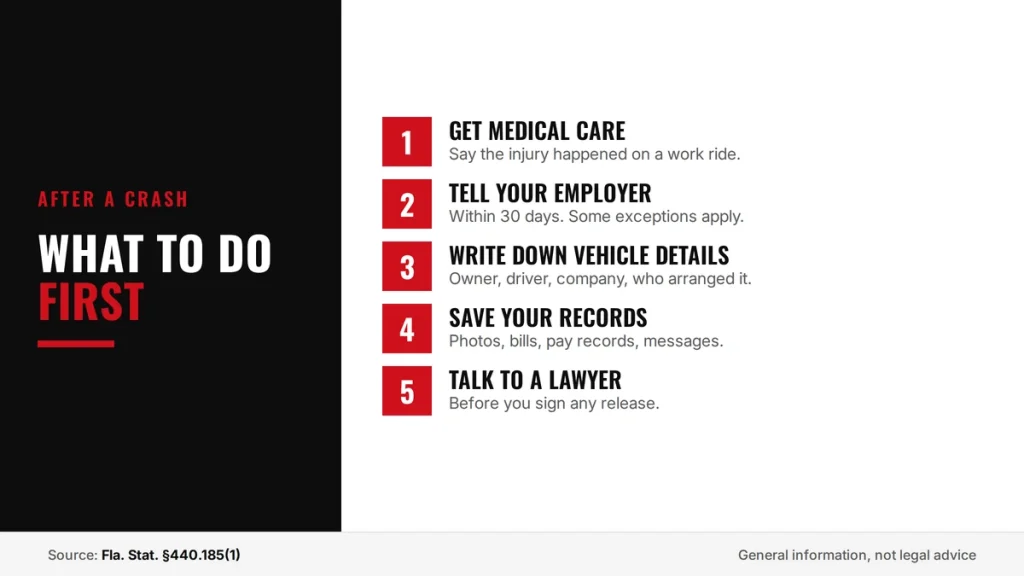 Five first steps after a farmworker bus or van crash. General information, not legal advice.
Here is a closer look at each step:
- Get medical care. Tell every provider that the injury happened on a ride to or from work.
- Tell your employer. Florida generally requires notice within 30 days (Fla. Stat. 440.185(1)). Once your employer knows, it must report the injury to its insurance carrier within 7 days (Fla. Stat. 440.185(2)). Keep a copy of any text, email, or note.
- Write down the vehicle details. Record the owner, driver, company name, license plate, and state sticker, if you saw one. Note who arranged the ride and who paid for it.
- Save your records. Keep photos, medical bills, pay stubs, messages, and the crash report. Florida sends reports of farm labor vehicle crashes to the state’s business regulation department each quarter (Fla. Stat. 316.622(8)).
- Talk to a lawyer before you sign. Releases and statements can limit your options.
Worker transport crashes have happened in Central Florida. In April 2023, the Polk County Sheriff’s Office said a bus carrying 38 workers to strawberry fields in Plant City crashed on U.S. 98 in Fort Meade, according to FOX 35 and WTSP. That reporting is preliminary. It does not decide who was at fault, and neither does this article.
For context, FLHSMV’s 2023 report counted 395,175 crashes and 3,375 deaths in Florida, and 27,474 crashes and 230 deaths in Hillsborough County (FLHSMV Traffic Crash Facts 2023). Nationally, the National Highway Traffic Safety Administration (NHTSA) counted 41,025 traffic deaths in 2023, its final figure, and 39,254 in 2024 in its first annual release, which NHTSA may revise (NHTSA, DOT HS 813 791, April 2026).
How The Reyes Firm Handles Your Farmworker Bus Accident Case
The Reyes Firm handles commercial vehicle accident cases quickly, with preparation and care. After a farmworker bus or van crash, we move quickly to preserve evidence, identify every responsible party, find the available insurance, and prepare for settlement talks or trial.
Here is how we help:
- We listen first. We start with your story, your injuries, and your worries about work and family.
- We investigate what happened. We look at the crash, the driver, the vehicle, and how the ride was arranged.
- We preserve important evidence. We move quickly to protect vehicle, driver, and company records, photos, and witness information.
- We identify each potentially responsible party. That may include a labor contractor, a grower, a driver, the vehicle’s owner, or another driver.
- We locate available insurance and coverage. We look for vehicle liability policies, workers’ comp coverage, and other applicable insurance.
- We document your injuries. We gather medical records and bills, and we track how the injury affects your work and life.
- We review how the pieces fit together. We look at how workers’ comp, vehicle insurance, and claims against others interact, and we tell you plainly what we can and cannot help with.
- We prepare for settlement and trial. We build each case with trial in mind, so you have options at the negotiating table.
We serve injured people in Tampa and the South Shore communities, including Riverview, Brandon, Plant City, and communities across Hillsborough County.
We work with English-speaking and Spanish-speaking clients.
Hablamos Español.
The Reyes Firm
4730 N. Habana Ave., Suite 201
Tampa, FL 33614
833-4 BAD DAY
thereyesfirm.com
Frequently Asked Questions About Farmworker Bus Accidents
If I get workers’ comp and win a claim against the other driver, do I have to pay the insurance company back?
Possibly part of it. Florida lets the comp insurer claim a lien on a third-party recovery for benefits it paid or will pay, less a share of court costs and attorney fees (Fla. Stat. 440.39(2)-(3)). A court can reduce the amount if you did not recover the full value of your damages. A lawyer can explain how this would work in your case.
Does it matter if the farm or a labor contractor arranged the ride?
Yes, it can. Florida requires labor contractors to register, carry insurance, and display a vehicle sticker (Fla. Stat. 450.30, 450.33). Growers who hire directly are outside that registration law (Fla. Stat. 450.29), but federal farmworker transport rules still apply to them (29 U.S.C. 1841(b)). Anyone who uses a contractor must first check that it is registered (29 U.S.C. 1842; Fla. Stat. 450.35).
Can I get benefits or file a claim if I don’t have papers or I’m on an H-2A visa?
Florida’s workers’ comp law defines an employee to include people who are lawfully or unlawfully employed, including aliens (Fla. Stat. 440.02(18)(a)). A 2026 bill that would have changed this, SB 1380, died in committee on March 13, 2026 (Florida Senate). Other rules, including federal rules for H-2A workers, may also apply to your situation. Because status questions are sensitive, talk to a lawyer you trust before you decide what to do.
Is a small farm exempt from workers’ comp?
Some are. Farm labor is outside Florida’s comp coverage only when a bona fide farmer has five or fewer regular employees and fewer than 12 other seasonal workers at one time. The seasonal work must finish in under 30 days and not exceed 45 days in a calendar year (Fla. Stat. 440.02(20)(c)2). The statute speaks of a “bona fide farmer,” so ask a lawyer if a labor contractor can use this exemption.
How long do I have to file a claim after a farmworker van crash in Florida?
The deadline depends on the claim. You must tell your employer about a work injury within 30 days (Fla. Stat. 440.185(1)) and file a comp petition within 2 years (Fla. Stat. 440.19(1)). A negligence lawsuit or a wrongful death lawsuit generally must be filed within 2 years (Fla. Stat. 95.11(5)). Federal farmworker-law claims have their own timing rules, so do not wait.
How do I report the injury, and how fast?
Tell your employer or labor contractor about the injury within 30 days (Fla. Stat. 440.185(1)). Keep a copy of any text, email, or note, and write down the date and who you told. A late report may still be allowed if your employer already knew, did not post the required notice, or another exception applies. Once your employer knows, it must report the injury to its carrier within 7 days.
What if the van was overcrowded or had no seat belts?
Florida requires seat belts at every passenger position on farm labor vehicles of 10,000 pounds gross weight or less (Fla. Stat. 316.622(2)). A farm labor vehicle is one used to carry nine or more farm workers plus the driver, with limited exceptions such as carpools and common carriers (Fla. Stat. 316.003). The law also limits how belts can be used in a lawsuit: a worker’s failure to use a belt the owner provided may be considered on comparative negligence, and an owner’s failure to require belts may not be used as evidence of negligence if the vehicle otherwise complies (Fla. Stat. 316.622(5)-(6)). Keep photos and notes about overcrowding or the vehicle’s condition.
Do I need a lawyer after a farmworker van crash?
You don’t have to hire one. But several insurers, rules, and deadlines can apply at once, and early mistakes can limit your options. A lawyer can review who may be responsible, what coverage exists, and how to handle releases or settlement offers. The Reyes Firm offers free consultations to injured people in Tampa and across Hillsborough County.

Edward Reyes, Esq. founded The Reyes Firm and is admitted to The Florida Bar. His practice focuses on serious personal injury cases, including motor vehicle crashes, catastrophic injuries, and claims involving injured children and families. He represents injured people in Tampa and communities across Hillsborough County.
How Can The Reyes Firm Help You?
If you’ve had a bad day — a car accident, a slip and fall, a trucking crash, or any injury that wasn’t your fault — The Reyes Firm is in your corner. Our Tampa personal injury attorneys offer free consultations and work on a contingency fee basis, meaning you pay nothing unless we win your case.
You shouldn’t have to fight the insurance companies alone. Let us fight for you.
📍 Address: 4730 N. Habana Ave., Suite 201, Tampa, FL 33614
📞 Phone: 833-4 BAD DAY
🌐 Website: Schedule your free consultation today at thereyesfirm.com
Had a bad day? Call The Reyes Firm. We’ll handle the rest.
Legal Disclaimer: This article provides general information about Florida law. It is not legal advice, and reading it does not create an attorney-client relationship with The Reyes Firm. Laws, deadlines, and insurance rules change, and every case is different. Talk to a licensed attorney about your situation. Past results do not guarantee future outcomes.