What You Need to Know
- Several parties may be responsible after a box truck crash: the driver, the driver’s employer, the truck’s owner, or a rental company, depending on the facts.
- A truck rated 26,001 pounds or more requires a commercial license, and federal safety rules can apply to trucks rated 10,001 pounds or more in interstate commerce.
- A rental or leasing company is usually shielded for owning the truck alone, so the renter and the driver often carry the main responsibility.
- Florida’s general deadline to file a negligence lawsuit is two years for claims that arose after March 24, 2023. Confirm your date with an attorney.
- Your own PIP coverage usually pays first, and Florida bars recovery if you are found more than 50% at fault.
Had a bad day? Call The Reyes Firm at 833-4 BAD DAY.
A box truck just hit you, and the name on the door belongs to a company you have never heard of. Now you wonder who pays your medical bills, who answers for the damage, and who to call first.
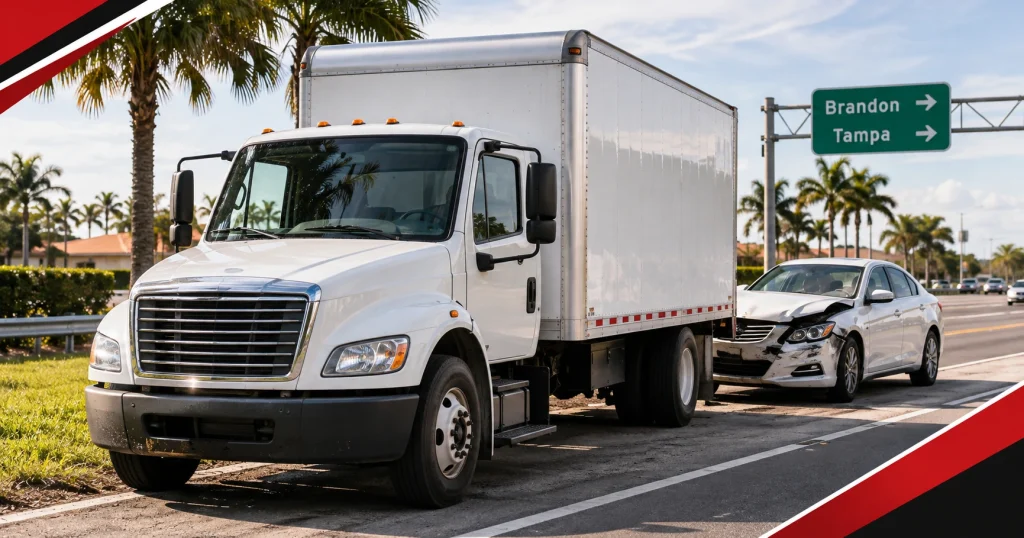
A box truck accident in Brandon or Tampa often involves more than one responsible party. The driver, the driver’s employer, the truck’s owner, and a rental or leasing company can each matter, depending on what happened and who controlled the truck.
This guide explains the Florida and federal rules that usually decide who may be liable, which insurance may apply, and what to do next. It is general information, not advice for your case.
Who Is Liable When a Box Truck Hits You in Florida?
The driver may be liable if they were negligent, and the company that employs the driver or owns the truck may share responsibility. Florida law can make a vehicle’s owner responsible for a driver the owner allowed to use it, with limits that vary by situation (Fla. Stat. § 324.021(9)).
Responsible parties may include:
- The driver, if the driver was careless or broke a traffic law.
- The driver’s employer, if the driver was working at the time.
- The truck’s owner, if the owner let the driver use the truck.
- A rental or leasing company, if its own negligence played a part, such as ignoring a known brake problem.
- A maintenance shop or parts maker, if a defect helped cause the crash.
- Another driver, if more than one vehicle contributed.
No one is automatically at fault just because a truck was involved. Fault turns on the facts. The police report, witness accounts, photos, and the truck’s own records help show what happened.
Commercial vehicle crashes are common in Florida. In 2023, the Florida Highway Safety and Motor Vehicles department (FLHSMV) reported 47,101 commercial motor vehicle crashes statewide, with 332 deaths. FLHSMV’s summary does not state whether those figures are final, and they cover all of Florida, not only Hillsborough County. FLHSMV’s Crash Facts 2023 report counts a vehicle as commercial under several tests, including a weight rating of 10,001 pounds or more.
If an employee was driving for a business, our guide to a company vehicle accident in Florida explains how those claims can work.
⚠️ Warning: The Filing Deadline. Florida’s general deadline to file a negligence lawsuit is two years for claims that arose after March 24, 2023 (Fla. Stat. § 95.11(5)(a)). Wrongful death claims also generally carry a two-year period (§ 95.11(5)(e)). Before the 2023 change (ch. 2023-15, Laws of Florida), the general period was four years. Exceptions exist, and the start date matters, so confirm your deadline with an attorney as soon as you can.
Does a Box Truck Driver Need a Commercial License?
Not always. A driver needs a commercial driver license when the truck’s weight rating is 26,001 pounds or more, and many box trucks are rated below that line (Fla. Stat. § 322.01(8); 49 C.F.R. § 383.91). Hazardous materials and passenger capacity can also trigger the requirement.
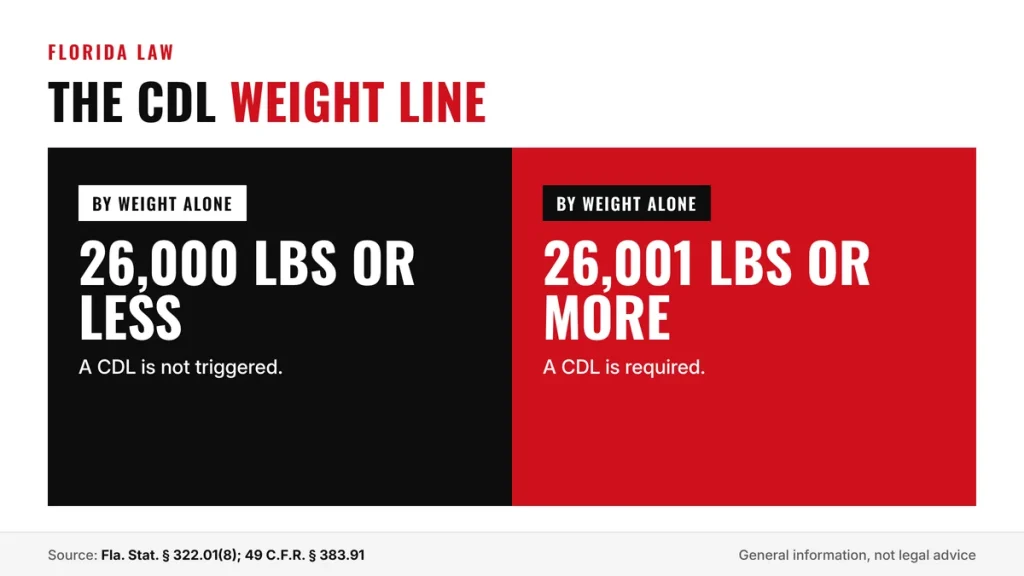
These rules use the weight rating, not the truck’s length. Here is how the licensing line works:
| Truck or use | Commercial license required? | Rule |
|---|---|---|
| Single truck rated 26,000 pounds or less | Not by weight alone | Fla. Stat. § 322.01(8)(a) |
| Single truck rated 26,001 pounds or more | Yes (Group B) | 49 C.F.R. § 383.91(a)(2) |
| Combination rated 26,001 pounds or more with a trailer over 10,000 pounds | Yes (Group A) | 49 C.F.R. § 383.91(a)(1) |
| Placarded hazardous materials, or 16 or more people | Yes, at any weight | Fla. Stat. § 322.01(8)(b), (c); 49 C.F.R. § 383.91(a)(3) |
A missing license where one is required can raise questions about how a company hired and trained its driver. It does not, by itself, prove who caused the crash. Your attorney can confirm the truck’s weight rating from its records.
What if the Box Truck Was Leased or Rented by a Business?
A rental or leasing company is usually shielded from liability just for owning the truck, unless the company itself was negligent. That protection comes from the federal Graves Amendment (49 U.S.C. § 30106), so the renter and the driver often carry the main responsibility.
Here is a scenario. A small business rents a box truck for a day of deliveries. Its employee, driving for the business, runs a red light and hits your car. The rental company is generally not responsible just because it owns the truck. The business and its employee may be. If the rental company ignored a known brake problem, its own negligence could change that.
The Florida Supreme Court applied the Graves Amendment to short-term rentals in Vargas v. Enterprise Leasing Co. (Fla. 2011). It held that federal law overrides a Florida rule that limited liability for rental companies. Our guides to a delivery truck accident in Florida and a Tampa U-Haul rental truck accident cover those situations in more detail.
🛡️ Your Rights Under Florida Law: Under Fla. Stat. § 324.021(9), an owner who lends a vehicle is generally liable for up to $100,000 per person, $300,000 per incident, and $50,000 for property damage. If the driver is uninsured or has less than $500,000 in combined coverage, the owner can be liable for up to $500,000 more in economic damages. The caps do not apply to an owner using the vehicle in its ordinary business, other than a rental company, and an owner stays fully liable for its own negligence.
Do Federal Trucking Rules Apply to Box Trucks?
Sometimes. Federal safety rules can apply to a box truck rated 10,001 pounds or more that is used in interstate commerce, and Florida applies the same rules to many in-state trucks (49 C.F.R. § 390.5; Fla. Stat. § 316.302). In-state trucks under 26,001 pounds face fewer requirements.
Interstate commerce includes trips between states and trips within one state that are part of a longer journey that starts or ends elsewhere. Under Fla. Stat. § 316.302, owners and drivers of covered commercial vehicles must follow the federal motor carrier safety rules in 49 C.F.R. parts 382 to 386 and 390 to 397. Those rules cover driver records, hours of service, and vehicle inspection and maintenance.
Most in-state trucks under 26,001 pounds that do not carry placarded hazardous materials are exempt from that general rule. They must still follow parts 382, 392, and 393 and certain sections of part 396.
A rule violation does not, by itself, decide who caused a crash. It can still be important evidence, and the company’s records may show how the driver operated the truck.
💡 Did You Know? In 2023, 5,472 people died in large truck crashes across the United States, and 3,837 of them, about 70%, were in other vehicles, according to NHTSA’s 2023 large truck report (DOT HS 813 717, April 2025). NHTSA counts a large truck as one with a gross vehicle weight rating above 10,000 pounds. These are national figures, not Florida figures. NHTSA’s June 2026 research note reports 5,340 deaths in 2024, also with 70% in other vehicles, but it does not say if that figure is final.
Which Insurance Pays After a Box Truck Crash in Florida?
Several policies may apply. Your own personal injury protection (PIP) coverage usually pays first for your medical costs, and the at-fault side’s liability insurance may pay for the rest (Fla. Stat. § 627.736). Florida also requires extra liability coverage for heavier commercial trucks (Fla. Stat. § 627.7415).
| Coverage | What it may cover | Source |
|---|---|---|
| Your PIP | Part of your medical costs and other losses, no matter who was at fault | Fla. Stat. § 627.736 |
| Basic liability proof of financial responsibility | $10,000 for one person’s injury or death, $20,000 for two or more people, and $10,000 for property damage | Fla. Stat. § 324.021(7) |
| Extra commercial truck liability | $50,000 (26,000 to under 35,000 pounds), $100,000 (35,000 to under 44,000 pounds), or $300,000 (44,000 pounds or more) | Fla. Stat. § 627.7415 |
| Your uninsured or underinsured motorist coverage | Help if the at-fault side has too little insurance, if you bought it | Your policy |
Many box trucks are rated below 26,000 pounds, so the extra bands may not apply. Trucks that fall under federal rules may also need to meet federal minimums. A company can also carry more than the legal minimum, and a lawyer can request the actual policy.
What Should You Do After a Box Truck Crash in Brandon?
Call 911, get medical care, and exchange information with the driver. Florida law requires drivers in a crash to share their information and give reasonable help to anyone who is hurt (Fla. Stat. § 316.062). Then photograph the scene and the truck, and speak with an attorney before giving a recorded statement.
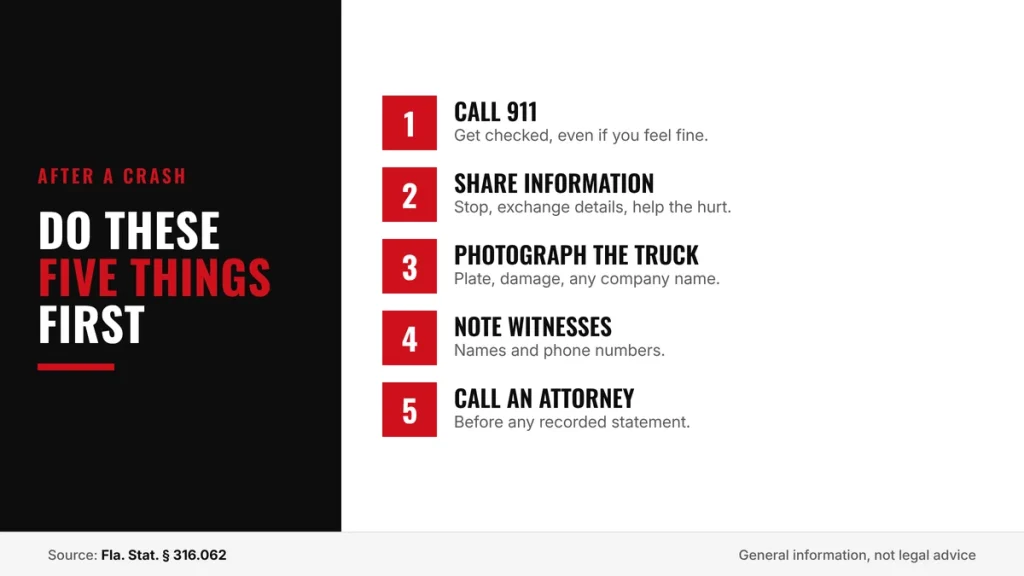
If your crash happened in Brandon, Riverview, Plant City, or elsewhere in Hillsborough County, the steps are the same:
- Call 911 and get checked, even if you feel fine. Some injuries show up later.
- Ask the responding officer for the report number.
- Photograph the truck, the license plate, the damage, the road, and any company name or number on the truck.
- Write down the driver’s name, the company name, and any witnesses’ contact information.
- Keep every medical record, bill, and receipt.
- Contact an attorney early, before the company loses its records.
Do and don’t:
- Do stick to basic facts when you talk with anyone about the crash.
- Do follow your doctor’s treatment plan.
- Don’t guess about speed or fault.
- Don’t post about the crash on social media.
- Don’t sign a release or accept an offer before talking with an attorney.
How The Reyes Firm Handles Your Box Truck Accident Case
The Reyes Firm handles box truck and other commercial vehicle cases with speed, careful evidence preservation, and a clear plan to find every responsible party and every source of coverage. Our truck and commercial vehicle accident attorneys in Tampa prepare each case for settlement or trial.
Here is how we help:
- We listen first. We start with what happened to you and what you need.
- We investigate the crash. We review the police report, photos, witness accounts, and the scene.
- We preserve important evidence. We ask companies in writing to keep driver logs, maintenance records, and camera or GPS data.
- We identify each potentially responsible party. That can include the driver, the employer, the owner, and a rental or leasing company.
- We locate available insurance and coverage. We look at your coverage and the truck’s policies.
- We document your injuries and losses. We gather records and bills that show what the crash has cost you.
- We review the truck’s weight rating and the rules that apply. That helps show which safety rules the company had to follow.
- We prepare for settlement and trial. We build each case so it is ready if it must go to court.
We represent injured people in Tampa and the South Shore communities, serving Tampa, Riverview, Brandon, Plant City, and communities across Hillsborough County.
The Reyes Firm
4730 N. Habana Ave., Suite 201
Tampa, FL 33614
833-4 BAD DAY
thereyesfirm.com
Frequently Asked Questions About Box Truck Accidents
Can I sue the company if its box truck driver hit me?
Possibly. If the driver was working for the company, or the company owned the truck and let the driver use it, the company may share responsibility. Florida’s owner rule is in Fla. Stat. § 324.021(9). The facts of your crash determine who you can name.
How long do I have to file a claim after a box truck accident in Florida?
The general deadline to file a negligence lawsuit is two years for claims that arose after March 24, 2023 (Fla. Stat. § 95.11(5)(a)). Wrongful death claims also generally carry a two-year statute of limitations. Treat these as dates to confirm, not guarantees, and do not wait for the last day.
How do adjusters decide who is at fault?
Adjusters review the police report, photos, vehicle damage, witness accounts, and driver statements. An adjuster works for the insurance company, and the adjuster’s view is not final. Under Fla. Stat. § 768.81, fault can be divided among everyone involved.
What is Florida’s 51% rule?
If a court finds you more than 50% at fault for your own injury, you cannot recover damages (Fla. Stat. § 768.81). That rule took effect for lawsuits filed after March 24, 2023 (ch. 2023-15, Laws of Florida); before then, Florida used a pure comparative fault system. It does not apply to medical negligence claims.
What should I not tell the insurance company after a crash?
Stick to basic facts. Don’t guess about fault or speed, don’t downplay your injuries, and don’t give a recorded statement or sign a release before you talk with an attorney. Read your own policy, because it may have its own requirements.
What evidence does a box truck company keep after a crash?
Companies may keep driver logs, dispatch records, maintenance and inspection records, hiring files, and camera or GPS data. FMCSA guidance says covered carriers generally keep driver duty status records and supporting documents for six months (49 C.F.R. § 395.8(k)(1)). Because records can be discarded, ask for them quickly.
What if the company says the driver was a contractor, not an employee?
A company’s label does not decide the question on its own. The facts of the working relationship matter, and the truck’s owner may still be responsible under Florida’s owner rule (Fla. Stat. § 324.021(9)). An attorney should review the contract and the day-to-day facts.

Edward Reyes, Esq. founded The Reyes Firm and is admitted to The Florida Bar. His practice focuses on serious personal injury cases, including motor vehicle crashes, catastrophic injuries, and claims involving injured children and families. He represents injured people in Tampa and communities across Hillsborough County.
How Can The Reyes Firm Help You?
If you’ve had a bad day — a car accident, a slip and fall, a trucking crash, or any injury that wasn’t your fault — The Reyes Firm is in your corner. Our Tampa personal injury attorneys offer free consultations and work on a contingency fee basis, meaning you pay nothing unless we win your case.
You shouldn’t have to fight the insurance companies alone. Let us fight for you.
📍 Address: 4730 N. Habana Ave., Suite 201, Tampa, FL 33614
📞 Phone: 833-4 BAD DAY
🌐 Website: Schedule your free consultation today at thereyesfirm.com
Had a bad day? Call The Reyes Firm. We’ll handle the rest.
Legal Disclaimer: This article provides general information about Florida law. It is not legal advice and does not create an attorney-client relationship. Laws change, and every case depends on its own facts. Speak with a licensed attorney about your situation before you act.