Shows about big-cat owners turned exotic pets into a national fascination, and they raised a strange but serious question: what actually happens if a tiger, or any wild animal, attacks you? In Florida the answer is a powerful legal doctrine called strict liability, and it works very differently from a typical injury claim. For the most severe maulings, which can even turn deadly, understanding this rule is the first step to holding the right people accountable.
TL;DR — QUICK SUMMARY
- If a wild or exotic animal like a tiger attacks you in Florida, the owner is held responsible under strict liability, even if you cannot prove they were careless.
- Strict liability exists because keeping a dangerous wild animal is treated as inherently dangerous, so negligence does not have to be proven.
- Florida classifies tigers and other big cats as Class I wildlife, the most dangerous category, under Florida Statute 379.303.
- Dog bites are covered by their own strict-liability law, Florida Statute 767.04, which is similar but separate from the wild-animal rule.
- You have two years from the attack to file a lawsuit under Florida Statute 95.11(3)(a), so acting quickly protects your claim.
The Reyes Firm
Injured by a Dangerous Animal?
Find out who is responsible for your Tampa injury. Had a bad day?
What does strict liability mean if a wild or exotic animal attacks you?
Strict liability means the owner or keeper of a wild animal is legally responsible for the injuries it causes, even if you cannot prove they did anything careless. In a typical injury case you have to show that someone was negligent, but with a dangerous wild animal that requirement falls away. Because keeping an animal like a tiger is treated as inherently dangerous, the law places responsibility on whoever chose to keep it, automatically.
That is a meaningful advantage if you are hurt. You do not have to prove the owner failed to lock a cage or ignored a warning. You only have to show that their wild animal injured you. These attacks are rarely minor, often causing deep puncture wounds, nerve damage, and the kind of catastrophic harm seen in a serious spinal injury, which is exactly why the law treats them so seriously.
What counts as a wild or exotic animal in Florida?
Florida sorts captive wildlife into three categories based on how dangerous the animal is. Under Florida Statute § 379.303, the Florida Fish and Wildlife Conservation Commission defines Class I, Class II, and Class III wildlife, with Class I reserved for the most dangerous animals. Tigers, lions, bears, and great apes are all Class I.
The rules reflect how risky these animals are. A person cannot legally keep Class I wildlife without special licensing, and the state requires either a $10,000 bond or $2 million in liability insurance to possess one. When an owner skips those requirements, or houses the animal unsafely, that failure can sit on top of the strict liability they already face if the animal hurts someone.
💡 Did You Know? Florida classifies tigers and other big cats as Class I wildlife, the most dangerous category, under Fla. Stat. § 379.303. State rules require anyone keeping Class I wildlife to carry either a $10,000 bond or $2 million in liability insurance, a sign of just how foreseeable the danger is. Source: Fla. Stat. § 379.303 and FWC Rule 68A-6, leg.state.fl.us.
How is an exotic animal attack different from a dog bite in Florida?
Both can make an owner responsible without proof of carelessness, but they come from different parts of the law. Dog bites have their own statute. Under Florida Statute § 767.04, a dog owner is liable when their dog bites someone, regardless of whether the dog ever showed aggression before, with only narrow exceptions.
Wild and exotic animals are covered instead by Florida’s common-law rule of strict liability for dangerous animals. The practical effect is similar, in that you do not have to prove the owner was negligent, but the legal foundation is different, and the injuries from an exotic animal are usually far more severe than a typical dog bite. Severe facial and head wounds, for example, can lead to a traumatic brain injury that changes a victim’s life.
Watch: What to do if a wild animal attacks you
In this short video, attorney Edward Reyes explains strict liability and what it means if you are ever bitten by a tiger or another wild animal.
Who can be held responsible when an exotic animal attacks?
More than one party may share the blame, and identifying all of them is part of building your case. Responsibility can fall on the animal’s owner, the keeper or handler, a roadside zoo or traveling exhibit, a sanctuary, or the owner of the property where the attack happened. When an unsafe enclosure, a missing barrier, or careless supervision contributed to the attack, a premises liability claim can exist alongside strict liability.
Even when responsibility seems obvious, pinning down every owner, handler, and insurer, along with any required bond or policy, is what turns a clear case into a fully compensated one. The party that controlled the animal is not always the same party that controlled the property, and both can matter to your recovery.
⚠️ Deadline Warning: Under Florida Statute § 95.11(3)(a), you have two years from the date of the attack to file a personal injury lawsuit. Missing this deadline almost always means losing your right to recover anything. Don’t wait to call a lawyer.
Can the owner blame you for the attack?
Sometimes they will try. Florida follows a comparative fault rule, so if you provoked the animal, ignored clear warnings, or were somewhere you were not allowed to be, the owner may argue that you share responsibility for what happened. In a strict liability case the owner’s defenses are limited, but conduct like provocation or trespassing can still reduce or even bar a recovery.
That does not mean your own actions end your claim. Whether you truly provoked an animal, or whether a warning was clear enough, are questions of fact that deserve a real examination rather than an insurer’s quick assumption. An attorney can push back when the owner tries to shift the blame onto you.
🛡️ Your Rights Under Florida Law: Under Florida Statute § 768.81, your compensation is reduced by your share of fault, and you may be barred from recovery if you are found greater than 50% responsible for your own harm. An experienced Tampa injury lawyer works to protect the facts, challenge unfair blame, and keep your percentage of fault as low as the evidence allows.
What should you do after a wild or exotic animal attack?
What you do next protects both your health and your case. These steps matter, and the order matters.
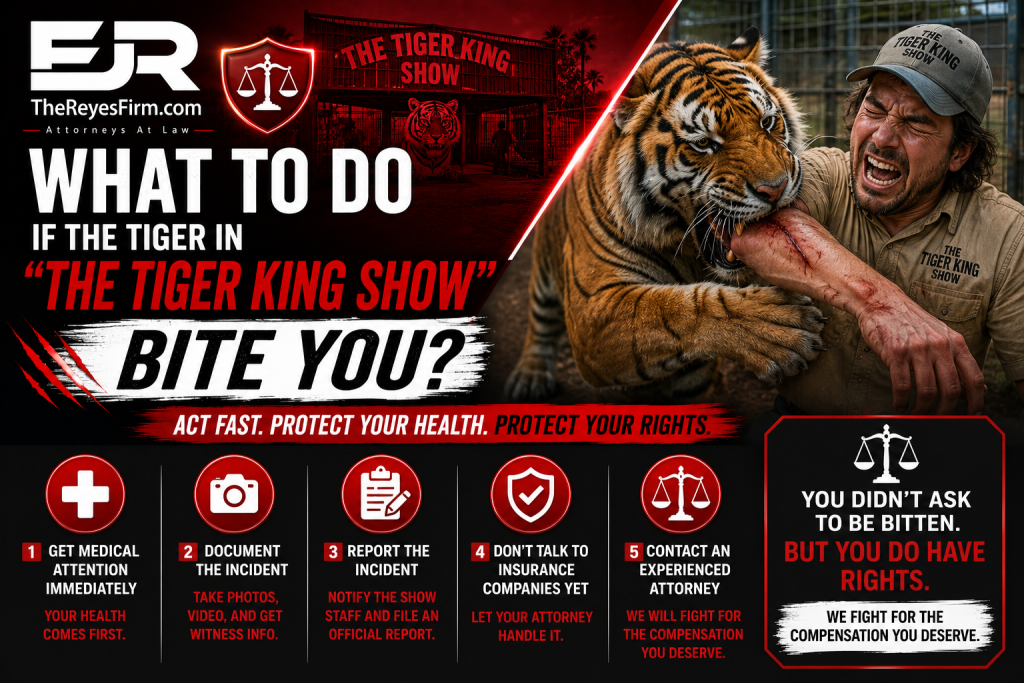
- Get emergency medical care immediately. Wild animal bites are medical emergencies that carry a high risk of infection, possible rabies exposure, and deep tissue and nerve damage, so go straight to the emergency room.
- Report the attack to the authorities and the FWC. Call the police and the Florida Fish and Wildlife Conservation Commission. An official report creates a record and can trigger an investigation of the animal and the facility.
- Document everything you can. Photograph your injuries, the animal, the enclosure or property, and any warning signs, and collect the names and numbers of anyone who saw what happened.
- Identify the owner, keeper, or facility. Find out exactly who owned and controlled the animal and who controlled the property, because more than one of them may be responsible.
- Do not give a recorded statement or sign anything. A facility or its insurer may move quickly to limit what they pay. You are not required to give a recorded statement or accept an early offer before speaking with a lawyer.
- Keep records of your treatment and recovery. Save bills and notes on how the injury affects you, including scarring, lasting nerve damage, and the very real emotional trauma that follows an animal attack.
- Call The Reyes Firm. The sooner a lawyer can preserve evidence about the animal and the facility, the stronger your case. Call 833-4 BAD DAY for a free consultation.
The Reyes Firm
4730 N. Habana Ave., Suite 201, Tampa, FL 33614
Phone: 833-4 BAD DAY | thereyesfirm.com
How The Reyes Firm handles an exotic or wild animal attack case
An attack by a dangerous animal is terrifying, and the injuries can last a lifetime. The owner or facility will have insurance and people working to limit what they pay. We make sure you have someone working just as hard for you.
When we take on a dangerous animal attack case, we typically:
- Establish strict liability quickly, so the focus stays on your injuries rather than on a fight over whether the owner was careless
- Identify every responsible party, from the owner and handler to the facility and the property owner, along with the bonds and insurance policies that can cover your losses
- Preserve the evidence, including the animal’s history, the condition of the enclosure, licensing records, and any prior incidents, before it disappears
- Document the full extent of your harm, working with medical providers on the physical injuries, the scarring, and the emotional trauma an attack leaves behind
- Push back on blame-shifting, challenging claims that you provoked the animal or ignored a warning when the facts say otherwise
- Pursue full compensation, covering past and future medical care, lost income, disfigurement, and the lasting impact on your life
No lawyer can promise a specific result. What we can promise is that we treat these cases with the seriousness they demand and explain every step in plain language. We help injured people in Tampa and across Hillsborough County on a contingency fee basis, which means you pay nothing unless we recover compensation for you.
Frequently asked questions about wild and exotic animal attacks in Florida
What does strict liability mean for an animal attack in Florida?
It means the owner of a dangerous wild animal is responsible for the injuries it causes even if you cannot show they were negligent. You only have to prove that their animal hurt you, not that they did something wrong.
Do I have to prove the owner was careless if a tiger bites me?
No. Wild and exotic animals fall under Florida’s common-law rule of strict liability, which removes the usual requirement to prove negligence. That is one of the most important advantages an injured person has in these cases.
Is a dog bite handled the same way as an exotic animal attack?
They are similar but separate. Dog bites are governed by Fla. Stat. § 767.04, while wild and exotic animals are covered by common-law strict liability. Both can hold an owner responsible without proof of carelessness.
Can I still sue if the zoo or sanctuary had warning signs?
Often yes. A warning sign does not automatically end your claim, and whether a warning was adequate is usually a question of fact. If an unsafe enclosure or poor supervision played a role, a premises liability claim may also apply.
What if the animal’s owner says I provoked it?
Under Florida’s comparative fault law, Fla. Stat. § 768.81, provocation or trespassing can reduce or bar a recovery. But whether you actually provoked the animal is a factual question an attorney can challenge, not something the owner simply gets to declare.
How long do I have to file an animal attack lawsuit in Florida?
Two years from the date of the attack under Fla. Stat. § 95.11(3)(a). Because evidence about the animal and the facility can disappear quickly, it is best to act well before that deadline.
Who pays for my injuries after an exotic animal attack?
Usually the owner or facility, often through the bond or liability insurance the state requires for dangerous wildlife. In many cases more than one party shares responsibility, which can mean more than one source of compensation.
How much does a Tampa personal injury lawyer cost?
The Reyes Firm works on a contingency fee basis, which means you pay nothing up front and nothing at all unless the firm recovers compensation for you. The initial consultation is free.

Edward Reyes, Esq. is a Florida Bar-admitted personal injury attorney and the founder of The Reyes Firm in Tampa, Florida. His practice focuses on serious injury and wrongful death cases, including dog bites and the rare but devastating attacks caused by exotic and dangerous animals. Edward Reyes, Esq. represents injured Floridians in Tampa and throughout Hillsborough County on a contingency fee basis, meaning clients pay nothing unless the firm recovers compensation for them.
Read more about Edward Reyes.
How Can The Reyes Firm Help You?
If you’ve had a bad day — a car accident, a slip and fall, a trucking crash, or any injury that wasn’t your fault — The Reyes Firm is in your corner. Our Tampa personal injury attorneys offer free consultations and work on a contingency fee basis, which means you pay us nothing unless we win your case.
You shouldn’t have to fight the insurance companies alone. Let us fight for you.
📍 Address: 4730 N. Habana Ave., Suite 201, Tampa, FL 33614
📞 Phone: 833-4 BAD DAY
🌐 Website: Schedule your free consultation today at thereyesfirm.com
Had a bad day? Call The Reyes Firm. We’ll handle the rest.